

Peter Drucker once observed that the greatest danger in times of turbulence is acting with yesterday’s logic. That insight applies directly to how leaders still think about risk today.
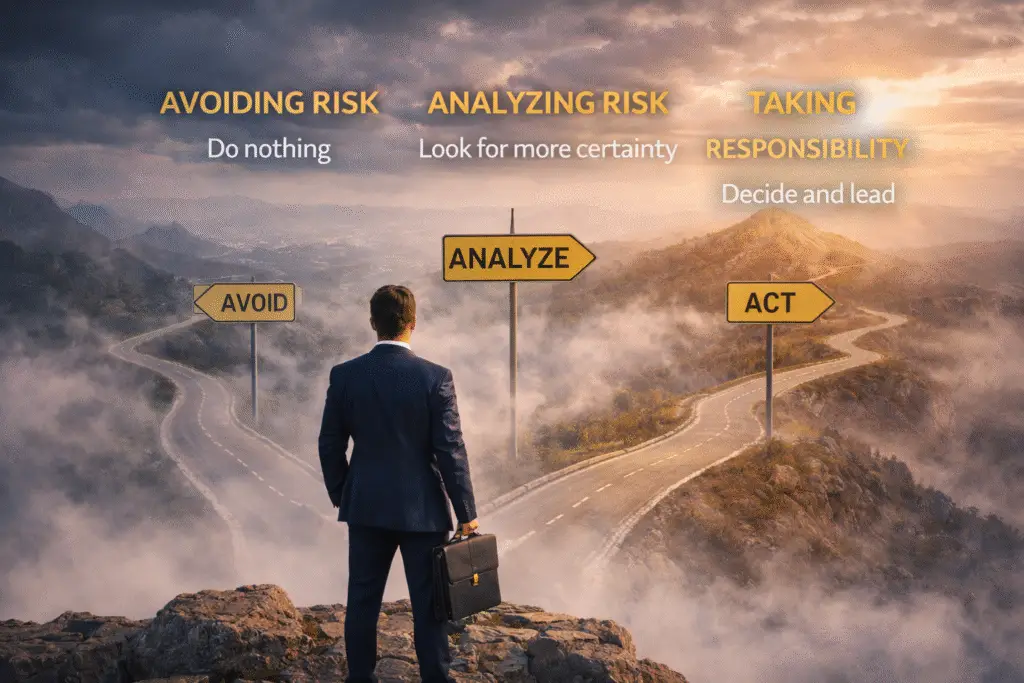
History remembers leaders not for the risks they avoided, but for the decisions they made when certainty was impossible. Lincoln signed the Emancipation Proclamation in the middle of a civil war. Churchill refused compromise when the outcome looked bleak. Every era has its version of this truth. Leadership is exercised long before clarity arrives.
Yet in modern organizations, risk is often treated as a flaw. Something to minimize, defer, or pass along. Leaders wait for more data, more alignment, and more reassurance. In doing so, they quietly hand momentum to circumstance instead of taking responsibility for direction.
“He who is not courageous enough to take risks will accomplish nothing in life.” – Muhammad Ali
This article looks at how effective leaders approach uncertainty and why risk management in leadership is less about courage and more about clarity.
As the creator and host of Thirty Minute Mentors, I’ve interviewed more than 500 of America’s top leaders, including Fortune 500 CEOs, founders of household-name companies, Hall of Fame and Olympic gold medalists, and senior military and political leaders.
Across those conversations, I have observed one pattern that appears consistently. The most effective leaders do not avoid risk. They develop a disciplined way of thinking when outcomes are uncertain.
“The leaders who make the greatest impact don’t wait for certainty. They take responsibility when the outcome is unclear and lead anyway.” – Adam Mendler
Bring Leadership Insights to Your Organization?
If you are developing leaders or planning a leadership event focused on practical decision-making, you can book Adam for your next event or email connect@adammendler.com to connect directly.
Book Adam Now
How Experienced Leaders Actually Think About Risk
Leaders who manage risk well do not rely on slogans or courage. They rely on judgment. And judgment is built through a few consistent ways of thinking.
These are not theories. They are patterns that show up again and again in how experienced leaders make decisions.
1. They Separate Reversible Decisions From Irreversible Ones
Not every decision deserves the same level of caution.
One of the clearest examples comes from Amazon’s leadership principle around decision-making. Some decisions are one-way doors. Once you walk through, there is no easy way back. Others are two-way doors. You can step through, learn, and reverse course if needed.
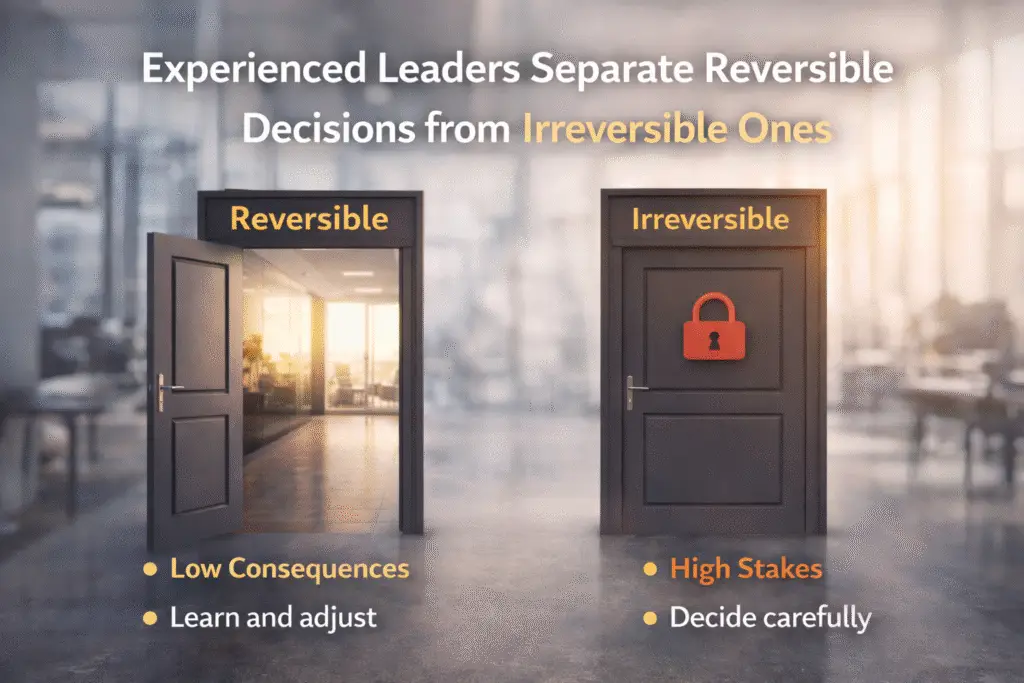
Experienced leaders move slowly on one-way doors. They involve the right people, challenge assumptions, and take time. But on two-way doors, they move faster, even without perfect certainty.
Many organizations struggle because every decision is treated like a one-way door. That is how bottlenecks form.
2. They Focus On Downside First, Not Upside
Reckless risk-taking looks at what could be won. Thoughtful leadership looks at what could be lost.
Before committing to a major initiative, experienced leaders often run a simple mental exercise. What is the worst realistic outcome, and can we survive it? If the answer is yes, and the potential upside justifies the effort, they move forward.
This is risk management in leadership at its most practical. It is not optimism. It is not pessimism. It is honesty.
One founder put it plainly. “I never bet on the company. But I will bet a meaningful portion of our time and resources if the learning is worth it.”
3. They Match Decision Speed To The Situation
Speed matters, but not in the same way for every decision.
In business, some opportunities close quickly. A market window. A key hire. A strategic partnership. In those moments, waiting for complete clarity is often the riskiest choice available.
Other decisions reshape the organization for years. A major acquisition. A shift in core strategy. A structural change that is hard to undo. Those deserve patience.
The mistake leaders make is mixing these timelines. Moving slowly when speed is required. Rushing when caution is needed. Experienced leaders develop the ability to tell the difference.
Is Your Team Ready To Decide Under Pressure?
When decisions matter and certainty is limited, leaders need more than motivation. I help teams sharpen judgment, take responsibility, and lead with clarity when the stakes are real.
Hire Adam To Speak
4. They Gather Information, Then Stop Gathering
Data matters. Experience decides.
The first stage of this process is gathering the data needed to make an informed decision. In many organizations, that information lives inside business management software, where the challenge isn’t only collecting data, but understanding what it means. Acumatica training, for example, can be part of how teams learn to navigate the systems and information they already rely on.
But strong leaders also know there is a point where more information stops improving the decision and starts delaying it. At that point, waiting feels productive, but it is not. It is discomfort disguised as diligence.
Leaders who manage risk well develop a sense for when they know enough. Not everything. Enough.
5. They Ask What Will Be Learned Either Way
Risk feels heavier when failure feels final.
Experienced leaders reframe decisions as learning opportunities, not all-or-nothing bets. Even when an outcome falls short, the question becomes, “What did this teach us that makes the next decision better?”
This is why smaller, contained risks often outperform big, delayed ones. Learning compounds. Stagnation does not.
6. They Consider Who Carries The Impact
Leadership decisions do not exist in isolation. Every risk affects people. Teams. Stakeholders. Sometimes customers.
Leaders who think clearly about risk ask not only whether they can absorb the impact but also how others will experience it. That awareness shapes how decisions are communicated, supported, and owned.
This is where managing risk in leadership becomes human, not mechanical.
7. They Understand The Risk Of Waiting
There is one risk many leaders underestimate completely. The cost of doing nothing.
Markets move. Talent moves. Expectations move. Every delay sends a signal, whether intended or not.
Over time, leaders often regret the decisions they did not make more than the ones that did not work. Waiting rarely feels risky at the moment. Its consequences show up later.
This is what disciplined risk management in leadership looks like. Not boldness for its own sake. Not endless caution. Just clear thinking, applied consistently, when the pressure is real.
The Questions Great Leaders Ask Before Taking Risks
When experienced leaders face a risky decision, they do not rush to answers. They slow down just enough to ask better questions. Not theoretical ones. Practical ones. The kind that cuts through noise and forces clarity.
These questions are simple on the surface. That is what makes them powerful.
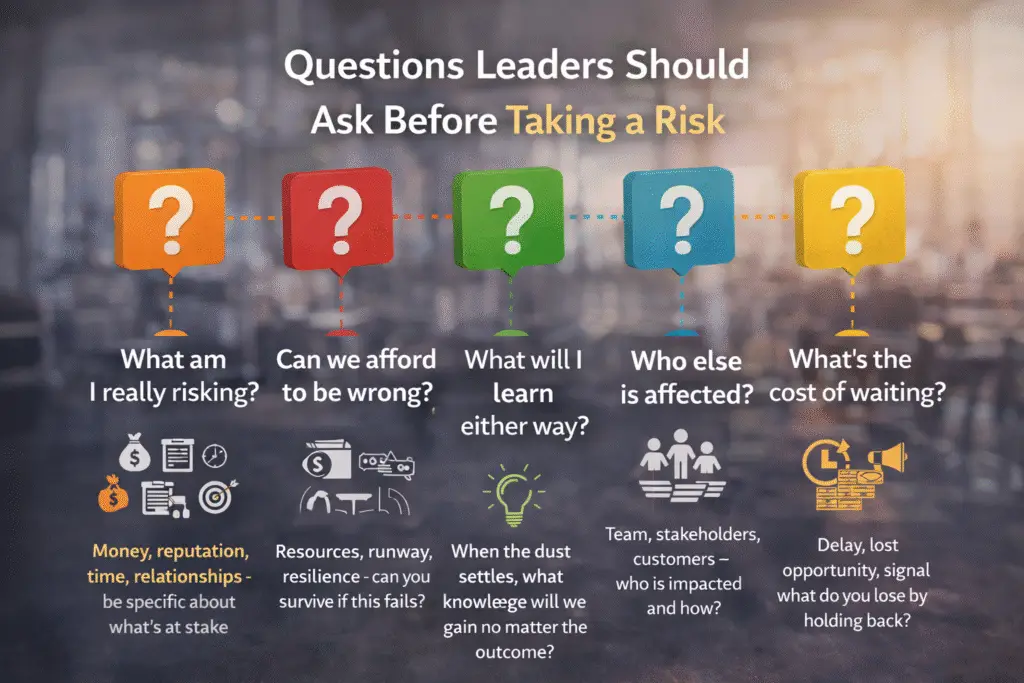
- “What am I actually risking?” Be specific. Is it money? Reputation? Time? Relationships? Market position? The clearer you are about what’s at stake, the better you can evaluate whether the potential return justifies the risk.
- “Can I afford to be wrong?” This isn’t about confidence. This is about an honest assessment of your resources, runway, and resilience. If this doesn’t work, can you recover? Can your team recover? Can your organization recover?
- “What will I learn either way?” Frame the decision as an information-gathering exercise, not just an all-or-nothing bet. Even failures teach you something valuable if you’re paying attention.
- “Who else is affected by this decision?” Leadership carries responsibility beyond yourself. How does this risk impact your team, your stakeholders, and the people depending on your success?
- “What’s the cost of waiting?” Opportunity cost is a real cost. What do you lose by delaying? What advantages do you give competitors? What signal does inaction send to your team?
Answer these five questions honestly, and you’ll make better decisions than 90% of leaders out there.
Want To Learn Directly From America’s Top Leaders?
Explore real leadership conversations through Thirty Minute Mentors, where I speak one-on-one with CEOs, founders, military leaders, athletes, and public leaders about how they think, decide, and lead in today’s world.
Explore The PodcastLead With Confidence Through Adam Mendler’s Keynotes
Great risk management in leadership is about asking better questions, thinking more clearly under pressure, and trusting yourself to make sound decisions with incomplete information.
My perspective on leadership has been shaped far beyond a single platform. My insights have been featured in respected outlets such as Forbes, Inc., HuffPost, Business Insider, and U.S. News & World Report and trusted by organizations ranging from global brands to universities and non-profits.
That real impact is reflected in how audiences experience my work.
“Adam is an engaging, dynamic speaker who fuels positive energy into his audience. He shared practical insights that helped us think differently about leadership and decision-making.” – Eva DiVenti, Global PM, Uber for Business
Let’s Connect
If your organization values leadership thinking grounded in experience, reflection, and real-world application, you can connect directly with me at connect@adammendler.com .
FAQs About Risk Management in Leadership
1. What does risk management in leadership actually mean?
Most people hear “risk management” and think of avoiding trouble. That is not what strong leadership looks like. Risk management in leadership means understanding uncertainty, making informed decisions, and owning the outcome. Leaders are paid to decide when the answer is not obvious, not when everything is already clear.
2. Why do so many leaders hesitate to take risks?
Because hesitation feels responsible. Waiting for more data, more approvals, or more comfort gives the illusion of control. In reality, it often leads to missed opportunities. The problem is not fear. It is confusing delay with good judgment. Markets do not pause while leaders wait to feel ready.
3. How can leaders make better decisions when outcomes are uncertain?
Good leaders stop chasing perfect answers. Instead, they clarify what is at stake, what they can afford to lose, and what they will learn either way. When leaders frame decisions this way, uncertainty becomes manageable. Not comfortable. Manageable.
4. Is taking risks the same as being reckless in leadership?
No. Reckless decisions ignore consequences. Effective leadership evaluates downside first. Leaders ask what happens if this does not work and whether the organization can recover. Thoughtful risk-taking is disciplined, not dramatic. It progresses with a seatbelt on.
5. What is the biggest risk leaders often overlook?
Doing nothing. Inaction rarely feels risky in the moment, which is why it is so dangerous. While leaders wait, competitors move, talent leaves, and momentum fades. Over time, the cost of waiting quietly outpaces the cost of acting.