

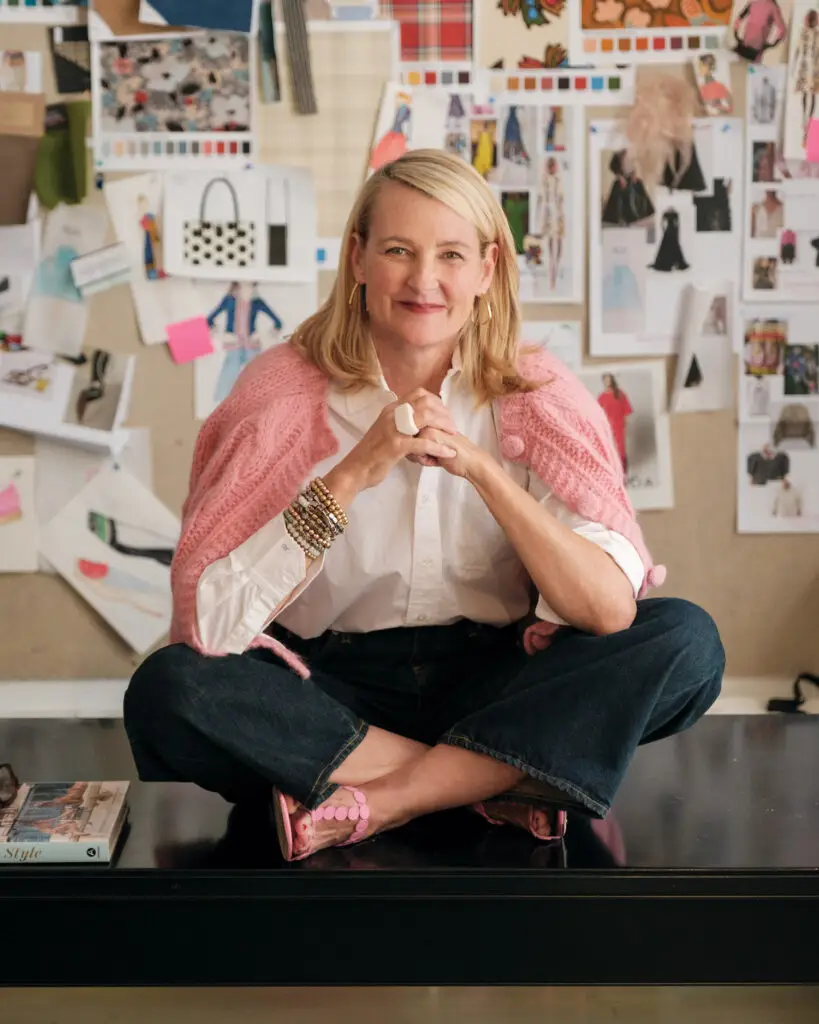
I recently interviewed Kate Spade Co-Founder Elyce Arons on my podcast, Thirty Minute Mentors. Here is a transcript of our interview:
Adam: Our guest today is a leader in the world of fashion. Elyce Arons is the co-founder of Kate Spade and the co-founder and CEO of Francis Valentine. Elyce is also the author of the book We Might Just Make It After All: My Best Friendship with Kate Spade. Elyce, thank you for joining us.
Elyce: Thank you for having me.
Adam: You grew up on a farm in central Kansas, a ways away from the bright lights of the New York fashion scene. Can you take listeners back to your early days? What early experiences and lessons shaped your worldview and shaped the trajectory of your success?
Elyce: Well, I was born the youngest of four daughters on a farm in Kansas, and we raised wheat, corn, soybeans, alfalfa, milo, and raised Angus cattle also. Luckily, my mother was a design student from the East Coast. She met my father on a TWA flight in the Midwest, and they eloped three months later, and she found herself on the farm. But she brought with her all of this great style. My mother was, and still is, a style icon to me. She was a design student and illustrator for all of the fashion companies, the retailers in Wichita, and she would illustrate garments on models for the Wichita Eagle Beacon newspaper. And so she took a copy of Women’s Wear Daily every day. Also, she did all of the costumes for our community theater in and around Newton and Wichita. And she’s just always been such an entrepreneur in so many ways. She also was a really good cook, and is a really good cook, and decided that she was going to turn our farmhouse into a restaurant. And we are out in the middle of nowhere, literally 20 miles outside of Wichita on dirt roads. And I thought she was crazy, I really did. But she flew to New York and went to the Culinary Institute. She interned at Le Bernardin and turned our farmhouse into a restaurant. It was a huge success, so much so that years later I’d be traveling on an airplane and someone would say, you’re from Kansas, I’ve got the best restaurant. You have to go to this place. It’s my mom. So she’s always been really at the forefront of everything and really showed all of us who we could become, and we could do anything we wanted to do. So my older sister Willow moved to New York when she was 17 years old to dance with the Joffrey Ballet School, which was an entree for me to come up and visit. And of course, I fell in love with New York immediately. I fell in love with the fashion scene here, and the arts and the theater, just everything going on. And it really felt like the top of the world to me, and I knew after college I was going to move here.
Adam: I love it, and I love what you shared about your mom. Wow. What a role model, what a mentor. If you can dream it, you can be it. It doesn’t matter what city you’re in. What does matter is what you want and what steps you’re going to take to get there. And in the case of your mom, she had this vision, and she set a plan. What am I going to do to make this vision become a reality? You had a front row seat and were able to learn from that experience and then go and do it yourself, not in building a restaurant, but in building not only one iconic fashion brand, but now a second successful fashion company.
Elyce: I think there are tools that I have that I learned on the farm. I mean, my parents obviously taught us morals and values, but also hard work and never giving up. Because anybody who has grown up on a farm really knows it’s seven days a week, all year long. And my mom used to joke when we were little, we were like, can we open our Christmas gifts now? Can we open our stockings? She’s like, nope, go and do your chores first, because the cattle don’t know it’s your birthday. They don’t know it’s the weekend, and they don’t know it’s Christmas. So we always had to do our chores first. The beginning of the day, middle of the day, and the end of the day, there are always animals to feed.
Adam: The cattle don’t know it’s your birthday. Your customers don’t know it’s your birthday. Your stakeholders don’t know it’s your birthday. And that’s such an important lesson because in the real world, people don’t really care whether or not it’s your birthday. People don’t really care whether or not you’re having a good day or having a bad day. What they care about is how you show up, what you’re delivering. Are you doing what they expect you to do? Are you doing more than what they expect you to do?
Elyce: Yeah, absolutely. I think it’s obviously being real and authentic, having a great product or a service to sell. Whatever you’re doing, be the best you can be at it. And if there are some problems with it, fix them and work until you get those fixed. But let your customers know that they are the reason you are there at every turn.
Adam: I love it. You left the farm to go to college. You went to the University of Kansas, and freshman year at Kansas, right away you make a new friend, and that new friend is a woman by the name of Kate Brosnahan. She later became known as Kate Spade. The rest is history.
Elyce: We were two doors down from each other in the dorm because her last name began with a B and mine began with a C at the time. And we both showed up the first day of college, and Katie had on Bass Weejuns loafers and baggy khaki shorts and a polo shirt with the collar popped, and I showed up in purple parachute pants with green pointy-toed boots, probably hair out to here. And we looked at each other, and we thought, oh my gosh. We didn’t think we were friend material to each other. But over the next few days, we realized that we shared a real love for vintage shopping, for practical jokes, and for Mary Tyler Moore, who was our icon. And we really became close very quickly and were just really tight right out of the gate, and remained best friends since then.
Adam: How did the idea for Kate Spade come together, and how did you turn it into such a successful business?
Elyce: We always talked about having a business together when we were in college. And because we were huge vintage shoppers, we thought, yeah, it’ll be part vintage and part modern designer clothes. So really mixing those two so it’s nostalgic, but also newer pieces to mix in with the vintage pieces. And of course, we had no money and we had no experience in doing that. I had either waited tables or bartended to put myself through college, and Katie had pretty much the same experience. So it wasn’t really until after we’d moved to New York and had gotten a lot of experience under our belt in the fashion business. Katie worked at Mademoiselle magazine for many years as an accessories editor, and I worked in marketing for several different fashion companies, J.G. Hook and Mary Tan and Francois Girbaud.
Adam: How were you able to ultimately turn it into what it became?
Elyce: So it was really Katie and her then-boyfriend’s idea to start a handbag company. And it’s because Katie had been the accessories editor at Mademoiselle for about seven years. And what she noticed is she had to pull things for all of the photo shoots happening at the magazine. She had to pull scarves and belts and gloves and all sorts of accessories and handbags. And she noticed that there was a real void in the market for chic, accessible American designer handbags. You had your really fancy European bags with a lot of hardware on them, or you had your L.L. Bean canvas totes, but there wasn’t a lot in between. And Katie’s idea was really to create these geometric shapes out of materials. So our first fabric was a satin nylon fabric, and using webbing handles instead of leather. They immediately took off. All of the editors at the magazines loved them. We took a booth at the Javits Center, which was called the Accessory Circuit at the time, and it paid every last dime we had. We put everything we had into going to that show, and it was $2,500. And Katie was really worried that we were going to fail and lose the $2,500. We were all the way back in the back by the hot dog stand, which was not a great place to be in the show. But Barney’s and Charivari and Intermix, which were all really good specialty stores at the time, found us at that show and placed orders. And I knew at that point we’re totally on our way.
Adam: You have that moment. You know we have something here. What were the keys to getting from that place to getting to the place where Kate Spade becomes a household name, becomes an iconic brand? What were the keys to really growing and scaling the business?
Elyce: Generally, it takes a longer time than it took us. But I think because there were four partners and we were all really available to jump into the business, we could handle a lot of work and more and more and more orders. We were producing everything in New York City at that time. So we had five different factories we were using in New York City, and they were able to expand with us. So getting production up and running was not really an issue. The thing was, back then, when you’re making your own handbags domestically, we had to buy the material ourselves and roll it out on rolling machines. So we checked all the fabric, and then you’d roll just enough for every factory you were sending it to. We would do the same thing with the lining we were using, with the zippers and the zipper pulls. Any part of the bag that was needed to make the bag, the webbing handles, etc., we would have to count out exactly what they needed and ship it to them just so they had just enough to make 200 bags or whatever number that we had given to them. At one point, we got so busy that we hired more and more and more people to help us. Our warehouse was in our office at one point. And when you don’t have enough room to move around and the boxes are stacked to the ceiling, you know you need to move. So we moved to a new space, and luckily in that space we could take more space every time we needed it. And there were so many milestones when we really saw that growth trajectory move. One was when Katie won the CFDA award for new talent in fashion design for accessories, and that was 1995. That really helped our business take off. The internet wasn’t around yet, so the press was everything. We got a ton of press across all of these different press platforms. Another one was when Vogue magazine came to shoot us. And of course, here we are, these kids from the Midwest, we’re 30 years old, and we’re like, oh my god, Vogue is coming to shoot us. And it’s a magazine that we had read and looked up to our whole lives. So that was a big deal. Another point in time when you sit back and think, wow, this is really something, was when Saks Fifth Avenue, Neiman Marcus, Nordstrom, and Bloomingdale’s picked us up. That really scales your business in a big way. Another one was when these Japanese companies came knocking and really wanted to carry our brand overseas and go international with us. So this all happened over a period of about five years, but it was so fast because there were so many opportunities coming at us left and right. But the good thing was we trusted each other, we stuck together, we respected each other, and we made all these decisions together. And we met every single week and talked about every decision that we were making to make sure everyone was on board.
Adam: That’s such an important takeaway. There were four of you, and two of you were best friends, two of you were husband and wife. There were dynamics that could have led to a really successful company blowing up, but instead, you went in the other direction. You trusted each other, you collaborated extremely closely. Something that I heard from you, which really stood out, you had these moments where you had to take a step back and pinch yourself and say, Vogue is shooting us. We’re just kids from the Midwest. This is unbelievable. And bringing that humility to what you do every day, no matter how successful you are, is what allows you to not only stay successful but become even more successful.
Elyce: Yeah, I think it’s really important to remember where you came from. As someone in my family would say, never get too big for your britches because it’ll be gone tomorrow. And it’s really important to be grateful for everything you have and don’t take any of it for granted, including all of the people you work with. I am so lucky to work with such a fantastic team of people, not only all those years at Kate Spade, but again at Francis Valentine. And I have to say, it’s rare for people to have such a wonderful family and team that we laugh all day long. Everybody works really hard. Everybody wears three hats here. But we all get along really well, and we have a great time together.
Adam: What do you look for in the people who you surround yourself with? What do you look for in the people who you hire? What are your best tips on the topic of hiring?
Elyce: Obviously, you have to be talented, good at your job, whatever your skill set is. And if it’s an assistant who’s right out of college and getting a job, I would say work really hard. Come in early, stay late, get in before your boss, stay later than your boss, and really prove that you’re willing to do any job. Because if you’re willing to do any job in the company, you’re going to learn every job in the company. It’s like getting paid for an education, and you end up finding out what you want to do and what you don’t want to do later on. But as far as looking for the right people to join our team, they have to be talented, of course. They have to have a sense of humor. They have to be gracious and kind and polite because we work eight hours or more a day next to people, and you want that to be a positive experience and a good experience. And we’ve all worked next to someone who might be a grump, and it’s not that much fun, or a negative person, and it’s not that much fun because you’re the one who’s always trying to buoy them up. But it’s really nice to have a whole team of people who really get it and are patting each other on the back and being happy about the success of the whole team.
Adam: I love that, and it’s the kind of thing that’s not that hard. It might be challenging to develop a certain technical skill set that qualifies you for a particular job. It’s not that hard to show up with a good attitude. It’s not that hard to show up with a smile. It’s not that hard to be kind, to be polite, to be gracious. It’s not that hard to simply be a nice person when you show up to work. Not that hard.
Elyce: Yeah, it’s true. And you want to be that person. Everybody’s had their first week at a job, and you remember who was really friendly and nice to you, and you remember who wasn’t. And don’t you as a person want to be that person that everybody said you were so nice to me my first week of work, and I’ll never forget it? You want to be that person. It’s like the nicest person you could be.
Adam: Going back to the dynamic between you and your other partners at Kate Spade, what were some of the lessons that you learned from that partnership? How were you able to make it work? Were there particular obstacles that had to be overcome given the complicated dynamics, working with such a close friend, working with a spouse? How were you all able to navigate those dynamics so successfully?
Elyce: I think it is complicated working with your best friends, and I can’t recommend it to everyone because I think it takes certain people who it might really work for, and then it might not work for some others. So I wouldn’t necessarily recommend doing it with your best friends because ultimately the friendship ought to survive. That’s the most important thing. I think ours worked really well because we spent so much time together. We all understood the same goal in the end. So we were all working toward the same goal. When there were conflicts, when we might not have agreed on how to go about getting something done or accomplishing something, we talked about it, and we were very transparent. It might have been three against one, but the three people explained to the fourth, this is why, and we have to do it this way. And so that was really how we did things. I mean, we didn’t always agree on everything 100 percent, but we understood it, we were transparent about why, and communicated to everybody else why we were doing it that way.
Adam: You shared some lessons that I think are extremely valuable to anyone who is working with a friend, working with a family member. To do it successfully, you have to really value the relationship of the person who you’re working with, and you have to come in with the mindset that no matter what happens inside the workplace, I am dedicated to protecting and preserving this friendship, this relationship. And it starts with being open, being transparent, being communicative. And it continues with not personalizing things.
Elyce: Yeah, I think that’s exactly right. It’s hard, and I think that comes with experience and maturity, is learning that lesson. Because I know I would get emotional and personal about things sometimes early on, and I’m not anymore. Hopefully I’m not anymore. But I think that you gain experience over time and learn that it really isn’t personal. When it’s about a business thing, it’s about business, and here’s why that’s important. And really, you can weigh something and determine what the answer is, and it can’t be personal. Personal should be your relationship over here, separate.
Adam: Could not agree with you more. What do you believe are the key characteristics of the very best leaders, and what can anyone do to become a better leader?
Elyce: Well, I think being a good communicator and being honest with your team about everything, having a plan and explaining that plan to everyone. Here’s how we’re going to get here, and motivating them to see your goal and be able to really mentor and foster growth for everyone at the same time. We have excellent managers throughout our organization now, and they really do mentor the team. Anyone new who comes in, they get trained. Everyone’s very patient with learning the systems and learning everything. So I think that is critical. And just understanding and empathy because everyone also has personal lives. So there’s personal stuff that happens sometimes in your life. And because we’re a design company, we are in the office four out of five days. We don’t have any other work-from-home days. But there are some days when people need to take off. So it’s being understanding about those things.
Adam: The most successful leaders show up every day caring, show up every day focused on helping the people who they’re around. And it’s impossible to do that without having empathy. You use the word design. You can’t design without being innovative. How do you get to a place where you’re at your most innovative? And what are the keys to fostering a culture of innovation?
Elyce: I think keeping an open mind about anything out there. I mean, AI is so new, and just having an open mind about that has been hard for me because I’m old-fashioned. I’m so analog about everything. But I think getting out as much as you can, networking as much as you can, and really being open to new forms of art and just experiencing different parts of life that you thought, no, that’s not for me, but just go try it. Try to experience something because it does help you understand why other people like it. So I think that is a really positive thing, to stay open. And our different teams here at the company will go do something completely different than another department just for a day out. They might go to a museum for the day. Some might go listen to a DJ. Some might go to a fabric mill just to check out their work there. But I think all those things can inspire. And it’s funny because we take the inspiration for our apparel pieces and our handbags and our shoes, we really look to the past, but bring it all into the future. So for us, pulling those nostalgic pieces from the 60s and 70s, but making them more modern with more modern materials, and maybe they’re more sustainable materials. Really thinking outside of the box on how we can keep the feeling that we love about this piece, but also make it better and more modern and innovate the product a little bit. Maybe it has pockets. Maybe it has different closures to it. Maybe it’s a really breathable fabric, or maybe it’s got some sort of texture to it that’s completely different than anything you’ve ever felt before. So I think that’s really interesting on the product side and keeping innovation alive there.
Adam: How do you know when you have a product that is it? And on the flip side, how do you know when to cut your losses and move on?
Elyce: When I love it. Seriously, I’m staring at this dress over here right next to me. I’m like, oh my god, I can’t wait to have that dress. It’s so pretty. And I keep staring at it. Another way is when we go into market for wholesale and we have specialty stores across the country come in to see the collection, as well as department stores. They gravitate to the things that they love and that they know their customers will like. It might be 60 percent of the collection upstairs, so we know that 60 percent of the collection is going to be a hit. We know then what to order, aside from all the data we already have. Hearing it from them and talking to them about it and just listening to their thoughts really informs what we’ll be working on next year for the same collection, doing something different and new that they’re asking for. On the flip side, if you’re not seeing sales on something, that’s really when you find out about that. And unfortunately, it’s too late. We try to have very few of those. But I might really like something that the rest of the people don’t. Or maybe the fit wasn’t exactly like we wanted it, or the color came out a different shade than we had planned. But for the most part, we catch all those things, and they never see the light of day anyway.
Adam: And a big takeaway for me is there will be misses. No matter how successful you’re going to be, you’re never going to be able to bat 1,000. But to have the best batting average possible, number one, trust your gut. Trust your instincts. If you’re sitting in the seat that you’re sitting in, you’re there for a reason. And there’s a good chance that deep down, you know what works. So trust yourself and trust your customers. Trust the market. When the audience around you is telling you something, listen to them and listen closely and carefully. That’s how you’re going to get your answer.
Elyce: I completely agree.
Adam: What are your best tips on the topics of marketing and branding?
Elyce: Oh boy. For me and for our company, it’s got to be authentic. It has to feel real. We have so much more success with our organic rather than using advertising for social media. We have so much more success with our social media that comes out of just our office here, which is really great and fun. Also, when we have influencers working with us who really love our stuff and will call us up, and we’re like, yes, we like you too, and we’ll send them something, and we have a great response from that because again, it feels really authentic. It’s someone who already likes our stuff. She’s wearing it the way she wants to, showing it to all of her followers. And those feel authentic and feel right. We tend to do everything in-house here. We don’t hire outside agencies or outside photographers. Everyone who works at the company creates the catalogs and all of our materials for marketing. So there is a real feeling about this brand. We live in it every day. There are racks of clothing, there are racks of shoes, there are shelves of handbags all around us. So we live it and breathe it here every single day. And everyone, particularly on the creative team and the design team, we all live together on one floor in a loft space. And I think organically, everybody here gets the theme every single season of what we’re doing and really understands the vibe. So it works really well to have it all in-house. And I love working with our team here. They’re terrific, and everybody works so hard.
Adam: A lot of the themes that I’m hearing from you, in order to build a successful brand, the core ingredients are authenticity, consistency, and ownership. You can’t outsource who you are. You can’t outsource your essence.
Elyce: A lot of people ask me, what can I do about my brand? They’re young entrepreneurs. And I always say, get out and talk about it yourself. You are your best advertisement. You’re your best marketer. And you know the ins and outs. You know everything about this piece that you’re wearing or this piece of jewelry you made. You know how it was made. You know the ingredients. You know what the clasp is like. You know the color. Why is this special? Because you love it. You made it, and you know all about it. So you are your best advertiser. So get out there and sell it. Like, oh, I’m so scared. I’m embarrassed on video, or I’m embarrassed to do that. Get out and do it because you are the only one who can do the best job.
Adam: Was there a moment in your career where you were scared or you had that kind of hesitation that you had to overcome and push past?
Elyce: I think we all do, particularly if you have to get up and give a speech somewhere or get up and talk in front of a large group of people. I think we all get nervous before we do something like that. And so yes, that happens to me all the time. As far as doing video, something like that, yeah, I think at the beginning I was nervous about it. So I had to do three or four takes at a time. But now, because I do it every single day, I’m not nervous about it anymore. I’m sort of like, yeah, yeah, I’ll do that. Sure. Tell me what we’re talking about today, and I’m happy to do it. So you get used to it and you get better. It’s like you throw 200 basketballs, you’re going to get better at throwing basketballs. It’s the same concept. So I think the more you do it, the better you become.
Adam: What can anyone listening to this conversation do to become more successful personally and professionally?
Elyce: Well, work hard. Work really hard. Learn from somebody else first. Go get a job at a company you admire or a person you admire. Go work for them for several years and really learn everything about that business possible. And I mean everything. Because if you want to start your own business someday, you’re going to need to know every job because you’re going to have to do every job and understand every job. So I think it’s really critical to do that. And I think once you decide to do it, really believe in yourself and don’t take no for an answer. There are so many people out there who have made it happen for themselves. I’m one of them. I came from the middle of the Midwest, didn’t have a dime in my pocket when I arrived here. And with a lot of hard work, but also a lot of luck, we made this happen. And I think it is still really possible for people to have the same kind of success, and it is doable. You have to have a belief in yourself and just keep at it. Don’t let anybody talk you out of it.
Adam: How can anyone cultivate self-confidence?
Elyce: You obviously have to have felt confident in your life before about something, whether it’s sports or feeling good. If you have educated yourself as well as you possibly can about your industry and your product, and you know it’s the best, you naturally have confidence in it. You just have to have confidence in yourself to be able to sell it in an authentic way and really be that salesperson.
Adam: And what you share is really important because every single person needs to believe in themselves. If you don’t believe in yourself, who’s going to believe in you? But it’s not just a matter of waking up in the morning and saying, I believe in myself because I in a very abstract way think I can do this. It’s a matter of believing in yourself because you’ve developed the experience that gives you confidence, that gives you reason to believe that you can do it.
Elyce: Exactly.
Adam: Elyce, thank you for all the great advice and thank you for being a part of Thirty Minute Mentors.
Elyce: I appreciate the time with you today. Thank you.