

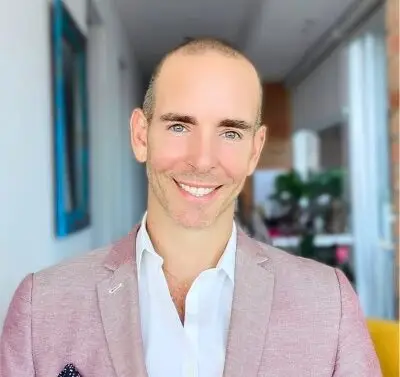
I recently went one-on-one with Dr. Keith Keating, Chief Learning & Talent Officer of BDO Canada and author of The Trusted Learning Advisor.
Adam: What drew you to learning and development, and what led you into the world of accounting?
Keith: Nothing drew me to accounting because I failed math every which way. Honestly, it is my absolute worst subject. So it is a little ironic that I’m responsible for learning at an accounting firm. Luckily, they all come equipped with those technical skills, so I do not have to help them from the technical perspective. In terms of what led me to learning, I have to start way back. I am actually a high school dropout. I never finished high school. I completed maybe two months of tenth grade. I grew up all over the world. My father was in the military, so we lived in Germany, Korea, and Japan before eventually moving to the United States when I was about twelve or thirteen. Because of that, my education was very uneven. For example, we did not study US history in Asia or Europe because it is such a small piece of the larger global story. So when I came to the United States, and the curriculum focused heavily on US history, I was significantly behind. As I mentioned, I was also behind in math. I just hated math.
I had teachers telling my parents completely different things. In one class, they would say he is above average and should skip a grade, and in the next classroom, they would say he has a learning disability and should be held back. There was this tension that existed around that. On top of it, there was bullying for always being the new person. Eventually, it became so heavy psychologically that I had to make a decision to protect myself, and I dropped out. I got my GED at fifteen, and when I did, my father and the school system both told me I would never amount to anything. They said I was destined for a life in fast food, as if working in fast food is wrong or bad. It is a very respectable job.
And I did exactly what they said. I got a job in fast food and worked at Wendy’s. I knew there was something else I wanted to be, but I had no idea what it was. No one ever told me that I could be anything. I did not have a guidance counselor. I never took any tests that said this is what you might be good at. So I had no idea what direction to take.
Then one day, I saw an ad in the newspaper for a Microsoft Office trainer. I do not know if you remember CompUSA. It was way before Best Buy. When computers started becoming more common, they had their own learning division, and they had won a contract from the government to teach Microsoft Office. This was around 1999. I saw the ad, went in, and applied. I was horrible. I had no idea what I was doing. I was seventeen or eighteen at that point, and they asked me to do a test teach. I did not know what a test teach was. I was trying to explain how to use Word. I was terrible. I was nervous. I was coughing. I told them I was sick, which is why I was coughing so much. They said thank you for coming in and that they would call me back for another interview.
About a week later, they called me, but to offer me the job, not to interview me again. I was seventeen or eighteen, and suddenly my job was to travel around the country teaching US government Social Security Administration offices how to use Microsoft Office. I was their children’s age, and they were my parents’ age. The first session I facilitated, I broke down in the middle of it. I cried, ran out of the room, got myself together, went back in, and finished the session.
That night I stayed up studying the entire night, trying to learn the content and practice. The next day, I was point zero zero one percent better. The day after that, I was point zero zero one percent better. Eventually, about six months into doing this, I was teaching Excel formulas and a light went on in someone’s eyes. They got it. It was such a rush because for the first time in my life, I felt like I had something to contribute. I had value I could offer someone else. That started me on this path. It began as a job, then it became a career, then a passion, and eventually a calling.
About a year into that job, when I had my performance review, I asked them why they hired me. I told them I must have been the worst person who showed up. My manager said, “You absolutely were. But you were the only person who had car insurance and no criminal record.” So the answer to how I got into this field is that I had car insurance and no criminal record.
Adam: At BDO, what do you prioritize when you’re evaluating candidates and deciding who to bring into the organization?
Keith: Curiosity and an aptitude to want to learn. We look for people who recognize that the world is shifting very quickly. Change is happening faster than ever, and the only antidote to change is learning. We have to be lifelong learners. So we look for individuals who have this mindset, or at least show signs of curiosity and a desire to keep getting better.
That idea of getting better is embedded in a phrase we use here, which is even better. If I said to you I want to help you be better, that might send the signal that you are not good today and something is wrong. But if I say I want to help you be even better, it signals that you are already good and potentially on a path to being great, and we can help you be even better as a practitioner and as a trusted advisor to our clients. As a firm, our goal is always to strive to be even better than where we are today and to have that continuous learning and development mindset.
Adam: How do you assess whether someone actually has that mindset? I’ll share something I tell my students at UCLA. There is this idea that there is no such thing as a bad question, but I don’t agree with that. There are bad questions. In my class, you are only allowed to ask questions you genuinely want the answer to. If you truly want to learn, it is a good question. If you are asking something just to sound smart or because you think you should, it is probably a bad question.
Keith: I love that. I would add that I do not know that you can truly assess this in people because they will tell you what you want to hear. If I ask whether you have a growth mindset or whether you enjoy learning, you are going to say whatever needs to be said in order to get the job. Instead, it is about the discussion questions. Tell me about the last time you failed at something. How did you identify that you were failing? What did you do to get better, and did you actually get better?
You can also ask what someone is actively trying to improve right now. How are they trying to grow? What have they done that is different? What has actually changed? You can use scenario-based questions as well and put someone in an unfamiliar situation, then watch how they respond. You can also tell in conversation whether someone is curious. Are they asking thoughtful questions? Are they trying to unpack things further?
At the end of the day, I would love to be able to hire specifically for that mindset. It is very difficult to know with certainty, but you can look for signals around learning, adapting, and improving.
Never stop learning is the first motto that we follow. It is a mindset that we are embedding into the firm from the very top, starting with the CEO, all the way down. Most people say they want to get better, but very few people define what better actually means. That is why the phrase even better is so important to us. It is about accepting people where they are and starting from the assumption that everyone is already good. The question is how we help you become even better.
We are always striving. As cliché as it sounds, it really is a journey and not a destination. We are never going to reach a point where we say we are finished and can stop learning. In our parents’ generation, the learning mindset worked differently. You went to school, earned a degree or designation, got your job, and applied what you learned until you retired. That world no longer exists.
Today, we have to learn, unlearn, and relearn continuously. We repeat that cycle over and over again, not just until retirement but throughout our entire lives. Inside an organization, one of the most important ways to embody that mindset is through feedback. Not just giving feedback, which is easy, but asking for feedback. Proactively demonstrating that you want to improve by asking others how you can get better.
Another critical piece is taking ownership of your own career and your own learning. One mistake people often make inside organizations is placing all of the responsibility on the learning and development function, as if we are solely responsible for their growth. I do not want anyone else responsible for my future. I am responsible for my future. I want everyone to embrace that same mindset.
There are people who sit back and think that the company did not create the right learning program for them or that they do not have access to something. Take ownership. Go out and find ways to learn. Today, we all have access to AI, which is one of the most powerful learning tools ever created. It democratizes our ability to learn. I use it every day to teach me about topics I do not understand.
Our CEO mentioned a phrase in a meeting the other day that I had never heard before. Within three and a half minutes, I had my AI tool explain what it meant and give me examples. That kind of real-time coaching is available to all of us, but we have to take ownership of our path rather than waiting passively for someone else to create it for us.
Adam: How can learning be incorporated into employees’ day-to-day lives?
Keith: Learning is not something that is punitive that happens to you. It is not something where you leave your physical or virtual workspace, go somewhere else, and have learning done to you from eight in the morning until five at night, and then you are finished. That is an event. People often confuse learning events with actual learning.
Learning happens all the time, and it can happen all the time. It is the difference between having a fixed mindset and having a growth mindset. I encourage people to stop thinking about learning as something separate from work and instead recognize that it exists in the moments when you have a question, when you encounter a problem, or when you think something could be done better. Those are the moments where learning should happen.
It is about taking a few minutes to pull on that thread of curiosity and find the answer using whatever tools you have available. Most organizations have a learning management system, an LMS, and people think that is where learning happens. If I need to learn something, I log in and take a course. I have never once gone into an LMS because I wanted to learn something.
Where do people actually go to learn? They go to the internet. They go to Google. Now they are going to AI. For me, it used to be Google. Now it is AI because it can coach me. It can act as the smartest coach in the world, with access to an incredible amount of knowledge, and it can help me in real time. Instead of sitting through a thirty-minute training, I can solve a problem or satisfy my curiosity in minutes.
As learning professionals, we need to evolve. It is not our job to deliver content. All the content already exists. Our job is to help people adopt the mindset of being lifelong learners and make sure they have access to the right tools so that when a moment of need arises, they know how to learn in real time.
Adam: We’ve talked a lot about lifelong learning and growth mindset and how they connect to success. What are the other skills that are critical, especially for someone in the accounting profession?
Keith: Critical thinking is at the top of the list, and not just for accounting but for everyone. But if I focus on accounting specifically, the industry is being completely transformed. It is no longer transactional. It is not about waiting for a client to show up once a year, completing their taxes, and seeing them again next year.
We have to evolve into problem solvers and trusted advisors. That requires becoming what is often called a T-shaped professional, where you have depth in your technical expertise but also breadth in how you apply that knowledge.
For a long time, the focus has been on technical expertise. That still matters, but what is increasingly important are the human, strategic, and adaptive capabilities. Accountants need to interpret data, not just report it. Business acumen is critical so you understand how a business operates, not just the financials. Adaptability is essential as AI and automation continue to change how we work. Relationship building is also key.
Ultimately, I would summarize it this way. The future of accounting belongs to professionals who can think critically, communicate clearly, adapt quickly, and build trust.
Adam: How has AI impacted the importance of these skills?
Keith: They are more important than ever. AI is taking over routine, rules-based work, so the value is shifting away from execution and toward thinking, interpreting, and advising. It is also making these skills more visible. It is easier to see who has them and who does not. I will admit something that may sound a little controversial. I used AI to help with my taxes. I am not submitting them that way, but I used it as a tool.
At this point, there is almost nothing I do that does not involve AI in some way. It makes me more efficient, but I have also noticed that it is impacting how I think. There are moments where I feel like part of my brain is going a bit dormant because I can rely on AI for so much. This morning, one of the tools I use was not working, and I actually felt a moment of panic thinking I might have to do it myself. Then I just switched to another tool. So while it is incredibly powerful, it can also become a crutch.
Adam: How do you balance using AI to improve your work while still maintaining and sharpening your critical thinking?
Keith: I do not know that I have a perfect answer because I am navigating that myself. It is so easy to rely on it. If I had to offer one approach, it is this. Do not accept the first response. Use AI for brainstorming and initial input, but then challenge it. Validate it. Add your own perspective. It shifts the role of critical thinking slightly. You are not just generating ideas, you are also evaluating and refining what AI produces.
We used to live in a knowledge economy where knowledge was scarce. If you had knowledge, you had power. Today, with AI, we all have access to an incredible amount of knowledge instantly. So knowledge itself is no longer the competitive advantage. What matters now is what you do with that knowledge. We have shifted from a knowledge economy to a value economy. The question is no longer what do you know, but what value are you creating with what you know and the tools you have. That is something I think about constantly. What value am I creating? If something is not creating value, then why are we doing it?
Adam: What advice do you have for people in accounting on how to most effectively use AI in their work?
Keith: I would give three pieces of advice. First, use AI as a brainstorming partner to better understand your clients, their industries, and the challenges they are facing. That helps you show up as someone who can identify problems and opportunities. Second, use it to help you expand beyond your technical expertise. Become more of a T-shaped professional by using AI to build broader knowledge and perspective. Third, use AI as a coach, especially for communication. Many accountants have strong technical skills but struggle with storytelling and presenting value. AI can help you prepare for client meetings, role-play conversations, and refine how you communicate. It is essentially a coach in your pocket.
Start now. If you are not using it yet, you are already behind, but that is okay because we are all learning at the same time. It can feel overwhelming because there are so many tools and so many use cases. Focus on where you are in your journey. You do not need to do everything at once. Use it to improve your personal and professional effectiveness first. Experiment. Try different tools. I use several and switch between them depending on the task. Most importantly, build a habit. Even fifteen minutes a day makes a difference. Ask the tool to teach you how to use it better. Ask it to push you outside your comfort zone. Just keep using it. Never stop learning.
Adam: How can leaders create a culture of learning and a culture of AI adoption within their organizations?
Keith: It starts with modeling the behavior. Leaders need to demonstrate that they are learning, growing, and using these tools themselves. It also requires creating a culture where failure is accepted. Failure stands for first attempt in learning. If people are afraid to fail, they will not experiment or take risks.
You also have to make it safe to experiment and connect learning and AI directly to real work. It cannot feel abstract. People need to see how it helps them do their jobs better. And you need to recognize and reward the behavior, not just the outcomes. Finally, you have to set the expectation that staying the same is not an option. Every organization wants to grow, and growth requires learning.
Adam: What pitfalls should leaders be aware of?
Keith: The biggest one, especially with AI, is making sure you are using it responsibly. There are regulatory, legal, and privacy considerations, particularly in professional services. You have to ensure that you are protecting your clients and your organization while still encouraging adoption.
Adam: Is there anything else you would like to share?
Keith: Three words. Never stop learning.