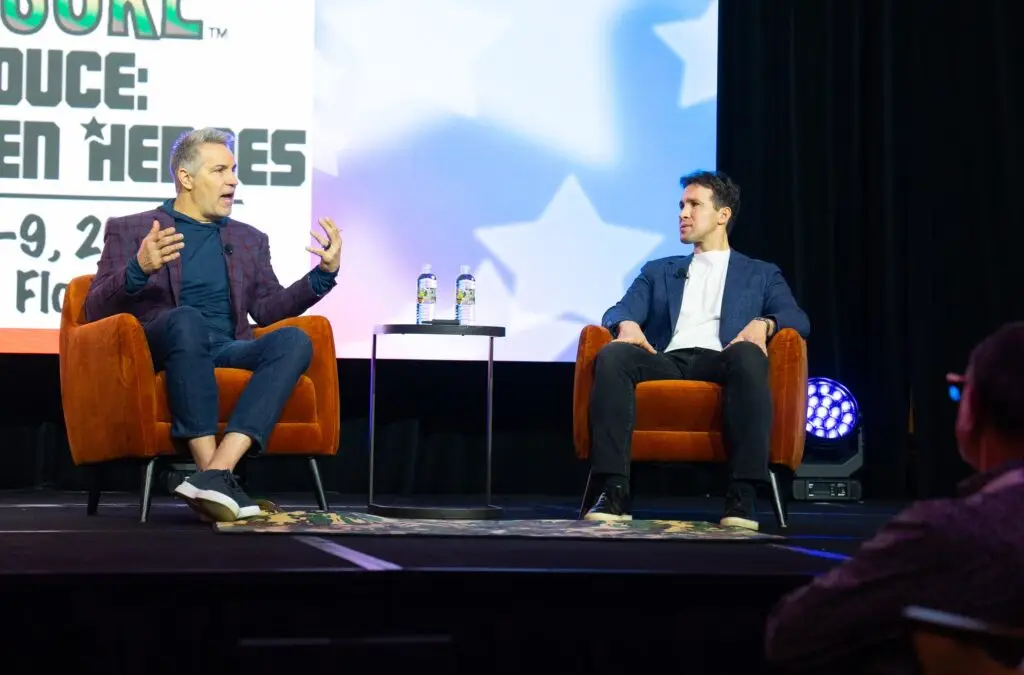


I recently went one-on-one with Wombi Rose, co-founder and CEO of Lovepop. Wombi is also a GRAMMY Award nominee.
Adam: Thanks again for taking the time to share your advice. First things first, though, I am sure readers would love to learn more about you. How did you get here? What experiences, failures, setbacks, or challenges have been most instrumental to your growth?
Wombi: Growing up, I was really lucky to have family in both Berlin, Germany and Western Pennsylvania. I got to experience elementary school both in a public school in a suburb of Pittsburgh and in a public school on the outskirts of Berlin. Both were very different. German school taught me independence and discipline. American school taught me the value of creativity and out-of-the-box thinking.
When I was 12, my lovely childhood came to an end. My parents divorced, and my brother, sister, and I were thrust into a very challenging situation. We felt like pawns in a pitched battle between my parents for control of custody and our upbringing. We developed thick skin and a resilience to stress that has enabled me to weather many of the extremely challenging times later in life. It helped me persevere through an incredibly challenging time at MIT, where I barely held on to graduate despite working harder than I ever had before. It’s been critical for building Lovepop, where we’ve almost run out of money five times. It also gave me an intense appreciation for those truly magical moments in life. I think my optimism and enthusiasm, especially in the face of challenges, were really forged in this dark time of my childhood.
When searching for college, everyone always told me, “You’ll find one you’ll fall in love with.” After visiting a number of schools, I was ready to give up. They all seemed the same. Same student tour, same dorms, same clubs. How could I fall in love with one when they are all the same? Then I remembered a postcard I had received from Webb Institute. It featured an America’s Cup sailing yacht and the cryptic words: “What floats your boat?” It was also in Glen Cove, NY, not too far from Princeton, where we had just finished yet another tour. My dad and I drove there in his minivan and arrived Friday at 4:30 pm. We didn’t meet any staff, only students. They took us to the pier and talked to us while unsuccessfully fishing with a home-made vodka bottle fishing “pole”. They told a magical story of living in an old Pratt Family estate, Honor code (no proctors for tests), full tuition scholarship for all attendees (and a free laptop), a hardcore engineering education on par with MIT and Caltech, and most importantly, two-month internships in the field every winter. I was hooked. Five years later, I graduated from Webb with two incredibly valuable skills and the most valuable thing I have ever been given in life. The skills: working unreasonably hard, and systems thinking.
The prize: lifelong friendships with a group of people I spent almost every waking hour with over the course of four years of shared learning, growth, fun, and occasionally some really meaningful suffering. Everything I have learned since then has built on these foundations, and I’m incredibly grateful to my family and my Webbie family for these lessons, even when it wasn’t sunshine and roses.
Adam: How did you come up with your business idea and know it was worth pursuing? What advice do you have for others on how to come up with and test business ideas?
Wombi: My co-founder, John, and I always wanted to start a business together. That desire preceded the idea of Lovepop and the Lovepop business. We thought we would do something in the industrial space. When we came across sliceform kirigami art in Vietnam on a business school trip, we were excited about it. We wanted to use it for our personal stationery. It was only after bringing samples back to the US and selling them from our backpacks and at local fairs and markets and saw firsthand the incredible reaction and excitement to the product that we knew we had the core spark that could build a business. I love Paul Graham’s advice to do things that don’t scale. We did that. We were working 70-hour weeks in the beginning, personally doing absolutely everything to barely make any money, but validating that people really wanted to buy Lovepop. Starting a company is all about the conviction that what you have will really solve a customer’s need in a big way. I think everyone should start there.
Adam: What are the key steps you have taken to grow your business? What advice do you have for others on how to take their businesses to the next level?
Wombi: Step 1: Validate demand. Unscalable fairs, markets, hand selling, Kickstarter.
Step 2: Figure out delivery. For us, that meant designing our own designs, starting a production facility, and contracting fulfillment.
Step 3: Figure out marketing. For us, that meant retail kiosks, PR, and Facebook marketing.
Step 4: Scale team. This eventually enabled us to really grow our advertising and overall business.
Turns out that hiring people and managing people is about 1,000 times harder than it appears. I think it’s almost impossible for any leader to spend too much time on people.
Adam: What were the best lessons you learned from your experience on Shark Tank?
Wombi: The number one lesson we learned from Shark Tank is the value of preparation. By a fluke of events, John and I ended up having a week in a hotel room together prior to filming Shark Tank. In that time, we watched every episode of Shark Tank. We wrote down every hard question. We decided how we would answer it and which one of us would answer it. We categorized them and decided who would respond for every category of question. We memorized the financial model. The whole financial model. Because we saw that contestants were getting tripped up by hesitating in responding to numbers questions.
When we got on set, we took care of all the gotchas in our first responses. We replied instantly without hesitation to every numbers question. We knew our margins, our plans, every detail. We never waffled on who was responding to a question. The right person just spoke. You could say our preparation was far over the top. But, the result of all the preparation: a deal with Kevin O’Leary, 7.5 million Americans learning about us in December 2015, and an episode that perfectly tells the story of the early days of Lovepop.
I keep relearning this lesson. Last year, we launched a product with the band OK Go. It was the hardest design project I’ve ever worked on. It took over 6 months and thousands of iterations. Damian, the lead singer and creative visionary, is one of the nicest people I’ve ever met. He’s also the most creatively exacting. We persisted, and the result was an album package that was not only nominated for a GRAMMY this year, but is truly a piece of art.
Preparation. Persistence. Hard work. There is no substitute.
Adam: What are the most important trends in technology that leaders should be aware of and understand? What should they understand about them?
Wombi: It’s hard to answer this question in 2026 without talking about Claude Code and all the incredible tools that Large Language Models are making possible. It may sound like hyperbole, but I think every person who creates and makes decisions is behind in leveraging the awesome capabilities and superpowers being made available to us. Every day I am learning new things that open entirely new lanes of possibility. Whatever you think is possible today is probably just a small fraction of what is already happening, and by tomorrow those possibilities will multiply.
I think the skills of the future are vision, judgment, curation, and taking action. And the path to exercising them is to understand how to mold the tools to create your vision. We used to interact with computers in a very deterministic way. The future is about shaping the direction they go. I’m unbelievably curious as to what this means. There’s scary parts, there’s exciting parts, but there is no question that it is happening faster than any of us can really comprehend.
The one thing that I think is true, no matter what happens in that world, is that real human connections and relationships, which are already the most important things in our lives aside from basic needs, are going to take on more and more importance. Because of that, I think what we are doing is more important than ever.
Adam: In your experience, what are the defining qualities of an effective leader? How can leaders and aspiring leaders take their leadership skills to the next level?
Wombi: I am a student of leadership, and I believe I am just at the beginning of my journey to really understand the answer to your question. The things I believe are most important are very core qualities to a person. I think it’s really important to lead from a genuine enthusiasm for what you are trying to build and care deeply about the people you are leading. It’s important to be able to imagine a different future and describe it in such a way that people can understand it. Finally, it’s important in all the really hard and difficult moments to be there. To show up.
Adam: What is your best advice on building, leading, and managing teams?
Wombi: Over the years, I’ve tried to exercise leadership best practices. Soften my feedback. Empower. Delegate. Founder mode. Fill up people’s cups. There’s so much out there. Ultimately, I just come back to the fact that there’s only one person I can be: me. I’m an intensely curious person who will always seek the 2nd, 3rd, and 4th order effects and try to objectively understand the world around us. I’m super hungry for pace and perfection. I love to dream up big visions and convince lots of awesome people to run at them. And I have to be at peace with the fact that not everyone is going to agree with every decision I make. Not everyone is going to like working with me. But for the people who do and can forgive me for the decisions they disagree with, it’s going to be a really energizing experience.
I’m not qualified to give advice on building teams, so take this at your own risk. My best advice is: be true to yourself and let others opt in.
Adam: What are your three best tips applicable to entrepreneurs, executives, and civic leaders?
Wombi:
- Phones are drugs, and exposure should be limited. Talking to real people is the antidote. Prioritize.
- Dream big. Working on big dreams and small dreams requires the same amount of work and has the same likelihood of success. I have no idea if this is accurate, but I believe it.
- Don’t slow down work in process. Once something has started, let it rip and fix it on the next rep. We call this the “donut burger” methodology after the bagel slicer in Finagle a Bagel in Boston, where our Vietnamese cofounder Bao had his first smoked salmon bagel, which he called a donut burger. Once the bagel hits the slicer, it flies across the counter to be made into a sandwich. Any approval step placed on that counter would destroy the process and result in an epic bagel pile-up. All other processes are the same, it’s just harder to see the damage of slowing down work in process when it’s not a physical bagel flying across the room.
Adam: What is the single best piece of advice you have ever received?
Wombi: On merchandising: Jay Margolis: “The fashion sells the basics.”
On people: “When someone shows you who they are, believe them the first time,” Maya Angelou (quote from my daily planner).
On business: “Don’t push on a rope.”
On life: “Make pigs fly,” my leadership mission given to me by my business school study group.