
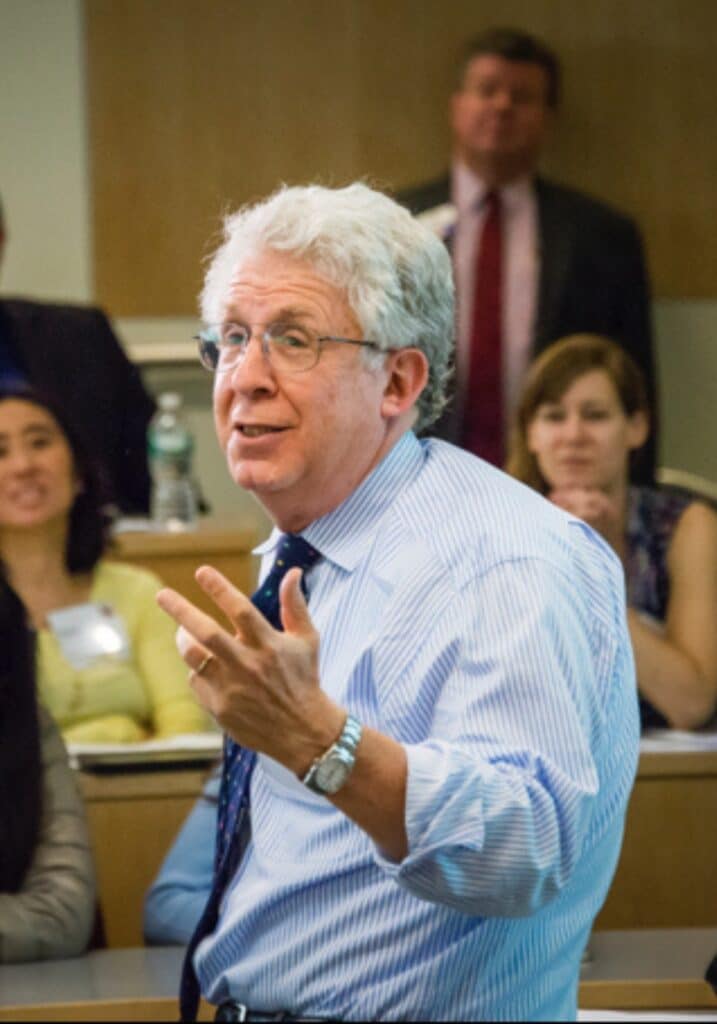
I recently went one-on-one with Bob Pozen. A Senior Lecturer at MIT Sloan School of Management and a non-resident Senior Fellow at the Brookings Institution, Bob was the Vice Chairman of Fidelity Investments and President of Fidelity Management & Research Company before becoming the Executive Chairman of MFS Investment Management.
Adam: Thanks again for taking the time to share your advice. First things first, though, I am sure readers would love to learn more about you. How did you get here? What experiences, failures, setbacks, or challenges have been most instrumental to your growth?
Bob: I grew up in Bridgeport, Connecticut, went to public high school, and got into Harvard on a scholarship. I graduated summa cum laude and Phi Beta Kappa. I mention that not for the biography but because it shaped how I think: I never assumed a door would open for me, so I learned early to prepare relentlessly and to make myself useful in every situation. That habit has mattered more to my career than any single credential.
From Harvard, my path was anything but a straight line. I finished a law degree at Yale and stayed on there to earn a doctorate for writing a book on state enterprises in Africa. My first permanent job was teaching law and economics at NYU, where I wrote the first textbook on regulating financial institutions. Then I took a senior staff position at the SEC, ran investment management at Fidelity, and later was executive chair of Massachusetts Financial Services. Along the way, I served in the cabinet of a Massachusetts Governor and as a member of a Presidential Commission on Social Security reform.
People sometimes see that path as scattered. However, that is the whole point. I took every opportunity that presented itself and applied similar analytic frameworks in each of the new positions. I got up to speed quickly on the situation, figured out my top priorities, and formulated a plan to implement them. Setbacks across my career taught me the most. When I proposed a Social Security fix called progressive indexing, I was attacked simultaneously from both the left and the right. That stung, but it also taught me that if you are trying to solve a hard problem honestly, taking fire from both sides is often a sign you are near the sensible middle.
Adam: What are the best lessons you learned from your time at Fidelity and at MFS?
Bob: Fidelity taught me the power of talent and decentralization. As president of its investment arm, I watched assets grow from roughly $500 billion to nearly $1 trillion. But my contribution was not from having clever stock ideas. It came from hiring exceptional portfolio managers and analysts, giving them real autonomy, and then getting out of their way while still holding them accountable for results. My job was to build the platform and protect the culture, not to be the smartest investor in the building.
MFS taught me that process and governance are critical to long-term success in the mutual fund industry. When I became chairman, the industry was living through the market-timing scandals, and trust was a scarce commodity. We invested heavily in risk management, compliance, and a team-based approach to investing. Our excellent performance did not depend on any single star. I believe that the assets of MFS almost tripled because clients could see that the firm was built to last for decades.
Putting together my experiences at Fidelity and MFS, you get my core management belief: hire great people, give them room, and surround them with systems strong enough that the organization outlasts any leader, including you.
Adam: What is your investment philosophy and approach to the markets?
Bob: I am a long-term investor. Recently, I have been making an argument that surprises people: most affluent investors are badly overinvested in bonds. The old 60-40 portfolio, 60 percent stocks and 40 percent bonds, has become a norm. However, for anyone with a long horizon, it is the wrong default. I favor what I call a 90-10 portfolio instead: 90 percent in a low-cost, broad-based stock index fund and 10 percent in a money-market fund.
The case rests on the historical record. Over almost all long periods, stocks have higher total returns than bonds, and the compounding difference is enormous. Over the 40 years ending in 2025, $100,000 invested in a 90-10 portfolio (with dividends reinvested) would have grown to $5.8 million, more than double the $2.5 million from a 60-40 portfolio. People underestimate how much that 40 percent in bonds costs them over a lifetime.
Keeping 10 percent in a money-market fund gives you cash to cover unanticipated expenses and to help you stay calm in the inevitable down years of stocks. To maintain a 90-10 portfolio, investors need not only a long-time horizon but also the temperament to withstand temporary declines in stocks without panicking.
My broader philosophy is the same as it has always been: keep your costs low, stay diversified, hold for the long term, and understand that the single biggest determinant of your investment results is not the stocks you pick but the asset allocation in your portfolio.
Adam: In your experience, what are the key steps to growing and scaling a business?
Bob: First, start by being ruthless about priorities. Most businesses fail to scale because they try to do too many things at once. Decide what you are best at and what your customers need most. Then focus, focus, and focus.
Second, as you grow your team, delegate real authority. You cannot scale an organization that funnels every decision through the founder. The hardest transition for most leaders is going from being the person who does the work to being the person who builds the team and the systems that do the work.
Third, protect the culture deliberately as you add people. Culture is so difficult to maintain as you scale. You need to be directly involved in interviewing and selecting your senior hires. This is a non-delegable function.
Finally, institutionalize your processes. Growth exposes every weakness in your operations, controls, and culture, so you need repeatable systems in place before volume arrives.
Adam: Who are the best leaders you have been around and what did you learn from them?
Bob: I have been lucky to work alongside some remarkable people. At Fidelity, I learned an enormous amount from the Johnson family’s long-term philosophy. They were willing to invest through downturns and to reinvest in the business when competitors were pulling back, because they thought in decades, not quarters. That patience is rarer and more powerful than most people appreciate.
In the public sphere, I saw Governor Romney bring a genuinely analytical, turnaround mindset to policy problems, breaking big challenges into components and attacking them with data. What struck me was his disciplined approach to public policy.
The common thread among the best leaders I have known is that they were secure enough to hire people who might outshine them and generous enough to give them credit. Insecure leaders hoard decisions and starve their organizations of talent. These leaders always want people to agree with them and do not tolerate honest debate on difficult issues. Great leaders multiply themselves and their work through others.
Adam: What do you believe are the defining qualities of an effective leader? How can leaders and aspiring leaders take their leadership skills to the next level?
Bob: An effective leader does two things well: sets a clear direction and builds a system that enables others to do meaningful work. You do not have to be the most charismatic person or give rousing speeches. But you must be clear about what matters, honest in your feedback, and disciplined about implementing your priorities.
To get to the next level, effective leaders need to delegate work to their lieutenants with a clear agreement on success metrics. I have always been surprised about how members of the same team have different conceptions of straightforward goals like improving customer service. To get everyone on the same wavelength, ask the question – how will we know whether we have succeeded at the end of the relevant period?
Feedback is the skill I would emphasize most, because it is rarely done well. Vague praise helps no one and harsh criticism shuts people down. The art is to be specific, suggesting changes to behaviors rather than the person. You also should be clear that you are giving constructive feedback because you believe in their capacity to improve. Done well, it is the single greatest gift you can give someone’s career
Adam: What are the most important trends in technology that leaders should be aware of and understand? What should they understand about them?
Bob: The trend leaders cannot afford to misunderstand is artificial intelligence, and specifically machine learning and generative AI. The realistic question is not whether machines will replace people, but how work gets redivided between them. In most knowledge work, AI is best understood as augmentation: it finds patterns, does routine analysis and generates first drafts of documents. By performing those functions, AI allows skilled people to concentrate on judgment, relationships, and genuinely novel problems. The organizations that win will be the ones that redesign their workflows around that partnership, rather than either banning the technology or unquestioningly trusting it.
Become a hands-on user, not just a reader of headlines. You cannot lead your organization through a technology you have never actually employed. Spend real time with these tools, understand where they are reliable and where they confidently get things wrong, and set clear guardrails for your team accordingly.
Adam: What are your best tips on the topic of productivity?
Bob: The key to my work on personal productivity is a single shift: measure yourself by results, not by hours. Many people confuse being busy with being productive, and they wear long hours as a badge of honor. But the goal is to produce the best results in the fewest hours, which leaves room for a life outside of work.
From there, a few habits do most of the heavy lifting. Rank your priorities explicitly, for the year and for the week, and make sure your calendar actually reflects them rather than just whatever lands in your inbox. Handle low-stakes decisions once and quickly. I use a rule I call OHIO, Only Handle It Once, so I do not keep reopening the same email or memo. And do not get addicted to your inbox; check it a few times a day, scan by subject and sender, and reserve your best hours for your most important work.
Two more suggestions: First, eliminate trivial decisions by routinizing them, from what you eat in the morning to when you exercise, so you conserve your mental energy for choices that matter. Second, when you write, build an outline before you draft a single sentence. Most people waste enormous amounts of time because they start writing before they know what they are trying to say. An outline forces you to articulate a logical argument.
Adam: What is the single best job description you ever received?
Bob: When I was interviewing for my initial job at Fidelity, I had seen a lot of people before I met the chairman, Ned Johnson, but I had never received a job description. When I met with Ned, I asked him for a description of the job that I would be doing at Fidelity. Ned responded: “Figure out what needs to be done and do it.” I knew I wanted that job.
Adam: Is there anything else you would like to share?
Bob: Whatever field you are in, invest in habits that compound, be willing to reinvent yourself more than once, and never be too proud to be the least experienced person in the room. The most interesting parts of my life came from leaps that seemed risky at the time. If you are clear about your priorities, have a big appetite for learning, and treat the people around you well, the results will take care of themselves.