
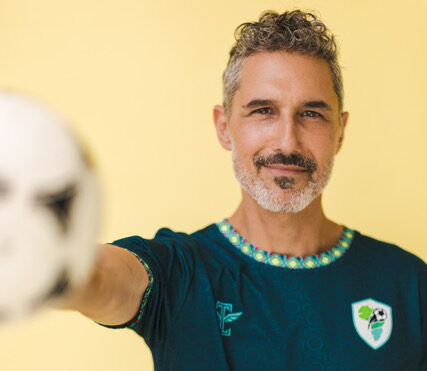
I recently went one-on-one with Ethan Zohn. Ethan is a former professional soccer player, a winner of Survivor: Africa, co-founder of the nonprofit Grassroots Soccer, and host of Kicking Back, a new documentary that explores legal cannabis culture in World Cup cities.
Adam: Thanks again for taking the time to share your advice. First things first, I am sure readers would love to learn more about you. How did you get here? What experiences, failures, setbacks, or challenges have been most instrumental to your growth?
Ethan: It starts at 14, when cancer took my father away from me. He was 49. When he died, all I wanted to do was curl up in a ball and not come out. But my family, my friends, my teammates, my community showed up and wrapped around us. That experience planted something in me I’ve never been able to shake: you are not meant to survive alone, and the people who show up for you in a crisis become the foundation for everything that comes after.
From there, a soccer career took me from Boston to Hawaii to Cape Cod to Israel and eventually to Zimbabwe, where I was playing professional soccer in the Zimbabwe Premier League. I arrived and started seeing graveyards on the side of the road, some with organized headstones, others with wooden crosses piled high, overflowing. I asked a teammate why they were buried differently. He said: “That’s where they bury the people who die of AIDS.” I was looking at the physical reality of a disease destroying an entire community. And what did I do about it? Nothing. I told myself it wasn’t my problem.
Then I got on Survivor, won a million dollars, won two goats in a reward challenge in Kenya, truly a life highlight, and wound up in a hospital parking lot playing hacky sack with kids, using the same one my father gave me before he died. A nurse told me those kids were all HIV positive. Something cracked open. I came home, co-founded Grassroot Soccer with my former teammates, invested my winnings in something much bigger than myself, and we’ve now reached over 25 million young people in 65 countries.
Then, at 35, I was diagnosed with a rare blood cancer. Twelve chemotherapy regimens didn’t work. Twenty-two blasts of radiation didn’t work. A failed transplant. Running out of options, scared, not wanting to die, and crushing medical cannabis. At the last possible moment, a new targeted therapy emerged, still in FDA approval, and I was eligible. It saved my life. Then cancer came back. Two stem cell transplants total. The second used my brother Lee as the donor. So, I’ve officially changed my name to Leethan, and I’m no longer my mother’s favorite son…
What I’ve learned through all of it is that a challenge isn’t meant to beat you down; it’s meant to raise you up. Every crisis in my life has pointed me toward the next thing I was supposed to do. I just had to be willing to look.
Adam: What are the best lessons you learned through your career in soccer that are applicable to those of us who will never earn a living playing sports?
Ethan: I spent time playing every level of soccer, college, semi-professional, professionally in Zimbabwe, and I coached at the high school and university levels too. The lessons that have stayed with me have almost nothing to do with soccer.
The first is that the team is the thing. Not you. You can be the most talented person on the field, but if you can’t function within a unit, if you’re not elevating the people around you, you’re a liability. That’s true in every organization I’ve ever been part of.
The second came specifically from studying goalkeepers, because I am one. In my years of playing and coaching, I became convinced that great goalkeepers and great leaders are almost identical. Goalkeepers do the dirty work, the thankless, unglamorous, sometimes painful things that others won’t do, and they earn respect for it. They perform in less than optimal conditions. They don’t wait until success is guaranteed before they take action. And critically, a goalkeeper can save a game, but they cannot win it alone. They need the ten field players to perform. The best goalkeepers I’ve ever seen spend enormous energy bringing out the best in people with ten completely different personalities. That’s leadership.
The third lesson is about character under pressure. When you’re exhausted, losing, playing in the rain on a terrible field against a better opponent, that’s when you find out who you actually are. Talent shows up when things are easy. Character shows up when they’re not.
Adam: What are the best lessons you learned from your experience on Survivor Africa?
Ethan: Survivor gets described as a game of strategy. But at its core, it’s a game of relationships. It’s one big 39-day community networking event. How can you sell yourself and your ideas to other people and get them to follow along, not hate you, and want to give you $1mm at the end? That’s the game. As Jeff Probst has said: “If there is anything you want to be good at, it’s social relationships — how to form them, when to stay true to them, when to avoid them, and when to blow them up.”
I went out there fully intending to play a cutthroat game. But it ran completely against my nature, so I did the opposite; I became a member of the community. First one up, last to bed. Helped with chores, brought back food and water, supported my tribe. During my entire time on the show, not one person voted against me.
The lesson: being a crucial member of the community, making yourself genuinely valuable to the people around you, is the most durable strategy there is. In any game. In any company. In any life.
The second lesson was unexpected. Once all my comforts were stripped away, no phone, no connections, nothing but the clothes on my back and a hacky sack, I was left with the bare essentials of who I am. What remained was character, compassion, and perseverance. That’s a clarifying experience I’d recommend to every leader: ask yourself what’s left when everything else is taken away. Is that someone worth following?
Adam: What is the most surprising thing about life as a professional soccer player? What is the most surprising thing about life on Survivor?
Ethan: As a professional player, the most surprising thing was how completely sport reflects the community around it. When I was the backup goalkeeper for the Highlanders FC in Zimbabwe, I was the outsider in every possible way. I looked different, spoke differently, and ate different food. But I worked harder than anyone. First to practice, last to leave, first in every fitness session, always supportive of my teammates. And they followed my lead. That surprised me; that work ethic and genuine investment in the people around you could transcend every other difference. The coach even gave me playing time, which, as a backup goalkeeper in the Zimbabwean Premier League, was not guaranteed.
As for Survivor, I was completely unprepared for how alone I would feel. I thought I was going out there to compete in physical challenges and play strategic chess. What I wasn’t prepared for was being cut off from everyone I loved with nothing but the clothes on my back. Once all my distractions disappeared, I was alone with myself in a way I’d never experienced. It turns out that’s both terrifying and deeply useful information. Survivor, it’s been said, is really a template for how to succeed in life, a model for how to navigate uncertainty, handle change, and keep going when things don’t go your way. I think that’s exactly right.
Adam: What are the best leadership lessons you have learned from leading a non-profit organization?
Ethan: The most important: be bold enough to try the idea, and humble enough to know you’re going to need help. Grassroot Soccer started as four soccer players with a concept and a lot of nerve. We didn’t have money, infrastructure, or a roadmap. We had a clear sense of why it mattered and the willingness to ask smarter people than us to come alongside us. That combination, conviction plus humility, is what got us from four guys with an idea to an organization operating in 65 countries.
The second lesson is about cooperation. In the nonprofit world, especially, organizations often compete with each other to accomplish the same goals, fighting over donors, duplicating programs, and building parallel infrastructure. I’ve seen it and participated in it. It’s wasteful, and it misses the point. Real leadership in service of a mission means letting go of who gets credit.
The third lesson took me longer to internalize: the people in front of you are the mission. At Grassroot Soccer, coaches working in communities are the real leaders; they’re the ones on the ground, building trust, delivering the message, changing behavior. My job was always to serve them, not the other way around. The best nonprofit leaders I’ve encountered understand that leadership flows down and out, not up and in.
Adam: What do you believe are the defining qualities of an effective leader? How can leaders and aspiring leaders take their leadership skills to the next level?
Ethan: I’ll borrow a line I came across that I’ve never been able to improve on: leadership isn’t a role, it’s a mindset. It’s the commitment to discovering your own greatness and then inspiring greatness in others. That’s the whole thing. A title doesn’t make you a leader. The mindset, the daily decision to show up, do the work, and make the people around you better, that’s what makes you a leader.
To take it to the next level? Know yourself first. Know your strengths and weaknesses well enough to find people whose strengths complement yours. A team built around one person’s ego is fragile. A team built around honest self-knowledge and complementary skills is nearly unbreakable. Then lead by example, not with speeches, but with behavior. The backup goalkeeper who’s first to every practice and last to leave does more for team culture than a captain who gives great speeches and cuts corners when no one’s watching.
Adam: What are your three best tips applicable to entrepreneurs, executives, and civic leaders?
Ethan: One: Never let a crisis go to waste, because it’s an opportunity to do some really important things. Every significant thing I’ve built came out of a crisis. The AIDS epidemic I witnessed in Zimbabwe. My cancer diagnosis. My father’s death. Medical cannabis for healing. Crisis creates clarity. It strips away everything unimportant and shows you what actually matters and what you’re actually capable of. Don’t just survive it, let it point you somewhere.
Two: Be a member of your community, not just a leader of it. The most effective leaders I’ve encountered aren’t elevated above their teams; they’re embedded in them. On Survivor, not one person voted against me in 39 days. Not because I outmaneuvered everyone strategically, but because I made myself genuinely indispensable to the people around me. That works in business, in organizations, in communities. People follow people who show up.
Three: Invest in something bigger than yourself. I took my Survivor winnings and built Grassroot Soccer instead of buying a very nice apartment. The return on investment in meaning, in resilience, in the ability to keep going when things are hard, is impossible to calculate. When your work is connected to a purpose that matters, the why never runs out. And on the days when everything is hard, the why is the only thing that gets you out of bed.
Adam: What is the single best piece of advice you have ever received?
Ethan: A teacher once shared with me that in Hebrew, the words for “challenge” and “miracle” share the same root. A challenge is not meant to defeat you; it’s meant to raise you to a higher level. The miracle isn’t something that descends on you from the outside. It’s what gets unlocked inside you when you’re tested.
That reframed everything for me. My father’s death at 14. Watching the AIDS epidemic in Zimbabwe and doing nothing at first. Two cancer diagnoses. The moment I collapsed in a physical challenge on national television. Becoming an advocate for medical cannabis. I used to experience those things as things that happened to me. Now I understand them as the moments I was being shaped into someone capable of doing something with them. The question stopped being why is this happening and became what is this asking of me. That’s a different question, and it leads somewhere much more useful.
Adam: What can anyone do to pay it forward?
Ethan: Ethan: Give away more hacky sacks. I mean that literally and figuratively. When I was filming Survivor in Kenya, I gave away a hacky sack, the one my father gave me before he died, to a boy named Milton outside a hospital. He was HIV positive. His smile lit up all of Africa. In that moment, I understood something I’ve never been able to shake: by giving, helping, and genuinely serving another person, you don’t just help them. You heal yourself. Focusing on someone else’s situation, even in the middle of your own worst moment, is one of the most powerful things you can do for your own mental state.
You don’t need a platform, a foundation, or a million dollars. You need to find the person in front of you who needs something you have: time, attention, knowledge, a connection, a kind word, and give it without keeping score. Leadership, at its most fundamental, is service. Not the glamorous kind. The quiet, consistent, nobody-sees-it kind. That’s the kind that actually changes things.
Adam: Is there anything else you would like to share?
Ethan: Just this: I’m one of the lucky ones, and I know it. I had the hospital, the doctors, the insurance, the community, the support system. Not everyone facing what I faced has that. And I think about those people constantly, the ones navigating a cancer diagnosis alone, without resources, without a network, without anyone in their corner. That’s what keeps me working.
Since going public with my story, 32 people have reached out to tell me that someone they knew recognized their symptoms from something I said, went to a doctor, and got diagnosed with lymphoma early enough to do something about it. That’s my proudest accomplishment. More than winning Survivor.
My dad died at 49. I’ve already surpassed his age, and I think about that every single day. It makes every morning feel like something I’m supposed to do something with. Survivor, in every sense of that word, is really just a template for how to live: say yes to the unknown, be brave, find ways to empower yourself and others in impossible conditions, and never, ever let a crisis go to waste.