


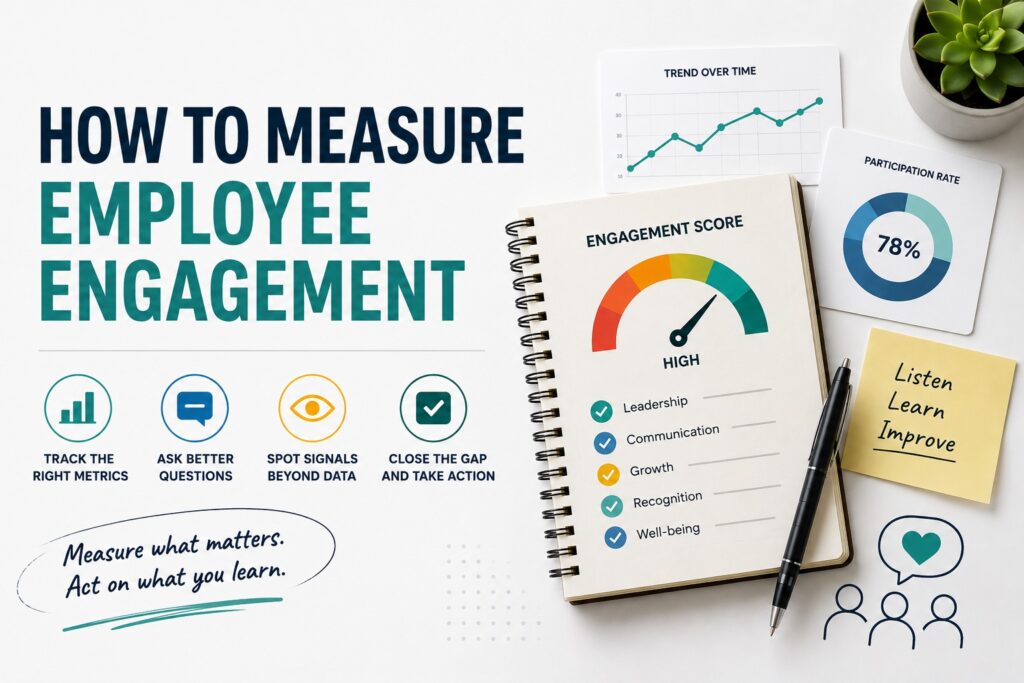
Employee engagement is visible every single day if you know where to look. It shows up in how people talk about their work, whether they raise problems early or let them quietly pile up, and how they respond when something goes sideways. That kind of signal is available to any leader who’s paying attention. The real challenge is that too many companies have replaced observation with an annual survey and convinced themselves that one data pull a year is sufficient.
Knowing how to measure employee engagement requires tracking the right metrics, asking questions that reveal what’s actually happening inside your teams, paying attention to signals that don’t appear in any spreadsheet, and closing the gap between what you learn and what you do about it. The survey platform matters far less than the discipline behind how you use the data.
Why Most Engagement Measurement Misses the Point
The playbook at most companies is familiar: send a long annual survey, compile a company-wide report, create a short list of action items, and move on. Six months later, the same problems persist because measuring employee engagement was treated as a one-time event rather than a discipline the organization returns to with any consistency.
Companies have been running these surveys for years, and the tools have gotten faster, more sophisticated, and easier to deploy. The engagement numbers across industries have not improved at the same pace. Global engagement dropped to 20% in 2025, the lowest level in five years and the first time it declined two years in a row, according to Gallup’s State of the Global Workplace report.
That disconnect points to a leadership problem, not a technology problem. The data was coming back; senior leaders just weren’t doing enough with what they received. That gap between data and action is exactly what an employee engagement speaker helps organizations close. When employees fill out a survey year after year and see nothing change in response, participation drops, honest feedback declines, and the data gradually stops reflecting reality. People stop trusting the process, and once that trust is gone, the survey responses stop reflecting what’s actually happening.
How to measure employee engagement effectively starts with a straightforward expectation: that the process will lead to real decisions that strengthen teams. If the end result is a report that checks a quarterly box and collects dust, the measurement failed before it began.
Five Employee Engagement Metrics Worth Tracking
Most organizations start the conversation about how to measure employee engagement by asking which tool to use. That conversation gets productive faster when you back up and ask which employee engagement metrics actually give you something you can act on. There are dozens of data points available. These five offer the clearest view of what’s happening inside your teams.
1. Employee Net Promoter Score (eNPS)
The simplest version of this metric comes down to one question: “On a scale of 0 to 10, how likely are you to recommend this company as a place to work?” Subtract the percentage of detractors (scores of 0 to 6) from promoters (scores of 9 and 10). A score above 30 is generally considered strong, while anything below zero is a serious concern that warrants immediate attention. Run this quarterly rather than annually to build useful trend data.
2. Voluntary Turnover Rate
Total turnover includes layoffs and terminations, which muddies the signal. Voluntary turnover isolates the people who choose to leave, and that choice is one of the most direct forms of engagement feedback any organization will ever receive. Divide voluntary separations by average headcount over the same period, and segment them by team and by manager.
3. Absenteeism Patterns
A single absence tells you very little. A rising trend of unplanned absences across a team or department, however, often signals burnout, low morale, or a leadership problem that hasn’t surfaced through formal channels. Track the pattern over time, not the individual data points.
4. Internal Mobility Rate
When employees don’t see a path for growth, they disengage well before they resign. Tracking the rate of promotions, internal transfers, and lateral moves tells you whether people are developing inside the organization or getting stuck in place. Low internal mobility is one of the earliest warning signs of stagnation, and it’s a metric that most organizations overlook entirely.
5. Survey Participation Rate
This is the meta-metric that tells you whether your other data is even trustworthy. If your annual engagement survey receives a 40% response rate, you’re hearing from fewer than half your people. The half that chose not to respond may be telling you more than the half that did. Declining participation year over year is itself a telling signal about trust and engagement.
| Metric | What It Measures | What It Tells You | Watch For |
| eNPS | Willingness to recommend the company | Overall sentiment baseline | Scores below zero or sharp drops between quarters |
| Voluntary Turnover | Employees who chose to leave | Whether people want to stay | Spikes in specific teams or following leadership changes |
| Absenteeism Patterns | Trends in unplanned absences | Burnout or disengagement risk | Rising patterns concentrated within a single team |
| Internal Mobility | Promotions, transfers, lateral moves | Whether growth paths exist | Stagnant rates across the entire organization |
| Survey Participation | Response rates over time | Trust in the measurement process | Year-over-year decline in willingness to participate |
Engagement lives and dies with leadership, not with HR programs or annual survey cycles. If you’re working to build a more engaged organization and want to bring that conversation to your leadership team, learn more about working with me as a speaker.
Learn More About Working with AdamEmployee Engagement Survey Questions That Surface Real Issues
When leaders ask how to measure employee engagement, surveys are usually the first tool that comes to mind. But most employee engagement survey questions are too broad to produce actionable data, and the quality of a survey depends entirely on what you choose to ask. “How satisfied are you with your job?” gives you a number but doesn’t point toward anything specific enough to address.
Gallup’s Q12 survey remains one of the most validated tools for measuring engagement, built on decades of research connecting specific employee needs to team performance outcomes. The questions below are organized around similar core categories, each targeting a different layer of the employee experience.
Role Clarity
- Do you clearly understand what is expected of you in your current role?
- Do you have the resources and tools you need to do your work well?
Recognition and Value
- In the last 30 days, have you received meaningful recognition for your work?
- Do you feel your direct manager values your contributions?
Growth and Development
- Do you see a clear path for professional growth within this organization?
- In the last six months, has someone at work talked to you about your progress and development?
Team and Trust
- Do you trust the leadership of this organization to make sound decisions?
- Do your coworkers hold themselves to a high standard?
- Do you feel comfortable raising concerns or sharing ideas without fear of negative consequences?
- Does the mission of this organization make you feel your work is important?
Keep surveys to 10 to 15 questions total. Anything longer reduces completion rates, which degrades the reliability of your data. Include at least one open-ended question, something like “What is one thing we could do to make this a better place to work?” And make anonymity explicit before anyone responds. People give far more honest answers when they trust their feedback won’t be traced back to them.
Signals You Won’t Find in Any Survey
Surveys capture what people are willing to write down, which leaves a large part of the engagement picture untouched. Some of the most telling indicators of engagement show up in daily behavior, and leaders who pay close attention can identify problems months before any formal measurement confirms what they already suspect.
Start with the quality of your one-on-one conversations. When employees bring ideas, concerns, or honest pushback into a meeting, you’re seeing trust and real investment in the work. When those same conversations turn into nothing more than status updates with no substance underneath, trust has eroded, and the manager needs to find out why. The content of a regular 1:1 is one of the most underused engagement signals available to any manager, and it costs nothing to track.
Exit interview patterns are another rich source. A single departure is just a data point, but three departures from the same team with overlapping reasons are a pattern that deserves attention before the next survey cycle begins.
Internal referral rates provide a different angle. When employees are proud of where they work, they recommend it to people they know. Referrals tend to decline well before survey scores show any change, making them a useful leading indicator.
In hybrid and remote environments, meeting behavior is worth watching as well. Pay attention to who speaks up in group settings, who has gone quiet over time, and who has stopped contributing to shared channels. None of these signals tells the full story by itself, but together they create a picture that survey data alone cannot match. Knowing how to measure employee engagement means looking at the complete picture, which a survey form never captures on its own.
“After listening to Adam’s keynote, I feel equipped with the confidence to harness my superpower to increase quality and experience for my patients in each and every interaction. Even more importantly, as a leader, I now feel like I can help my team members identify their superpower and walk through their daily work with the same confidence.”
– Coral Phillips, Chief Technologist of Diagnostic Imaging, Johns Hopkins All Children’s Hospital
Want to bring this kind of leadership conversation to your organization? Explore what it looks like to book Adam for your next event.
Book Adam for Your Next EventHow to Read the Results Without Overreacting
Employee engagement metrics are only valuable when they’re interpreted in context. A single low score in one quarter doesn’t mean your culture has collapsed. A new manager adjusting to the role, a particularly stressful product cycle, or even the time of year when the survey was distributed can all push numbers in the wrong direction temporarily.
Your own organizational history is a far more reliable comparison point than any industry average. If your eNPS moved from 12 to 24 over the past year, that trajectory matters more than whether an external benchmark sits at 30. Industry averages provide general orientation, but your internal trend line is where the actionable insights live.
Segment your data by team and by manager whenever possible. Organization-wide averages are fine for executive presentations, but they mask the real variation underneath. It’s common for one team to score in the top quartile while another in the same company sits near the bottom, with the difference coming down to one manager’s approach to building a culture their team wants to be part of. That gap is where senior leadership should focus.
Focus on directional movement rather than any individual number. A five-point improvement in trust scores after a leadership coaching initiative tells you the investment paid off. A sudden drop in participation from one department after a reorganization tells you the transition created problems that need attention. How to measure employee engagement well comes down to building the habit of watching for change, asking what caused it, and responding before small problems grow into larger ones. No single score will ever tell you everything; the discipline of paying attention over time will tell you far more.
From Measurement to Action
The organizations that sustain strong employee engagement close the loop between what they learn and what they do about it. Frequency of data collection matters far less than the speed and seriousness of the response. A straightforward four-step process makes this manageable regardless of organization size.
1. Share findings transparently: Don’t filter survey results through three layers of leadership review before managers see the data. Teams that participated in the survey deserve to know what it revealed, including the parts that are uncomfortable to discuss openly.
2. Prioritize two to three focus areas: Trying to address every issue at once is a reliable path toward addressing none of them. Choose the areas where focused effort can create the most visible improvement in a reasonable timeframe.
3. Assign ownership: Every focus area needs a single person responsible for follow-through. Committees spread accountability too thin to be effective. Managers should own the actions that affect their teams directly.
4. Set a 90-day check-in: Progress reviews keep engagement work from stalling between survey cycles. Ninety days is long enough for real change to show and short enough to maintain real accountability.
If you’re looking for a framework on what to do once you’ve identified the gaps, my guide on employee engagement strategies covers the broader picture. The connection between engagement, culture, and leadership is a recurring theme on the Thirty Minute Mentors podcast.
Frequently Asked Questions
How often should you measure employee engagement?
A comprehensive survey once a year establishes your baseline. Supplement that with shorter pulse surveys every quarter, focused on five to eight targeted questions. Surveying more frequently tends to create fatigue and lower response quality. Match cadence to your organization’s ability to act on what you find.
What is a good employee engagement score?
There is no universal target because every organization starts from a different baseline. What matters more is the direction of the trend. A company that improves from 55% to 65% engagement over 18 months is in a stronger position than one sitting at 70% with no movement in three years. The most useful comparison is always against your own organizational history before looking at anything external.
Can you measure employee engagement without surveys?
Absolutely, and there are several strong options. Voluntary turnover patterns, absenteeism trends, internal mobility rates, referral activity, and the quality of one-on-one manager conversations all provide usable engagement data without requiring a formal survey. The strongest measurement approach combines survey data with these behavioral signals rather than depending on either one alone.
What is the difference between employee engagement and employee satisfaction?
Satisfaction means an employee is content with the terms of their job, things like compensation, schedule, and benefits. Engagement means they are emotionally invested in their work and committed to the organization’s outcomes. A person can be satisfied with their pay and working conditions while still feeling no real connection to the work itself or the people around them.
Who should own employee engagement measurement in an organization?
HR typically handles the logistics of measuring employee engagement, from survey design to data analysis. But ownership of outcomes belongs to managers and senior leaders. HR surfaces the patterns and flags the risks. Managers act on those insights through daily interactions, coaching, and how they respond when real problems surface.