
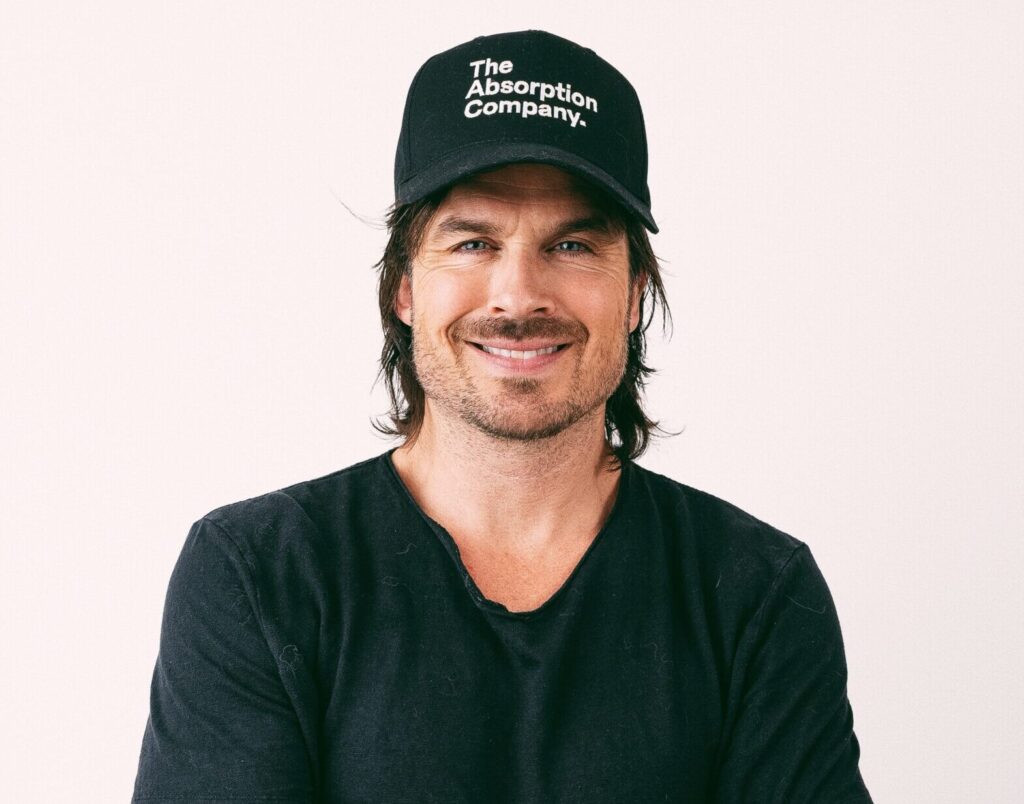
I recently interviewed award-winning actor Ian Somerhalder on my podcast, Thirty Minute Mentors. Here is a transcript of our interview:
Adam: Our guest today is an award-winning actor turned entrepreneur. Ian Somerhalder starred on The Vampire Diaries and on Lost and is the co-founder of the Absorption Company. Ian, thank you for joining us.
Ian: Thank you for having me. It’s an honor to be here, but congratulations. You’re really inspiring a lot of us out there with these really incredible conversations that you have.
Adam: I really appreciate that, and the honor is mine. You grew up in Covington, Louisiana, 40 miles away from New Orleans, but a world away from Hollywood. Can you take listeners back to those days, those early days? What early experiences and lessons shaped your worldview and shaped the trajectory of your success?
Ian: One of my greatest heroes is Malcolm Gladwell. I don’t get to read that much right now, but I listen to Outliers at least once or twice a year, every year, and I have since that book came out 15 or 17 years ago. Where and when you were born does make a difference. And I happened to be born in 1978, down deep, deep, deep South, not too far from New Orleans, on a bayou, and we were extremely poor. We danced with the poverty line my whole childhood. But what that gave me was that you didn’t really need much. You needed family, you needed culture, you needed some structure, but we had everything we needed. We lived off the marshes, and the land, and my mom’s family were Mississippi farmers, so we had everything we could possibly need.
And what I learned from that was, when you grow up somewhere like a Southeast marsh, there’s an incredible balance of nature. And what my parents taught me was when you take more than you give back, there’s an imbalance. Now, at the end of the day, not to sound too heady about it, or even negative, but the world will be okay. And so what I learned was, from my dad especially, spending time with my mom on the farm, my dad in the marsh. At the time, in the 80s, there was this campaign, Save the Lake. They were dredging Lake Pontchartrain, destroying it, killing it. So the ecosystem wasn’t even thriving. It was dead. And I remember as a kid thinking, why would they ever do that? Why would you destroy the one thing you have in your backyard, which is the world?
And I remember thinking everything was about Save the Lake. So, conversations my parents would have, everything was about a community coming together to stop big industry from destroying the one thing that gave them life. It wasn’t a matter of, oh, we’ll just go to the grocery store and get more. No, no. That is all we had. We depended on the bayous, the rivers, and the lakes. And my family shot all the ducks out of the sky, and we lived off venison and fresh beef and all the stuff that came from my grandparents’ farm, and the speckled trout, redfish, amberjack, tuna, the crawfish, the oysters. Everything came out of that water.
So it was a little hairy back then, and I saw what happened when a community got together. And I realized when people come together, things happen. So, segue into my mom. She got a severance check when Ronald Reagan decided to reappropriate funds and take out some of the mental health facilities in the US to save some money. One of them was shut down, which is the one my mom worked at. She got a $10,000 severance check from the government. We had never seen that kind of money ever. Because I was a kid who did theater and all these things, my mom spent all of that money, plus borrowed money from my Aunt Nancy, so I could get modeling and acting classes.
The foresight of this woman. She didn’t want me to have a ceiling to what I could do, so she spent every dollar we had on all these lessons and classes and stuff for me, and then putting me in this big convention. So you have to fly, hotels, and all this stuff. She’s a Mississippi farm girl. She didn’t have money to do all this, but she did it. And that connection paid off in spades, because I had the work ethic of a poor farmer boy, but the understanding and balance of real ecosystem biodiversity, then the balance and trade of that, where when you take too much, there’s too little, and you suffer.
And then getting into the fashion business, working with all the biggest people. I was the face of Versace when I was like 16, and spending time with all of those, the greatest art directors and photographers and designers and all the best chefs and sommeliers, winemakers and all this stuff. So as a young person, I was exposed to people who had an enormous amount of passion but also an enormous amount of success.
When you’re jet-setting around with Versace and stuff at a young age, you’ll learn a lot. And getting to Hollywood, having that work ethic, doing very well in a TV show like The Vampire Diaries, and then all of a sudden you have a massive global platform. I dropped out of high school. Well, I mean, I did everything through correspondence. Didn’t get a fancy degree in any school. But I realized, because shared experience bonds people, especially what I learned when you have a show that’s been seen by over a billion people, that I might not have fancy degrees, and I might not have a business degree, and I might not have all these things that typically allow you to do these things, but I could leverage entertainment value to create quantifiable global change.
And that is where I just set my sights and started to build a network of people and be fearless with steadfast conviction that I could do it. And that’s the thing, the audacity of life. Not to sound incendiary, but you have to be dumb enough to believe you can make enormous amounts of change. And by the way, make billions of dollars doing it, because at the end of the day, money talks, bullshit walks. If you can’t build successful businesses, then you don’t have a bunch of money to do things with. And that’s where I wanted to set my sights and just never stopped.
Adam: Ian, I love it, and you shared so much that I would love to dive into. When you spoke about your mom having this opportunity to take $10,000 and invest in herself, and instead, she chose to invest in you, you took that responsibility and did everything you possibly could with it. On the one hand, you had this incredible work ethic, but on the other hand, because of your background, you understood the importance of knowing your role within community, knowing your role within a team, within your organization, and in the industries that you worked in. Modeling, fashion, entertainment. You could enjoy success and have a big ego, and that ego can completely blow you up. But because you had the humility to understand that you can’t be successful without the people around you, it requires a community. My success relies on the success of those around me. That’s the big lesson that I took away. That’s the big lesson from Covington, Louisiana.
Ian: Yeah, Covington and Mandeville. Mandeville, Louisiana, too. Growing up on that lakefront, looking out over the water at New Orleans, seeing it twinkling in the distance. And I remember my mom was a huge fan of Anne Rice. She then became a massage therapist. I think Anne Rice was one of her clients. But I used to look out, and when I was really little, it was all about the vampires that were there. And it’s New Orleans, so it’s this very sort of mystique.
And I remember having this conversation with my mom. We were in some cool, fancy place once the show really exploded. And I used to say, you know, Mom, I remember you used to read all those, she was obsessed with Anne Rice. She used to read all these books because it was a really amazing escape. And she said, I know. We used to sit there and look out on the lakefront, and we would see the city twinkling in the distance. And I would say, Mom, they’re over there, hon. She would say, yeah.
And who knew that 20 years later I would end up starring in and really building out, arguably from a television perspective for sure, the single-handedly most powerful and successful vampire piece of IP in the world, been seen by 1.2 billion people. And you think about that, wow. Okay. So you just do a 10,000-foot view. It’s one in eight people in the world have somehow come in contact with this story, this piece of IP.
And so there’s a lot of authenticity there. And I built another brand on that. But then also, too, the health and wellness space for me is how I got through soaring a little bit above everyone as far as productivity. So when we were shooting The Vampire Diaries, I had this trainer. His name is Jance Footit. He trained Olympic strength training teams and stuff. And this guy was a disciple at the time of Charles Poliquin, which unfortunately Charles is no longer with us.
He pushed really hard. Pushed his body hard. We learned so much. And so I’ve been biohacking, really even prior to that. I started in 2007 or so in Venice, California, Gold’s Gym. And once I started shooting The Vampire Diaries in 2009, I got hooked up with the biohacking, sort of integrated medical community. All the guys that were working with Falcons and the Hawks and everyone down in Atlanta, and Jance taught me all this amazing stuff.
I used to pack transdermal B12 under my neck into my carotid artery, because if you think about it, there’s so little tissue for that to travel into, it goes immediately into your artery, and it’s pumped around your body. And I would take a nap with that every five minutes, if I could, on set. So 4 a.m. hit,s and everyone’s dragging, and I’m like this.
And I learned just that we’re small little biochemical reactors. And it’s just a series of biochemical reactions that get us through our day. Now, you can be predisposed to all sorts of things, but if you’re giving your body the natural necessary nutrients or things throughout your day, then you can really overachieve or feel good. Have energy. The two things that we need in life. You want to have energy, and you want to feel good.
Because out in society, not to sound too cerebral or again negative about it, but I think we all have access to a tremendous amount of data. There are some formidable societal issues happening right now, but when we peel it all back, our bodies are only as good as what we’re putting into it. So increase your input, increase your output. At the end of the day, it’s what we’re putting into our bodies. And if our bodies are toxic, our brains are toxic. If the system is so toxic and our bodies are so toxic that we’re not absorbing our nutrients, well, I’m a poor kid. I can’t imagine my mom working three jobs to buy supplements that don’t work. That didn’t sit right with Nikki and I and our team.
And so I’m fed up with it. I’m tired of, in an unregulated industry, parents like my mom spending money on things that don’t work. And we just said, no more. We’re putting a stop to it.
Adam: It’s an important point, because there is a ton of information out there, and there’s a ton of information out there that can help us get better. But the challenge becomes, what do we do in a world where there is so much information? And oftentimes what happens is, because there’s so much information out there, we do nothing, and the perfect becomes the enemy of the good. And oftentimes the most important thing to do is just get started, do something, figure out what tangible step can I take today, just to get going one step at a time.
Ian: To your point, years ago, I started a foundation, the Ian Somerhalder Foundation. And it wasn’t like a vanity label. I think you know that. I mean business. So it was never about starting this. I had witnessed the Gulf oil spill firsthand. I realized there was a lot of information that wasn’t right, and people weren’t getting the right information, and I realized I wanted to become a voice and amplify the voices that weren’t heard.
And we did it. It was an unbelievable experience. I ran it for 10 years, and at one point we were in like 180 countries. But running a public nonprofit, it’s so legally prohibitive, just because it’s such a litigious side of society, just by virtue of the fact people have done a lot of bad personal things with public money.
And so I realized, if you really want to change the world, don’t start a nonprofit. Start a for-profit that feeds all of that necessary nonprofit initiatives and meets those capital costs. People get very mad at me when I say that, when I break it down for them.
And what I learned was, we did this program, and I think we spent like a million dollars on this thing, 1,100 interviews around the world, because youth education was the biggest thing for me. Because I had access to so many young people at that time when The Vampire Diaries was first starting. Our youth is our greatest untapped natural resource. If we don’t teach them, we are legitimately screwed.
And so we just wanted to find out, what made people tick? Young people. Kids that weren’t already having all the filters that you and I have from just decades of being out in the world. And we wanted to distill it down to just a few really core pillars.
And one of the things we realized when we asked kids, what is it that makes you tick? What is the thing that makes the sun come up and go down like two or three times before you ever even knew time had elapsed? Is it a computer terminal? Is it a shovel? Is it a scalpel? Is it building blocks? Is it a telescope, a microscope? What is that thing?
And what we realized was there’s one really common thread in humanity, and it ties into this one thing that is really missing in society, and it’s a core pillar of society. Because if society is a direct reflection of parenting, clearly we’ve been doing it wrong for years. To all those parents out there, I mean, I am one. We all work so hard to be good parents. No one’s perfect. But I think as a macro perspective, we have some serious work to do.
But what we found was the world is lacking, society’s lacking, this one thing. But it was this one thing that we all searched for our whole lives, whether you’re six or 66 or 96. And yet no one talked about it in school. No one talked about it at the job site or in the office around the water cooler. It wasn’t taught by college professors. But it was this one silly little word, and it was the one word that could set you free. And I think it’s the most important word in any language, obviously other than love, because that’s the most important.
But that word was purpose. We don’t talk about purpose enough, because that’s what really drives us all. But there’s no formula for purpose. There’s no equation people taught us. What we distilled it down to was that the formula for purpose was just when you marry skill with passion. If you just bring together the things you’re good at with the things you love, then you find purpose. And then boom, it’s like your whole world opens up to you.
And it was this giant aha moment. And being able to share that with young people around the world, and on a corporate level as well, that was the greatest unlock ever. To give people the equation for finding purpose. Because if you think about anything that’s purpose-driven, it moves the needle farther and faster. Whether it’s a purpose-driven organization, a human, a company, a government. Well, there aren’t many super purpose-driven governments. But you see this exponential trajectory that’s much faster and moves the needle higher.
Adam: I wasn’t 100% sure where you were going to go, and I thought this could go one of two directions. Either you were going to say the word that I’m thinking of, or you were going to say a different word, and I was going to have to tell you the word that I think it is, and that’s going to shift things a little bit. And the word that I wrote down, purpose, could not agree with you more. There are so many different ways that anyone can make impact. You don’t need to start a nonprofit to make impact. You don’t need to work for a nonprofit to make impact. You can start a business to make impact, but you don’t even need to start a business to make impact. It ultimately comes down to making impact. And this is something that I spoke to your wife about earlier. It’s something that I share with audiences all the time. There are three things that you have to do when you’re trying to figure out what you want to do with your life. Number one, do something that you love. Number two, do something that you’re great at. Number three, do something that allows you to make a positive impact in the lives of others. And that is exactly what you shared, marrying skill with passion, the formula for purpose. I spoke to a friend of mine who is a couple of decades older than us, and he’s going strong. He’s in his late 60s, and he’s going hard. He looks great. He has a ton of energy, and he has no intention of retiring anytime soon. And I’m an inquisitive person, very curious, not going to surprise anyone. And one of the questions I asked him was, what’s your secret? What’s the secret to having so much energy in your late 60s, to continually waking up every day fired up? And he said that it ultimately comes down to having purpose. No matter what you’re doing, no matter how old you are, how young you are, when you’re waking up in the morning and you are fired up and excited and ready to get at it, that makes all the difference. That makes all the difference when it comes to your physical health, your mental health, your emotional health. That is the word. That’s the magic word.
Ian: That’s it. And you can build multinational, multibillion-dollar companies that serve the interests of society, not just a couple of shareholders. You want to give people the ability to feel good. Those schoolteachers that are busting their asses in classrooms, those bus drivers that are driving our kids and people around.
And you start seeing that, and you realize, wait a minute, we haven’t just changed five or 10 or 100 people’s lives. We’ve changed thousands of lives. And that’s the stuff that you get teary-eyed thinking about sometimes. You go, holy shit, we’re doing it.
So people come up to me all the time because they also think that I’m like this billionaire entrepreneur. They don’t realize I did really well in television, and then I really screwed up, and I lost it all. This is all public. I made a really bad choice in humans, where I used all the money I made from The Vampire Diaries to finance companies. Some of them worked. One of them really didn’t.
I was in my early 30s, lots of big ideas, and we had an amazing product. We revolutionized an industry in oil and gas and mining and border patrol, and safety. We had basically the most powerful LED light system in the world. We were the ones who designed it. It’s called Ecolink. You could connect one generator to 10 or 20 light towers. So, especially for oil and gas and border patrol and all these things, we were innovating like hell.
But I made a bunch of personal guarantees to a bank in Bakersfield, California. And there was embezzling from a top executive and our number one customer up in the Bakken Shale formation. He was stealing from us, not paying us, cannibalizing our equipment. And all of a sudden, I was just finishing The Vampire Diaries. I should have been able to stop working for five years and take a break and have kids. I get a call from my lawyer, my business manager, like, hey, you should be sitting down.
And I learned in that moment, when I was just exiting all of this and Nikki and I were ready to have a baby, that I was in an eight-figure hole that was really hard to swallow. So note to self, never make personal guarantees, no matter how well your company’s doing.
I don’t know if you remember in 2013 when oil went from like $100 a barrel to $27 a barrel in a couple of weeks. Yeah, that was us. But it destroyed us. My wife is such an unbelievable negotiator and gangster, but we sold houses, paintings, watches, cars, you name it. And eight-figure holes were really hard to climb out of, but we did it, and I learned a lot.
It almost killed me. Hypertension, blood clots, pre-cardiac arrest, all sorts of crazy shit. Hospital four times in two years. But I learned, and it made me such a better businessperson.
And one of my great business mentors, this guy, Lyndon Lee, my wife was very resourceful and brought all the great businesspeople we knew in our lives to figure out what was the right way out of this. And when we had just gotten out of it, I had just signed this huge check to the bank. It was so painful. And he said, now that you can take a break, take a breath, now you’ve got to go work.
And by the way, I figured out a way to pay it all back, regenerate all that cash. Figured it out. And then COVID hit, so I couldn’t travel and go make all that money back.
But Lyndon said, mate, you know what’s so funny about business? He goes, it’s not what you see, it’s what you don’t see. What’s really under the hood? What are the core foundational components of this business, and how are they running? And what’s that house of cards built on? Who are those people?
And that’s the thing. People come up to me because they think I’m some zillionaire entrepreneur, and they always ask, how do they start a business? What do they do? What do they do? Team. No one can stress that enough. And every billionaire or successful entrepreneur or business owner or executive will tell you, your team, the people you have around you, are everything.
And that was a big wake-up call. It almost killed me. It didn’t. We got to build these incredibly beautiful, successful businesses, and the rest is history. But I’ll tell you, man, it has not come without some pain points. Almost dying in your living room from a near heart attack at 39 is really not ideal.
Adam: Talk about highs and lows, and we all experience highs and lows in our lives, but those are extreme highs and extreme lows. And you were able to navigate them and come out on the other side. And I would love to know if you could share with anyone listening, how can anyone, regardless of where they are, regardless of what they’re experiencing, navigate the highs and lows and ups and downs and failures and setbacks that they face in their lives and in their careers?
Ian: Couple core pillars in that, too. One of them is it’s an insurmountable job to pull ourselves out of these things, because there’s so much information and it’s so easy to get sucked in. The great thing is there’s so much information out there. Now you can ask ChatGPT a million ways to figure something out.
But one of the big core pillars is, and this is going to sound more cerebral, but in practice, it’s absolutely imperative, be stronger than your excuses. Because motivation and inspiration are fleeting, right? But discipline is what carries you through when those are gone.
So it’s getting up in the morning, getting that workout in, getting a routine set where your body and your cortisol are balanced enough. And sometimes it’s hard because you’re just running, running. Once you can balance your body and your system and your cortisol and your brain function, you’re actually able to take a lot of hits and then take a step back.
Whiteboard it out. Get a whiteboard on Amazon or just a piece of paper or take a wall and write it out. What are the things plaguing me right now? Let’s look at what’s actually putting the pressure. Where’s the pressure? Let’s find the valve. And then let’s make a great strategy of how to fix these things so I can get on the path that I want.
You can always reverse engineer it. You can say, what’s plaguing me now? Or you say, what is it that I want? A lot of people just want to be healthy and happy. They want to feel good. They want to live a good, decent life.
Once you do whiteboard that out, finances are always number one. Finances and health, and then people around you. You start realizing that once you lay it out in front of you, it’s not as scary. So you can start to put things in columns. And just like you said, it’s one step at a time. You just take the first step.
Today is the day I’m going to improve my overall health, because that’s going to improve my well-being and my ability to focus and work. I’m going to improve the people around me. And then I’m going to look and see where my pain points are or what the big obstacles are, because the only way around it is through it.
What are my goals in life? What do I want? There are people that say, oh, I can’t do that, I can’t afford it. And then there are other people that go, I’m going to figure out how to get that. I’m going to figure my way around. I’m getting that. I’m going to do it.
It’s not like I want caviar every morning with my eggs. No, the real shit. I want this life. Write it down. Write it down. I cannot stress that enough.
And once you do that, it’s a pressure valve. Relieve the pressure so that you can actually start to focus. Sleep, exercise, and diet are everything. Sometimes people go, well, I can’t do this. I’ve got three kids. I’ve got three jobs. And I’m like, I totally hear you. I get it. Oh my God, that must be super intense. I got you. But so do I.
And I grind myself to the bone. And I’ll tell you, the first thing I do is, like every other animal in the world, from that 6 or 7 a.m. to 9 or 10 a.m., I get my face in the sun. I get that natural red light, and I start my body up. And if that red light’s not around, I use a red light. Stop making excuses. Figure it out.
I wanted things when I was young. My mom said, okay, well, I don’t have money to do that. So we used to go after my soccer games. We realized people threw away so many cans after a soccer game. So we would wait until after everyone was done with the soccer park, and my mom would park in the trees because I didn’t want anyone seeing me out there. And we’d get trash bags, and we’d run out, and we’d take all the cans. We’d load them up in the back of the car, and then I would go and I’d turn them in. I’d get the bottles and the cans, and I’d get some cash, and I could get that thing I needed.
And she said, see what I mean? Just figure a way around it. The only way around it is through it. So there’s a million options out there. You can pick up any extra job. And you know that it’s full of purpose. Doesn’t matter if you’re driving an Uber, if you’re pouring coffee, whatever you’ve got to do, you just do it. And you don’t have any ego about it. And you know that it is that purpose that’s driving you, and that’s the way to go.
Those core foundational pillars build up your body and your mind, because that’s your first pillar. Without that working, nothing works. Set those goals. Identify your pain points. Identify what that pressure is, and then write it down.
And then just start listening. Find all those people that inspire you. Start listening to podcasts like this. Start listening to the people that inspire you. How did they do it? Shit, if they could do it, I can do it. I’ll do anything I need to.
But most people did not come from what you’re seeing them as. Talk to a guy like Mark Cuban or Tim Armstrong. It wasn’t into the Verizon IPO where they weren’t buying beans and rice. It’s the investment, but it’s the belief that something is going to work and constantly building it, constantly building it, constantly building it with the right people.
So there is this misconception that people who are successful were that way their whole lives. Simply not the truth. And so that, if anything, is so inspiring to people. They go, okay, yeah, I got this. All right. It’s the one step.
Adam: Ian, what do you believe are the key characteristics of the very best leaders, and what can anyone do to become a better leader?
Ian: Compassion, kindness, grit, and inspiration. People need structure. They need to be inspired. They need to feel a part of a team.
And I think what happens is, because a lot of people are overrun and tired, they’re not their best selves when they’re in a position of power. But if you really want to lead, the greatest leaders in the world are the ones that set their ego aside. Because by the way, you’re already boss.
Finding compassion for those that work with you or for you. I never say anyone works for me. I always say they work with me. It changes the literal cellular makeup of someone when they are empowered by a compassionate, kind leader who can lead with enough structure and enough grit where you know that you are in the trenches with this person.
That is the mark of a leader. Being fearless, being brave, but being compassionate. And those are the leaders you want to be around. Those are the people that will follow you to the ends of the earth.
You can build anything with that, because again, instilling purpose in someone, for whatever sector of business that you’re in. And you have some companies that have retention of people for 20, 30, 40 years. And you have companies that are very transient, people coming in and out.
There’s a big workforce headwind for people right now trying to run companies, because post-COVID people had this redirection of energy where they really want to experience more. They don’t want to work as hard or as much. But when you can find that purpose point for someone, whether you’re working at a coffee shop with an owner but you really want to be an engineer or something, seeing that person and helping them on their path, but executing what you need to do with that business first, is huge.
Now you can’t do that when you’ve got 1,000 employees, 1,000 people under you. But when they know that you’re working even harder than they are, or maybe they’re working harder than you are, but you are so grateful for what they are doing, and you are on that team with them, they wake up every morning feeling really good about what they do.
And that compassion, that thing where someone goes home at night exhausted and goes home to their kids or their family or back to their tiny studio or apartment, or even their parents’ basement, which there’s no problem, hey, it’s all about reassessing, redefining, regrouping. Hell, we’ve all done it.
Coming off one of the biggest TV shows in the world, thinking, man, that CEO, he really cares about us, or she, or man, my boss really went to the mat for me today. I owe it to them, myself, to get up tomorrow, stop complaining, and just bust my ass with a smile on my face.
Now this is a different person when they know that they’re part of a team. It’s very easy to show up at a job and just get through it. It’s a different thing to walk into that business under different leadership.
Where you walk in and they go, hey, we’re doing this. What can I do for you? We got this. It’s unbelievable. It’s unbelievable, just that one shift that a leader or a boss or a CEO or an exec chair or whoever makes, where we’re going to lead with kindness and compassion but grit and purpose.
Innovate. Constantly innovating. The old adage of Larry Ellison, you’ll never be successful in business doing the same thing everyone else is doing. It’s like physics. What can you do differently? You innovate. You come at it with real grit, but compassion and kindness for the people around you. It’s the only way to do it.
Adam: Ian, what can anyone listening to this conversation do to become more successful, personally and professionally?
Ian: Take the first step. Identify the things you love. Identify the things you’re good at. In the quiet moments when you’re brushing your teeth at night, or when your head hits the pillow, or when you wake up in the morning.
What are those things that you love? What are those things that you’re good at? You can get access to find that purpose, even if you’ve got to do something first. Start that and take that first step.
Get out of bed early in the morning before everyone else does if you have to. Go on that walk. Do that workout. Stretch. Breathe. Whatever you can do.
Whether you are in a tiny studio apartment or in a mansion, just take the first step. Cut out the sugars, the chemicals, all the things that aren’t natural going into your body, and just start.
Here’s what I’m going to do. I love this. I’m good at this. I’m going to bring them together. I’m going to find the network of people in my community or globally that do this thing, and I’m going to start listening to them. I’m going to start researching. I’m going to start figuring out how they did it. I’m going to do it a little differently.
I’m going to do this with every breath I’ve got, even though I’ve got to balance school or work and kids or this or that. I’m doing it. It’s the first step.
Identify what you want, and then take the first step to get it. Because at the end of the day, it’s so easy for us to go, oh, I can’t do that thing. I’m just going to sit here, and doom scroll on my couch and poor me. No.
And I’m telling you, man, anyone hearing this or listening to this, you’re inspired by this. You take that first step. You make a plan. Pivot when you need to, but stay focused on that goal.
And what’s the great Prefontaine quote? To give anything less than your best is to sacrifice the gift. Quitters never win and winners never quit. It’s really that simple.
Adam: Thank you for all the great advice, and thank you for being a part of Thirty Minute Mentors.
Ian: Thank you, brother. And it’s that thing, when you inspire people, you need story, you need quality and authenticity. But when you can inspire someone with your story or your product, people say, well, what should I make? Make something that enhances someone’s life. How do I help you live a better life? What can you buy from me that makes your life better?
And nine times out of 10, people go, oh, well, I got this thing. And then you run into them a couple years later, and you go, hey, I’ve been seeing this thing you’re doing. Yeah, man, dude, it’s working. I’m loving this. I mean, it’s hard, it’s really hard, but we just raised a Series A at this valuation. You’re like, holy shit, you did it. You built this out of your parents’ garage, man, and that’s it.
So thank you for allowing me to be on this exceptional forum of speaking and listening to some of the people that you have here, sharing their story. I’ve listened to them and been inspired, and it helps me push through, always just being stronger than my excuses, because it’s easy to let them get to you. So thank you, brother.
Adam: Hey, I appreciate it, and thank you for inspiring. Thank you for the words of wisdom. Thank you again for all the great advice and for being a part of Thirty Minute Mentors.