


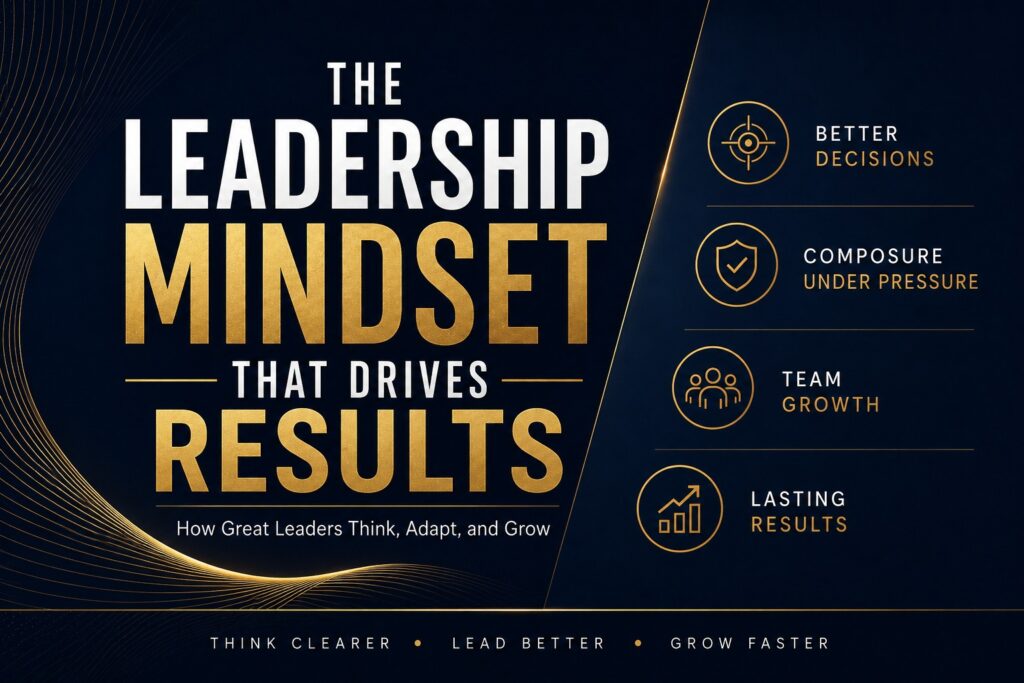
A leadership mindset shapes how you make decisions, handle pressure, and bring out the best in a team. It often does more to determine your results than any single skill on your resume. Two leaders with the same experience and the same resources can face the same problem and reach very different outcomes. How each of them thinks is usually the reason.
The research supports this. Work led by Stanford psychologist Carol Dweck found that employees at growth-mindset companies were more likely to trust their colleagues, feel committed to the organization, and say their workplace supported risk-taking and innovation than employees at fixed-mindset companies. How a leader thinks does not stay in their own head. It sets the standard for how an entire team operates, which is why building the right mindset is one of the most important things any leader can work on.
What Is a Leadership Mindset?
A leadership mindset is the set of beliefs and mental habits that shape how a leader interprets situations, makes decisions, and responds to pressure. It determines whether a challenge reads as a threat or as a problem to work through, and it shapes how a team performs and how people feel about their work.
Those habits show up long before any decision gets made. A leadership mindset governs a handful of things that decide most outcomes:
- Decisions under uncertainty: whether you move on incomplete information or freeze, waiting for certainty that never comes.
- Response to setbacks: whether a failure becomes a lesson or a reason to protect yourself.
- How you treat people: whether you see a struggling team member as a liability or as someone with a next level to reach.
- What you model: the standard your team quietly copies, since people watch how you react far more than they listen to what you say.
None of this is fixed at birth. A leadership mindset is built through experience, reflection, and the willingness to change how you think when the evidence says you should.
Why a Leadership Mindset Outweighs Raw Skill
Skills get you into the room. Your mindset decides what you do once you are in it. Two people can hold the same title and the same technical ability, and the one who thinks better about problems, people, and pressure will pull ahead over time.
This gap tends to open up right after a promotion. The behaviors that earn someone a leadership role often include personal output, technical mastery, and being the smartest person on the task. Those are not always the behaviors that succeed in the seat. A strong leader mindset makes that switch possible, moving you from doing the work yourself to getting results through other people. The skill that got you promoted becomes the smaller part of the job, and how you think becomes the larger one. Understanding this shift is a big part of becoming a better leader.
| Skill set | Mindset |
| What you can do | How you think about what you do |
| Built through training, practice, and repetition | Built through reflection, feedback, and deliberate reframing |
| Shows in routine execution | Shows under pressure and ambiguity |
| Caps at your competence | Determines whether that competence gets used well |
| Can be taught directly | Can be built over time through experience and feedback |
Skills make you capable. A leadership mindset determines whether that capability produces anything worth having.
Want this way of thinking built into your leadership team? Bring Adam in to speak at your next event.
Bring Adam to Your Next EventThe Mindset Shifts That Separate Strong Leaders
The difference between good leaders and the rest often comes down to a few mental shifts. These are the mindset shifts that matter most when the pressure is real and the answer is not obvious.
From having the answers to asking better questions
Early in a career, value comes from knowing things. In a leadership role, that instinct can quietly cap a team, because a leader who supplies every answer stops the people around them from thinking. The stronger move is to ask the question that helps the team find a better answer than you would have reached alone. The goal is a group that solves problems whether or not you are in the room.
From proving yourself to developing others
A leader focused on looking capable spends energy defending their own standing. A leader focused outward spends it building the people around them. That switch, from protecting your own reputation to growing the next person, is where teams start to improve faster. Your win stops being the credit you collect and becomes the capability you leave behind.
From avoiding hard problems to moving toward them
Most people are wired to steer around discomfort. Strong leaders do the opposite. They treat the hard conversation, missed target, or uncomfortable truth as the thing to handle first. Problems left alone rarely shrink. This connects directly to how the best leaders think about risk: they read a difficult situation as information to act on rather than a threat to survive.
From reacting to responding
Pressure pulls a fast, emotional answer out of most of us. The habit that separates strong leaders is the pause between the trigger and the response. That is the space where you choose how to act instead of firing off the first thing you feel. A team reads that composure and borrows it. Steadiness at the top becomes steadiness down the line.
From chasing quick wins to compounding decisions
A short-term mindset optimizes for the win this quarter, even when it costs more later. A leader who thinks in compounding terms weighs the second and third consequences of a choice, not just the immediate payoff. The same discipline shows up in how elite performers operate. What Olympians do after they lose is a study in playing the long game: absorb the setback, extract the lesson, and keep building.
Growth Mindset vs Fixed Mindset in Leadership
A growth mindset in leadership is the belief that ability, in yourself and in your people, can be developed through effort and learning. A fixed mindset treats talent as a set quantity you either have or you don’t. The distinction comes from Carol Dweck’s research, and in a leadership role it changes almost everything about how you handle feedback, failure, and the potential of the people you lead.
The tell is in the everyday moments, not the mission statement.
| Situation | Fixed-mindset leader | Growth-mindset leader |
| Gets hard feedback | Defends or deflects | Asks a follow-up question |
| A team member struggles | Writes them off | Looks for what could help them improve |
| Faces a setback | Protects their reputation | Finds the lesson and moves forward |
| Sees a rival succeed | Feels threatened | Studies what worked |
Here is where most leaders lose ground. Almost everyone will say they believe in growth. Far fewer act like it when a project fails or someone challenges them in a meeting. Growth mindset leadership is not what you claim in calm moments. It is what you do in the tense ones, and closing the gap between the two is most of the work.
That gap is one of the issues I often focus on with leadership teams.
“Adam did a wonderful job guiding our team through leadership training. He was personable, knowledgeable, and easily facilitated discussion among our group. Adam has built valuable insights and expertise through interviewing top leaders across several industries. Would definitely recommend him to other teams!”
— Juliana Balich, Threat Intelligence Analysis Lead, Google
Give your team a session designed to be practical and actionable. See how I work with organizations.
See How I Work with OrganizationsHow to Develop a Leadership Mindset
You develop a leadership mindset the same way you build any habit: through deliberate practice, honest feedback, and repetition until the better response becomes the automatic one. These five steps give you a place to start.
1. Name your default under pressure: Notice how you react when a plan breaks. Do you blame, freeze, control, or withdraw? You cannot change a pattern you have not named. A structured leadership assessment, or even a simple feedback process, can show you where you actually stand rather than where you assume you do.
2. Reframe problems as decisions: A problem feels like something happening to you. A decision is something you get to make. That shift moves you from stuck to active, and it changes the quality of what you do next.
3. Ask for feedback you would rather not hear: Then act on one piece of it within the week. Feedback you file away and ignore does nothing. Feedback you use is how a mindset gets rebuilt.
4. Study how leaders you respect think: Not just what they decided, but the reasoning underneath it. The lesson is simple: tactics matter, but judgment is what carries a leader through pressure.
5. Build a reset habit: How you recover from a setback is your mindset in practice. Decide in advance how you will regroup after a hard day, so the recovery is a routine and not a wish.
What a Leadership Mindset Looks Like in Practice
The best way to understand a leadership mindset is to watch it operate in an ordinary moment. Leadership mindset examples rarely look dramatic from the outside. They look like small choices made under pressure.
A product launch slips its deadline. The fixed-mindset response is to find who to blame and protect the record. The growth-minded leader gathers the team, asks what the delay taught them, and adjusts the plan without turning it into a trial. The problem still exists, but the team stays intact and gets smarter.
A talented employee starts underperforming. One leader concludes they were overrated and quietly writes them off. Another gets curious about what changed, has a direct conversation, and often finds a fixable cause. That difference in thinking is also the difference in keeping a team engaged instead of watching good people drift.
This is why a strong mindset for leaders holds across settings. The person running a company, the officer leading a unit, and the athlete recovering from a loss are all doing the same thing: choosing a response instead of surrendering to a reaction. The context changes. The thinking does not.
Frequently Asked Questions
1. What is a leadership mindset?
A leadership mindset is the set of beliefs and mental habits that shape how a leader makes decisions, responds to pressure, and treats the people around them. It determines whether challenges read as threats or as problems to solve, and it shapes how a team performs and feels at work.
2. How do you develop a leadership mindset?
Developing a leadership mindset starts with naming your default reaction under pressure, then practicing reframing problems as decisions you get to make. It grows through feedback you act on, studying how leaders you respect think, and building a reliable way to recover from setbacks. It is a habit, not a trait.
3. What is the difference between a leadership mindset and a skill set?
A skill set is what a leader can do. A mindset is how a leader thinks about what to do. Skills get someone into the role, while mindset determines how well those skills get used under pressure. Skills can be trained directly, and a mindset is built through reflection and feedback over time.
4. What is a growth mindset in leadership?
A growth mindset in leadership is the belief that ability, in yourself and your team, can be developed through effort and learning. Leaders with it treat feedback as useful, setbacks as data, and other people’s potential as something to build rather than judge. The concept comes from psychologist Carol Dweck’s research.
5. Why is a leadership mindset important?
A leader’s mindset shapes the ceiling on performance. It drives the quality of decisions, the response to pressure, and the culture a team works in. Two leaders with the same skills and resources often get different results, and mindset is usually what separates them.
The Takeaway
A leadership mindset is built, and once built, it compounds. Every decision you reframe, every piece of hard feedback you use, and every setback you recover from cleanly makes the next one easier. The leaders who pull ahead are rarely the most gifted in the room. They are the ones who kept working on how they think while everyone else worked only on what they know.
If you want to bring this work to your team, you can invite Adam to speak at your next event or start with an episode of Thirty Minute Mentors to hear how the best leaders actually think.