
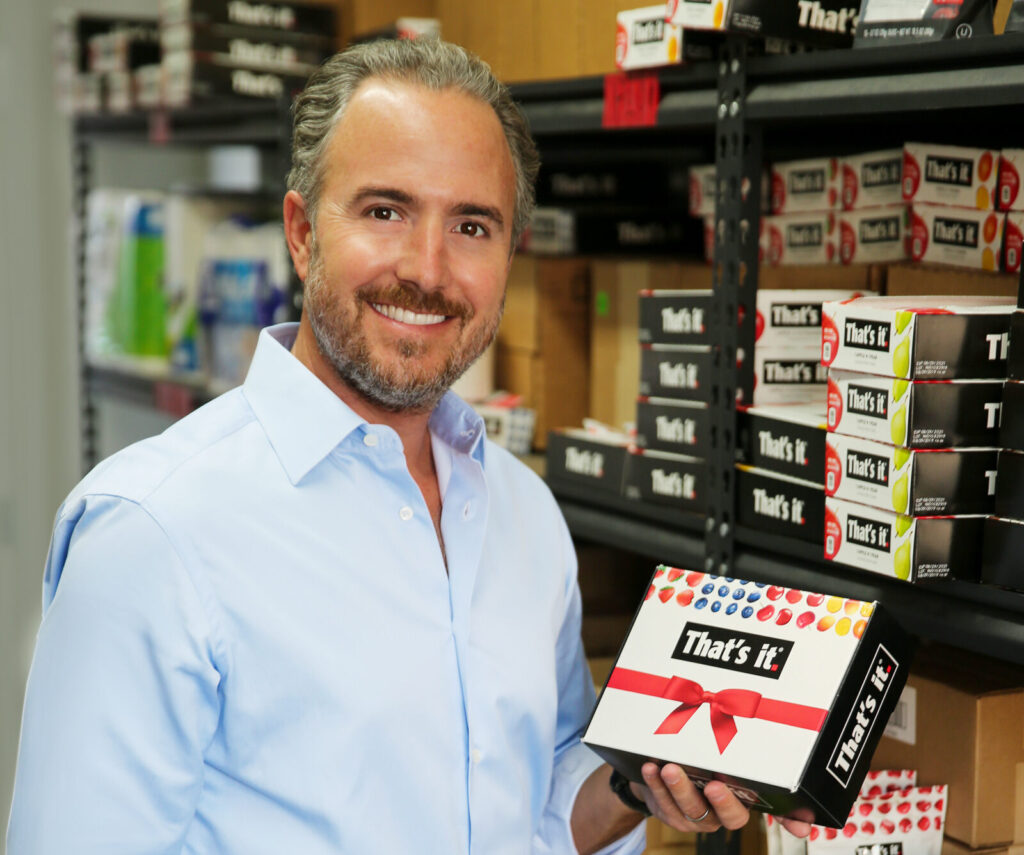
I recently went one-on-one with Dr. Lior Lewensztain, founder and CEO of That’s it.
Adam: Thanks again for taking the time to share your advice. First things first, though, I am sure readers would love to learn more about you. How did you get here? What experiences, failures, setbacks, or challenges have been most instrumental to your growth?
Lior: Thank you for having me. My journey has been shaped by a few major pivots. I was originally on the path to becoming a doctor, but during medical school, I came across a statistic that stopped me in my tracks: only about one-third of Americans were getting their daily servings of fruit. Today, that number is closer to just one in ten. It completely reframed how I thought about health. Food is the most fundamental form of preventative medicine, yet back in 2012, almost no one was talking about it that way. I started asking myself, what if we could improve people’s health earlier, simply by changing what they eat every day?
I made the decision to leave clinical medicine and earn my MBA, with the goal of creating a solution that was both simple and accessible. I launched That’s it. from the ground up, selling fruit bars at local farmers’ markets in Los Angeles. One of the biggest challenges was breaking into an already crowded and competitive nutrition bar market, and convincing people that a bar made with just two kinds of fruit could be a scalable business. There were plenty of obstacles along the way, but staying disciplined in our mission to keep things simple has become one of our greatest strengths. That focus continues to drive us forward today, beyond fruit bars and into functional areas like our Organic Energy Bars, Probiotic Fruit Bars, Organic Dark Chocolate Truffles, and our newest toddler snack, Organic Fruit Crunchables. It was never my intention to just sell fruit bars. From day one, the vision has been to build a full snacking platform in multiple formats – all of it fruit-forward, with five ingredients or less. We’re creating these formats to make getting daily fruit servings easier, more convenient, and delicious for all ages and lifestyles, and we continue to innovate.
Adam: How did you come up with your business idea? What advice do you have for others on how to come up with great ideas?
Lior: The idea came from connecting two simple dots: people need more fruit, and there wasn’t a single snack on the market that delivered it in a real, honest way. Most “fruit snacks” don’t contain any real, whole fruit. They’re made with juices, purees, and added sugars, many containing artificial colors, dyes, and flavors. The bar category isn’t much better – most bars have the nutritional profile of a candy bar once you look at the amount of added sugar.
So, we created the simplest solution: bars made with just two ingredients – fruit + fruit. That’s it.
For anyone looking to come up with a great idea, I’d say to look for the gaps. Find a fundamental need that isn’t being met simply or effectively. Don’t just chase trends or what’s popular in the moment. Look for a problem that genuinely frustrates or inspires you to find a better solution, because that’s the kind of problem you’ll stay motivated to solve over the long run.
Adam: How did you know your business idea was worth pursuing? What advice do you have on how to best test a business idea?
Lior: I knew the idea had legs when we started sampling the product at farmers markets and people kept coming back for more and often bringing friends with them. It wasn’t a flashy big budget launch or advertising campaign; it was grassroots validation. When people try something, love it, and then go out of their way to come back and share it with others, that’s a strong sign you’re onto something meaningful.
If you’re testing an idea, resist the urge to overbuild. Start small. Create the simplest version of your product or service and get it in front of real people as quickly as possible. Spreadsheets and projections can only take you so far. It’s real feedback from real people that shows you what works and what doesn’t. That’s how you build something that actually matters.
Adam: What are the key steps you have taken to grow your business? What advice do you have for others on how to take their businesses to the next level?
Lior: Growth has come from a few deliberate steps; staying true to our core values of simplicity and ingredient integrity, listening to our consumers and letting that guide product innovation, scaling distribution carefully (from farmers markets to now 82,000 retail doors across the country), and building a strong team that is fully aligned with our mission and committed to delivering on it every day.
My advice for anyone looking to take their business to the next level is to avoid growing just for growth’s sake. Know exactly what your brand stands for and use that as your filter for every decision. Don’t chase every opportunity. Focus on the strategic ones that build long-term trust with your customers and strengthen your mission.
Adam: What are your best sales and marketing tips?
Lior: Let your product do the talking. For us, sampling has been the most powerful sales tool–we’re on track to sample 10 million new consumers this year. There’s no substitute for giving people a chance to experience your product firsthand.
Focus on authenticity. Consumers are smarter than ever, and they gravitate toward brands that are transparent and consistent.
Prioritize repeat purchase, not just trial. It’s relatively easy to get someone to try something once, it’s much harder to keep them coming back.
Adam: In your experience, what are the defining qualities of an effective leader? How can leaders and aspiring leaders take their leadership skills to the next level?
Lior: Effective leadership requires clarity, resilience, and composure. As a founder, people look to you for vision, but just as importantly, they look to you for steadiness when challenges arise. Staying calm and not getting caught up in the small stuff keeps the team focused on what truly drives progress.
To take your leadership to the next level, build a team with diverse skill sets and perspectives. Combine specialists who excel in their areas with well-rounded leaders who can work cross-functionally and connect broader strategic goals. That mix creates an environment where the best ideas emerge and complex challenges are solved effectively. It also frees you to stay focused on the bigger picture and identify opportunities others might not see.
Adam: What is your best advice on building, leading, and managing teams?
Lior: Hire for alignment, not just experience. Skills can be developed over time, and with technology evolving faster than ever, everyone needs to keep leveling up their skill set anyway. But being mission-driven is different; you’re either bought in or you’re not. That shared commitment creates a strong foundation for teamwork and progress.
When you’re scaling a fast-growing company, it’s important to stay hands-on, even as you focus on big-picture growth. Getting your hands dirty on a regular basis shows the team that this mentality starts at the top, and it keeps everyone motivated to roll up their sleeves and move forward together.
Adam: What are your three best tips applicable to entrepreneurs, executives, and civic leaders?
Simplicity scales. Whether it’s your product, your service, or your mission, clarity is everything. If people don’t immediately understand what you do and why it matters, it’s nearly impossible to build momentum. The simpler your value proposition, the easier it is for consumers to adopt it and for your team to rally behind it.
Stay close to your consumer. Listen to your customers, track market trends, and stay connected to your team. But remember, the consumer is the ultimate decision-maker. Time and again, we’ve seen that great customer service turns critics into brand champions. Listening to and responding to consumer needs builds trust in a way no marketing campaign ever could.
Embrace adaptability. Markets move fast, and if you can’t pivot, you’ll get left behind. During COVID, shopping behaviors changed overnight as consumers shifted to digital channels. Because we were nimble and willing to evolve quickly, we captured market share that larger, slower-moving brands couldn’t. In 2025 and beyond, adaptability isn’t optional–it’s a requirement for survival and growth.
Adam: What is the single best piece of advice you have ever received?
Lior: One of the best pieces of advice I’ve ever received wasn’t directly given to me, but it’s something Kobe Bryant said that has always stuck with me: “Rest at the end, not in the middle.” As an entrepreneur, there are days when you feel tired, discouraged, or overwhelmed, and it’s tempting to slow down. But that mindset of always pushing forward, continuing to improve, and never settling until the job is done has guided me and our team. It reminds me that real progress is built together, one step at a time.
When we started That’s it. with a simple two-ingredient fruit bar at LA farmers markets, no one could have predicted that 13 years later we’d be delivering over 200 million servings of fruit to Americans in a single year, but that’s exactly what happened in 2024. Staying the course, even when it wasn’t easy, is what got us here. And we’re just getting started.
Adam: Is there anything else you would like to share?
Lior: I’ve always believed that simplicity, when done well, is transformative–especially when it comes to what we eat. At That’s it., our mission has always been to take something as fundamental as fruit and make it simple, accessible, and enjoyable. In a world where food has become increasingly complicated with artificial dyes, colors, and ultra-processed ingredients, it’s validating to see the industry finally moving in a direction that prioritizes real, whole foods.
Brands like Apple, Nike, and Tesla have shown the power of simplicity in their industries, taking something complex and distilling it into a clear, powerful offering that people instantly understand and trust. The early days are hard, and the middle is often even harder, but if you stay rooted in your purpose and solve a real problem with integrity, momentum will come.