
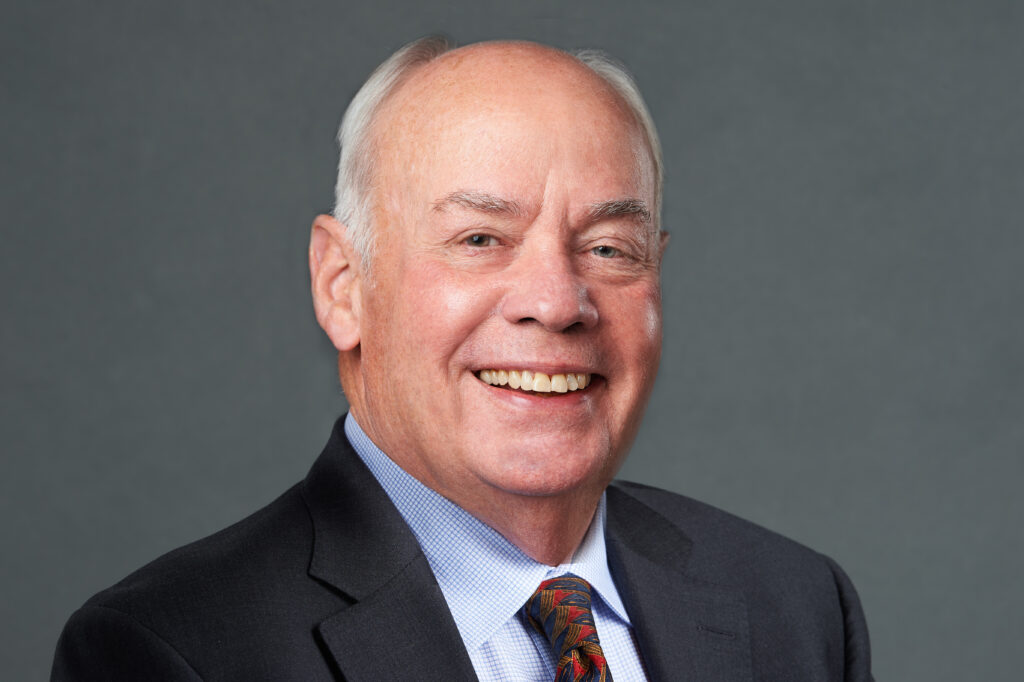
I recently caught up with Patrick MacLeamy, former CEO of HOK.
Adam: What sparked your interest in architecture and drove you to pursue a career in the field of architecture?
Patrick: Actually, it’s a good story. My grandfather. My grandfather was a carpenter, and he built houses for people. That’s how he made a living. And I was fascinated by everything he did, but especially fascinated by how he drew up house plans.
He had a homemade drafting board, and he literally drew house plans on his kitchen table with a homemade T-square and a four-block triangle, and he used thumb tacks to tack down the four corners of a piece of paper that he was drawing on. And I sat there and watched, and I begged my grandfather. We called him Pop Pop. Let me try it. Let me draw something.
And finally, he let me. Well, what do you want to draw? I want to draw a house plan. And I worship my grandfather. He did things, I learned many good lessons from him. He was a simple carpenter. I think his education stopped at about the eighth grade, but he was a great guy. And so he let me draw a house plan, and I was just electric. I was on fire.
And I finished it up, and I took the draft, the paper, after my grandfather was sitting in his chair. Well, grandfather, what do you think about this? He looked at it. He said, Well, I think you forgot the bathroom. So back to the drawing board.
But for a long time, as a youngster, I wanted to be a carpenter, because carpenters got to draw house plans. And only later did I learn that, oh, that’s something called an architect. And so I wanted to be an architect ever since I was a boy, little small boy, and I loved building things, and I loved making things, working with my hands.
So it was a natural thing for me to step into architecture. So there were a lot of my peers, a lot of people these days, go to high school and then university, don’t know what they want to do. I knew, and I never looked back. I went to university, got an architecture degree, and then had to find a job, and it was tough times.
Graduated in 1960, before a lot of people that you and I both know, before they were born. And I had grown up near St Louis, Missouri, on the Illinois side of the Mississippi River, in an industrial area filled with a lot of dirty, nasty industries, oil refining and steel mills and smelting plants, and what at the time was the largest glass bottle making plant in the world. Really big, noisy, nasty industry. And I wanted to go somewhere else.
But after university, I went looking for a job, and I went to the University of Illinois. That was the only state school that offered a degree in architecture. My imagination didn’t carry me to, well, I could go to another state. I went to the University of Illinois. In-state tuition, $500 per semester. That was affordable.
So when I got out of school, I did two things. I needed a job, and I went to Chicago, because that’s the nearest big city, and interviewed with a number of firms. I got a job offer from a firm that people that know architecture will know of, Skidmore, Owings and Merrill, SOM, and they had a very successful practice in Chicago. They were started in New York City. They’re now in a lot of different cities, like HOK, but not as large, but with a real specialty of designing high-rise buildings in the center of cities.
So I didn’t like the feel of the place. It was all very regimented. Every draftsman, this is before the computer, was at a desk that was all lined up in a grid. The ceiling was in a grid, and the tables were just below the grid of the ceiling. And it didn’t feel like it was the kind of place where I could be as inventive and curious as I wanted to be. So I continued to look, and I went to Boston.
Why Boston? Because the architecture magazines of 1960 and the 50s and so on were touting the architecture in Boston, which were the star architects of that day, people like Cambridge Seven and so on. So I drove to Boston. I had the car of choice for college kids, which was a Volkswagen Beetle.
I drove to Boston and interviewed there, and I got the same story. One firm said, Well, we can’t give you a job just yet, but if you’re willing to work as a free intern for a couple of years, maybe we can fit you in. Well, I needed to eat, so I needed a real job.
So long story short, a friend of mine that had graduated the year before at the University of Illinois went to work for this firm called HOK, which was one office, founded in St Louis, Missouri. Why St Louis? Why would that firm start there? George Helmuth was the founder. He was the only native St Louisan.
But all three founders went to this little very well-regarded school, Washington University, and over periods of circumstances, they all hooked up and became HOK. Gyo Obata, the O of HOK, was Japanese American. His journey was a little different than the two Georges, George Helmuth and George Kassabaum.
He grew up in Berkeley, California, across the bay from San Francisco. His father was a widely renowned painter and taught painting at the art school. And Gyo enrolled at Cal in September 1941 to study architecture. And in December 1941, the Japanese bombed Pearl Harbor, and World War Two started.
And one of the sad parts of our history is that the Japanese Americans, including Obata’s family, were rounded up and sent to detention camps, because if they lived in the western states, there was great fear that the Japanese that were living in those states would aid what was an expected Japanese invasion.
So Gyo escaped the camp. There was a provision in the law that if he was a full time student, he could continue his studies, but he had to change schools. He could no longer study at Cal or in Washington, Oregon or California. So as he put it, I started writing letters and sending telegrams to schools in the Midwest and the East to see if any would take me.
And the only one was little Washington University in St Louis. And actually, Washington University had several Japanese American students. Gyo was one of them that pursued study there. So that’s how Gyo got there.
Anyway, I came to St Louis. I didn’t really want to be in St Louis. I wanted to go out west someplace, but I needed a job, and I thought, well, it’s a good firm with a good reputation. I’ll work here a few years, take my license exam, and then I’ll go out west and start up my own firm and become rich and famous. That was kind of the master plan.
And HOK was different than other firms. The founders built the firm around the employees, not around themselves. Their idea was, and there’s a long story behind this if you’re interested, but it’s that the heart and soul of any architectural practice is the people.
Seems obvious when I say it out loud. And attracting and keeping good people and giving them a career at the firm is paramount. Well, how do you do that? Well, you have to have steady work.
That was where Helmuth came in. If you run out of work, you can’t just lay everybody off, because you’ll lose all the investment you’ve made in your people. So he became a full-time marketer for the firm, probably the first architect in the country to recognize the importance of marketing, that you need to cultivate clients and projects.
It takes years sometimes, so you have a steady flow of work to keep these people that you’ve hired and trained, keep them busy and let them grow up inside. So that happened to me when I joined HOK.
One office, St Louis, Missouri, and I didn’t particularly want to be in St Louis, but it was a wonderful place. I learned a ton about how to practice architecture. And two years later, I was transferred to a project office in Pittsburgh, Pennsylvania.
And one year after that, I was transferred to the first branch office, my lucky day, San Francisco, California,
I had never been west of Denver. I knew about San Francisco and LA. I knew about LA because I always watched the Rose Parade on New Year’s Day and found there are people in shirt sleeves there. What are they doing? I knew it was warm, and at the time it was good, but I wasn’t sure if it was LA or San Francisco that had that Golden Gate Bridge.
So, of course, I learned that. So we started a practice here. Basically, Gyo Obata said, You kicked me out of California once. I’m back, and I’m going to plant my HOK flag. And so we started an office with six people and scraped and scrounged for work, and eventually built it into, I think today the office is 250 people and works all over the world, not just in San Francisco.
So following the same principle of the three founders, we had a principal that did nothing but market, a principal that led design, and a principal that led putting the projects together and delivering the documents through to the contractor and through construction. And that formula has worked ever so well.
Now, when I stepped down, 50 years to the day after I started, HOK had 27 offices, about 2000 people, and the firm would accomplish or pursue work on 4000 projects a year in over 100 countries, every continent except Antarctica.
So that same idea about taking care of people, it’s a little bit like in the Renaissance. Renaissance had guilds, and you might be in a stonemasons guild or something. The guild would take care of the masons, the masons would take care of the clients. So it was very egalitarian kind of thinking.
You’re not just working for me or for us, we’re all working together. I’m the boss. I’m supporting you so that you can take care of clients. It’s an upside-down organization diagram. The bosses aren’t the boss really. They’re the servant, making sure that the people that work there have the tools they need, have the work they need, have the organizational structure that they need to be successful, and that they have a way to grow up inside the firm, to get better at what they do, and to grow up inside the firm and not have to leave to seek their fortune elsewhere.
That’s a long, rambling statement, but basically, I learned that by having this stop off at St Louis, where I didn’t really want to be, because I had grown up there. The only vestige of that is I’m still a Cardinals baseball fan, because if you grow up in that area, you can’t be anything but, and it’s still true today.
Adam: What were the keys to rising in your career? And what advice do you have for anyone in the field of architecture on how to rise within their careers?
Patrick: If you’re in any kind of a service business or even manufacturing, you have to make yourself useful. You have to be needed. And that means if somebody says, draw this up, you draw it up.
And if they say, I need it by Tuesday, you get it to them on Monday. If they say, I need two schemes, give them three. Because by pressing yourself to excel, you learn. And so I learned a lot about hustle as a young architect.
And then I got another great lesson that’s probably more important. Well, I don’t know. It’s equally important. Once I got to be well regarded in the firm, they gave me my own projects, and I started then needing assistance and helpers, younger people to help me draw things up or make a model, and so on.
And so, how do you manage people? Well, I got pretty well confused at the beginning about managing. Thought, well, management, oh, that means you sit behind a desk, and people come in and say hello, and you tell them what to do, and then they leave, and they do it.
And that management was about telling people what to do, knowing what to do, and telling people, okay, you do this and you do that, and giving them a schedule, do it by Tuesday, and do it by Wednesday. That kind of works in the army.
It doesn’t really work in architecture. People don’t like to work that way, especially if it’s a creative field or where you want somebody to grow. They’re not robots. They’re humans.
So I had to learn the difference between managing and leading, and it’s a huge difference. Leading is engaging with people. Instead of saying, you need to do this, what do you think we should do? How can we solve this? Draw people into it.
And it’s amazing. What I learned is, I have an idea that in order to solve a design problem or a detail of a building, we need to do this, that, and the other. And that’s kind of my conclusion. If you ask other people, they just might come up with a better idea. That surprised me.
Then it became routine. I could expect it. Young people, especially, who weren’t burdened by all this knowledge and this experience, this is the way to do things, they would come up with the better ideas that were fresh, that I hadn’t thought of.
So I began to understand that, oh, leading is what is really called for here, not managing. Managing, yes, you need to do certain things. You need to have a schedule for a project, and that’s a management function, to map out a schedule or a scope of work or a budget. But working with people is all about engaging people to bring out the best in people.
So it’s a bit like a football coach helping players become their best. How do you motivate players to trust that one move that they haven’t made that makes them one turn better as a player? And so helping people to learn and grow it’s a mentoring job. That’s called leading.
And if you do, the amazing thing is, people respond to it so positively. So what I learned is that you can build a real bond of trust with people, and they will, if they know that you regard them in this way, they won’t worship the ground you walk on, but they will go through the gates of hell for you if you need them to do something, because they’re so motivated, whereas just being a boss and telling people, you do this and you do that, there’s no bond there. It’s just following orders.
So I had to learn that. That was a huge thing, besides the hustle and how do you lead people? As I got further up into the organization, I first got to run my own projects. Then I was given the job to lead the much bigger office, 100 people.
How do you do that? That’s where I learned that the best leaders that I found as mentors were what I call servant leaders. They were the leaders that made sure that the office had what everybody needed to function properly.
We had work. We had a good work environment. If there was a troublemaker in the office, that project fell to me to correct the trouble, either by a quiet off to the side talk with the troublemaker, or in extreme cases, I’m sorry, but you have to leave. This doesn’t work.
I had to learn how to let people go, sometimes, very few times, but I always did it personally, not through the HR department. And we were always generous with letting people go. We always gave them extra severance, well beyond what tradition or the law would require, because they’re human beings, and they need a stake in the future.
We even helped them, if they wished, put their resume together and help them with taking the first step toward another job.
You don’t hear many firms talk about it like that, but the most wondrous things have happened. People that I let go, I didn’t really fire them, I just parted ways with them, came back afterwards to say, you know, I’ve grown up a lot since. I realized I was behaving like an idiot or a jerk, and what I remember most about it is your kindness.
And I’ll never, I learned a great lesson. I’ll never forget it. And some of those people we’ve even hired back.
George Kassabaum, the K of HOK, when I first met him as a young architect in St Louis, he asked me to tell him about myself. So I gave him my little story of growing up, my grandfather, and architecture school. He listened very intently.
And after I finished, he said, Well, welcome to HOK. If you want to be a success here, it’s up to you. If you want to make this a career, it’s up to you. If you decide you don’t like it here and you want to leave, it’s up to you.
If you want to come back, you’re welcome to come back once, one time.
And that struck me, because the door was open, but not a revolving door. You had to have the maturity to say, this is what I want. I want to be part of this firm, HOK, or I don’t, and you get one chance to mess with that.
So over the years, I’ve had numerous people, several dozen at least, that have left the firm, sometimes because they were in a huff. I didn’t get the job assignment I wanted, or I wanted to do this, and you told me to do that, or something else.
And they actually came back after a year or so, and became, in certain cases, some of our very best employees. So learning to work with people is an ongoing job, and it’s one that I never stopped learning.
Just one other piece. Working with clients, working with attorneys, working with accountants, working with people that had different skill sets to get contracts signed, negotiating a fee with a tough-as-nails client. That’s another whole thing, we could talk for an hour about that easily, but it’s something that I had to learn on the go.
I didn’t learn that at school. I had to learn those things by doing and by getting some mentoring. So I had some good mentors at HOK growing up in the firm.
I think architects, too often, as a profession, we let ourselves get walked all over by clients that know that we really need and want that job, and we’re willing to take a cut rate fee for it, and so on. And what I learned at HOK was, well, no.
If you really have value for your client, you have to meet your client in the middle, not having the client at the top and you at the bottom. You got to meet as colleagues.
The client needs something from you, the architect. Good design service, good advice. The best kind of architect-client relationship is one where the client trusts the architect and seeks the architect out for advice about not just how the building gets designed, but other parts of the client’s business.
Do we need a new building? Maybe not. Maybe you need to renovate the old one. Maybe you need to relocate a building. Maybe you need, in other words, it’s as if you’re talking to a friend instead of somebody who’s superior.
So too many architects, I think, go into a relationship with a client, not thinking about building a relationship, but just thinking about, I need to get through this and get a contract and get a job. So you put yourself in this subservient role instead of putting yourself in a position to actually befriend that client and become a trusted advisor to that client in the course of doing the work with that client.
And you do it for them, yes, and they pay you, yes. But if you do it properly, the client will gradually begin to, by properly I mean doing a damn good job, the client will begin to see the merit in what you’re doing.
And it’s not just how pretty the design is, but how well the building works. Most clients are fixated on only a few things. Most clients are fixated on, can I afford this building? Is it going to do the job of whatever it is that it’s intended to do?
If it’s an airport, will it serve as a proper airport? If it’s a hospital, can we heal people in it, and so on.
And less about the things that architects traditionally talk about. We tend to talk about superficialities, and from a client’s perspective, how pretty the building is is at the end. It’s not at the beginning.
So I’ve many times had interviews with clients before we got hired, and the firm before and after us is all full of themselves. We often meet in the lobby, coming and going. And they start out by saying, I’m John Jones, and my firm is the greatest, and let me show you our work.
Okay, well, that’s no big deal. We come in and say, I’m Patrick from HOK. Let’s talk about your project. I want to understand from you.
What are you looking for? What’s your goal? What kind of a project you want this to be, and how will it help your business or your entity be successful at whatever you’re doing?
Engaging with your client from the very first step is the first step in building a relationship, and that’s a step you take before you negotiate a successful fee.
Most architects miss that. They’re all about, look at the pretty buildings I’ve designed, and showing pictures. These days it’s PowerPoints. The old days, it was holding up sketches and drawings.
So being engaged with the other person works outside the firm, just like it works inside the firm. Instead of giving orders to people, I need to find out.
What do you think about this? How would you solve this? How would you make this building work in this location? How would you solve this detail problem of how the roof and the wall meet so that the water doesn’t come in when it rains?
And you’ll get further if you take that approach. You’re not selling yourself. You’re engaging with the other person.
And that, and it sounds, actually can I digress? I’m going to tell you a funny story, please, about my mother.
God love her. I was one of four boys, and I grew up in this industrial area. My father was a chemical engineer. That’s why we were there. He worked in an oil refinery.
From our front porch, we could see three different refineries, including the one where my dad worked.
Anyway, my mother, we all sat at the dining table for dinner every night. That was just the way it was. No TV trays.
We were going to have dinner together, and it was always conversation. My mother came home one night. We gathered for dinner, and my mother said, I’ve just had the most wonderful day.
I met the most wonderful woman. I just met her today, and I feel like we’re best friends.
And she went on about this woman for five or ten minutes. My father finally said, Well, what did you talk about?
My mother thought a minute, said, Well, actually, mostly about me, about herself.
That’s the secret to it. You need to engage the other person. And it’s not so much about me. It’s about you, the client, or you the other person, the engineer I’m talking with.
That’s, if I could bottle that, I could sell them like hot cakes. But it’s amazing how many people don’t get that and don’t practice that, and not only in architecture, but I think architects are particularly plagued with that.
It’s all about them and not about their clients. The clients are the ones that hire architects and pay the fees. The clients are the ones that own the building at the end of the day. The architect is like the midwife helping that building to become real. So you better find out what your client’s about if you want to have a good relationship, and if you want the client to appreciate what you do.
That’s just simple.
Adam: I love it. And that piece of advice really speaks to the broader lesson that you shared about not only how to build successful client relationships, but how to build successful relationships, period. And it speaks to how to lead, how to be a great leader. You spoke about the importance of engaging the people who you lead, empowering the people who you lead, the importance of listening, leading with humility, not thinking that you know everything, but recognizing that in fact, your job as a leader is to surround yourself with people who know a lot more than you, and your job is to listen to them and create an environment where they’re going to be able to share their best ideas. They’re going to be able to show up every day as their best selves, do their best work. Your job as a leader is to create that environment and let them be. I love that you shared that you recognized early on, look in this field, I can’t be successful as a leader if I’m going to lead highly creative people and not recognize their creativity and lead in a very rigid, regimented, disciplined way. Yes, I need to give my people room. I need to give my people rope. I need to give my people space.
Patrick: Yes, yes, precisely, bingo. That’s a good summation of the secret to it. Of course, there are lots of things to know, and of course, there are ups and downs and dips and so on.
But the idea of working with people by engaging with them, bringing the best of everyone out, is the secret to success. And I’m sure more than just architecture, it would be good if we all practiced that in daily life with our families, our spouses, our friends, etc, because everybody has something to offer, and everybody has an interesting idea about how to do something that I don’t know about, and I’m better off if I learn from them instead of just trying to say, I know everything, and you’re just my slave, and I want you to draw this up or build this for me.
That’s really not the way the world works.
Adam: Another really important takeaway is the power of treating human beings as human beings, not as numbers. And it’s evident in what you shared as you were talking about your philosophy as a leader, and evident in what you shared as you were talking about your philosophy on how to cultivate successful client relationships. Yes, when you were talking about your experience dealing with people who you fired, yep, these are people who are no longer, quote unquote, valuable to you as an employer. Right, in your mind, you could say, look, I’m done with them. We’re done. This relationship is over. But instead, you have the attitude that no, these are human beings. I might not be paying you anymore. You might not be delivering any kind of service for me. But you’re a person, and I’m a person, and we live in this world together, and if I can offer some kind of value to you, I am going to. And whether there’s going to be something in it for me in the long run, that’s irrelevant. So what value can I provide for you? I’m going to help you with your resume. I’m going to help position you so that you can be successful in your next job. And I think it’s amazing that you were able to have that come back to you in a way where some people who maybe didn’t really work out the first go around, because they left on such good terms with you, came back as better versions of themselves, and definitely were very valuable employees the next go around.
Patrick: Yes, well, and go back and think about, in the first place, we hired somebody. You want to hire people in a careful way. You want to have a pretty good feeling for that person before you hire them.
You’re not just hiring a body. You’re hiring a human being, just like you said. So you’ve already invested in this person. Why throw that away? Even if you have to separate from that person, you once saw that value in them. It didn’t go away.
It’s there. And some of those people who have come back to the firm over the course of my career have been amazing employees, doubly dedicated to the firm when they come back.
I’ve heard it many times, a story that goes something like this: I didn’t know what I was doing. I was a hot head, or I was angry about something, but I learned a lot, and you were kind, and you always wanted to know what I thought.
And I realized out in the rest of the world, I thought the grass was greener on the other side of the fence. It wasn’t. It isn’t. And I haven’t been as happy being apart from HOK as I was when I was there. I just didn’t know it.
So those people have come back and grown up into great positions in the firm and been able to give great service to the clients that we have and be great colleagues and partners to the people inside the firm.
So yes, don’t burn any bridges. Don’t burn any bridges. Don’t throw people away, absolutely.
And don’t start off your relationship with your client by telling them how great you are. They don’t actually react well to that. They react well to architects who are interested in them.
What are they thinking about? What are their goals? What do they need to do? Why are they designing? Why do they need a building, and how can we?
What’s their dream? What’s their idea? So it’s amazing, if you ask that question, how engaging people can become.
Adam: It’s such a simple shift, but it’s such a powerful shift. The difference between opening up a conversation with let me talk about me, let me talk about my work, compared to let’s talk about you, let’s talk about your project, yes, and the difference that that makes in shaping your success?
Patrick: Yes, well, we actually went one turn more on that. We know most of the time, going into a project, the client wants a building for some purpose, and so we study that. They often have a site picked out, location, and so we study it.
We start thinking about it. We’re actually able to ask thoughtful questions, not just tell me about it, but we see that you want to have a new wing on your hospital with patient beds for 100 people.
And have you thought about, when you were making this plan, did you think about how they get to the surgical suite for those who need surgery, or what the path of travel is for the waste material that leaves the patient rooms that can’t intersect with sterile environments?
And there’s a thousand things that you can engage with a client. And depending on what the client’s thinking about, it can be right up their alley.
And it’s not just hospitals and airports. It’s true with ballparks, and it’s true with office buildings and schools, and certainly true with a single-family home.
HOK has only designed a few of those, mostly as favors to clients. But if I could give you an example, I’m interviewing you. I’m your architect for your new home. I’m interviewing you.
And I know that you’re married. You got two kids, this and that, and maybe, and I know you pretty darn well.
And I say, you know which side of the bed do you sleep on? Well, I sleep on the left.
Well, I think, because I know who you are, maybe the bathroom ought to be on your wife’s side of the bed, because she gets up at night, or maybe it ought to be on your side of the bed, because you get up at night.
And do you want to have the bedroom, do you want to have the morning light come in your bedroom? Some people do. I do. I’m a morning guy. Others don’t.
So I want to have that light coming in my bedroom window in the morning to help me wake up, and I want to have it coming in my breakfast area in the morning so I can appreciate the light in the morning.
So those kinds of things are engaging with the client. You’re actually designing a building together.
And clients, I have never met a client who wasn’t in love with the idea of designing their own building at some level, where they’re engaged in that process and able to make certain key decisions about how to do that, how to be engaged with that design.
Those are the best kinds of clients too, by the way, the ones that actually get engaged with the design process and become active members in it all the way through.
So the whole team gets to work with the client. And as we do design work and show different iterations of the design, different versions, the client will say, Oh, I like that, because that would allow me to do something, or, Gee, I’m not sure about this, because it would mean I can’t do something else.
So it’s all about engaging with people, and it’s less about myself. It’s really, actually, it’s really simple. It just took me a whole lifetime to learn it.
I did not know that at the beginning, but I do now.
Adam: What are other key best practices that you would advise any architect to follow, and what are other pitfalls that you would advise any architect to avoid?
Patrick: So we could spend at least an hour on this, but I’ll just give you a summation.
When I started in the practice in the 60s, the average size architectural firm in the United States was eight people. When the AIA was founded in the 1860s during the Civil War, the average size architectural firm was eight people.
When the Royal Institute of British Architects was founded in the earlier 1840s, average size was eight people.
What’s the average size of the architecture firm today? You get three guesses. The correct guess is eight people.
How come that hasn’t changed over all those hundreds plus years? And HOK was 2000 people.
The average firm struggles. It’s founded by somebody, usually somebody that wants to design, and they hire a few draftsmen, or now computer jockeys, to help them draw things up.
And they don’t make provision for the future. They might take on a partner, but if they do, there’s very often friction between the partners, because they haven’t been clear about what each partner is responsible for.
George Helmuth, the founder of the firm HOK, grew up as the son of an architect in St Louis, and his father and his uncle were both architects.
They practiced together in the same firm for a lifetime. The firm was called Helmuth and Helmuth. Both brothers fought like cats and dogs. Each one wanted to design buildings.
They finally reached an agreement: if I brought in the work, I get to design it, and you get to help me.
They didn’t have continuous marketing. Once they ran out of work, they would lay off the draftsmen that they had and start over just with the two brothers.
So these two men, George Helmuth saw, they worked so hard over all these years, they never built a practice.
They hired some helpers. They didn’t actually have the idea of bringing in talented people to help them do the work.
It was all about, so they didn’t give enough thought to how do I actually strategize about a firm?
It was just, I want to design, and I want a client, not because I’m in love with my client, but because it’s an opportunity for me to design something, and I want to be the next Frank Lloyd Wright or the next star architect.
And HOK started with the idea of, how can we attract and keep talent and give people a chance to grow up in the firm?
I’m the poster child for that, 50 years from junior designer to CEO.
How can we attract and keep good people, and how can we have a constant flow of good work for these people to do?
And how can we invest in these people?
So here’s a couple of other little things. HOK was never started as a partnership, which most architects are.
HOK was started as a corporation with stock.
And as a young architect, I was given the chance to buy a few shares of stock in the company. To buy it. I didn’t; they didn’t give it to me. I had to pay for it.
And they made it easy for me, and for other young architects in the firm in the early days. Not everybody got stock. It was by invitation.
If they saw promise in you, you were offered stock. Today, HOK, 2000 people, about between a third and 40% are shareholders, and you buy the stock, it’s not given to you.
So you own a piece of the firm. If you leave the firm, if you die, you retire, or you get fired, you have to sell the stock back, and the firm is required to buy it from you.
That means the firm needs to know how to manage cash flow and manage money. No architect I know was born knowing how to manage money. Had to be learned. Had to learn how to do that.
And then embracing change. I was trained traditionally, drawing with pencil and paper. When I started at HOK, it was all pencil and paper.
We had really nice pencils and really good paper called Mylar, but it was pencil and paper.
In the 90s, it all changed with computers. Some architects, even today, are using pencil and paper because they haven’t changed, or if they have changed, they’re using some old program that’s not updated.
They’re not using the latest in technology. And if you don’t do that, if you’re not cutting edge in this field, it’s changing fast.
Using the right software, we’re not designing two-dimensional sheets of paper anymore. We’re designing in three dimensions in the computer.
And we used to have a companion to the drawings, which were on paper, called a specification, a big thick book.
What’s in the spec? Things that are good in words. It’s good to have a floor plan to show me how the building is laid out. It’s good to have a spec to tell me I want one white paint here, green paint there, purple paint here, and I want three coats, and I want it mixed a certain way, and I want Sherwin-Williams, or I want whatever.
So the world of architecture and design and construction is merging.
We recognize, oh, designing a building is just the first step. It doesn’t mean anything unless you build it.
The architect and contractor work together during construction. But design bid build, which is the tradition that probably everybody knows about, where you hire an architect, they design a building for you, then you go out to bids and you select a low bidder, that is going away because it’s not an efficient process.
You need the architect and the contractor working as partners. Why? Because architects are pretty good about design. They’re not really good about construction.
And contractors are really good about building things. They’re not so good about design. But each can help the other.
So design-build is gradually replacing design-bid-build, which means we now have a new partner, the contractor.
He’s not our opponent, he’s our partner. Have to treat him as such.
And all the subcontractors and all the equipment suppliers and the people that make pieces and parts for buildings, they are, by extension, partners.
So it’s a whole different, new, complex world.
Now, buildings are complicated things. A typical teaching hospital, it’s got more than a million parts and pieces.
So managing complexity is the other big challenge for architects.
And if you have an eight-person firm and you’re not trained to do this, you will not be in that league of being able to do teaching hospitals.
You’ll be out on the fringes of things, designing a back porch for somebody or something like that.
So my goal has been in writing the book is to teach architects how to engage with owners and how to stay in the game, because I think the world needs good design.
The world doesn’t need crappy design.
Exhibit A, iPhone, well designed, useful as hell, affordable. Fits in the hand. I can, with one thumb, I can surf the world. I can actually even use it as a telephone. But so much more.
I want our buildings to be this good. That was done by one firm that meshed design and construction, if you will, design and manufacturing under one roof, with in the early days a very gifted but somewhat tyrannical leader called Steve Jobs.
And he drove them without mercy to get the most out of making this. And now that’s one of the most valuable companies in the world.
I want our architecture to be more like this and less like when my grandfather built. I love my grandfather, but it was a stick at a time, and we can’t afford that now. We have to do something else.
So understanding how technology is changing, understanding your clients as people and engaging with them at that level, and understanding how to manage the complexity of the more modern process are all things that any good architect, or anybody in almost any kind of business, needs to do, because the world is changing. We gotta move fast to keep up.
Adam: Which of your projects stands out to you most, and what did you learn from that experience?
Patrick: Yeah, well, that’s a tough question to answer, because there have been a lot.
But I’ll tell you what Gyo Obata said. He was a designer. He worked until he was 98. He sold his stock back to HOK at age 70, and then worked as a consultant for the next 28 years in the St Louis office. He never moved back to California.
Gyo always said, when people said, What’s your favorite project? It was always the same answer, the one I’m working on now.
But I’ll give you my own personal favorite that was late in my career. I didn’t run the project. I was the CEO at the time, but I was involved in it.
LaGuardia Airport, which was probably one of the worst airports in the US at the time. It’s in a very tight, difficult site in Queens, New York, but it’s the airport that’s the closest to Manhattan.
So if you can fly in or out of LaGuardia, it was a pain to get in and out of there, but it was a short trip over to Manhattan.
LaGuardia was owned and operated by the Port Authority of New York and New Jersey. It’s a joint bi state entity shared by New York and New Jersey, but New York dominates it.
And the World Trade Center was also theirs. World Trade Center used to be part of the port system, but then the World Trade Center, the Twin Towers, were built, and when the Twin Towers were destroyed at 9/11, the Port Authority was stuck with the bill.
Had to pay a lot of money out to do a lot of things, and they ran out of cash flow. So they still operated the port, and they operated the three New York City area airports, but the airports, they just stopped putting money in.
And LaGuardia had become, it was designed for a passenger load of, I don’t remember the numbers, but something like 5 million. These numbers aren’t right, but you’ll get the idea.
It was designed for 5 million passengers a year, and it was handling 30 million with the same footprint. It was impossible.
So HOK, so the Port Authority was under great political pressure to do something, but they had no money, so they developed a new strategy to do this, called a public private partnership.
Basically meaning, I’m the public entity. I have no money. What can you do for me?
So HOK joined a consortium that agreed to finance, design and build a new LaGuardia airport and operate it for 30 years.
So the Port Authority would have no skin in the game, and the Port Authority just had to give up the operating revenue for 30 years, but they could get a new airport.
And that airport has transformed air traffic and transformed the aviation experience for passengers and pilots in the couple of years now since it was finished.
One of the innovative steps was it’s such a tight airport. You know, airports are typically a terminal with long fingers of gates.
LaGuardia was like that in spades. Airplanes had to be towed into position to pick up passengers and towed out before they had room to maneuver and turn and go down a taxiway and take off or land.
So we did something different. Never been done before.
Because we couldn’t go underground, because it’s subject to flooding, especially during hurricanes, yes, hurricanes in New York.
What we did is we put bridges from the new terminal over the taxiways to remote gates, meaning that the aircraft could now circumnavigate all the way around both of these two new remote gates where all of the gates are.
And it changed the game.
LaGuardia is now one of the coolest, best airports in the US, from one of the worst.
And it goes back to what I said originally. It’s working with the client to understand what it is they need, and hearing again and again, this airport doesn’t work well. It’s too crowded on the aircraft side for us to maneuver the aircraft.
We sure wish we had some way to get more land so we can maneuver the aircraft.
Well, we can’t give you more land, but we can give you a bridge and take away a walkway.
That was it. So you can now have the aircraft. Anyway, it was an exciting project. It took some special engineering to do that.
These bridges are 800 feet long. They’re 140 feet in the air and so on. It’s all approved. It’s all working.
And the passengers coming and going on the bridge get a dynamite view of Manhattan. So it’s a win win all the way around.
The city is thrilled with it, and the Port Authority is relieved, because they actually got something done basically by trying something different.
So that’s kind of my favorite last but not least story.
Adam: I love it, and it ties in so many important themes: the importance of collaboration, the importance of listening and the importance of doing something different, being bold, not trying to be like everyone else. If you’re trying to build the same thing that everyone else is building, if you’re trying to do the same thing that everyone else is doing, what are you bringing to the table?
Patrick: What are you bringing, exactly right, yeah. So that was a wonderful project. I was thrilled by it, and it still reverberates. People say, oh, you guys designed LaGuardia. Wow. It’s very satisfying.
There have been a lot of other wonderful projects that people are excited by, and I am too, but LaGuardia was, it’s a case study in listening to what a client needs and delivering it. And we made money. We made a profit on that project. We became heroes locally in New York.
It furnished our reputation as airport designers, and everybody in New York now knows about HOK. New York, which is a big office, has gotten bigger since then. So it was a wonderful thing, but it was a good project, thoughtfully done and ingenious for the idea of the bridges that go over the aircraft. It’s exciting, you know, why not try it? So anyway, Adam, that’s my favorite project among many.