

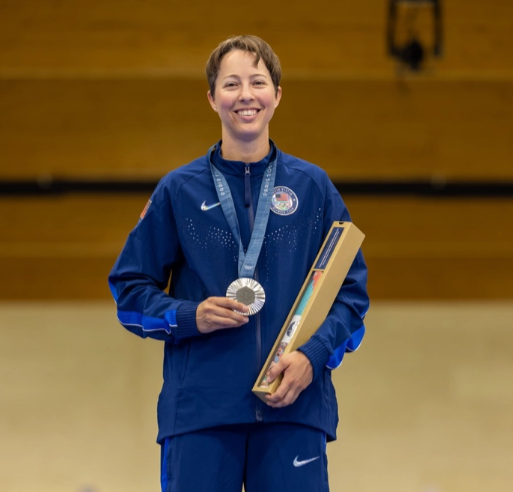
I recently went one-on-one with Olympic silver medalist and United States Army soldier Staff Sgt. Sagen Maddalena.
Adam: Thanks again for taking the time to share your advice. First things first, though, I am sure readers would love to learn more about you. How did you get here? What experiences, failures, setbacks, or challenges have been most instrumental to your growth?
Sagen: I’ll share one short story on how setbacks really propelled me forward. While in college at the University of Alaska Fairbanks, I competed on the NCAA rifle team. During my first season, I ended up with a labral tear and a stretched-out shoulder capsule that caused some big discomfort. I was determined to compete for the season before getting it fixed. To help with my mentality, I wrote a letter to my future self. I needed something that would help me fight through discomfort and perform/compete regardless of my brain telling me not to. I wrote this letter as if I had won the Olympics and had a medal. I told myself that the struggle I was enduring then was what helped me win on the world stage. That letter now sits beside my silver Olympic medal.
I personally define failures as lessons and opportunities for growth. It took more than five years of competing internationally on the World Cup team without coming close to having an opportunity to medal. I couldn’t make it out of the qualifying round, and for any finals I made, I’d finish last, but I kept at it. The drive to compete was so intense that the continual loss prepared me for many future successes and made those successes meaningful.
Several injuries have also caused setbacks in my career and have even altered it in ways. The recovery time after surgeries and injuries added a unique time to reflect and prepare for the next part of training or competition preparation. I have also used my recovery time to evolve how I train and prep by allowing myself to see training in a fresh way. By being weak in one area of my body, I can call on stronger parts and adapt. Being on the more “petite” side, I must take advantage of my size but also add more time for strengthening my shoulders and back from the brunt of over-training that can occur.
Adam: What would surprise people about the Olympic experience? What was most surprising to you?
Sagen: The Olympic experience is unique. All the best athletes in their respective sports come together to test themselves. These athletes come in all shapes, sizes, and personalities; yet we are all there with the thought in our mind: “I must get the most out of myself on the day and in the moment to win.” In the days leading up to Olympic events, I found that there is a sense of calm around the village or housing areas set up at the Olympics. It is after the event that the exhaustion and emotions hit HARD. It was as if I had emotions stirring inside that my mind and body didn’t acknowledge until after I won the Olympic medal. Before I walked onto the firing line to compete for a medal at the Games, I felt completely calm and still. I was in control and ready to compete. After securing Silver, while I waited for the athlete bus back to housing, my guts turned over, and I started dry heaving and throwing up. The next day, my mind started wandering: what would be next? After pursuing something with such dedication and sacrifice and securing a large success, my body felt empty. It took several months of reflection and planning to reprogram my drive and purpose in the sport.
Adam: What are the best lessons you learned from your Olympic experience?
Sagen: The best lesson I learned at the Games is not to treat it as something special or different. It’s an opportunity to test my skills. I must have control of what I can (like my personal sleep schedule and workouts) and let go of things I can’t, like bus schedules or flexing training times.
Adam: What are the best lessons you’ve learned from your time in the military?
Sagen: The best lesson I’ve learned from the Army is one that keeps on giving, and that is to keep moving forward. On the hard days, of which there are many, keep taking one step forward. For the nights when I can’t sleep and my mind and emotions are stretched thin, I get up the next day and take one step forward. When an assignment comes down or a competition is on the horizon and I don’t feel prepared, I’ve learned to take it in stride and to embrace the challenge. I treat each training with full focus and personal control, regardless of how I feel. Why? Because when the walls start crumbling all around or competition becomes strained, I fall back on my training. Trust in my training and preparation allows me to take advantage of winning opportunities.
Adam: In your experience, what are the defining qualities of an effective leader?
Sagen: The defining qualities of an effective leader:
- Patience
- Kindness (they don’t need to be nice, but they do need to be kind)
- Physical strength, with a look of professionalism, and mental strength to be resilient
- The ability to connect with their Soldiers and to see things in their Soldiers to bring the best out of them
- Personal drive and purpose
Adam: How can leaders and aspiring leaders take their leadership skills to the next level?
Sagen: Leadership is not something given, nor is it a trait that people naturally have. Leadership is learned and experienced. Being a leader is more than a title, and just because someone is in a leadership position doesn’t mean they are a leader. It takes a growth mindset to become and remain a leader, as well as daily effort. Those you are leading are always growing and changing themselves, so if you want to grow as a leader, every morning ask yourself, “How can I help those around me?” By doing so, you are keeping your eyes up and searching for ways to propel those around you.
Adam: What are the defining characteristics of a great teammate?
Sagen: Some characteristics of a great teammate are:
- Selflessness
- Motivation
- Respect for others training
- Being fully focused on becoming the best that they can become. In turn, this drives and motivates those around them to do the same
Adam: What is the single best piece of advice you have ever received?
Sagen: Maintain your equipment. For me personally, this is my sporting equipment and firearms. My first boss taught me this and demonstrated it every working day. He works in the woods, and his equipment could very well cause serious harm or worse if it were to break. With this, I will include myself and equipment. My body needs to be maintained just as much as my equipment. If the equipment fails or the mind/body breaks, I lose. For competitions, it’s not life and death, but we can see how this is vital in all aspects of life.
I’ll add one more piece of advice that has hit home in many ways: Just compete. When the competition starts, the self-judgment and the distracting thoughts of how to perform a process go away. It means to act in the moment and let the training and preparation shine without hindering it through judgment.