

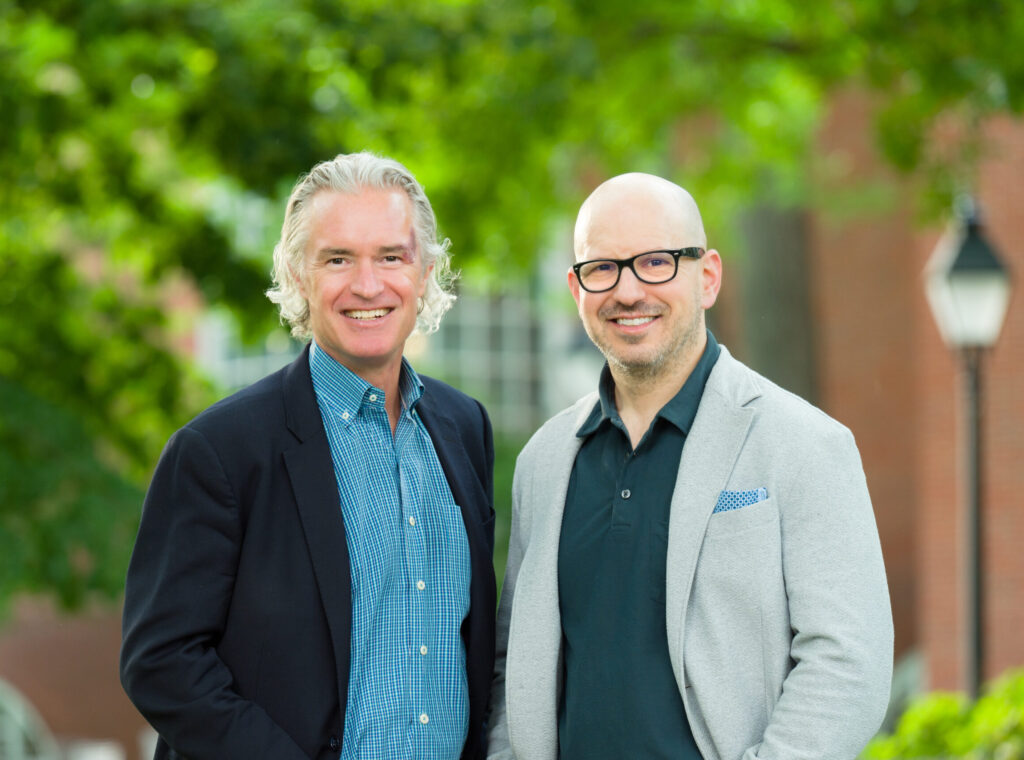
I recently spoke to Deloitte’s Geoff Tuff and Steven Goldbach, co-authors of the new book Hone: How Purposeful Leaders Defy Drift. Geoff is a Principal at Deloitte Consulting, where he leads sustainability work globally for energy, resources, and industrial clients. Steven leads Deloitte’s Sustainability practice in the U.S. after serving for nearly a decade as Deloitte’s Chief Strategy Officer.
Adam: Thanks again for taking the time to share your advice. First things first, though, I am sure readers would love to learn more about you. How did you get here? What experiences, failures, setbacks, or challenges have been most instrumental to your growth?
Geoff: I’ll be honest: I never had some grand plan to end up here. In fact, when I started in strategy consulting more than 33 years ago, I actually raised my hand during orientation at Monitor Group and said I’d probably be gone in six months. And yet, here I am, still with the same company, even after it became part of Deloitte.
I’ve had a good career, but not without some big bumps. Every time I stumbled, it was usually because I lost sight of the people around me and focused too much on my own ambitions. Sometimes it was a client who wasn’t ready to go the direction I was pushing. Sometimes it was a colleague I unintentionally rubbed the wrong way. Those moments taught me humility, how to read the quiet signals people send, and that creativity only matters if you can bring others along with you.
Steve: For me, strategy has always been about trying to build a better future. But I had to learn (sometimes the hard way) that strategy means nothing if it isn’t lived. Earlier in my career, whether at Forbes or working with clients at Monitor Deloitte, I saw how even brilliant plans can drift without steady attention.
Failures taught me that big, one-time transformations rarely stick. Real progress comes from small, continuous adjustments—what we now call “honing.” I also credit my family for grounding me in that mindset. Being a parent has been one of my greatest lessons in adaptation. Nothing goes exactly as planned, and growth often comes from listening, improvising, and learning alongside the people you love.
And of course, the reason we’re here today is because we’ve brought those ideas together in our new book, Hone: How Purposeful Leaders Defy Drift (Wiley, 2025). It’s actually the third in what’s become our unplanned trilogy—after Detonate in 2018 and Provoke in 2021. We enjoy writing together, but we definitely didn’t expect to be three books in!
Adam: In your experience, what are the key steps to growing and scaling your business?
Geoff: The key to begin with lies in understanding the nature of growth that you’re aiming for: is it an expansion of your core business, a stretch into adjacent spaces, or a completely new domain which you’ve never operated in before? And as Steve and I have written extensively about, the best long-term growth strategies usually comprise a portfolio of these moves. Regardless of the scale of your ambition, the secret to execution on a day-to-day basis is to plan and enact a series of small steps. We call these “minimally viable moves.” Instead of waiting for perfect certainty, successful leaders take action, learn from the results, and then adjust. Growth is really about experimenting, gathering feedback, and iterating quickly. Each step builds momentum and reduces risk, because you’re always learning and adapting as you go. It’s also crucial to put management systems in place that encourage the right behaviors: collaboration, continuous learning, and agility. These systems help keep everyone aligned and prevent the business from drifting off course as things change.
Steve: The other thing I’d add is that not all growth creates value. I’d add that growth isn’t just about getting bigger; it’s about continuing to reinforce any advantages you have over competition, which requires usually staying true to your core purpose. Growth for growth’s sake is more likely to struggle to create long term value. Every business has a “north star,” the fundamental reason it exists. If you scale without keeping that purpose front and center, you risk losing what makes your business special. The organizations that really thrive are the ones that treat strategy as a living, breathing system—not just a document that sits on a shelf. They’re constantly revisiting their choices, making sure they fit the current reality, and staying grounded in what matters most. That’s what creates resilience and lasting success, even as the business grows and the environment shifts.
Adam: What is your best advice on building, leading, and managing teams?
Geoff: Teams thrive when leaders genuinely care about the humans in the system. That means understanding motivations, anxieties, and aspirations, not just roles and responsibilities. I’ve learned to watch how people respond to me and to others on the team, and to design systems that make collaboration the natural choice rather than the heroic one. A big part of that comes in showing some vulnerability and revealing my “true self.” It’s amazing how just a little dose of humanity will put people at ease and empower them to be themselves rather than what they might imagine others are looking for. And it helps to break the rules a bit. As a leader, if you can show you’re willing to challenge orthodoxy and shake things up, I’ve found it makes people feel more comfortable and encourages creativity to boot.
Steve: I’d emphasize transparency and reinforcement. If you want collaboration, make it part of how people are measured and rewarded. And don’t underestimate the power of modeling the behavior you want to see. If leaders show up, listen, and pitch in, it sets the tone for everyone else. It’s also important to check in regularly, not just on progress but on how people are feeling and what’s getting in their way. That kind of ongoing support is what keeps teams engaged and moving forward. Teams succeed when they see their leaders constantly honing, adjusting, and communicating, not when leadership vanishes after setting a vision.
Adam: What do you hope readers take away from your new book?
Geoff: As Steve mentioned, we never consciously set out to write a trilogy, but now that Hone is being published, it’s pretty clear that a through-line to all our books is a focus on helping organizations and leaders thrive amid disruption and uncertainty. Our first book, Detonate, challenged entrenched business playbooks and urged leaders to break free from outdated “best practices” by adopting a beginner’s mindset and focusing on first principles. Provoke built on this by highlighting the dangers of waiting too long to act on emerging trends, advocating for proactive leadership that shapes the future rather than merely reacting to it, and emphasizing the value of cognitive diversity in overcoming biases. Hone completes the arc by focusing on the ongoing discipline of leadership. It encourages leaders to continuously refine their approach, stay engaged, and avoid the need for episodic, dramatic transformations, which can end up being a waste of time, focus, and money.
Steve: In Hone, we wanted to really emphasize that the work of strategy is not just making a set of bold pronouncements and then moving on to something else. In our experience, that’s how a lot of people see it. But strategy is also about what happens afterwards, and about keeping your hands on the proverbial knife and constantly adjusting and paying attention.
It’s an ongoing process, not a one-time event. Leaders need to be hands-on, willing to revisit decisions, and adapt as new information comes in. I hope readers walk away inspired to lead differently, and that the book helps them understand the value of constant improvement, seeing action as a way to learn, and appreciating the process of refining strategy just as much as achieving the end results.
Adam: What do you believe are the defining qualities of an effective leader?
Geoff: Curiosity. If you aren’t deeply curious about humans and why they behave the way they do, you’ll miss what really matters. This applies to your employees, your customers, your competitors.
Also, effective leaders understand that uncertainty is now the norm … and uncertainty pretty much always resolves in some way; very little stays a question of “if” in perpetuity. That makes the qualities of attentiveness and adaptability critical. The more you hard-wire systems to run according to a set of rules based on the way things have gone in the past, the less likely you’re going to be able to react appropriately when some uncertainty goes from being a question of “it” to a question of “when.”
Steve: I second every one of these ideas. In addition, I’d highlight good communication. Great leaders don’t just have ideas; they can make them vivid, compelling, and actionable. If you can break things down clearly, show why they matter, and invite others into the conversation, you’re way more likely to see real change. And let’s be honest, when communication gets messy, even the best ideas can grind to a halt. Good leaders keep things moving by being clear, asking questions, and staying open to learning from others.
Adam: How can leaders and aspiring leaders take their leadership skills to the next level?
Geoff: Get closer to the details than you think you should. The old myth that senior leaders should just “set vision” and not dirty themselves with execution is a recipe for drift. Next-level leaders roll up their sleeves and stay close enough to understand how their choices reverberate through the system. It’s about being present and not micromanaging, but showing genuine curiosity about how things actually work on the ground. When you spend time with your teams, ask questions, and really listen, you pick up on the small signals that can make a big difference. You also build trust because people see you’re invested, not just in the outcomes, but in the process and the people making it happen.
In Hone, we mention the practice of “management by walking around” pioneered at Hewlett-Packard and later popularized by Tom Peters. When Bill Hewlett and David Packard walked the factory floors, they weren’t just showing up for appearances. They were getting real, hands-on feedback about what was actually working. By being on the ground, they could catch issues early and fix things before problems showed up in the numbers. Leaders who do this today can often spot misalignment quickly and make changes before things really go off track.
Steve: Practice seeing every action as an experiment. Don’t wait for perfect information; make minimally viable moves and treat them as learning. Success is all about staying flexible and open to change, rather than holding out for certainty.
And importantly: hone yourself. Leadership is personal as much as organizational. Take time to reflect on your own habits and style, ask for feedback, and keep working on how you lead. The more you focus on growing and refining yourself, the more you’ll be able to help your team and your business thrive.
Finally, don’t neglect management systems! Management systems are what I call the “pinky toe” of the Strategy Choice Cascade, a methodology established by Roger L. Martin and his Monitor colleagues that guides organizations through the process of developing strategy. They’re often an afterthought, but they actually have a crucial role in keeping an organization balanced and sustainable for the long term. I love management systems so much that I had a shirt made declaring my love for them and used them in our author photo.
Adam: What are your three best tips applicable to entrepreneurs, executives, and civic leaders?
Geoff:
- Stay relentlessly curious about people. Their behaviors are the building blocks of every system.
- Love the process, not just the outcomes. If you don’t, you’ll give up when it gets hard.
- Balance vision with detail; don’t lose sight of the day-to-day mechanics that make big goals achievable.
Steve:
- Design systems that reinforce the behaviors you want; every system gets the results it’s designed to produce.
- Communicate with clarity and humility. The sludge of miscommunication kills more ideas than bad strategy ever could.
- Think in minimally viable moves. Big transformations sound bold, but it’s the small, steady honing that creates durable impact.
Adam: What is the single best piece of advice you have ever received?
Geoff: “Don’t overthink it.” That’s not actually exactly what my Dad said, but it’s the way I’ve distilled it over the years. This was close to 30 years ago at this point: I was trying to decide whether to apply to business school, move abroad, or do something completely different with my life … and, all of a sudden, my wife and I found out we were pregnant. How could that be?! I was way too young! This was going to disrupt everything and limit all our options! So I went to my Dad and casually asked for advice on how you figure out when the right time is to have kids. His response: “If you think too much about it, it’s never the right time.” And this advice has stayed pretty applicable over the years—for big moves, for financial decisions, and for indulgences small and large. It’s been an easy lesson to carry into my professional life as well.
Steve: “Always make an error of commission rather than an error of omission.” That’s from my old boss at Forbes, Jim Berrien.