

The skills that get you to the top are rarely the skills that keep you there. I’ve heard this from many of the founders and CEOs I’ve spoken to in hundreds of conversations. And the longer I spend in rooms with the people who have actually built something significant, the more I believe it is one of the most important and most ignored truths in business.
I have spent years sitting across from some of the most accomplished leaders in the world through my Thirty Minute Mentors podcast, people who have built category-defining companies, led Fortune 500 organizations, commanded military operations, and steered institutions through the kind of complexity most of us will only read about. What strikes me most consistently is not how different their journeys are, but how similar the turning point tends to be.
At some stage of growth, many of them describe a version of the same experience. Leading started to feel harder than it did before; the instincts they had relied on stopped producing the results they expected, and the habits that had built the company to where it was began working quietly against where it needed to go.
This is a story about what scaling genuinely demands from leaders and why so few organizations prepare for it honestly. According to DDI’s Global Leadership Forecast, 77% of organizations report significant leadership gaps across all levels. Companies grow their headcount, their revenue, and their market presence, but leadership capability inside those organizations does not grow at the same pace, and the gap between the two is precisely where performance erodes, culture drifts, and good people leave.
If you are leading a growing organization right now or preparing to, this post is built for you. The skills, habits, and instincts that brought your company to this point are often the very things that will limit where it goes next, unless you are willing to examine them honestly and evolve with intention. To bring this conversation directly into your organization, explore my leadership keynotes designed for teams overcoming the real complexity of scale.
What Changes When a Company Scales
Leading a team of ten is fundamentally a personal endeavor. You know everyone individually; you read the room in real time, and your instincts are calibrated by daily proximity to the work and the people doing it. Most course corrections happen before they become real problems because you are close enough to see them forming.
At 100 people, that proximity begins to disappear. At 500, it is largely gone, and the informal systems that once kept the team aligned, the culture coherent, and the decisions moving are no longer sufficient for the complexity the organization now carries. This phase is the transition that catches most leaders off guard, not because they lack capability, but because it happens gradually and the early warning signs are easy to rationalize until they become impossible to ignore.
The shift from leading people directly to leading people who lead people is one of the most underestimated transitions in all of business. It requires a genuinely different set of skills, habits, and ways of thinking about what leadership means in practice, and most leaders arrive at it without a map.
The Specific Challenges of Scaling Leadership
After hundreds of conversations with CEOs, founders, and executives who have led organizations through meaningful growth, the same pressure points surface consistently. Here are the ones that matter most.
1. The Proximity Problem
When an organization is small, a leader can feel the culture, monitor execution closely, and step in quickly when something is drifting. As the team grows, that direct line gets interrupted by layers of management. A message communicated clearly to a VP gets filtered, interpreted, and passed down through multiple levels before it reaches the people whose behavior it was meant to shape.
By the time it lands, it may look very different from what was originally intended, and the leader, now removed from the daily reality of the work, often has no way of knowing the signal degraded in transit. This is a structural reality of scaling that every growing organization will encounter, and it requires a structural response.
2. The Muscle Memory Trap
This is where the conversation gets genuinely uncomfortable for most leaders, and it is worth spending real time here because it sits at the root of so many of the other challenges. The behaviors that made a leader effective in the early stages of a company often become liabilities at scale.
The founder, who was hands-on and detail-oriented and who succeeded precisely because of that attention, can become a micromanager who slows the entire organization when it needs to move faster. The executive who made every decision quickly when the team was 20 people creates compounding bottlenecks when the team is 200 and everything still flows through the same single point. The leader who built culture through personal presence finds that culture is becoming inconsistent across departments they no longer have the bandwidth to touch.
3. Delegating Without Losing Standards
One of the most consistent tensions I hear from leaders leading growth is the pull between genuine delegation and the standards they have spent years building their reputation on. You bring talented people in specifically to take ownership of areas you can no longer cover. But when they approach a problem differently than you would, the instinct is to step back in, to add unnecessary oversight, or to quietly redo the work yourself.
Real delegation is about trusting people to own outcomes and accepting that their path to the result may not look exactly like yours. Leaders who cannot make that distinction end up becoming the ceiling their organization cannot grow beyond. Holding people accountable to clear outcomes while releasing control over method is one of the defining skills of effective leadership at scale, and most leaders have to develop it deliberately rather than discover it naturally.
4. Communicating Vision Across Distance
Early-stage companies run on shared context. Everyone is in the same room, the same conversations, and the same daily reality. The vision is alive because it is present in almost everything that happens. At scale, that context has to be deliberately engineered because it no longer transfers on its own.
Leaders who have not learned to communicate direction consistently and repeatedly across functions, levels, and geographies will watch alignment erode in ways that are slow to surface and expensive to repair. People will make locally reasonable decisions that are collectively incoherent, not because of a lack of effort, but because they are missing the shared context that once existed naturally and now has to be built and maintained with real intention.
5. Building Leaders, Not Just Teams
At a startup, the primary job is to build a great team. At a scaling company, the job becomes building the people who will build the teams. These require fundamentally different approaches to leadership. It means identifying potential early, investing in development before it is urgently needed, and giving people meaningful challenges before they feel fully ready for them.
According to research from Korn Ferry, only 14% of CEOs say they have the leadership talent they need to execute their growth strategy. That gap starts at the top but gets solved in the middle, and closing it requires sustained and deliberate investment in developing leaders at every level, not occasional training events scheduled when the calendar allows. If you want to go deeper on this topic, my thoughts on generational leadership in modern organizations are worth a read.
6. Maintaining Culture Across Departments and Distance
Culture at scale is built deliberately, or it quietly deteriorates. I have written more about this in how to build a company culture that lasts. As companies grow, subcultures form across teams, offices, and functions, each developing their own norms, their own unwritten rules, and their working interpretation of what the organization actually values in practice.
The result is often a senior leadership team that believes the culture is one thing while the people doing the daily work experience something meaningfully different. By the time that gap shows up in engagement scores or turnover trends, it has often been building quietly for months. Culture consistency at scale requires consistent behavior from leaders at every level of the organization, not just visible commitment from the top during company-wide moments.
7. Decision-Making Speed Versus Decision Quality
Small organizations move quickly because decisions get made by the people closest to the relevant information. At scale, decision rights become unclear; everything escalates upward. People who should be empowered to make decisions keep asking for permission, while those who should focus on strategic direction are still making the same operational decisions they handled when the company was much smaller..
The result is not one dramatic failure but a slow accumulation of smaller ones. Missed windows, delayed responses, and talented people who eventually leave because they cannot get things done without navigating an approval process that was never properly designed for the organization it now serves. This is one of the most costly and least visible consequences of leadership that has not kept pace with organizational growth.
How Is Your Leadership Holding Up Under the Pressure of Growth?
My leadership impact assessment is a free diagnostic built to help leaders understand exactly where their leadership is strong and where it may be creating friction as their organization scales.
Take The AssessmentWhat Effective Scaling Leadership Looks Like
The leaders I have spoken with who channel scale successfully share a few qualities worth naming directly. They invest in leadership infrastructure before they feel the pain of not having it. They build systems, habits, and accountability structures that allow their standards to travel through the organization without requiring their personal presence at every level. They develop the leaders around them with the same seriousness with which they once developed their own capabilities.
They also stay honest about where their leadership needs to evolve in response to where the organization is today, not where it was when their current habits were first formed. Kat Cole put it well in our conversation. Effective leaders need the humility and curiosity to learn from the people around them, and the courage to make the tough calls when it matters. That combination is what makes standards credible at any stage of growth.
They ask harder questions than most. Not only whether they are hitting their numbers but also whether the culture still feels like theirs. Not only whether decisions are getting made, but also whether the right people are making them at the right level. Scaling requires a real shift from doing the work to designing the conditions in which others can do it well, and it is genuinely more difficult than most leaders anticipate.
Jim Koch said something in our conversation that has stayed with me. He still tastes every batch of Boston Lager that leaves the brewery. His point was simple: delegate and trust the leaders around you, but never lose touch with what matters most to the organization. That balance is harder to maintain at scale than most leaders expect.
Ready to Lead Your Organization Through Its Next Stage of Growth?
My keynotes and workshops are built around the real challenges leaders face inside growing, complex organizations. The insights I share come from thousands of hours of direct conversation with some of the most accomplished leaders across business, the military, sports, and public life.
Book A Keynote For Your Next EventScale Your Leadership With Adam Mendler
Growth tests everything inside an organization, including strategy, operations, culture, and people. However, nothing undergoes a more thorough or consequential test than leadership. The organizations that scale successfully are not always the ones with the most capital or the strongest product. They are the ones whose leaders were willing to grow as fast as the business did and were honest enough to recognize when the way they were leading needed to change.
If your organization is growing and you want to make sure your leadership is keeping pace with it, I would be glad to help. If you want a sense of what to expect, the testimonials page is a good place to start. My keynotes, workshops, and resources are built around one goal: helping leaders at every level develop the capability to lead their organizations to greater and more sustainable performance. To learn more or connect directly, reach out at connect@adammendler.com.
FAQs
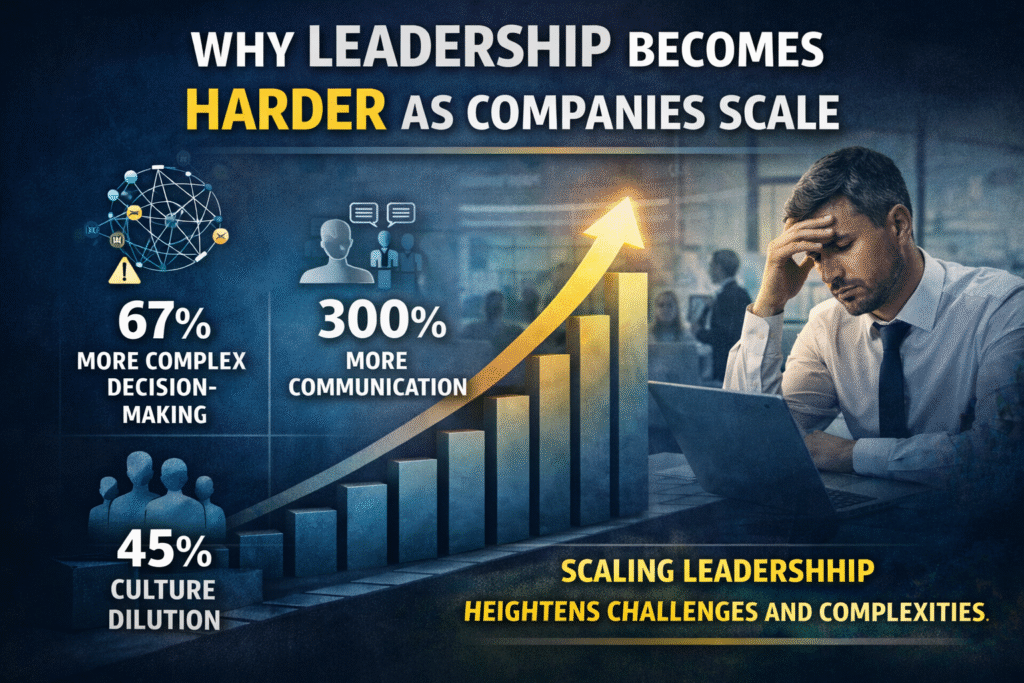
1. Why Does Leadership Become Harder as Companies Scale?
The skills that work in small teams, including direct oversight, personal relationships, and hands-on decision-making, become less effective as organizational distance and complexity increase. Leaders must shift from doing to enabling and from managing individuals to building other leaders, which requires a genuinely different mindset and a real willingness to evolve how they operate day to day.
2. What Is the Biggest Leadership Mistake Companies Make When Scaling?
The most common mistake is promoting high performers into leadership roles without giving them the development they need to lead effectively at a larger scale. Individual contribution and people leadership require very different skill sets, and that gap consistently shows up in turnover, cultural inconsistency, and underperformance as the organization continues to grow.
3. How Do You Maintain Culture When a Company Is Scaling Quickly?
Culture at scale requires deliberate reinforcement across every level of the organization. That means investing in leadership development, being intentional about what gets recognized and rewarded in practice, and ensuring that leaders across all functions consistently model the values rather than leaving that responsibility exclusively to the senior team.
4. What Does Good Leadership Development Look Like in a Scaling Company?
Effective leadership development goes well beyond periodic training events. It includes honest structured feedback, stretch assignments that build capability ahead of demand, meaningful mentorship, and clear accountability frameworks. Companies that invest in developing leaders before the need becomes urgent are consistently more resilient and better positioned to sustain strong performance through growth.