

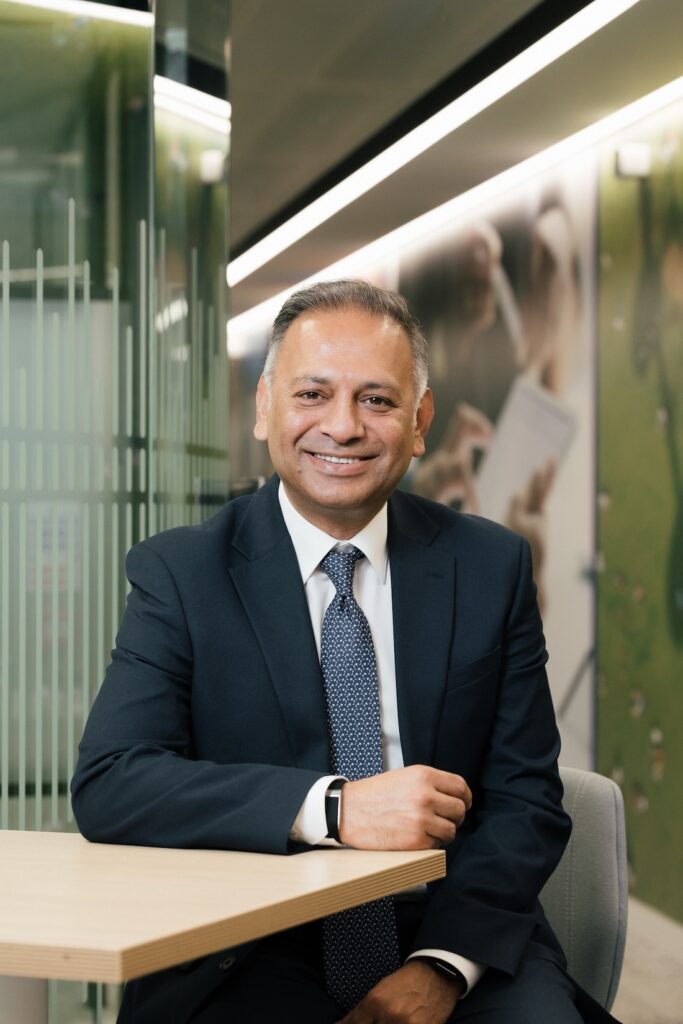
I recently went one-on-one with Sudhir Chaturvedi, Chief Growth Officer and CEO, North America of NTT DATA, Inc.
Adam: First things first, though, I am sure readers would love to learn more about you. How did you get here? What experiences, failures, setbacks, or challenges have been most instrumental to your growth?
Sudhir: I’ve probably made my career by accepting jobs that seemed rather illogical on paper. Take leaving a $450 million company to run a declining business roughly a third of the size. It was smaller, struggling, and certainly wasn’t the obvious career move, but that was exactly why it interested me. In three years, we nearly tripled the business to more than $400 million, and that experience shaped my reputation as a turnaround leader. Going back even further in my career, I was given two weeks to move from London to New York and take over an underperforming business in an industry I didn’t know particularly well. A new city. A new country. A new industry. We turned that business around within a year.
Candidly, not every bet worked. One merger I was involved in looked compelling financially, but we underestimated how hard it is to integrate cultures, teams, and operating models. The transaction ultimately destroyed value. It was a foundational lesson in my career and probably taught me more than many of the successes did. A spreadsheet can tell you why a deal should work. It cannot tell you the myriads of other things necessary to make two organizations behave like one. If there’s a common thread, it’s that I have learned the most when I was uncomfortable.
Adam: In your experience, what are the key steps to growing and scaling your business?
Sudhir: I’ve always believed that growth solves a lot of problems. It creates energy, opportunity, investment capacity, and confidence. Here are six guidelines that have served me well:
- First, know where the growth is actually going to come from. “Grow faster” is not a strategy.
- Second, stay close to customers. They’ll usually tell you where the next opportunity is before the market does.
- Third, be very clear about the few things you want to be known for.
- Fourth, build a team that can execute repeatedly. Growth becomes much harder when everything depends on a few individuals.
- Fifth, don’t wait for absolute certainty before investing. If you can see the opportunity clearly, your competitors probably can too.
- And finally, sixth, keep it simple. Businesses often make scaling harder by adding layers, processes, and complexity faster than they add revenue.
Adam: What is your best advice on building, leading, and managing teams?
Sudhir: This often goes against the grain, but resist the temptation to immediately bring in “your people.” When you inherit a team, it’s incredibly valuable to spend quality time with them before deciding who needs to change. Find out strengths and, more importantly, reveal gaps that will better inform areas that may need investment. Earlier in my career, I was much more impulsive, direct. I liked speed and I usually had a strong opinion about how something should be done. Over time, I learned that if you always give people the answer, eventually they stop bringing you their ideas and action plans. Make no mistake, I still believe in accountability and high standards. But now I spend significantly more time removing obstacles, coaching people, and creating agency for others to lead. When it comes to mentorship, many of my peers are often quick to emulate corporate icons, industry titans, and Fortune 500 legends. The Jack Welches and Sam Waltons of the world. I respectfully take a different path. I’ve always said my favourite leadership reference is The Mandalorian: clear mission, serve and protect the team, lead from the front.
Adam: What are the most important trends in technology that leaders should be aware of and understand? What should they understand about them?
Sudhir: This isn’t likely to stop the presses, but AI is clearly the biggest and most profound. But the conversation has changed. A few years ago, everyone wanted to know what AI could do. Now the question is whether it can create measurable business value at scale. AI alone isn’t enough. You need the right data, cloud foundation, governance, security, and operating model around it. The pitfall for many leaders is thinking of AI primarily as a productivity tool. It’s increasingly changing how companies sell, serve customers, make decisions, and design work. We are still very early in the AI journey. I believe the impact of it will be much more significant than any previous technology wave in my lifetime, even the internet. The companies that win won’t necessarily be the ones with the most AI. They’ll be the ones that know how to leverage it best.
Adam: What do you believe are the defining qualities of an effective leader?
Sudhir: My leadership philosophy is influenced by five defining characteristics:
- Servant leadership, like The Mandalorian: serve and protect the team (and customers) first.
- Inspiring purpose: be driven by something other than just the bottom line.
- Psychological safety: create a safe space to share ideas, ask questions, and take risks.
- Building world-class teams: understand your gaps, fill them with talented, driven people.
- Authenticity and transparency: be human, be yourself, be honest
Adam: How can leaders and aspiring leaders take their leadership skills to the next level?
Sudhir: Leaders, even those in the C-suite, are no different than the rest of the org chart. Growth through experience. Take on assignments with stretch goals, ideally outside your comfort zone. A new country. A new industry. A turnaround. A role where you don’t know all the answers or even who to get them from. What I found particularly effective was to work under different types of leaders. Hands-on. Hands-off. Agreeable. Abrasive. Relaxed. Demanding. You learn as much from the styles you don’t want to imitate than the ones you admire.
Don’t be afraid to seek feedback from all levels of the org. The junior financial analyst has a different yet equally valuable perspective than the CFO. Importantly, learn when to intervene and when not to. This can be excruciating for problem solvers, but to build a proper growth engine you have to give your teams and talent agency to fail or figure it out. Build. Hand it off. Build the next one. Most importantly, keep learning and stay humble. The moment think you have figured leadership out, you probably haven’t.
Adam: What are your three best tips applicable to entrepreneurs, executives, and civic leaders?
Sudhir: I could give you three, but six is better, all of which were imparted to me over the past 25-plus years and continue to shape my leadership approach:
- Build a growth mindset. Growth creates momentum, investment capacity, and opportunity for people. It’s very difficult to transform an organization that has stagnated.
- Build something that doesn’t depend on you. Develop the team, inspire the next generation of leaders, and build an engine that can keep growing after you move on.
- Stay close to the people you serve. Clients, employees, and communities will usually tell you what needs to change if you’re willing to listen.
- Think in horizons. Deliver what matters today but always make time to build what will matter next. Organizations get into trouble when they only optimize the current business.
- Stay curious beyond your own industry. Some of the best ideas come from other sectors, markets, and cultures. Leaders who only benchmark against their immediate competitors usually end up thinking the same way as everyone else.
- Back potential, not just proven performance. Some of the best talent decisions come from seeing what someone can become, not only what they’ve already accomplished.
Adam: What are your best tips on the topics of sales, marketing, and branding?
Sudhir: First, it’s understanding these are distinct yet deeply integrated parts of your business. In sales, it’s imperative to recognize clients’ business and market priorities. Focus on solving the problems that matter most and help them create a better future for the people they serve. In marketing, build the brand, develop the market, and create demand that translates into pipeline for sales. And in branding, be intentional about the feeling you want to create in the minds of the people who matter, specifically clients, partners, and the broader market.
Adam: What is the single best piece of advice you have ever received?
Sudhir: “Growth solves all problems.” Growth creates momentum. It attracts talent, builds confidence, and gives you the resources to solve challenges. Without growth, organizations become defensive; with growth, people see possibility, for the business and for themselves. So focus on growing your people, your capabilities, and your impact. Growth makes everything else more solvable.