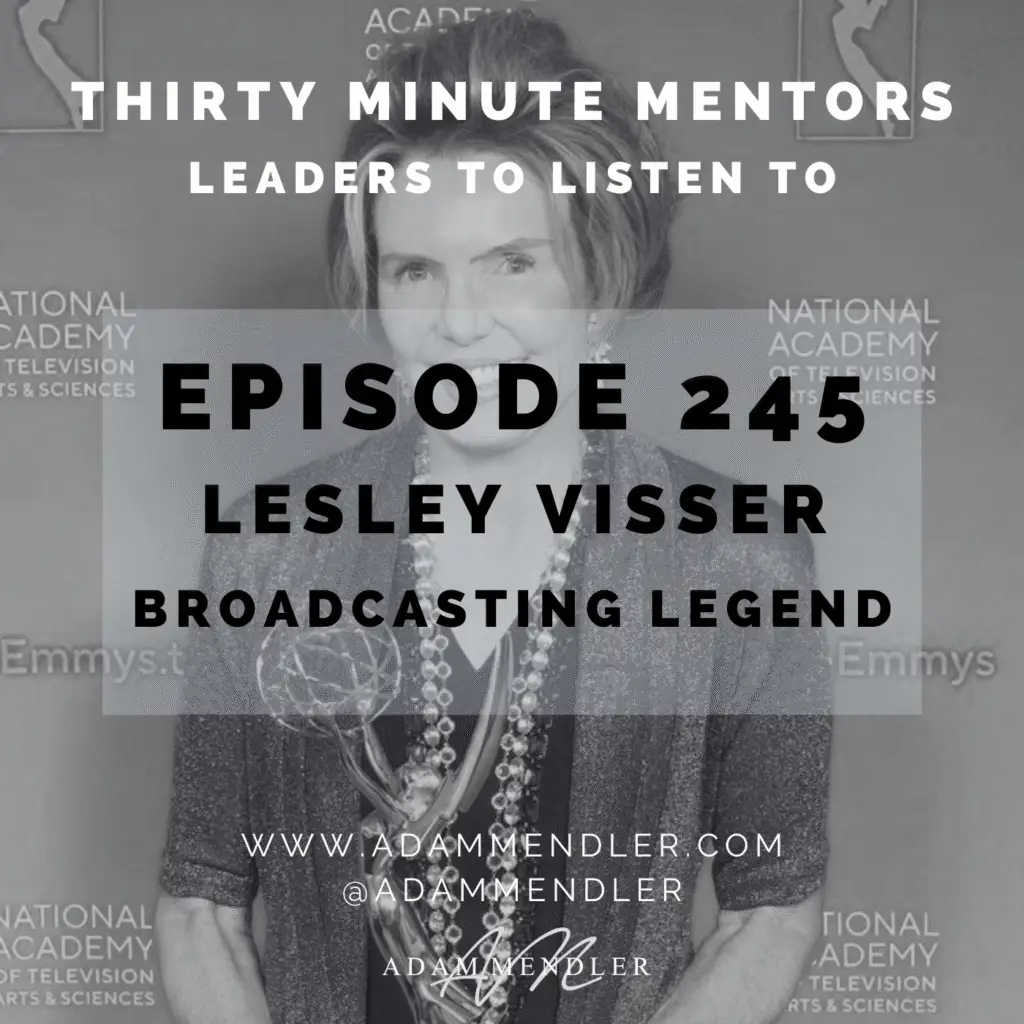
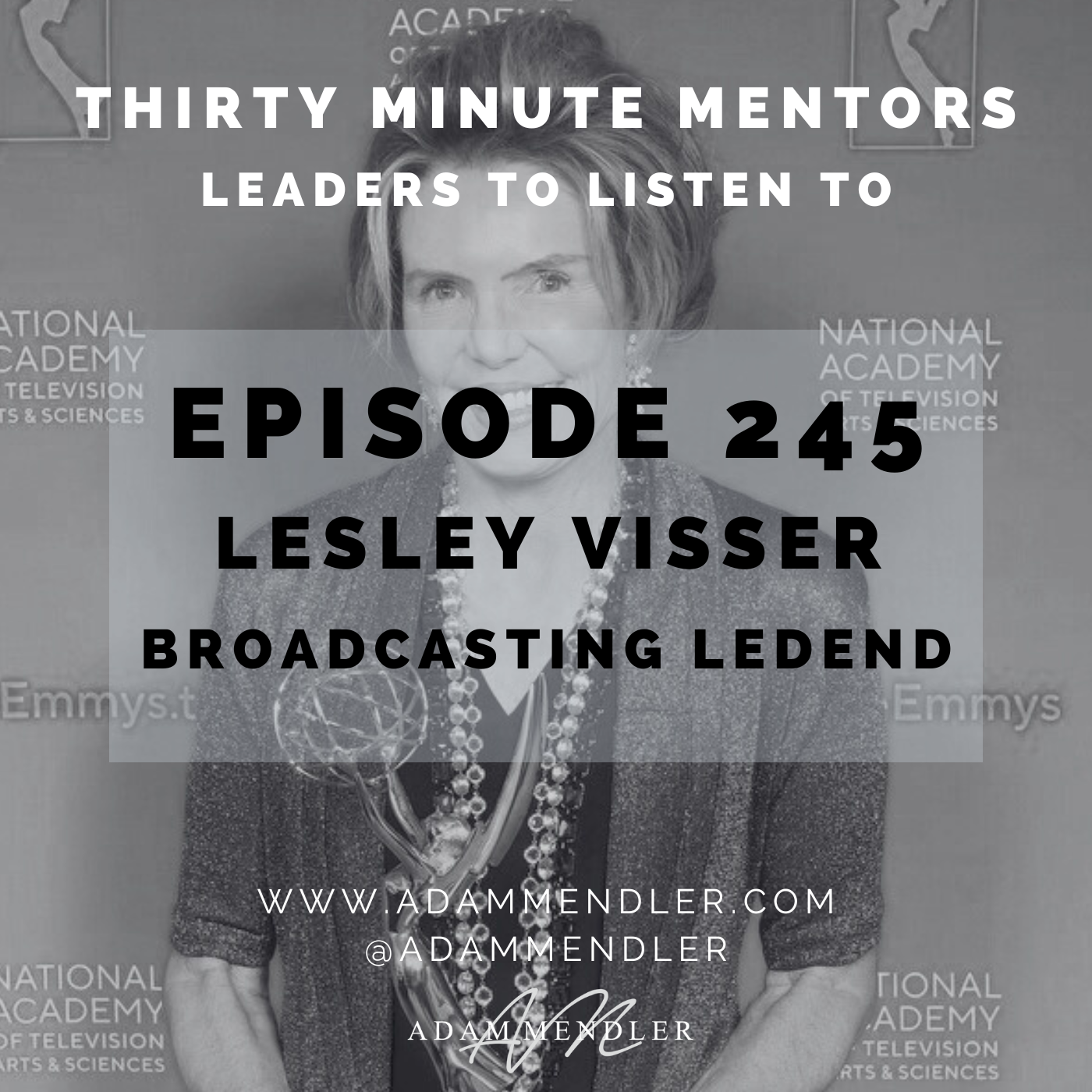
Episode 245: Broadcasting Legend Lesley Visser
A trailblazer in the worlds of journalism and broadcasting, Lesley Visser is the only sportscaster in history who has covered the Final Four, the NBA Finals, the World Series, the Triple Crown, Monday Night Football, the Olympics, the Super Bowl, the World Figure Skating Championships, and the U.S. Open on network television. Among her many firsts, Lesley is the first woman to receive the Sports Emmys Lifetime Achievement Award. Lesley joins Adam to share her journey and best lessons and advice.
Join Adam and the best network of mentors – Fortune 500 CEOs, founders of household name companies, Hall of Fame and Olympic gold medal-winning athletes, political and military leaders – for intimate half-hour conversations each week. Thirty Minute Mentors is available wherever you listen to podcasts. If you enjoy the episode, visit your favorite podcasting app and subscribe, rate, and leave a review, and spread the word by sharing on your social media channels and sharing directly with your friends and colleagues.




Read the full transcript of Adam’s conversation with Lesley Visser.
Episode Summary
Lesley Visser is a pioneering sports journalist and broadcaster who became the first woman to receive the Sports Emmy Lifetime Achievement Award. She tells Adam how a kid who loved sports the way other kids love dance or music built a career in an industry where she was always the first, and she shares the lessons she took from the athletes, coaches, and mentors around her.
Lesley recalls going to Fenway Park from about the age of eight and learning to score the double play. Her family moved 11 times, she says, but growing up in Boston was really important: the Red Sox gave you humility and the Celtics gave you pride. She recalls winning a Carnegie Foundation grant, in 1973 or 1974, for women entering fields that were overwhelmingly male, and going to the Boston Globe, where her colleagues included Bud Collins, Peter Gammons, Bob Ryan, and Will McDonough. She says she had mentors from the start and asked much more than she spoke. Red Smith, walking the Kentucky Derby infield with her, gave her one piece of advice for her entire career: make a memory.
Covering the Patriots for the Globe in the 1970s, Lesley says, there were no ladies’ rooms, but she kept an attitude of gratitude: this was a childhood dream. She remembers Sugar Bear Hamilton going over the defense with her on a sheet hung in his house, and when she asked why the players were so good to her, one told her it was because they knew what it was like to be the only one. Her lesson: be open, extend yourself to make connections, and keep a sense of humor. She shares her own on-air stumble from her early days at CBS, when Hana Mandlikova credited her rise in the rankings to her new “couch,” Billie Jean King, and Lesley asked if she had bought new furniture. You can survive it, she says. A lost interview with Barry Sanders, when the audio was never recorded, taught her that you are part of a team, and she says nobody landed on Normandy by himself.
Lesley lays out three non-negotiables she draws from watching athletes: passion, knowledge, because knowledge gives you confidence, and stamina, because the Ferris wheel will come down as well as go up. She says she knew how to diagram a safety blitz, and that John Madden used to tell her 90 percent of the guys out there were bluffing. Great leaders, she says, are good listeners who want to get better and have vision, and she points to Rick Pitino, whom she recalls covering at Boston University, and to Bill Parcells, who understood that people are different.
On pressure, Lesley recalls being nervous as the first woman on Monday Night Football, and says a producer told her, “You got the job, now do the job.” She urges listeners to know the destination before every interview and to use details, warning that a boring question gets a boring answer. She describes making a memory when CBS sent her to the fall of the Berlin Wall. Her final advice is to make every at-bat a quality at-bat, take the stairs rather than the elevator, and be a teammate, because you are not going to get to the World Series by yourself.
What You’ll Learn
- Bring three non-negotiables to your work, Lesley says: passion, knowledge, which gives you confidence, and stamina, because the Ferris wheel will not always be at the top.
- Make a memory, Lesley says, the one piece of career advice Red Smith gave her, which she carried all the way to the fall of the Berlin Wall.
- When you are different, extend yourself to make connections, Lesley says: Patriots players who knew what it was like to be the only one helped her learn the game.
- Remember you are part of a team, Lesley says: nobody landed on Normandy by himself, a lesson driven home when a candid interview with Barry Sanders was lost because the audio was never recorded.
- Once you have the opportunity, reach inside yourself and deliver, Lesley says, recalling a Monday Night Football producer who told her, “You got the job, now do the job.”
- Make every at-bat a quality at-bat, Lesley says: rather than looking too far ahead, she set out to honor the fishermen’s sons in a small high school game and cover it fully, and she advises taking the stairs, not the elevator.
About Lesley Visser
Lesley Visser is a pioneering sports journalist and broadcaster. She began her career at the Boston Globe in 1974 after winning a Carnegie Foundation grant, and in 1976 she became the first female NFL beat writer. She joined CBS Sports in 1984 and also spent nearly seven years with ABC Sports, where she was the first woman on Monday Night Football. In 2006 she became the first woman to receive the Pro Football Hall of Fame’s Pete Rozelle Radio-Television Award, and in 2020 she became the first woman honored with the Sports Emmy Lifetime Achievement Award. She is the author of the memoir Sometimes You Have To Cross When It Says Don’t Walk.
Related Episodes
- Episode 19: MLB Play-By-Play Announcer Victor Rojas
For more on sports broadcasting, Victor, an Emmy Award winning broadcaster, discusses his non-linear path to the top of his profession and how to become a better communicator. - Episode 358: NFL Hall of Famer Anthony Muñoz
For more on lessons from the NFL, Anthony, a member of the Pro Football Hall of Fame, discusses coaching, mentorship, resilience, teamwork, and sustaining excellence. - Episode 262: Former Baseball Star Jake Peavy
For more on performing under pressure, Jake, a two-time World Series champion, discusses teamwork, mentorship, and performing at an elite level. - Episode 203: Hockey Hall of Famer Chris Pronger
For more on leadership in sports, Chris, a member of the Hockey Hall of Fame, discusses leadership, teamwork, motivation, and mental toughness. - Episode 69: McClatchy CEO Tony Hunter
For more on the newspaper business, Tony, a former publisher of the Chicago Tribune, discusses the lessons he learned leading and driving turnarounds of major publishing companies.