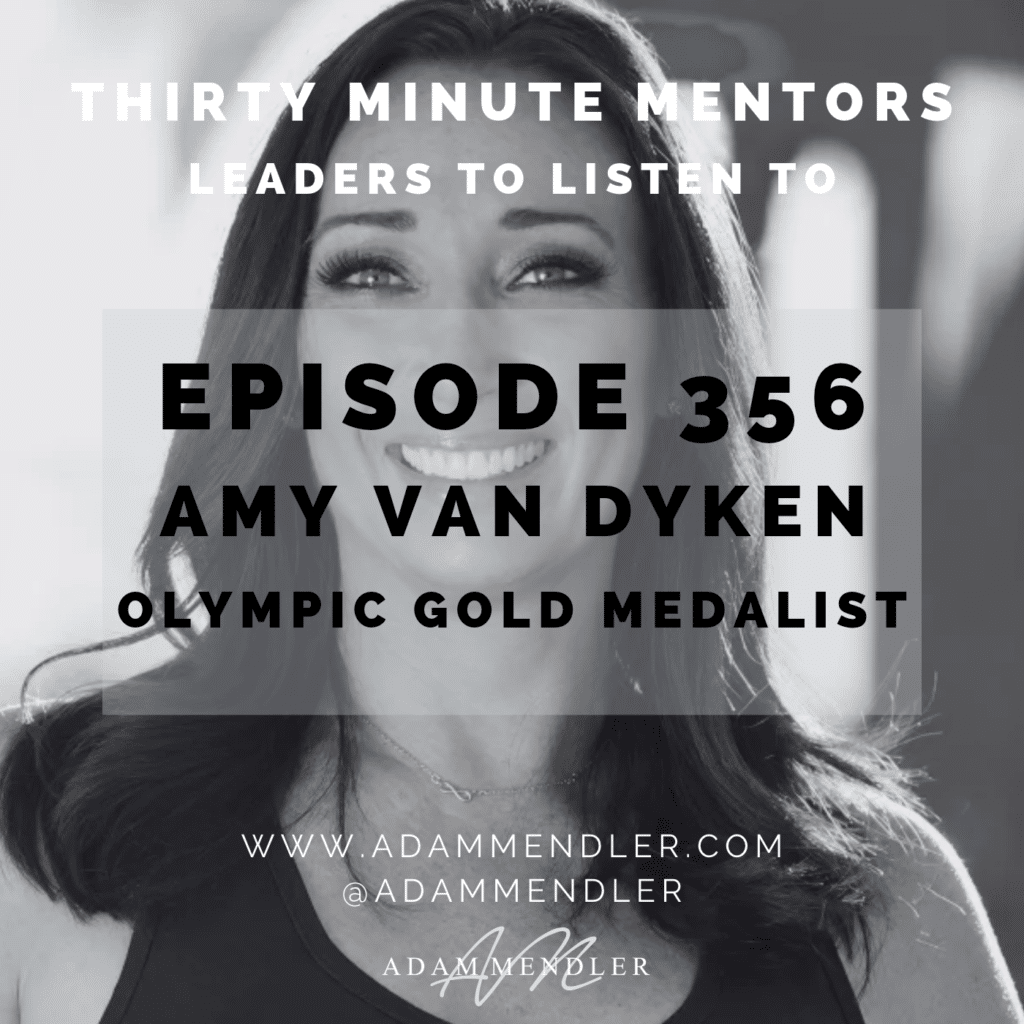
Amy Van Dyken is a six-time Olympic gold medalist and the first American woman to win four gold medals in a single Olympic Games. Amy is also a leading disability advocate. Amy joins Adam to share her journey and her best lessons and advice. Amy and Adam discuss a wide range of topics: achieving greatness and peak performance, resilience, navigating highs and lows, leadership, motivation, mindset, and more.
Join Adam and the best network of mentors – Fortune 500 CEOs, founders of household name companies, Hall of Fame and Olympic gold medal-winning athletes, political and military leaders – for intimate half-hour conversations each week.
Thirty Minute Mentors is available wherever you listen to podcasts. If you enjoy the episode, visit your favorite podcasting app and subscribe, rate, and leave a review, and spread the word by sharing on your social media channels and sharing directly with your friends and colleagues.
Read the full transcript of Adam’s conversation with Amy Van Dyken.
Episode Summary
Amy Van Dyken is a six-time Olympic gold medalist and the first American woman to win four gold medals in a single Olympic Games. She tells Adam how a child with severe asthma became an Olympic champion, how she rebuilt her life after an ATV accident that left her paralyzed, and why she now uses her voice to change how people see disability.
Amy says she was diagnosed with severe asthma at 18 months old. She recalls a first-grade classmate asking why she was so weird, and going home in tears; her mother took her to a doctor, who told her to exercise her lungs and suggested water sports. The swim team became her second family. She says it took her six years to finish her first length of the pool and that she won her first race at 13, with her parents as her biggest support system.
Amy recalls making her high school team as the last of 28 swimmers chosen, and a coach telling her she was so bad she would not swim in meets but could swim a relay at the last meet of the year if she kept improving. Behind the blocks before that relay, she overheard her three teammates say they could not believe she was on their relay. She swam the leadoff leg, the relay won, and she qualified for the state championships. As a senior, she qualified for the 1992 Olympic trials, and she says she thought of those girls even at the Olympics. Still, Amy says she had quit swimming before she went to Colorado State, where a loving, kind coach she calls her second father changed her career. Living so long in a negative headspace, she says, makes you negative.
Amy is a big believer in visualization. For months before a big meet, she would picture everything going wrong in a race and then work up to a perfect one. She wrote target times on sticky notes around the house; aiming to break the American record in the 50 freestyle, she says, she wrote 21.7 everywhere and swam 21.77 at the NCAAs. Under pressure, she told herself the crowds and cameras were there for her: it was her time to show off the hard work she had put in.
Amy then walks Adam through her accident. She recalls riding her ATV to dinner, and says she hit a curb, went over a cliff, and was not breathing when her husband found her. Before surgery, when he told her she could let go, she thought, “Who are you to tell me what I can and can’t do?”, the thought she once had about her high school relay teammates. She credits her Olympic training for pushing her through rehab and says she left the hospital a month early. Since then, she says, she has rock climbed, skied, mountain biked, and gone to the CrossFit Games.
Today Amy uses social media for what she calls teachable moments about doors, restrooms, and accessible parking, with a goal to make disability not a bad word. She urges grace and kindness, since everyone is dealing with something, and says that if six gold medals had changed her, she was not who she thought she was to begin with. Her advice is to believe in yourself, know your goal, put in the work, and validate yourself.
What You’ll Learn
- Motivate yourself with positivity rather than anger, Amy says: if you are angry all the time, you will be angry all the time, and a coach who led with love and kindness changed a career she had once quit.
- Visualize everything going wrong before you picture it going right, Amy says, so that when the big moment comes, your brain feels like it has been there and done that.
- Treat pressure as your time to show off, Amy says: the crowds and cameras are there to see the work you put in, from her early-morning practices to her hours in the weight room.
- Know who you are talking to if you lead others, Amy says, because a message you think is positive can be received as negative, and she had coaches who motivated through fear and anger as well as one who led with love.
- Offer everyone a moment of kindness and grace, Amy says, because we are all going through something; she now wonders what a man who walked through a door she held without thanking her was going through, recalling how her husband spent her nine-hour surgery curled up in a corner.
- Know yourself well enough that highs and lows do not change you, Amy says: if six gold medals had changed her, she was not who she thought she was, and she applies that to failures like her false start at world championships.
About Amy Van Dyken
Amy Van Dyken is a six-time Olympic gold medalist in swimming. She took up swimming at age 6 to help manage her asthma. At Colorado State University, she was named NCAA Female Swimmer of the Year in 1994. At the 1996 Atlanta Games, she became the first American woman to win four gold medals in a single Olympics, and she added two relay golds at Sydney 2000. She has served as a sports commentator and talk show host. A 2014 ATV accident left her paralyzed from the waist down, and she is an advocate for people with spinal cord injuries. She is a member of the U.S. Olympic & Paralympic Hall of Fame.
Related Episodes
- Episode 134: Olympic Gold Medalist Gary Hall Jr.
For more on overcoming obstacles, Gary, a five-time Olympic gold medalist who competed in three Olympic Games, discusses reaching peak performance, managing pressure and expectations, motivation, and mentorship. - Episode 73: Olympic Gold Medalist Dara Torres
For more on performing under pressure, Dara, a four-time Olympic gold medalist who competed in five Olympic Games, discusses reaching peak performance, overcoming obstacles, motivation, and teamwork. - Episode 323: Olympic Gold Medalist Shannon Miller
For more on goal setting, Shannon, who led the Magnificent Seven to the United States’ first Olympic women’s gymnastics team gold at the 1996 Summer Olympics, discusses developing a winning mindset, resilience, and leadership and coaching. - Episode 260: Olympic Gold Medalist Greg Louganis
For more on navigating challenges and setbacks, Greg, a four-time Olympic gold medalist in diving, discusses attaining greatness and peak performance, motivation, and performing under pressure. - Episode 268: Olympic Gold Medalist Cullen Jones
For more on mental wellness, Cullen, a two-time Olympic gold medalist and the first Black swimmer to set a world record, discusses motivation, goal setting, managing pressure, and developing comfort in your own skin.