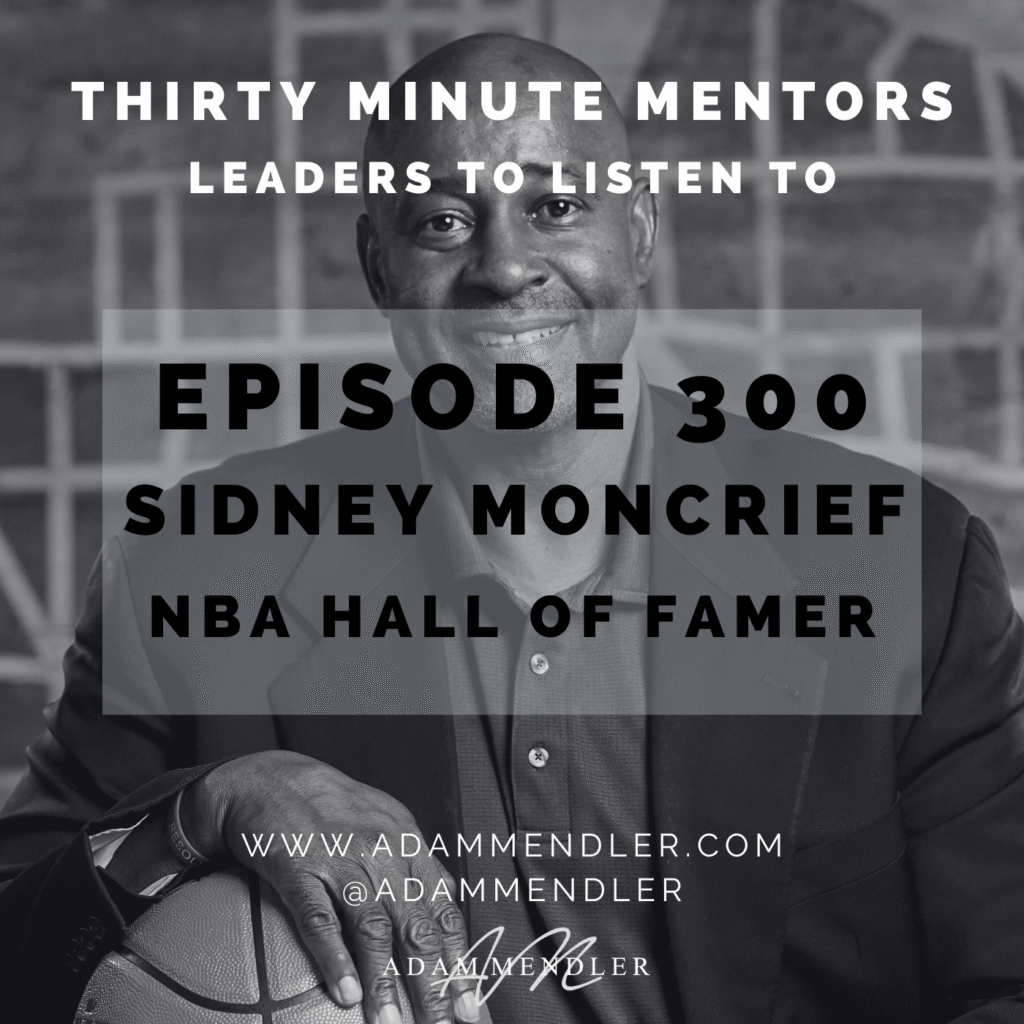
An NBA legend and a member of the Basketball Hall of Fame, Sidney Moncrief was a five-time NBA All-Star, five-time member of the All-NBA team, and two-time NBA Defensive Player of the Year. Sidney joins Adam to share his journey and his best lessons and advice. Sidney and Adam discuss a wide range of topics: leadership, teamwork, the keys to individual and collective greatness, adaptability, resilience, lessons from competing against Michael Jordan and the NBA’s best, and much more.
Join Adam and the best network of mentors – Fortune 500 CEOs, founders of household name companies, Hall of Fame and Olympic gold medal-winning athletes, political and military leaders – for intimate half-hour conversations each week.
Thirty Minute Mentors is available wherever you listen to podcasts. If you enjoy the episode, visit your favorite podcasting app and subscribe, rate, and leave a review, and spread the word by sharing on your social media channels and sharing directly with your friends and colleagues.
Read the full transcript of Adam’s conversation with Sidney Moncrief.
Episode Summary
Sidney Moncrief is a Basketball Hall of Famer, a five-time NBA All-Star, and a two-time NBA Defensive Player of the Year who spent ten seasons with the Milwaukee Bucks. He tells Adam how the principles he now teaches through the acronym GRIT shaped his path from the University of Arkansas to the NBA, and what he learned about leadership, teamwork, and competing against the game’s best players.
Sidney says that when he arrived at Arkansas, traditionally a football school, the basketball program was just starting to turn. Playing for Eddie Sutton alongside Ron Brewer and Marvin Delph, he says, the team simply kept getting better, because a team is built on individuals getting better, and each player came back a little stronger every summer. The Razorbacks reached the Final Four, and in his senior year, he recalls, they lost in the Elite Eight to Larry Bird and Indiana State. He says they won more than 100 games and lost 20 in his four years. His own growth, he says, started with self-awareness: he recalls a game of one-on-one in which Delph, later his Arkansas teammate and freshman-year roommate, outplayed him and showed him that, as an All-State player from Little Rock, he had not arrived.
Sidney explains GRIT as growth, resilience, intentionality, and tenacity. You will fail, he says, and what matters is how you respond. He kept an intentional practice plan for the specific areas he needed to improve, and he told himself that an opponent might have more talent, but would never have more effort. Effort, he says, can be the great equalizer, as long as you work smart and with a purpose, and he adds that work ethic without developing your skills will not get you to your potential either.
In Milwaukee, Sidney credits the Bucks’ leadership, including coach Don Nelson, with picking players from winning college programs who did not accept losing, and with setting high expectations. He says great coaches are transparent, so players can trust their word, and curious about what each player does best. Nelson built his system around his players’ skills, he says, letting Sidney post up as a two-guard and letting Paul Pressey play point forward, and he was one of the first coaches to let big men shoot three-pointers, which Sidney, a self-described traditionalist, first questioned. Sidney’s own rule is to try an idea, and if it does not work, not to do it again.
Sidney says he was not very vocal and led by example, never wanting to come in second in any drill. He says his trademark was outworking people, and his leadership followed it. Asked about guarding Michael Jordan and other greats, he says you cannot stop a great player one-on-one; the Bucks’ defense was set up for him to push a player in a certain direction and for teammates to rotate. He applies that to business, recalling that in his car dealerships he was not a “car guy,” so he brought wholesalers onto the lot on busy Saturdays to price trade-ins. In a draft exercise he used to run in workshops, he says, people often passed over the high performer, though a prima donna, normally a high performer, surrounded by solid players can still make a very good team.
On setbacks, Sidney says he has a very short memory and tries to stay in the present. He says he prepared for Jordan just as he prepared for any other player, and that he never went to a game feeling fear, though he might have felt anxious or ready, because it is just another game. He wants teammates who understand their role, take their craft seriously, and do not blame others. His closing advice is to be curious and honest about yourself and to keep adapting, noting that four or five of the 12 books he says he has written are about reinventing yourself.
What You’ll Learn
- Get better every day, starting with honest self-awareness, Sidney says: losing a game of one-on-one to Marvin Delph showed him he had not arrived and needed to step up his game.
- Expect to fail and focus on how you respond, Sidney says; his GRIT framework pairs resilience with an intentional plan and the tenacity to give more effort than anyone, while working smart and with a purpose.
- Build trust through transparency and build your system around your people’s strengths, Sidney says, crediting Don Nelson for letting him post up as a guard and for making Paul Pressey a point forward.
- Know your strengths and let others fill your gaps, Sidney says: you cannot stop a great player alone, and since he was not a “car guy” in his car dealerships, he brought in wholesalers to value trade-ins.
- Do not pass over high performers because they seem difficult, Sidney says: you can surround a prima donna with solid players and still have a very good team, but a team of average performers is an average team.
- Keep a short memory and prepare for every opponent at your highest level, Sidney says; he prepared for Michael Jordan just as he would for anyone else, and no one got in his head.
About Sidney Moncrief
Sidney Moncrief is a member of the Naismith Memorial Basketball Hall of Fame, inducted in 2019. Born in Little Rock, Arkansas, he starred at Hall High School and the University of Arkansas, where he helped lead the Razorbacks to the 1978 Final Four. The Milwaukee Bucks selected him fifth overall in the 1979 NBA Draft, and he spent ten seasons in Milwaukee before a final season with the Atlanta Hawks. A five-time NBA All-Star and five-time All-NBA selection, he won the NBA’s first two Defensive Player of the Year awards, in 1983 and 1984. He is an author, entrepreneur, and motivational speaker.
Related Episodes
- Episode 110: Basketball Hall of Famer James Worthy
For more on performing when the stakes are highest, James, a three-time NBA champion and Basketball Hall of Famer, discusses leadership and teamwork, the key to performing in big games, and his takeaways from Kobe Bryant, Magic Johnson, and LeBron James. - Episode 314: Former NBA Star Jamal Mashburn
For more on building a business career after basketball, Jamal, a former NBA All-Star, discusses leadership, professionalism, strategic thinking, and building winning teams and cultures. - Episode 93: Orlando Magic Co-Founder Pat Williams
For more on leadership lessons from basketball’s greats, Pat, who co-founded the Orlando Magic, discusses leadership, mentorship, and what leaders can learn from Julius Erving, Charles Barkley, John Wooden, Chuck Daly, and Jerry West. - Episode 13: NBA Legend Rick Barry
For more on what it takes to excel in basketball, Rick, a Basketball Hall of Famer, discusses how to manage pressure, the biggest misconception people have about success, and the most important thing a coach must do to excel. - Episode 319: Basketball Coach Muffet McGraw
For more on coaching and building winning cultures, Muffet, a Basketball Hall of Fame coach who won two national championships at Notre Dame, discusses leadership, building confidence, and handling losing.