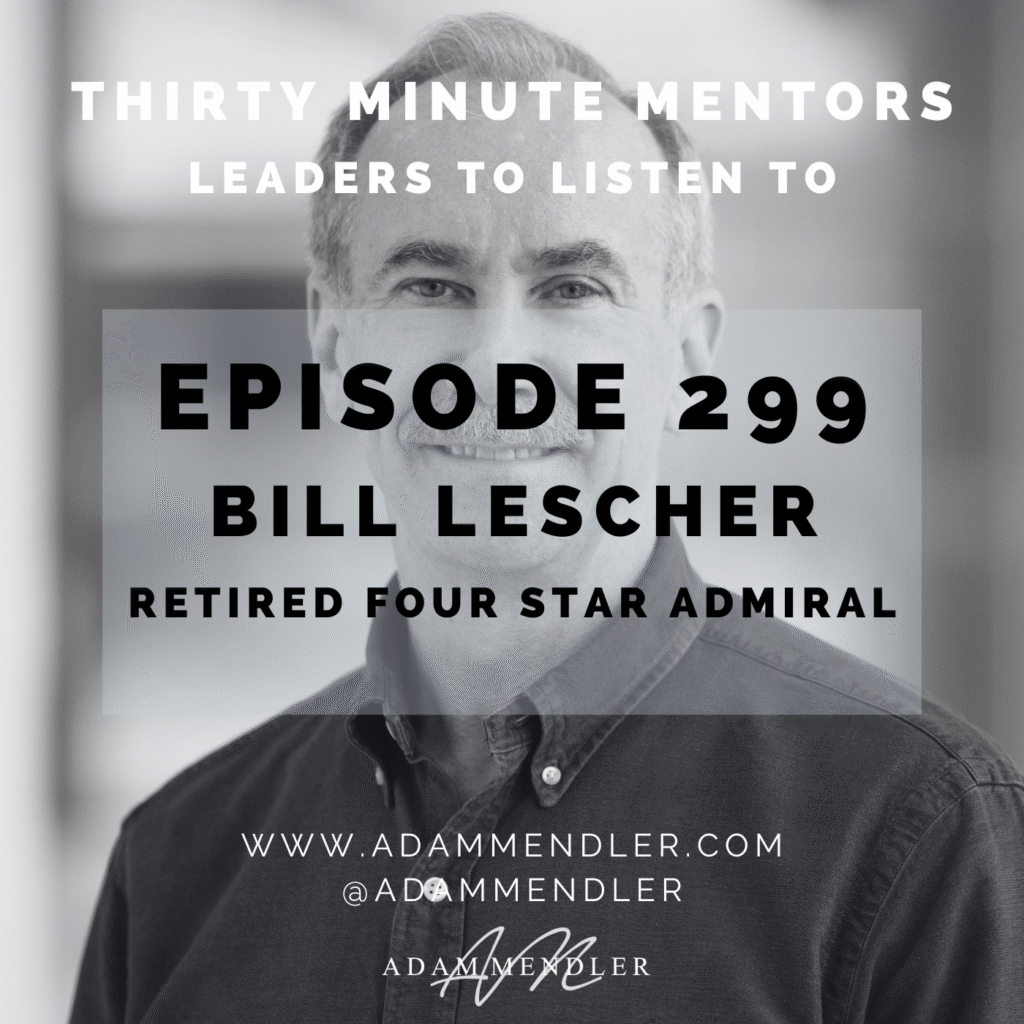
A retired four-star admiral and the former Vice Chief of Naval Operations, Admiral Bill Lescher was the second-highest-ranking commissioned officer in the United States Navy. Admiral Lescher joins Adam to share his journey and his best lessons and advice. Admiral Lescher and Adam discuss a wide range of topics: core leadership principles universal to success, the keys to enterprise-wide leadership, barrier removal in leadership, building a learning culture, motivation, performing under pressure, and more.
Join Adam and the best network of mentors – Fortune 500 CEOs, founders of household name companies, Hall of Fame and Olympic gold medal-winning athletes, political and military leaders – for intimate half-hour conversations each week.
Thirty Minute Mentors is available wherever you listen to podcasts. If you enjoy the episode, visit your favorite podcasting app and subscribe, rate, and leave a review, and spread the word by sharing on your social media channels and sharing directly with your friends and colleagues.
Read the full transcript of Adam’s conversation with Admiral Bill Lescher.
Episode Summary
Admiral Bill Lescher is a retired four-star admiral who served as the 41st Vice Chief of Naval Operations, retiring after 42 years of naval service. He tells Adam how a Highland Park, Illinois, native with no direct family connection to the military became a naval aviator and, later, a senior leader in the Navy’s effort to improve performance across the enterprise, and he lays out the leadership principles behind that work.
Admiral Lescher says his father was an engineer at DuPont for more than 40 years, and his mother returned to school, earned her master’s degree, and worked as a clinical social worker. Sailing a small catamaran on Lake Michigan with his oldest brother, he felt a pull to see what was over the horizon, and the Naval Academy sounded like a great place to see the world before, he thought, probably returning to a more conventional path as an engineer. As a midshipman on a small frigate in the Mediterranean, he was exposed to the LAMPS community, which flies helicopters off the Navy’s smallest combatants, and he went to flight school after graduation. He recalls that his first squadron lost four of its nine aircraft in mishaps and that squadron mates were killed, which taught him early the value of maintenance discipline, flight discipline, and knowing the aircraft in every respect. After test pilot work, a Desert Storm deployment, and, unconventionally, business school, he served four consecutive tours as executive officer or commanding officer of two squadrons, a ship, and a wing.
From those tours came what he calls five pretty important things. Set a few consequential priorities, because allocating bandwidth means allocating risk; his units generally had two, combat readiness and growing leaders. Consistently reward and enforce high standards, because standards are not what is written or said but what we accept. Communicate fearlessly, with the understanding that consensus is neither required nor desired and the goal is a well-informed decision by an accountable leader. Earn trust through action by making others successful and removing barriers. And lead with radical transparency, following what he calls the sunshine theory.
At the enterprise level, Admiral Lescher says, strong unit leadership is table stakes, and cross-functional objectives worked by committee are a recipe for stagnation and failure. He says that in 2017 the Navy, though world-class in force employment, had 300 non-flyable F-18 aircraft and a steady drumbeat of pinnacle-level mishaps over a few years. When he testified as Vice Chief, he says, oversight committees’ recipe was to punish harder; he saw it differently, locating the deficit in how people hold each other accountable in stride every day. That understanding, he says, was the origin of the Get Real, Get Better and Perform to Plan principles and playbook, built on three behaviors: act transparently and embrace the red, focus on what matters most and fix or elevate barriers, and collaborate with clear supported-supporting ownership. He called the resulting operating reviews four-star barrier removal forums, focused on barrier removal rather than blame, and he says learning itself should be valued as an outcome.
He acknowledges these conversations can feel uncomfortable and tells teams that this is what right feels like. To scale the culture, the Navy studied others, including Microsoft under Satya Nadella, and learned it had to roll out from the top down and earn trust. He recalls telling the more senior prospective leaders in a class of upcoming commanding officers to evaluate a subordinate who embraces the red and improves above one who reports all green, every time.
On motivation, he says mission, more than vision, inspires people to take risks. To perform under pressure, be brilliant at the basics and understand what world-class looks like in your key functions. His closing advice is to make others successful, collaborate across boundaries, pair humility with confidence, and measure yourself by the barriers you remove for others.
What You’ll Learn
- Align your team to a few consequential priorities, Admiral Lescher says, because any time you allocate bandwidth and resources, you are allocating risk; he generally gave his units only two, combat readiness and growing leaders.
- Your standards are what you accept, not what you write or say, Admiral Lescher says: walk past a sailor working on an aircraft without protective equipment and say nothing, and you have reset the standard downward; the consequence does not have to be harsh, and is best when it is not.
- Don’t aim for consensus, Admiral Lescher says: ask every stakeholder to speak courageously and marshal the facts, let an accountable leader make a well-informed decision, and then commit to execute it as one.
- Run reviews to remove barriers, not to assign blame, Admiral Lescher says, and when you elevate a barrier, take it to a named individual, never an office, with the change in outcome you expect from removing it.
- Value learning as an outcome, Admiral Lescher says: a team that sets a ten-times goal and misses but illuminates the barriers to it is often more consequential than one that sets and delivers a two-times goal.
- Reward improvement, not all-green reports, Admiral Lescher says: leaders have to role model embracing the red, and he directed senior prospective leaders to rate the subordinate who embraces the red and gets better above the one who reports all green.
About Admiral Bill Lescher
Admiral Bill Lescher is a retired four-star admiral who served as the 41st Vice Chief of Naval Operations from 2020 to 2022, retiring after 42 years of naval service. A native of Highland Park, Illinois, he holds systems and aeronautical engineering degrees from the Naval Academy and Naval Postgraduate School and an MBA from Harvard Business School. An engineering test pilot who launched the first guided missiles from a Navy helicopter, he commanded two helicopter squadrons, the Atlantic Fleet Helicopter Maritime Strike Wing, and Expeditionary Strike Group 5, and served as Deputy Chief of Naval Operations for Integration of Capabilities and Resources. He is a senior advisor for national security at Red Cell Partners.
Related Episodes
- Episode 10: Admiral James Stavridis
For more on leadership lessons from a Navy career, Admiral Stavridis, who served for thirty-seven years in the Navy, including his last four as Supreme Allied Commander of NATO, discusses his core leadership principles and misconceptions about military leaders. - Episode 96: General Robert Neller
For more on leading a large military enterprise, General Neller, who oversaw a $43 billion global enterprise as Commandant of the Marine Corps, discusses leadership, culture, change management, decision making, and performing under pressure. - Episode 231: Former NASA Administrator and Secretary of the Navy Sean O’Keefe
For more on leading large public institutions, Sean, who served as Secretary of the Navy and Administrator of NASA, discusses leadership, career development, motivation, and innovation. - Episode 340: General Gary Brito
For more on team-building and leading change, General Brito, who most recently led the U.S. Army Training and Doctrine Command, discusses leadership, motivation, team-building, and leading through organizational change. - Episode 8: Former Campbell Soup CEO Doug Conant
For more on leading a large organization, Doug, who led the turnaround of Campbell Soup Company as CEO, discusses lessons from his journey to and time inside the C-suite, including leadership, management, success, and failure.