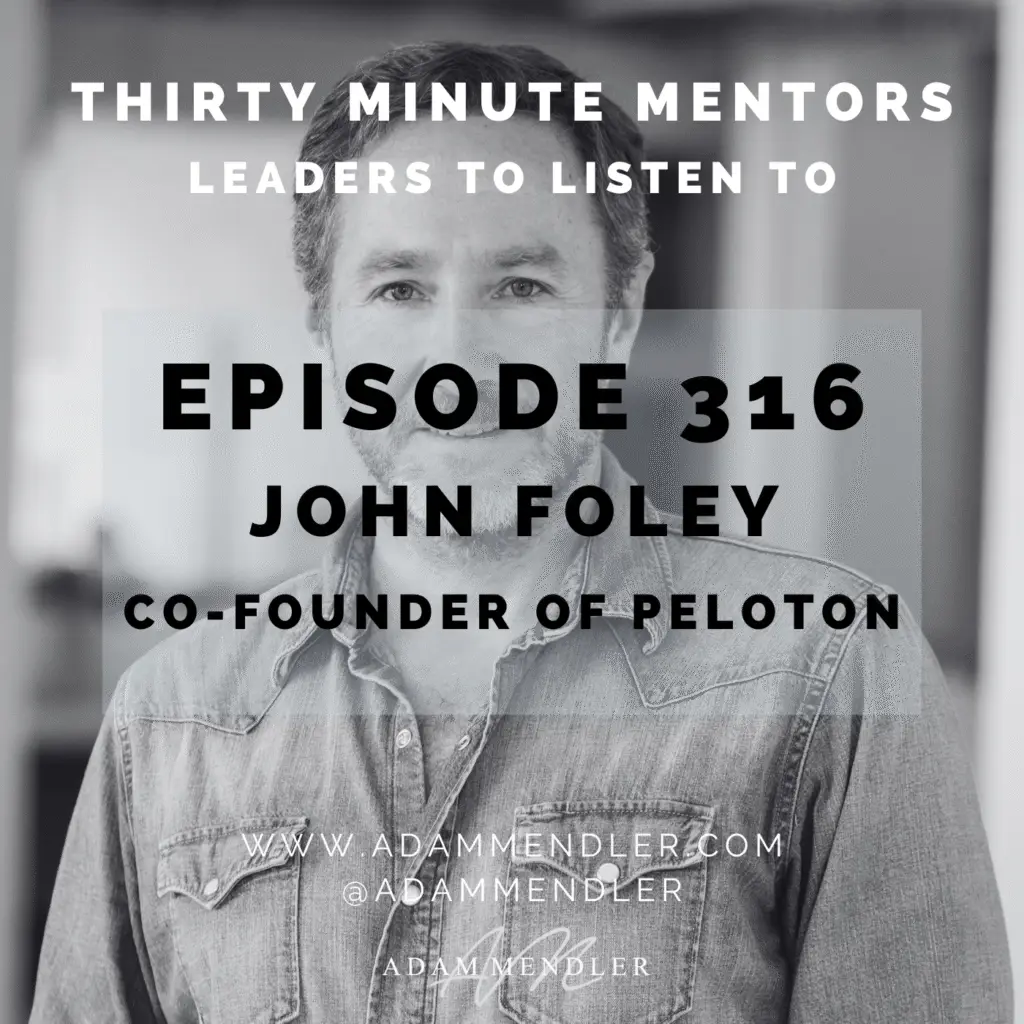
John Foley is the co-founder and former CEO of Peloton – where he built and led a company that changed the way millions of people exercise – and is the co-founder and CEO of the interior design startup Ernesta. John joins Adam to share his journey and his best lessons and advice. John and Adam discuss a wide range of topics: leadership, entrepreneurship, career success, risk-taking, growth and scale, leveraging AI, and much more.
Join Adam and the best network of mentors – Fortune 500 CEOs, founders of household name companies, Hall of Fame and Olympic gold medal-winning athletes, political and military leaders – for intimate half-hour conversations each week.
Thirty Minute Mentors is available wherever you listen to podcasts. If you enjoy the episode, visit your favorite podcasting app and subscribe, rate, and leave a review, and spread the word by sharing on your social media channels and sharing directly with your friends and colleagues.
Read the full transcript of Adam’s conversation with John Foley.
Episode Summary
John Foley is the co-founder and former CEO of Peloton and the CEO of the custom rug company Ernesta. He tells Adam how early jobs and a first management role shaped a leadership style built on getting great people around him and getting out of the way, and what he learned from leading Peloton through the ups and downs of the pandemic.
John says work was always part of his life. Growing up in Key Largo, he worked at McDonald’s and delivered pizzas at Domino’s to pay for gas to drive his dad’s old pickup truck 45 minutes to the nearest public high school. He later worked in manufacturing at Mars in Waco, Texas, where he says a culture of egalitarianism and self-led, empowered teams allowed him, as a 22-year-old manager of 120 people, to lead by learning from people who had been on the floor for decades.
John says leaders should build people up rather than browbeat them. Citing the no a-hole policy in Netflix’s culture deck, he says a whole leadership team has to be net builders of confidence, because startups bring a daily emotional whipsaw. He tells his son, who is preparing for college, that he is smart enough to get in the room, and from there it is all about hard work and teamwork. John recalls a TV program in which Dean Smith, Michael Jordan’s coach at North Carolina, said Jordan flat-out outworked everyone, and he says he has tried to make working hard and leading from the front a hallmark of his career.
John does not consider his corporate career a success by his own framework. He says he worked directly for Barry Diller for five or six years and later reported to the CEO of Barnes & Noble, but felt the work was not that soulful, not that lucrative, and safe. At 40, he says, he was ready to take risk and go after the Peloton opportunity, which he says turned out to be less fundable than he expected, or he was a terrible fundraiser. During COVID, demand went through the roof, then fell when people wanted to travel again. Unlike Zoom, he explains, Peloton had to make twice as many bikes and treads and expand logistics and manufacturing, and maybe retail stores, to double in size, and that fixed cost became a liability on the way down, which he says eventually cost him his job and cost shareholders a lot of money. He adds that it is hard to be a public company.
At Ernesta, John says the team is more conservative, avoiding its own fixed cost and vertical integration by buying through suppliers and importers in the U.S. rather than going to mills in India. He has brought over former Peloton leaders, including CTO Yony Feng, and he looks for categories that matter but are not sexy: people called fitness equipment and rugs dopey categories, and he saw the opportunity. His formula for scaling is to define the challenge, assemble a capable team, and raise the capital. He also uses a John Foley agent he built in ChatGPT, which he says has read Harvard Business School cases and books by great business leaders, to think through strategic decisions.
John says the best leaders combine kindness, compassion, and low ego with being hyper smart, hyper competitive, and having a chip on their shoulder. His advice is not to be in a hurry: he says he was 40 when he started Peloton and had read hundreds, maybe thousands, of books about leaders, and he recommends Call Me Ted and Shoe Dog because learning what you don’t want to be is as important as learning what you do. Before starting a company, he says, wait for the right idea, experience, a network to fund it, and partners ready to leave their day jobs. His final advice, which he credits to Will Smith, is to read more and run more.
What You’ll Learn
- Get great people around you and get out of the way, John says: he learned it at 22, managing 120 people at Mars, where the culture asked managers to empower teams to lead themselves.
- Build people up instead of breaking them down, John says, and make sure everyone at the leadership table is a net builder of confidence, which is why he cites the no a-hole policy from Netflix’s culture deck.
- Being smart gets you in the room, but from there it is all about hard work and teamwork, John says, pointing to how Michael Jordan flat-out outworked everyone.
- Look for big opportunities in categories that are off people’s radar, John says: people called fitness equipment and rugs dopey categories, and that is exactly where he saw the opportunity.
- Think hard before taking on fixed cost and vertical integration, John says: the capacity Peloton built for pandemic demand became a liability when demand fell, so Ernesta works through suppliers and importers.
- Don’t be in a hurry, John says: read widely, learn from leaders’ flaws as well as their strengths, and consider starting a company when the right idea, experience, network, and partners come together.
About John Foley
John Foley is the co-founder and former CEO of Peloton and the CEO of Ernesta, a custom rug company he launched in 2022 with fellow Peloton co-founders Hisao Kushi and Yony Feng. He co-founded Peloton in 2012 and served as its CEO for 10 years before becoming executive chair in February 2022, a role he resigned in September 2022. Before Peloton, he was president of e-commerce at Barnes & Noble, president and CEO of Evite, and director of operations at Citysearch. He holds an engineering degree from Georgia Tech and an MBA from Harvard Business School.
Related Episodes
- Episode 300: NBA Hall of Famer Sidney Moncrief
For more on what separates the very best, Sidney, a Basketball Hall of Famer and two-time NBA Defensive Player of the Year, discusses teamwork, the keys to individual and collective greatness, and lessons from competing against Michael Jordan and the NBA’s best. - Episode 107: Beachbody Co-Founder and CEO Carl Daikeler
For more on building a fitness business, Carl, the co-founder of Beachbody, discusses sales, marketing, product development, leadership, and how to get into and stay in great shape. - Episode 124: SoulCycle Co-Founder Julie Rice
For more on building a fitness brand, Julie, the co-founder of SoulCycle, discusses how and when to pivot, the keys to building a highly successful business, and how to approach hiring and relationship building. - Episode 271: Venture Capital Pioneer Alan Patricof
For more on venture capital and entrepreneurship, Alan, the co-founder of Apax Partners and Greycroft, discusses leadership, investing, failure, and success. - Episode 136: Overstock CEO Jonathan Johnson
For more on leading through ups and downs, Jonathan, who led Overstock as CEO, discusses leading in times good, bad, and uncertain, reinventing yourself and your business model, and building winning teams and cultures.