

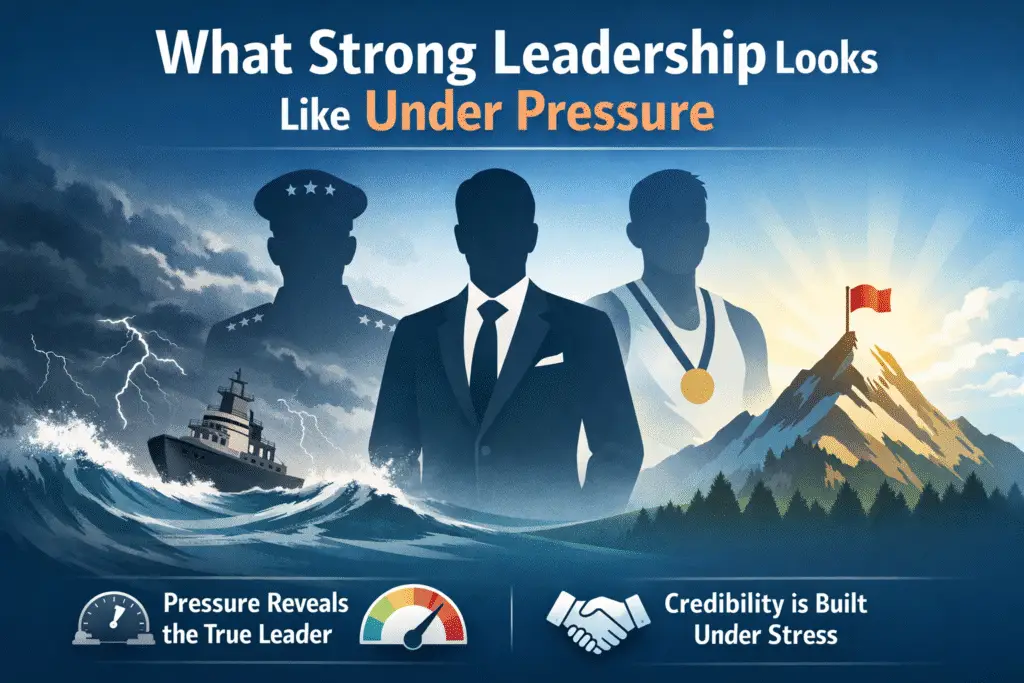
Over the years I have spent hosting Thirty Minute Mentors, I have sat down with some of the most battle-tested leaders in the world: military generals, Fortune 500 CEOs, Olympic athletes, and founders who guided their organizations through storms most people never see coming. Across all of those conversations, one thing has become unmistakably clear: the true measure of a leader isn’t visible when things are only going well.
Pressure is the great revealer. It strips away the polished communication and the confidence that comes easily when results are strong. What it leaves behind is the real leader, and what that leader does in those moments shapes everything from team trust to long-term performance. That gap between who you are in good times and who you are under pressure is where leadership credibility is either built or quietly lost.
If you want to bring leadership insights to your organization, reach out to me directly at connect@adammendler.com .
Why Pressure Exposes the Truth About Leadership
I have noticed something consistent across my high-stakes conversations on Thirty Minute Mentors and Leadership Today. The leaders who earn the deepest respect from their teams are rarely the ones who performed best when everything was working in their favor. They are the ones who held themselves together when it was not. Leadership under pressure does not care how good you look on a good day. It only cares about who you actually are.
1. Pressure Strips Away the Performance
Most leaders spend years building a certain image: someone who is calm under fire, decisive in the room, and always a step ahead. And honestly, when things are running smoothly, that image is not hard to maintain. But that image can quickly fall apart the moment real difficulty shows up. A failed launch, a key person walking out, a situation with no good options. Those are the moments your team stops looking at the image and starts seeing the actual person. That gap is where your real reputation as a leader gets built or gets damaged.
2. Your Team Is Watching More Closely Than You Think
Something I have come to understand deeply through both my own experience on teams and leading teams and through my conversations with leaders at every level is that teams are far more perceptive than most people at the top give them credit for. They are not just watching what you say during a hard stretch. They are watching your body language in the hallway, the tone of your emails, and whether you show up differently when the numbers are not where they need to be. When a leader unravels under pressure, even slightly, that signal moves through an organization faster than any official communication ever could.
3. Composure Is a Choice, Not a Trait
The leaders who carry themselves with genuine steadiness during difficult moments are not built differently than anyone else. They have just made a decision, repeatedly and in advance, about how they intend to show up when things get hard. That decision, made before the pressure arrives, is what most people are actually seeing when they admire someone’s composure.
Curious how your leadership holds up when the pressure is on?
My free leadership assessment is a short diagnostic designed to show you exactly how your leadership is showing up in the moments that matter most.
Take the Free AssessmentWhat Strong Leaders Actually Do Differently Under Pressure
There is a clear difference between leaders who survive pressure and leaders who lead through it. Understanding how leaders handle pressure at the highest level comes down to a set of deliberate habits that hold up when the environment around them stops being predictable, and those habits are learnable.
1. They Control Their Response, Not the Situation
The best leaders I have been around are not distinguished by their ability to control outcomes. They are distinguished by their ability to control themselves. When I spoke with General Tim Haugh on Thirty Minute Mentors, one of the things that resonated most was his recognition that in high-pressure environments, a leader’s response to a situation often determines the outcome more than the situation itself. Strong leaders recognize they cannot always choose what happens to them, but they can always choose how they respond.
2. They Communicate With Clarity When It Is Hardest
The instinct in a crisis is to go quiet and wait until the picture is clearer. That instinct is one of the most costly mistakes a leader can make. When people are operating in uncertainty, silence from leadership does not read as thoughtfulness. It reads as a lack of direction. The leaders I most admire communicate early and honestly, not because they have all the answers, but because their teams need to know someone is in front of the situation. Research from Harvard Business Review consistently shows that transparent communication during uncertainty is one of the most critical drivers of team trust. You can also read more in my post on how to improve leadership communication across distributed teams.
3. They Make Decisions Without Waiting for Certainty
Pressure often creates a paralysis that looks like prudence from the outside. Leaders tell themselves they are waiting for more data, when what is actually happening is that the weight of the decision is too uncomfortable to move through. Strong leaders understand that a timely, imperfect decision almost always outperforms a delayed, perfect one. Research from Harvard Business Review consistently reinforces this principle when studying how leaders perform under real pressure.
That ability to move forward with confidence when certainty is unavailable separates the leaders who perform under pressure from those who simply endure it.
How to Build Your Leadership Resilience Before the Next Crisis
Building leadership resilience doesn’t necessarily happen in the middle of a crisis. That is the part most leadership conversations skip over. By the time the pressure arrives, the window for preparation has already closed. What I have seen consistently across my conversations with leaders who perform well under real adversity is that they were ready long before anyone knew they would need to be.
1. Resilience Is Built Before the Crisis Hits
It is natural to think resilience is something that shows up when you need it. Through my conversation with the most successful leaders, I have come to understand that is simply not how it works. The leaders who hold up under genuine pressure built that capacity through the unglamorous, everyday work of knowing themselves well, reflecting honestly after hard moments, and refusing to let small difficulties pass without learning something from them. Developing true leadership resilience begins in the ordinary moments, not the dramatic ones. If you are waiting for a crisis to find out how resilient you are, the preparation is already overdue. I explore what that daily foundation looks like in my post on how great leaders build cultures that people love.
2. The Trust You Build Today Holds You Up Tomorrow
When things go sideways, the first thing a leader reaches for is the trust their team already has in them. Not a plan, not a framework, not a communication strategy. And here is the thing about trust: you cannot manufacture it under pressure. It was either built before the moment arrived, or it was not there at all. The leaders I have spoken with who navigated genuine crises with their teams intact were almost always the ones who had invested in those relationships consistently, in the ordinary moments that most people treat as unremarkable. My post on leadership skills every new manager needs to succeed goes deeper on exactly how that foundation gets built.
3. Every Hard Moment Is a Leadership Rep
One perspective shift I have found genuinely valuable, and that I have heard echoed by accomplished leaders across hundreds of interviews, is treating every high-pressure moment as a development opportunity rather than a threat to be survived.
The difficult conversations, the tough calls, the periods of real uncertainty: each one builds leadership strength if you approach it with the right mindset. Leaders who reflect honestly after hard moments and carry those lessons forward are the ones who get measurably stronger over time, something McKinsey’s research on resilience directly supports.
Bringing these conversations to your team is something I genuinely love doing.
My keynotes and workshops are grounded in real experiences and real leaders, not theory, and they are built to move people at every level of an organization.
Book a Keynote for Your Next EventConclusion: The Leader Your Team Needs When It Matters Most
Dick Vermeil told me something on Thirty Minute Mentors that I have thought about many times since then. When I asked him about the most demanding stretches of his career, he did not talk about tactics or game plans. He talked about knowing who he was and what he stood for before things got hard. That foundation, built quietly over years, was what allowed him to lead with clarity when everything around him was uncertain.
That is the real answer to what strong leadership under pressure looks like. It is not a skill you develop at the moment. It is the sum of every decision you made, every standard you held, and every relationship you invested in long before the pressure arrived. The leaders who show up best for their teams in the hardest moments are the ones who did the work when nobody was watching. To connect or explore how I can bring these ideas to your organization, reach out at connect@adammendler.com .
FAQs
1. What does leadership under pressure really look like?
Honestly, it looks a lot less dramatic than most people expect. It is a leader who stays present when others are panicking, who communicates with honesty when the easy move would be to go quiet, and who takes ownership when pointing fingers would be far simpler. The leaders who do this well are not extraordinary people. They are people who made ordinary choices consistently enough that the right response became second nature when it mattered most.
2. What skills help leaders stay calm under pressure?
The ability to regulate your own emotional response is the foundation everything else is built on. Without that, clear communication and sound decision-making both fall apart. Beyond self-regulation, the leaders who stay calmest under pressure are almost always the ones who built genuine trust with their teams before the pressure arrived. That trust removes a layer of friction that can make an already difficult situation feel unmanageable.
3. How does pressure reveal a leader’s true character?
It removes the conditions that make good leadership feel easy. When resources are tight, timelines are broken, and the path forward is unclear, a leader has nothing left to rely on except what they have actually built in themselves. That is when you find out whether the values they talk about in meetings are the values they actually hold, and whether the culture they say they are building is the one their team has actually been living.
4. How can leaders build resilience for high-pressure situations?
Start by getting genuinely honest about how you show up when things get hard. Most leaders skip that part because it is uncomfortable. From there, treat every difficult moment you encounter, even the small ones, as a real opportunity to practice the response you want to have when the stakes are higher. Resilience is not something you find when you need it. It is something you build quietly, consistently, and well in advance.