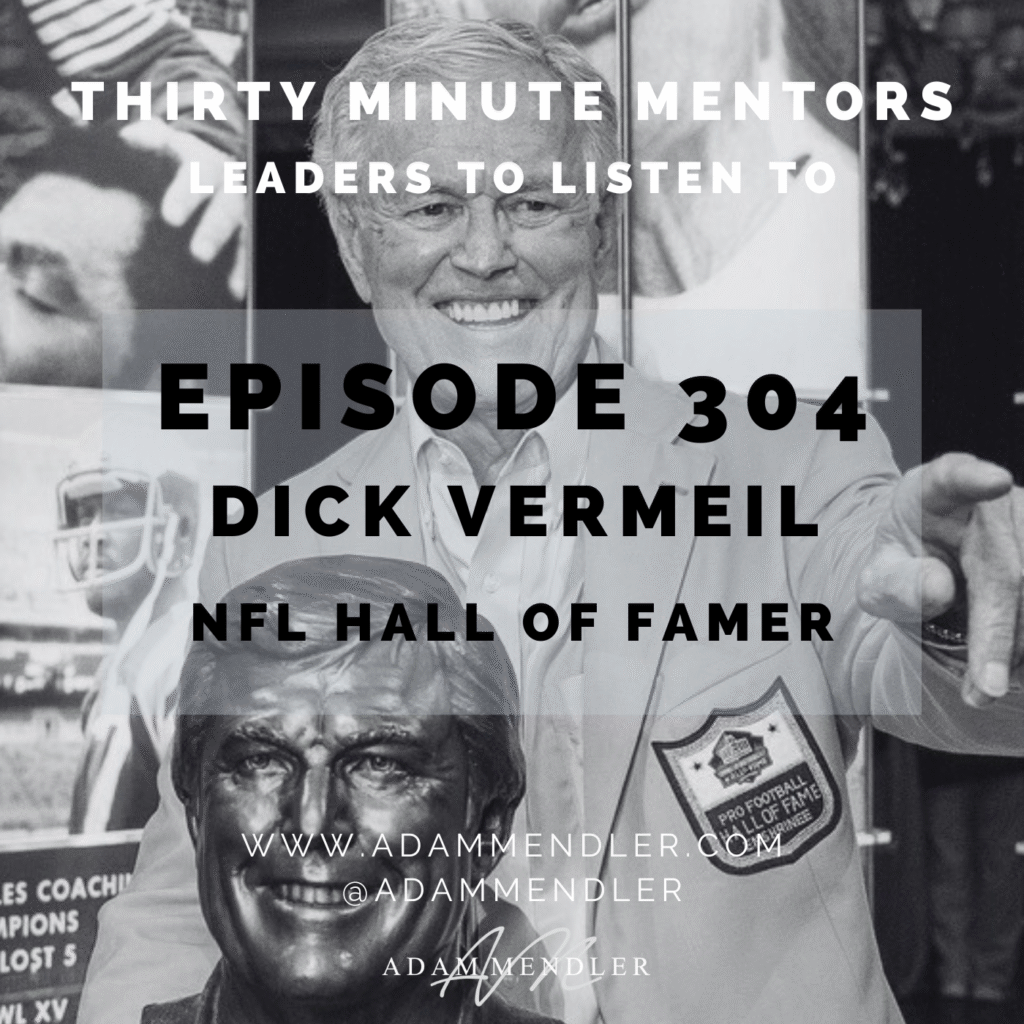
I recently interviewed NFL Hall of Fame Coach Dick Vermeil on my podcast, Thirty Minute Mentors. Here is a transcript of our interview:
Adam: Our guest today is a coaching legend and a member of the NFL Hall of Fame. Dick Vermeil spent more than four decades coaching and broadcasting football, leading the Rams to a historic Super Bowl Championship along the way. Dick, thank you for joining us.
Dick: Hey, my pleasure. Thank you.
Adam: You grew up in Northern California, and you played football and coached football in Northern California until you were in your early thirties, when you landed your first job in the NFL as a special teams coach with the Rams.
Dick: Right, very first guy ever hired to coach special teams. That was 1969. George Allen was an innovator. I was part of his innovation.
Adam: Can you take listeners back to those early days? What early experiences and lessons shaped your worldview and shaped the trajectory of your success?
Dick: I have always felt that I had an advantage once I got into big-time coaching, having had the experience of being an assistant coach in high school, a head coach in high school, an assistant coach in junior college, a head coach in junior college, an assistant coach in college, and a head coach in college before I got into the NFL. You learn to grow as a leader. You learn what you believe in as it matures, because you do not start out with an automatic philosophy. You build it as you go along and learn from the people you are coaching.
I learned an awful lot from coaching high school, actually from coaching high school swimming as well, working with individuals in events like that. It really helped me gain a deeper understanding of the total growth of a person. Everyone matures at a different rate. There is no correlation between age and maturity, but you learn so much from people. It gave me an opportunity to learn what works for me and fits my profile as a person, especially in connecting and communicating with people.
When I went into the Hall of Fame, six of my starters from my Hillsdale High School Championship team in 1961 were there wearing Hillsdale High School blue T-shirts. You learn how to work with people at every age group, and it gives you a good composite of information about what people are all about as they mature. I think that really helped me.
Adam: It really speaks to the power of relationships, to have players from those early days showing up at your Hall of Fame ceremony, showing up wearing their high school uniforms from back in the day.
Dick: They are in their early eighties now. I still call them kids. To me, I was a relationship coach. You have to be who you are, and you cannot be who somebody else is who was very successful in his own way, in his own process. You have to be who you are. I have always really enjoyed the relationship side of it.
A lot of my former players are very close friends of mine, and some of them are now widows. I had dinner with Bill Birdey’s widow last week. I cherish those deep relationships because they were the ones who put me in the Hall of Fame. They were the ones who won a Super Bowl. They were the ones who won an NFC Championship. These are the kinds of things that I take very seriously. When I hear players say, “I played for Coach Vermeil,” that really touches me.
Adam: What are the keys to building winning relationships?
Dick: I think being honest and not being afraid to let them know who you really are. You do not need a façade. They have to understand who you really are as a person, not so much as a coach.
My wife and I, from high school days on, fed most of the kids that we have ever coached, all the way into the NFL in the offseason. It is amazing how much you learn about kids when they do not have shoulder pads on and they are not in the meeting room or in your office. At your home, they are another person. I have learned a lot about kids in that environment, and I have enjoyed it.
I think I have gained insight into kids that has helped me help them be what they really want to be, but did not yet know how to do it. I always believed you make them better and tougher on the field, and you make them happy off the field. That is the way we operated. You teach people to hold themselves accountable. I always felt that if we did a great job in coaching and developing relationships and structure and discipline, the players would take their jobs so seriously that they would hold themselves accountable. They would not need someone over the top of them demanding accountability. They did it because they took pride in being part of the organization and enjoying the relationships with the coaching staff and the rest of the team. It worked for me. I am sure there are other ways to do it better, because I have coached against some of those guys, and they kicked my rear end. But to me, relationship building was a very big part of my whole philosophy. I did not organize it to be that way. It just became that way.
Adam: And what it really comes down to is that a great coach views players as people. A great leader views employees as people, not numbers on a spreadsheet, not a means to an end, but human beings.
Dick: I agree. I used to tell my coaches, “You take good care of your people, and they take good care of you.” It is so true. When a player really feels bad about what he did not do well that day on game day and takes it upon himself to make sure he does not do it next week without you chewing him out or demanding more, you have developed a depth within the program. You get a commitment from people that comes from within. When it comes from them, it is amazing. It is amazing when someone finds out what he can do that he never thought he could do, how it enhances the rest of their life and starts a pattern of growth emotionally, technically, and intellectually that might never have happened if they did not do it on the football field.
Adam: And that right there is at the essence of great coaching and great leadership, being able to get people to do what they did not think they were capable of doing.
Dick: How do you do that? First, you have to teach them that hard work is not a form of punishment. It is a solution, especially for younger kids today. It was not so much that way when I first started coaching, because each generation raises the next generation not to work as hard as they did. I do not know why, but I did not work as hard as my dad. My kids did not work as hard as me. My grandkids do not work as hard as my kids. It is almost a degeneration in work ethic.
I love people who like to work. Especially as I advanced in coaching, I never wanted to put myself in a position to try to outsmart somebody. How can you come into the NFL with Tom Landry and Don Shula, Don Coryell and George Allen, Bud Grant, Bill Parcells, and all those guys coaching football, and think you are going to outsmart them? No, I never wanted to put myself in that position. But I thought I could get my staff and myself and my organization to outwork them.
When we came to the Eagles, we did not have a choice. We did not have first-, second-, or third-round picks the first two years, and they had been losing. We did not have a first- or second-round pick my third year. So you had to do it through work. In the old days, a coach could control the practice schedule, the contact level, the amount of time they were on the field, and the amount of double days. That is all controlled by the players’ union now, and in a way, it is best for the player, but not best for the total improvement of an individual player or a team. I just really tried to teach people that the best way to be the best you can be is to work very, very hard.
Adam: What can you control? What can’t you control? You can’t control how talented you are. You can’t control what gifts you naturally have. You can control how you show up every day. You can control your work ethic. You can control your attitude. You can control your mindset. Focus on what you can control. That is what the greats do.
Dick: That is the leadership job, the coach’s job. You go into a season, you recognize your strengths and weaknesses. What you try to do is make your strengths stronger and your weaker people better. Sometimes you are like last year’s Eagle team. They did not have a weakness in the starting lineup. They had nobody to hide. They were all excellent and extremely well-coached. They won the world championship.
John Wooden used to say, “If you have a better team, make sure you do not screw them up. Let them be the better team. Do not over-coach them. Do not over-restrict them. Let them be what they have the ability to be and then gradually enhance what they do from a technical standpoint.”
When I left coaching in 1982, it was totally different from when I came back in 1997. The size of the players was totally different. They were bigger and faster. The volume of what kids could consume in terms of a scheme was much greater, and you demanded more. You had more meeting time. You had OTAs, which we did not have. You had free agency, which we did not have in the early days. So in the old days, the only way you improved the team was your own draft, if you had it, and making the players you had better, and signing players cut from other rosters or considered too old and ready to retire. You talked them into playing a couple more years. Today, it is totally different, which in some ways makes it easier to build a team, but everybody has those same tools.
I have always leaned back to finding a way to make hard work fun for them and to help people realize the value of every day’s concentration on getting better and assuming responsibility for their own performance. You have to do all the little things that they did not know how to do until you taught them.
I have always said, “Players do not care how much you know until they know how much you care.” That is true today. You can build a team through adversity, through hard work, and through the process of elimination. I invested a lot of time helping kids I cut get on other rosters. The relationship part of a team is so valuable today.
Adam: Working hard, working together, working toward a common goal, something you mentioned that is essential: players show up for coaches who care, and people show up for leaders who care.
Dick: That is the heart of all of this. You and your staff must be examples. You have to build a locker room filled with good examples. If you sit next to someone who gives everything he has, you feel good about it. But if you sit next to someone who is just gifted and not giving his all, everyone knows.
I have sat in NFL locker rooms while broadcasting, two days before a game, and players told me that. It helped me gain a deeper understanding when I returned to coaching. You need good examples in that locker room. You need everyone committed to one way of doing things.
You see players sometimes lose a game because they celebrate before crossing the goal line. That is a mindset problem. You fix that long before it happens through culture, training, and discipline.
Adam: You mentioned something interesting, which is the motivation that some players have. Players in the NFL and people in all professions have different motivations. One player might be motivated by winning, another by glory, another by money. As a coach, you have to motivate every person in the locker room, and people have different motivations. What are your best tips on motivation?
Dick: People used to ask me that, and I have been given credit for being a good motivator. I appreciate that and accept it, but I think I was a better evaluator. You surround yourself with people who are already motivated, who have that burning desire to excel.
The desire can come from wanting to be something their family never had and to provide for them in ways they never could. Buy your mother her first home. I bought my mother a Cadillac in 1979. She had always dreamed of owning a Cadillac. It cost $11,000 at the time, which was like giving her a million dollars.
But the real deep motivation comes from a desire to be the best you can be. Sometimes it comes from the environment you grew up in. You want to be better than the circumstances you were raised in, and then you want to go back and make a difference in the lives of the people who made a difference in yours. Some of the best kids I ever coached came out of environments that would shock you because they could have easily taken a different path but made the right decision.
We always tried to build an atmosphere that people enjoyed being in, even when they knew it was going to be tough. Our guys used to tease me all the time about our training camps because they were tough. I would say, “You know it is going to be tough Sunday. It is first down and goal to go, and they have the ball. You have to stop them on four downs or they beat you.”
If they came into the building excited about walking in, putting on their helmets, sitting next to the guy they were going to battle against in practice, and doing it all full speed, then we did our job. I always emphasized building an atmosphere where players could truly enjoy being there, even when it was hard and insecure, because in football, there are no guarantees.
I always told my coaches to tell players the truth. Some people ask questions because they want to hear what makes them feel good, but the truth is what helps people. Sometimes they resent it at first, but in the long term, they respect it. When people see that honesty spreading through a locker room, it strengthens the belief and trust within the team.
A great example right now is the Detroit Lions. They are leading the league in scoring, and they do it as a team. They play hard, disciplined, structured football. Great leadership and demanding leadership, and the players love it.
I once made a mistake after winning the right to play in the Rose Bowl. I told my team we were going to have fun going to the Rose Bowl. We were given 15 days to practice, and I accepted the 15 days, but no one said we could not practice twice a day. Halfway through, the players came in and went on strike. My captain said, “Coach, we have a problem. We are not practicing today.”
So I went in and dealt with it. That team had already beaten us earlier in the season, scoring more than 40 points. We were 16-point underdogs. We went back to work, doubled up on practices, and we beat them. Years later, when we are together, all those players talk about that strike and what they learned from it. Those are the lessons that shape teams and build trust.
You cannot bend when you lead. Look at Bill Belichick. His coaching of Tom Brady was just as disciplined and structured as his coaching of a third-string lineman. Everyone was held to the same standard. That is what it takes.
Adam: You shared so many critical lessons there, the importance of building trust, honesty, feedback, and creating an atmosphere that people are going to want to show up to every day.
Dick: Yes, people want to be part of something special. But it is hard to hang on to once you get to the top. Especially in the NFL, everyone wants to beat you. When you are the champions, every opponent plays their best game against you. Handling success can be as difficult as handling failure.
Adam: What goes into building that environment and maintaining it over time?
Dick: Everyone now talks about culture. When I was coming up, we called it team chemistry. Culture evolves from how you do everything, not just one thing. It is in how you talk to your team, how your assistant coaches carry the same message, how everyone in the organization operates.
The presentation and personality of each coach may differ, but the message must be the same. And it always has to be backed up by the boss, the head coach, the GM, the CEO. I have spoken to so many CEOs over the years who face the same issues as football coaches, getting everyone to do what they are paid to do, doing it well, doing it for the right reasons, and enjoying it so the whole organization can succeed.
You will not win every battle, but if everyone could fit on the bus, the bus would be too big or too easy to get on.
Adam: What do you believe are the key characteristics of the very best leaders, and what can anyone do to become a great leader?
Dick: The very best leaders have a deep belief in what they do. They have a deep belief in how they do it. They surround themselves with people who can learn, adopt their philosophy, and then sell it to others. Everyone has to know what the plan is, but before they believe in the plan, they have to believe in you.
You have to define what you are about, your value system, and your purpose. Why are we doing this? Why are we working this hard? Why are the meetings this long? Once you answer those questions and put the concepts in place, you have to stay with them, even through losing.
When I took over the Rams, we lost eight in a row my first year. That is hard to do. You almost have to try to lose eight in a row. But by 1997, they had lost more games in the 1990s than any other team in football. Three years later, they were world champions. Only nine players from that 1997 roster were still with us on game day.
It all came together because of belief, evaluation, and persistence. I always tried to hire people smarter than me. I never wanted to outsmart others, just outwork them.
When you build a team of people who buy in, success follows. I have coached in and won championships at every level, high school, junior college, college, and the NFL. I have also lost, but every experience taught me the same thing: surround yourself with people who share your purpose, keep the main thing the main thing, and stay committed to that purpose every day.
Winning is not complicated. People complicate it. I told that to Bobby Knight once. Later, he told me he had been thinking about that line all season. He understood what I meant, that the more you can simplify, the better.
It is harder today with social media and distractions, but the principles have not changed. The best leaders stay authentic, consistent, and committed to their values.
Adam: You mentioned coaching in the biggest games, in high school, in college, in the NFL, winning championships, leading players to perform at their very best in the biggest moments. What are the keys to performing under pressure, performing in the biggest games, performing in the biggest moments?
Dick: For some people, pressure is not a problem. It is almost part of their personality. I will go back to Kurt Warner. There is no way you could predict that he would play the way he did until you put him under pressure.
I once sat in a roundtable with military officers at Fort Leavenworth discussing how they evaluate who will be a great leader in battle. It is almost impossible to predict. Some people just have it in them.
As a leader, you have to recognize clues about each person. Some surprise you positively. Some negatively. The key is to observe how people handle adversity. That tells you a lot about how they will handle pressure.
You also create pressure in practice, through the tempo and demands of preparation, day after day, year-round. When you teach players that work and discipline are normal, pressure becomes familiar.
When we upset the number one team in the country, Ohio State, we were 16-point underdogs. If we had played them five times, they would have beaten us four. But not that one. That day, almost every player on our team had his best game on the same field, at the same time. That does not happen by luck. It comes from preparation, belief, and the environment you build over time.
Adam: You mentioned that there are clues that help you detect whether someone will excel under pressure or fold under pressure. What are some of those clues?
Dick: You have to be around someone enough to see how they handle adversity. Watch how they react when things go wrong.
In the NFL, you see teams come back from big deficits all the time. That is a reflection of leadership and mental toughness. Those players handle adversity well because it has been built into their culture.
Look at Baker Mayfield. He has been with multiple teams, but now he might be the most valuable player in the league. What changed? Someone believed in him, built a room full of people like him, and created an environment where he could lead and thrive. That is part of leadership, recognizing those people and putting them in the right situations.
Adam: Dick, what can anyone listening to this conversation do to become more successful personally and professionally?
Dick: Become who you are for unselfish reasons. I never had a football agent. Maybe that is wrong from a business standpoint, but I did not want anyone between me and the owner. I coached three NFL teams and was never fired.
Relationships matter, with people above you and below you. John Ralston taught me that when he built Stanford into a powerhouse that won back-to-back Rose Bowls. Everyone in the organization must be on the same page, from ownership and management to coaches and players.
You cannot win a Super Bowl without a full team. At the Rams, I needed Mike Martz, Jim Hanifan, Al Saunders, John Bunting, Wilbert Montgomery, all of them. Success takes a whole group working as one.
It becomes contagious in a positive way. I always loved seeing former players years later and hearing them repeat lessons we taught them, values that became part of who they are. That is how you know you have done something lasting.
Great organizations in any field are the same way. You walk in and can feel it. Everyone is aligned, from top to bottom. It starts with caring about people and building an atmosphere where they can care too.
There is no substitute for being authentic, honest, and accountable. The best leaders are instinctive, decisive, and self-aware. They make mistakes, but they admit them. They surround themselves with people who make them better and let those people shine.
I always say I am just an exaggerated high school football coach. Coaching in the NFL never changed who I was. I have been very fortunate.
Adam: We are fortunate to have had you on Thirty Minute Mentors. Thank you for all the great advice, and thank you for being part of Thirty Minute Mentors.
Dick: Thank you for the opportunity.