

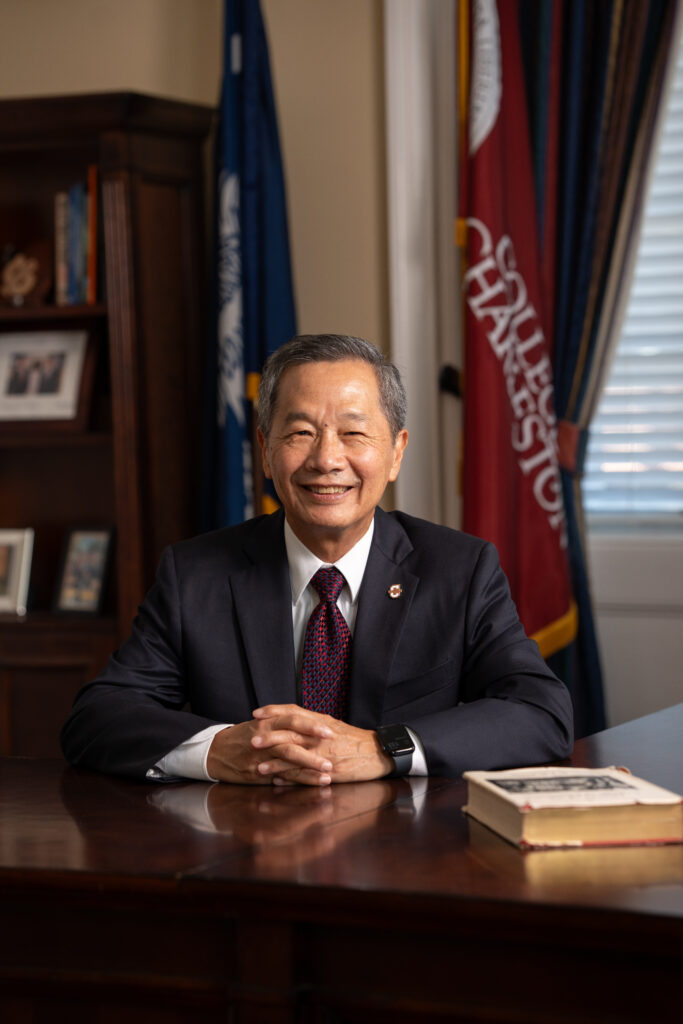
I recently went one-on-one with Dr. Andrew Hsu, President of the College of Charleston,
Adam: What were the best lessons you learned from your time working as an engineer?
Andrew: I think the 10 years that I spent working either for NASA or in industry really gave me a sense of what the real world needs in terms of the next generation of engineers. Once I realized that my calling was in the classroom, those 10 years of experience became incredibly valuable in teaching and education. The biggest takeaway for me was that in industry and in the real world, you need real-world knowledge. You need the real-world ability to solve problems, not just an understanding of theory, but an understanding of practice as well.
Adam: What drove you to switch from working as an engineer to pursuing a career in a university setting?
Andrew: Initially, it was really just boredom. I was bored working in industry and was looking for something more interesting to do. Then I found out that Purdue Indianapolis was looking for an adjunct faculty member, so I started teaching. I taught for two years as an adjunct professor, and I realized very quickly that this job was far more interesting and a lot more fun than the nine-to-five engineering job I had at Rolls-Royce. That experience led me to look for a full-time teaching position, and eventually I transitioned fully into academia.
Communication skills are probably the key to success in any field. Certainly, in engineering, it doesn’t matter how good an engineer you are if you can’t communicate your ideas and innovations because nobody will know you have those good ideas. You have to be able to communicate in ways that other people can understand. Oftentimes, the top managers are not engineers, so you have to make sure people can follow what you’re saying. In the classroom, communication becomes even more critical. One of the most important skills for a professor is being able to explain very complex and difficult things in very simple terms that students can understand.
Adam: What are the keys to successful communication?
Andrew: I think it really starts with mindset. When you talk to people, you have to meet them at their level, and you have to think about how they think. Especially as engineers or technical experts, we tend to assume too much. We say certain things assuming other people understand exactly what we mean, when in reality, they often don’t. The first thing I try to do is gauge the audience’s level of understanding on a topic. Then I start from where they are. You don’t want to talk over people’s heads, but you also don’t want to speak at such a basic level that they become bored immediately and stop paying attention. Hitting the right level is critical, and speaking from the perspective of the listener is the key.
The other thing I would add is that communication has to be a two-way street. If you simply talk at people, you really don’t know where they are mentally, whether they’re paying attention, or whether they actually understand what you’re saying. Especially in the classroom, creating dialogue and back-and-forth discussion between professor and student is often much more effective than simply lecturing.
Adam: You bring up a great point. I do a lot of keynote speaking, and while there are probably some people out there who can sit and listen to me speak for an hour or an hour and a half, most people can’t sit still for an hour, period. So I make my keynotes very interactive. I use different forms of engagement and participation. As an educator and as someone who leads a university, you’re thinking not only about how you teach, but about how all of your professors teach. How do all of your educators create two-way communication so students aren’t sitting there bored, disengaged, or worse, not showing up at all?
Andrew: That’s exactly why we have a Center for Teaching and Learning on campus. We work with faculty members on how to teach in a way that creates dialogue instead of a monologue in the classroom. The same principle also applies to administration communicating with faculty and staff. A lot of information can technically be sent through a concise email, but often those messages get ignored or misunderstood. That’s why I think it’s extremely important for leaders to have direct interaction with people. Our provost and I regularly go into department meetings, school meetings, faculty gatherings, facilities meetings, custodial meetings, all kinds of different groups across campus. We talk about what’s on our minds, ask what’s on theirs, answer questions, and have real dialogue. That level of interaction is incredibly important for effective communication at any level, not just in teaching.
I would say the most important thing is being genuinely interested in what other people think and being willing to adjust your own thinking through conversations with them. I’ve always believed that decision-making improves when you get input from your constituencies. A decision made only in the president’s office by myself is not necessarily going to be the best decision. I’m always interested in hearing how other people view a problem and what solutions they might propose. When people sense that genuine interest, the conversation becomes more meaningful. It becomes a real discussion or even a real debate, and that level of engagement makes communication far more effective.
Adam: Can you share an example of a very difficult decision you had to make and how this process played out?
Andrew: When I first came to the College of Charleston, we were trying to introduce more practical degrees in professional disciplines. Traditionally, this campus has been very proud of its liberal arts history and identity, which goes back more than 250 years. So there was significant resistance from the Faculty Senate around introducing programs that weren’t rooted in the traditional liberal arts core.
The first thing I did was try to understand who the key influencers were on campus, especially among senior and more vocal faculty members. I literally went office to office, knocked on doors, and asked whether I could spend some time discussing the issue with them. We had long conversations and, at times, fairly heated debates about the future of higher education and the future of the institution.
Those discussions helped me understand why they thought the way they did, and they helped them understand why I thought the way I did. Whether we ultimately agreed became almost secondary because once there was mutual understanding of the rationale behind each position, we could disagree respectfully and productively without turning it into something personal.
Adam: Such an important point. As a leader, your job is to bring stakeholders into the process, albeit not necessarily to do exactly what they tell you to do, because then you’re no longer leading. Your job is to make decisions, but also to make sure people feel heard, listened to, and empowered.
Andrew: Exactly. A leader still has to lead. You can’t simply follow every opinion. But in an academic environment, especially where faculty members are highly independent-minded, the best approach is to create an environment where everyone can contribute ideas.
When I first arrived seven years ago, we needed a strategic plan for where the campus was headed. I intentionally made sure the process was not driven only by administrators. We formed a large committee that included faculty, staff, alumni, and others across the campus community. Then we held town hall meetings where people could openly discuss where they believed the institution should go.
After collecting all of that input, we developed a draft strategic plan and then iterated on it several times through additional town halls and smaller group discussions. Not everyone agreed with the final direction, but nobody could say they hadn’t been heard. Everyone had an opportunity to contribute ideas and voice opinions before we made a final decision. That’s the key. Even when people disagree with the outcome, they still feel they were part of the process.
Adam: What are the keys to managing competing constituencies?
Andrew: My philosophy is that transparency is the best way to manage those situations. Sometimes leaders and boards have to make decisions that directly conflict with the opinions of students, faculty, or staff. When that happens, I think the best thing you can do is clearly explain the reasoning behind the decision.
Even if people disagree with the decision itself, they can at least understand that the decision involved real consideration of the pros and cons. Sometimes the reasoning involves political risk. Sometimes financial risk. Sometimes it’s about student success or making sure all students feel welcome, not just one particular group.
We recently had a very difficult situation when our board voted to eliminate diversity-related campus programs. That decision created significant backlash among faculty and students. We spent hours in town halls and Faculty Senate meetings explaining the reasoning and the risks the board believed existed if those decisions weren’t made. I don’t think many faculty or students changed their minds about whether it was the right decision, but they at least understood why the board acted the way it did.
Adam: What major challenges have you had to navigate as a university president, and how have you navigated them?
Andrew: The most obvious example is the pandemic. It’s amazing how quickly people forget how disruptive that period was. At the beginning, the debate centered around whether we should shut down campus entirely and move classes online. Then very quickly, especially in the South, the conversation shifted into whether we should bring students back to campus, whether masks should be required, and how we should handle social distancing.
That period led us to create large online town hall meetings where we communicated not only with faculty, staff, and students, but also with parents. We discussed the pros and cons of bringing students back for in-person classes and the risks involved either way. In the end, we only closed campus for about a month and a half in the spring of 2020 before bringing students back in September.
Those were incredibly tense times because people had very strong opinions. For many people, these were not only health issues, but political issues as well. People tended to fall strongly on one side or the other, and we had to navigate all of it through communication, transparency, and constant dialogue where people could ask questions and receive answers in real time.
Adam: What are the keys to leading though crisis?
Andrew: Again, I probably sound like a broken record, but it really comes down to communication and transparency. You need to make sure your entire team understands where the organization is, what challenges you’re facing, and what decisions may need to be made. Then you work together to identify solutions. That doesn’t mean delegating leadership authority entirely to your constituencies, but it does mean getting input from people before making decisions and then clearly explaining the rationale behind those decisions afterward.
The other thing that’s critically important is flexibility and being willing to make quick changes. During Covid, we went from debating whether we needed to close campus to actually announcing a shutdown within seven days. Then, only a few months later, we made the decision to bring students back because we realized the university probably would not survive if students remained home taking online classes indefinitely. Leaders have to be willing to make difficult decisions and adjust strategy very quickly when circumstances change.
Adam: You bring up a really important topic and point as it pertains to leadership. One of the defining characteristics of the best leaders is flexibility. As a leader, you set the tone. Are you willing and able to make decisions quickly, or are you the bottleneck?
Andrew: I’d like to think I’m not the bottleneck. If I were, I probably wouldn’t still be here. But while leaders need to make decisions quickly, I also don’t believe in making decisions without hearing the facts and listening to people who disagree with me. My staff knows that I expect them to challenge me if they think I’m wrong. My chief of staff and my leadership team regularly disagree with me in meetings, and we’ll often have real arguments in my office about what the right decision is. I’m willing to change my mind if someone persuades me that my initial thinking was wrong and their approach is better. So yes, leaders need to be flexible, nimble, and decisive, but they also need humility. You have to recognize what you don’t know and understand that other people may genuinely have better ideas than you do.
Adam: I agree completely. Flexibility and humility go hand in hand. Flexibility and adaptability start with the leader. They start with your willingness to bring people in, listen openly, and change course when necessary. How else can leaders create agile, flexible organizations?
Andrew: One important piece is empowering your team and making sure accountability comes with that empowerment. People can’t be effective if they’re constantly waiting for approval on every decision. On a university campus, you’re essentially running a small city. We have campus police, student affairs, residence life, food services, custodial services, academic schools, finance, budgeting, athletics, and much more.
No matter how smart or capable a leader is, no one can be an expert in everything. Before I came to this campus, I knew nothing about campus policing and very little about athletics. So you have to build a strong team made up of people with expertise you trust. Then you have to trust them enough to make decisions within their own areas instead of funneling everything through your office. One of the best ways not to become a bottleneck is to avoid creating a system where every decision requires presidential approval.
Adam: How do you find the right people, and how do you know they’re the right people?
Andrew: There are really two things I look for. First is expertise. I’m not a believer in appointing people simply because they’re friends or politically connected. If I’m hiring someone to lead student affairs, that person needs years of real experience working with students and understanding the nuances of supporting 18 and 19-year-olds. If I’m hiring a chief information officer, that person better have substantial experience in technology leadership.
The second thing I look for is personality, which is harder to evaluate because it’s more subjective. I need people who are willing to lead, willing to take risks, able to work collaboratively, and able to function effectively within a team. Communication skills are a given, but beyond that, I want people who are confident enough to make decisions and flexible enough to work well with others.
Adam: When you’re sitting across the table from someone during an interview, how do you evaluate whether they’re the right fit?
Andrew: I ask a lot of questions, but sometimes I’m not even asking formal questions. Sometimes we’re just talking casually about family, sports, where they grew up, or personal interests. Through those conversations, you can often get a much clearer sense of someone’s personality and how they think.
Then, of course, I ask questions about the role itself. What do they know about the position? What experiences prepared them for it? Reading personalities can be difficult, and sometimes I get it right while other times I get it wrong. That’s another reason I value the broader interview process and the input of search committees.
Sometimes someone performs extremely well in a one-on-one meeting with me but struggles in group discussions or public presentations. Other times, the opposite happens. That broader feedback helps identify strengths, weaknesses, and potential concerns you may not catch in a single conversation.
Adam: We spoke about a few of the key characteristics among the best leaders, humility and flexibility among them. What do you believe are the key characteristics essential to successful leadership, and what can anyone do to become a better leader?
Andrew: I think the willingness to learn is probably the number one trait a leader must have. Leadership is a learning experience. Every step forward in leadership requires learning something new. In academia, professors are often placed into classrooms with no formal training in teaching. They earn advanced degrees in their disciplines, graduate, and suddenly they’re expected to know how to teach effectively.
Leadership works very similarly. I was a faculty member at one point. I taught well, won teaching awards, did strong research, and secured multimillion-dollar grants. Then one day, I was placed into the dean’s office and expected to know how to lead a school. There’s no magical leadership school where someone spends four years and emerges fully prepared to lead every situation perfectly.
Without the desire and willingness to learn continuously, you’re never going to become a truly effective leader. Leadership development happens on the job, through experience, through mistakes, and through learning from other people. That mindset of being a lifelong learner is absolutely essential.
I think leadership is something anyone can practice at any level. Leadership isn’t reserved only for people with formal authority. You can lead the people who report to you, the colleagues who work alongside you, and even the people you report to. A successful leader has to be capable of leading in all three directions: down, laterally, and upward.
Part of the reason I eventually became a university president is probably because I naturally tended to lead upward. I was very vocal with the people I reported to. I told them when I thought something wasn’t working and why I thought a different approach would be better. In fact, my first administrative role as Associate Dean for Research and Graduate Programs came largely because I complained so much about not getting enough support as a researcher and professor.
Eventually, the dean basically said, “Well, if you know how to do it better, come do it yourself.” Once I stepped into that role, I quickly realized that while I thought I knew how to lead, there was still a tremendous amount I needed to learn. That’s when I started seeking mentors who could guide me and help me understand leadership more deeply. I also began attending leadership workshops and development programs to continue learning.
That experience reinforced for me how important lifelong learning really is. Leadership is not static. You have to keep growing, adapting, and improving over time.
Adam: It really starts with the desire to become better. I’ve interviewed thousands of highly successful leaders, and the best leaders are continually trying to improve. The people everyone else looks at as exemplary leaders are the very people waking up every day asking themselves, “How can I get better?” What do you believe are the most important skills people need today, and what skills will matter most tomorrow?
Andrew: I think critical thinking skills are probably the most important. Especially in today’s world, where AI and countless sources are constantly providing opinions and information, people really need the ability to think critically and independently. We now live in a world where there are almost parallel realities depending on where people get their information.
Without critical thinking, people simply become part of an echo chamber instead of contributing original thought. You have to be able to think for yourself, evaluate ideas independently, and develop your own understanding of right and wrong and your own approach to solving problems.
Adam: How can people develop stronger critical thinking skills?
Andrew: One thing we try very hard to do at the university is create environments where opposing opinions can be expressed openly and discussed civilly. Students need opportunities to hear very different perspectives and participate in meaningful dialogue about them. When students experience that kind of environment, they begin learning how to evaluate ideas more critically instead of simply accepting whatever aligns with their preexisting beliefs. That ability to engage with opposing viewpoints thoughtfully is one of the foundations of critical thinking. It’s not about shutting down disagreement. It’s about learning how to process disagreement productively.
I think it requires a willingness to step outside your comfort zone and outside your own echo chamber. I’m not going to tell you my personal political views, but I can tell you there were times when I intentionally watched both CNN and Fox News and went back and forth between them because I wanted to understand what both sides were saying. People need to do more of that. They need to expose themselves to perspectives they may not naturally agree with. Otherwise, it becomes very easy to get trapped in a self-reinforcing cycle where you only hear one version of reality.
Adam: Are there any other skills that you believe are essential in today’s workplace or tomorrow’s workplace?
Andrew: I think the ability to continue learning and evolving is itself a critical skill. In many ways, universities are becoming less about simply teaching information and more about teaching people how to continue learning throughout their lives.
Today, with AI, so much information is instantly available. AI can write computer code. AI can provide technical answers. What matters increasingly is not simply memorizing information but developing the ability to learn new things continuously as technology and industries evolve. That mindset of lifelong learning is going to be essential for success as an employee, citizen, and leader.
Adam: You shared something really interesting, which is that universities are teaching students how to become lifelong learners. How do you actually do that?
Andrew: That’s something our Center for Teaching and Learning spends a lot of time thinking about. In my view, the best approach is moving professors away from simply lecturing about knowledge and instead encouraging them to guide students through the learning process itself. There’s a difference between teaching students information and helping students learn how to learn.
What I mean by that is not simply telling students, “Here are the facts,” or, “Here’s the formula to solve this problem.” Instead, it’s presenting students with a problem and then working through the process of solving it together. You guide students through how to think about the issue, how to analyze it, and how to arrive at solutions on their own. To me, that’s where real learning happens. Students become comfortable figuring things out independently, and that’s what allows them to continue learning 10 or 20 years after graduation instead of relying only on what they memorized in college.
Adam: I love the way you framed that. The way I think about it is very similar. A great leader doesn’t tell you what to do. A great leader teaches you how to think. A great mentor doesn’t tell you what to do. A great mentor teaches you how to think. A great teacher doesn’t tell you what to do. A great teacher teaches you how to think.
Andrew: Exactly. I think you summarized it much better than I did.
Adam: We’re fully aligned. Is there anything else that you’d like to share?
Andrew: I don’t know how much of the background of the College of Charleston your audience knows, but we’re the oldest institution in South Carolina and the 13th oldest institution of higher education in the United States. We’re very proud of that history and tradition. At the same time, though, we’ve also become one of the most innovative universities in the country, and we’re very proud of that as well.
I often tell our faculty that while people think our tradition is rooted in history, the oldest tradition of the College of Charleston is actually innovation and change. The institution has survived and evolved for more than 250 years precisely because it has continued adapting.
Adam: How do you foster innovation?
Andrew: First, people have to understand that the status quo is not acceptable because in a fast-changing world, the status quo eventually leaves you behind. Once people understand that, they become more willing to think differently and more willing to innovate.
In academic environments, especially, people can become very comfortable because institutions like ours have been successful for a very long time. That comfort can make innovation feel unnecessary. Part of leadership is helping people understand that if you stop evolving, eventually the world passes you by.
My approach is really to force yourself to think differently. If there’s a process or system that has always been done one particular way, challenge yourself to think about different ways of accomplishing the same thing. Sometimes you’ll realize the traditional way is still the best way, but other times you’ll discover a much better approach. Innovation often starts simply by questioning assumptions and asking whether there might be a different or better solution than the one everyone has accepted for years.
Adam: It really comes down to always questioning and always challenging instead of simply accepting things at face value. That connects directly back to what we discussed earlier around critical thinking. If you simply absorb information without processing it critically, you’re setting yourself up for failure. But when you combine critical thinking with curiosity and humility, you’re much more likely to make strong decisions and uncover better solutions.
Andrew: One thing you said really resonates with me, which is always questioning. On university campuses, people often simply ask how to do something and then continue doing it that way indefinitely. But if you encourage people to ask why something is done a certain way, that’s when more innovative thinking starts to happen.
One of the ways institutions can encourage that is by bringing in new people. Over the seven years I’ve been here, we’ve brought in a large number of new leaders from different backgrounds and institutions. Almost every new leader comes in and immediately starts asking, “Why are we doing this?” If the only answer is, “Because we’ve always done it this way,” then it’s probably time to rethink the process. Bringing in people with different perspectives and different experiences helps challenge institutional habits and often becomes a catalyst for meaningful change.
That’s how organizations continue evolving instead of becoming stagnant. If leaders only surround themselves with people who agree with everything, eventually innovation stops. You need people who are willing to challenge ideas respectfully and think differently if you want to continue improving over time.