

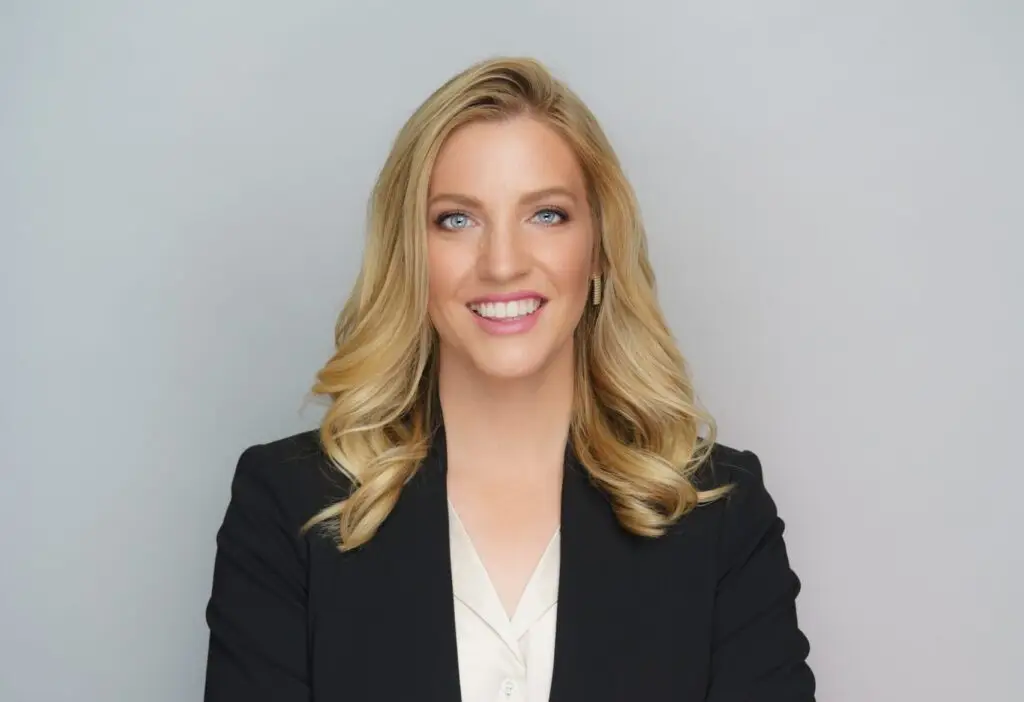
I recently went one-on-one with Lauren Border, Assistant United States Attorney for the Central District of California.
Adam: You pursued a career in medicine and even went to med school before going to law school and becoming an attorney. What led you to the field of law?
Lauren: Thank you for having me, Adam. I want to start with a disclaimer, which is that everything we’re talking about today is just my personal view and does not reflect the Department of Justice, as fancy as my title may be, so this is just me talking here.
I had a very meandering path, as you hinted at. I started out thinking I wanted to be a doctor. When I was 17, I became an emergency medical technician and really liked that feeling of helping people day to day and being there in emergency situations. But then I got to Tufts University and started taking different courses, and my interest naturally developed into looking at more big-picture issues rather than the day-to-day. What was really transformative was that I studied abroad in a country where I didn’t have a good experience. I had a lot of sexual harassment, and I just had a really bad experience in that country. I came back and thought, I don’t want to just go back to school anymore without having a transformative, classic study abroad experience. What can I do? I ended up taking a semester off entirely and moving to New York City and interning at Planned Parenthood as well as an anti sexual violence organization. That’s when I really saw what the law could do and how important it was. And there’s also that connection, of course, to healthcare with Planned Parenthood. Over time, my interest became more into the law, and what the law can do for people on a more national level. I ended up working at a law firm right after I graduated, while still, funnily enough, applying to medical schools. When it was time to make the decision, I basically decided I couldn’t decide and entered an MD JD program. My plan was to do both. I started at Boston University to do the medical degree, and I quickly realized it wasn’t for me. Another transformative moment was when I was talking with someone who was a teacher’s assistant in anatomy, and she was going into gastroenterology, which is a kind of interesting choice. You do a lot of colonoscopies and fun stuff like that. I asked her what drew her to that, and she said, it’s where my people were. I looked around, and I had such good friends there, but it just didn’t feel at home. It wasn’t where my people were. I ended up leaving and then took a year off, took the LSAT, and ended up at law school about eight months later. I had a very meandering journey that I think was for the best because it’s really great for well-rounded people. You can study so many different things.
Adam: You wound up at Stanford Law School, but you don’t necessarily learn how to become a lawyer in law school. How did you learn how to become a lawyer?
Lauren: The thing that was most influential was when I was at Stanford, I did the prosecution clinic, which is a four-month course where you’re actually in court almost every day. You have your own docket, and you’re acting as a prosecutor with the benefit of having a really experienced Stanford professor walk you through it. That was key. Honestly, so much of the law, unfortunately or fortunately, is just doing it yourself. There’s a funny saying from medicine that I think actually applies to law, which is, see one, do one, teach one. That means you should see it once, then you should do it, and then you’re ready to teach it to others. I apply that to everything I do in the law. I like to go watch a hearing that I haven’t done before, and then, whether you’re ready or not, you just have to jump into it. Some of the best advice I got was to say yes to opportunities, even if you don’t feel ready, because that’s really the best way to grow. By saying yes and putting myself into practical environments where I can work on skills in court or my writing skills, you learn by doing.
Adam: What were the most important skills you developed early on?
Lauren: This is a pretty classic example for a lawyer, but communication is a massive one, figuring out how to effectively communicate, and not just for a brief or in court, but also amongst your peers and the people you’re working with. I found that communicating, especially as a junior attorney, about your workload with everyone around you and setting boundaries set me up for success and made me do the best possible work that I could do. And staying very organized. I am probably the most obscenely organized person I know with the way that I attack each day, with different spreadsheets and different to-do lists. That’s kept me really on top of it, and has also really importantly, made sure that I don’t burn out. I was certainly at the point of burnout in medical school, so I know what that’s like, and it was really important to me going forward from that to not burn out. Those skills are important for any lawyer, and particularly when starting out.
Adam: How can anyone become a better communicator?
Lauren: Particularly in the interview setting, I have a whole system that is just practice, practice, practice. Again, you learn by doing. I had a really good mentor when I was starting to interview at law firms who sat me down and said, these are going to be the 50 most common questions that you’re asked. What you’re going to do is write out your answers to every single one of these, and you’re going to practice it out loud three times. At that point, during the interview, when a question pops up, you have something that you prepared. It might be similar, it might be exactly it, and it almost becomes muscle memory in the way that you deliver it. The trick at that point is to not seem like you’ve already prepared the answer. It’s almost more of an acting class at that point, to come across not as super prepared, but more thoughtful, and as if you’re coming up with it on the fly. A lot of it is practicing things like that in interviews. And then in the law firm setting, I’ve found that millennials in particular hate phone calls, but I love them. I found that it really is a good way to connect with people, and it’s also just faster. I don’t know why everyone spends time drafting emails when things could just be discussed on the phone. It adds a personal touch. Picking up the phone is a lost art that lawyers need to come back to, particularly more Gen Z and millennial lawyers.
It’s funny because I actually got into trouble once because someone was trying to get a hold of my team, and we were trying to strategically keep some distance. I got a phone call from a blocked number, and I picked it up because I always pick up the phone. It was funny because the partner jokingly said to me, I’ve never had a millennial pick up a blocked phone number, so it’s just hilarious that I ended up being the one to pick it up. But to your point, knowing your audience, and particularly for jury trials, knowing your audience is so important. So much of being a jury trial lawyer is simplification and simplifying ideas. I’ve found that a really effective way to communicate to juries now is that my first initial thoughts of the case tend to be the theme that I pick. I will go through the documents, analyze the case, and within those first few hours, I will form my thoughts of what I think is the strength and what I think is a weakness, and I will take those and work with that and refer to that throughout my case, because lawyers get really, really in the weeds, and it’s really easy to lose sight of the case because you learn all of the nuances. I’ve found that that technique really helps me go back to the basics. What was my initial impression of this case when I got it? What did I think the theme was? What did I think was effective and important? Bringing that into communicating to the jury has been very successful and is just a good way to remember to keep things simple.
Adam: How do you approach trial prep?
Lauren: I’ve prepared for maybe six or seven trials as an AUSA, and honestly, it’s pretty formulaic. Preparation is everything to me, and organization is everything to me. I have a trial checklist that I run through on everything that I need to do, from the tiniest things like making sure I have a parking space and that I’ve communicated that, to witness prep. I’m a big fan of meeting with your witnesses as much as possible, to run them through what the courtroom is going to be like, in addition to what the topics of their conversations are going to be, and just making them feel a little bit more at home, because the courtroom can be such an intimidating environment. Even for special agents who have been working for the FBI for 15 years, it’s still scary. Getting everyone involved as much as possible for the witness prep is super important. And to your point before, knowing your judge, knowing what arguments will probably be most effective, and knowing what is not worth arguing about, because your credibility in court is truly everything with the judge. You’re a repeat player in front of the judge, so your credibility is just so important. I find that distilling your arguments and really only pushing things when it makes sense in front of that particular judge is a very important part of being a jury trial lawyer, particularly because that happens so much not in front of the jury. Those are two separate things. Most of your legal arguments at trial are made to the judge out of the presence of the jury. So you can have two personas, your legal hat and then your jury hat.
One of my weaknesses is probably that I prepare so much that I don’t feel like I can do things on the fly, if that makes sense. Almost like if the judge asks me a question that I haven’t thought about for three hours, I feel like I’m not capable of doing that. One of the best experiences I had to address that was when I was at my former law firm, Hueston Hennigan, which is known for being a really elite trial boutique law firm. We had an arbitration, and I was supposed to conduct a direct examination of an expert. But unfortunately, the arbitration could only last five days, and it came time for me to do my portion, and it was going to get cut just because it wasn’t the most important issue in the case. Of course, I was more junior. The partner saw the disappointment on my face, and he turned to me and said, “you’re doing my portion now,” and I had absolutely no preparation. I just looked at him, dumbfounded. The other partners said, “we won’t blame you if you don’t do this.” But he said, “if you want to be a jury trial lawyer, be a jury trial lawyer.” I took 15 minutes, read it over, and then I jumped into it. It was a great reminder that, as much as you can prepare, you can also do things on the fly when you really know the case and really know the issues. That’s what they reminded me of. That was very instrumental in building confidence that, as much as I may not feel prepared, you’re able to do those things on the fly as well. A lot of women struggle with that particular kind of imposter syndrome, and just feel like they need to have turned over every stone before they step into court or do anything. That was a great experience for me to learn early on.
Adam: How do you tackle imposter syndrome?
Lauren: Yeah, that’s a great question. I struggle with it because, in a way, I almost find that it is an asset to feel a little bit of imposter syndrome, which might be a hot take, but I think it keeps me really humble and it keeps me modest, and those are good qualities that a leader should have. I know on paper I’m qualified to do the things that I’m doing. Though sometimes I wonder why I got into Stanford or why I found the success that I have, and that’s the imposter syndrome part. But the asset to that is that when I’ve managed younger attorneys, I will always say to them, I don’t believe in hierarchy. You have had different life experiences than I have, and I would love to hear your perspective. If you think I’m wrong, tell me I’m wrong. You might have had a Ninth Circuit clerkship, an appellate clerkship. I only clerked at the trial court level, so we are bringing different things to the table. In a way, it’s not about eradicating imposter syndrome, but it’s about making it work for you and turning that into a strength.
So much of being a lawyer is maintaining that confidence. I’ve thought a lot about how a lot of the law is acting. I brought that up before in the interview setting, where you have to act like that’s a really novel question when you have the answer completely prepared. In the courtroom, you act confident; you learn to act. One of my mentors said something really interesting to me, because there’s a lot of talk about how to be your authentic self in the courtroom and finding that balance of being professional but also being you in the courtroom. She was the first one who told me that’s all BS. You just find a way to be comfortable acting as your corporate persona, and that’s the key. It was really interesting to hear two different trains of thought, which I think is similar to this imposter syndrome conversation we’re having now. How do you do that in practice? I’m still learning it, and I would say a lot of people, as experienced as they are, say if you’re not nervous in court, you should go home. Your career is done because you should be nervous. It’s important. You’re in court. I think it’s just a lot of practice and playing around with different things, maybe a little bit of humor. Sometimes that’s something I’ve struggled with, when humor can be effective versus when it’s inappropriate, particularly in very serious criminal cases. That’s something I think about. But finding that balance of trying to be yourself while also understanding that this is performative, the law is performative, and just accepting that has been really instrumental in the way I think about my career.
Adam: In a previous interview, a leader of a major law firm recommended improv as a way to improve as a communicator.
Lauren: It’s funny you say that. I’ve heard the same thing, and actually, when I was a summer associate in New York City, one of our summer events was doing improv. It’s definitely a common school of thought that that is helpful for lawyers. I always like to think, especially if you’re a stand-up comedian, you can’t be as scared going into court if you’re able to stand up in front of an audience and be faced with the proposition that no one’s going to laugh. I do think it’s almost about getting used to being rejected or making requests that are not received well, and just becoming a little bit hardened to that discomfort. That’s what improv does. You’re putting yourself out there, and it may not work out, but you get up, and you do it again. I think that’s super applicable to the law and just finding that confidence to bring to the courtroom. I have not myself done it outside of that one summer program, but I am a big fan of comedy. I’m always at improv shows and always at stand-up comedy shows.
Adam: But you’re on the other side of the stage.
Lauren: Yes. I have written, or I did at least at Stanford, a little bit of comedy. But yeah, I have not yet wandered into the performance realm. Maybe that will be something for a couple of years from now.
Adam: How do you react and respond to failure?
Lauren: I grew up swimming every single day for far too long, for years and years and years. I think that mentality stuck with me. I remember very vividly one race where I just blew it, and I was about to cry, and my coach just looked at me and said, this is not the way to approach this. You’re not crying. You’re here to just do a better job next time. I’ve always remembered that, and I bring that to my professional career now. There’s always room for error, and you’re going to mess up. That’s a large part of having so much autonomy in my position now. I will make mistakes, but it’s how you confront them, and how you, to use a very legal word, fall on your sword and get back up and do it all over again. Just the confidence that things might be different next time is important.
There are always small things that are happening, right? Filing things that might have typos or that might slightly misstate the law. When those things come to the forefront, it’s exactly what I said. You just need to fall on your sword. When I think of major failures in my life, I actually think of medical school and the decision that I made to go to medical school. But again, looking back, the process of having done that has made me so much more of a well-rounded person. To come back from that and change my career and remind myself that you can walk away from something when you need to and not fall into the sunk cost fallacy was a really important lesson for me to learn early on, too. Even things that you think are failures, whether professionally or personally, you can learn a lot about yourself from, and I certainly have.
Adam: What are the keys to excelling in private practice and in the public sector?
Lauren: Just really practical advice. One of the best sayings I’ve heard, actually from my mentor here, was a Mark Twain quote, which is, if your job is to eat a frog, eat it first thing in the morning, and if your job is to eat two frogs, eat the biggest one first. I think that applies to all areas of the legal profession. You should just tackle your hardest things first. I’m not a big fan of procrastinating. I find it just gives me anxiety. Tackling the hard things first is such an important skill to be able to excel. We talked a bit about communication and then trying to keep balance in your life. It’s such an important skill. I’ve seen so many of my friends be very, very unhappy in big law, and I like to think I’m very lucky. I was surrounded by incredible people at every law firm that I’ve worked with. But I also do think that it takes a certain skill set to find that balance and find happiness. Finding that balance to the point where you can have a very great professional career and feel very fulfilled, but then also not feel like it consumes your entire life, is such an important balance to find, and that ultimately makes you even more successful as you continue forward in your legal career. How do you do that? For me, practically, I have a rule where I don’t work at least one full day of every week. I find that super important to just stay sane. Of course, things will come up. If I have a trial to prepare for, I might work on a Saturday. But for me, Saturdays are sacred. It is my one time to just relax, and what keeps me balanced. I unfortunately realized that I needed to do that when I got very burned out in medical school. I was working eight hours every single day, every single weekend, for months, and there was no end in sight. That is what ultimately led to me completely burning out. Having those boundaries and being disciplined, that’s where the athlete mentality comes in. I woke up at 5 a.m. to go to swim practice, however many days of the year. Having the discipline to see what’s in front of you, stay organized, and then cut yourself off is such an important skill.
I think there are pretty distinct differences between the two, at least in my experience. When I was at the private law firms, a lot of it was teamwork. You’re constantly working with other people, communicating with your teams, navigating different opinions, and so having those communication skills is super important. But the downside of being in private practice, at least as a junior lawyer, is that you don’t have the autonomy. You may be sending emails that 20 people have edited in the background, and so it’s not really your voice. That is something that every younger attorney struggles with a bit at the beginning. Then you transition to the government, and it’s a whole new world because it’s only your voice, and everything is on you. That means every single mistake that I make is also pretty much only on me because I’m the only person who’s on the docket. Being able to transition from having the team mentality in big law to being able to feel more independent and confident in your own abilities as a single lawyer was something that I really worked on, and I’m still working on it. I really appreciate the fact that I have amazing people around me in the office that I can go to and ask advice from, but it is ultimately a test of learning to trust myself as a lawyer and not having a backstop of someone reading every single sentence of something that you’re filing to support. Finding that confidence in myself is its own kind of asset.
I always knew that I wanted to work at some point for the government and in prosecution in particular, just because I had some really formative experiences at Stanford that made me become interested in being a prosecutor. That said, it’s unfortunately such a personal decision, particularly financially. That’s just the reality of our world today. So many people are graduating with hundreds of thousands of dollars of student loans, and it’s a matter of preparing yourself for being able to go into the public sector, a lot of financial planning, honestly. But I do think a natural point of transition tends to be around your fourth or fifth year into private practice. You can learn a lot in those first four years. You’re a solidly mid level associate. You know how the law firm works. You’ve developed professional connections. I really liked the time that I was able to step away and go into the government. I felt like it was the right time for me. There’s always more for me to learn in private practice, but it was just the perfect time for me to transition, both financially and for me to develop the new skill set that I talked about, such as being the lawyer who is conducting the trial strategy and talking to the jury. It was a great way to really get the experience that sometimes junior associates don’t get at big law, although I was very lucky at my former law firm. They were very good at giving junior associates a lot of experience. It’s going to be a very personal decision, particularly financially, but I would suggest that everyone do a little bit of time in both. That’s what’s so great about the law, is you can dabble in so many different things, in so many different subject areas. Ultimately, that’s why I love it so much.
Adam: What are the keys to building a network?
Lauren: This is something I’ve talked a little bit about with younger attorneys. I feel like millennials and Gen Z have really lost the art of networking, and lawyers in particular are notoriously bad at it, whereas business school people have it down. There’s a moment when I was in law school, we were all studying for final exams, and the law firms came to throw events for us and recruiting events to try to get to know us. So many people didn’t go to these events and stayed home and studied instead. I just thought to myself, well, if my ultimate goal is to get hired by these law firms, doesn’t it make more sense for me to take three hours out of my night to go talk to these people rather than study? That was the mentality I took. I think every single offer I got after that summer was from an event that I had attended. Getting to know lawyers that way is so important. And also being part of bar organizations. I’m now on the board of the Federal Bar Association and lead up their younger lawyers division. I have found so many mentors who actually helped me navigate my way into the position I have now, just through Federal Bar Association connections. I’ve found fantastic mentors from all of those different networking events that I have done, and I’ve found that so many younger lawyers seem like they just don’t want to spend their time that way, when I think it can actually be super beneficial.
I also had the privilege of working for an incredible judge when I clerked, District Judge Fernando Aenlle-Rocha. I learned a lot from him and the way that he approaches connection and mentorship. We are one of the busiest districts in the country. Our dockets are insane. Everyone is overworked. There’s always work to do, and I cannot remember a time when I had a question or even had a life problem, and my judge didn’t take time to sit down and talk with me about it. I know how busy he was, but to him, connection was a priority, and mentorship was a priority. He took it so seriously. He took it just as seriously as the brief that he was supposed to be reading. I learned so much from that kindness and his patience. That’s something that I really, as I get more senior, want to channel into spending time mentoring other people and really making people feel welcome and like they’re in a very supportive environment. I just think that’s so important.
Adam: How can anyone find a great mentor and cultivate a successful mentorship relationship?
Lauren: I have always found that my mentors have just been organic. Those are the best mentors that have really touched my life and my career, and it has been by going to random events. It’s been luck, quite honestly. But I guess in some ways it’s not just luck, because you have to put yourself out there to even form those relationships to begin with. But in the law firm environment, I can’t remember a single time where I asked someone to go get coffee or go get lunch, and it wasn’t received well, and we didn’t go out and do it. Just putting yourself out there, shooting an email, it’s so easy to do, and you get to learn from other people. Whether or not it develops beyond that, you are still spending your time asking questions and learning from another person who’s successful. I found value in that, too. But really putting yourself out there and getting those connections is just so important.
I was actually told, and it was so jarring to me to hear this, by one of my career advisors, to cold email Stanford Law graduates who were doing things that I was interested in, and just ask, can you send along my resume, or can we have a quick phone call? Again, it is shocking. I was so nervous to do that. I was not socialized to think that that was something I should be doing. But once I did it, I found so much success and connected with so many people. And to your point about the hard work going into that and making your own luck, I think a good example of that is, again, I went to a networking event for a law firm that is known for being pretty exclusive and very selective in their hiring. They only had about 30 people, though, in LA in their office. So I figured, how hard could it be to just memorize everyone who works in the LA office and just know a bit about every single person who is there and who works there? I show up to an event having spent a few hours trying to memorize everyone on this website, and I think it became very clear to them that I knew a lot about the firm, I knew a lot about what they were working on, and then I ultimately got an offer there. So much of this is being able to get through just diligence.
Adam: What are the keys to successful management and leadership in law?
Lauren: That’s something that’s really not valued enough in the law. So many lawyers don’t have any training on what makes a successful manager or leader, and I find that really unfortunate. We touched on modesty. I think that’s an important thing, at least for me. Some of the best leaders I have seen, including a recent mentor and leader in the office, are just quick to say when they don’t know something. I think that’s great, because I get to learn, and we get to figure it out together. I’ve seen all different styles. One leader in the office here, I can tell that he spends so much of his time thinking about how to make my life easier. Any roadblocks that are within his control to remove, to make my job easier, so that I can do the best work I can possibly do, he does. He checks in almost every single day to see if there’s something he can do to make my life easier. I’ve never seen that before to that extent, and it’s just been so invaluable. Thinking about your team and how to do simple things to make things easier for them, so that they can do their best work and be their best selves, is so important.
Adam: What you’re describing is servant leadership.
Lauren: Yeah, absolutely. I see that every day in all of my jobs. The hard part in law is finding the time, and it goes back to priorities. We’re all so busy. Are you going to focus just on the legal work in front of you, or are you also going to have the very intentional mindset of helping other people around you and being in a leadership mindset?
Adam: You used the word modesty, and I often talk about humility as one of the key characteristics of the best leaders.
Lauren: Absolutely, and I think particularly in my current role as a prosecutor, that is so important. We are dealing with very serious issues. Someone’s liberty is at stake. And if I am not the type of person who can admit if I made a mistake, or that maybe this case shouldn’t have been charged, or this evidence shouldn’t have been found because there was a Fourth Amendment violation, if I can’t admit that, I can see how that affects the person in front of me when I go to court. Particularly for criminal prosecutors, that is one of the most important attributes that you can have, to just be able to turn around and say, I don’t know everything. And then if I do not know something and it didn’t turn out the way that I wanted it to, I can move on and realize, I messed up, and own up to it. It’s just doing the right thing. That’s what ultimately led me to want to do this job so badly, the idea that my job is to follow the law and to do the right thing.
I think that also goes back to a really important characteristic of attorneys, which is judgment. If I could boil down what you’re paying a lawyer for, it’s for their judgment, and you can develop your judgment in a lot of ways, in large part by talking to those around you who have more experience than you, who have experienced what you’re going through already. And that modesty of approaching people and saying, hey, have you done this? How did you react? Is a really great way to build up your judgment. And kind of a funny thing about my career too is that I am actually very shy. I don’t particularly like being in the spotlight, and so it’s a little bit strange that I’m now a jury trial lawyer. But I wanted to do this because I think that I’ve developed good judgment, and I wanted to be the person in the room making decisions and to be able to try to determine what I think is the right thing, obviously with input from others, and then to try to do it.
Adam: How can you overcome shyness and fear of public speaking?
Lauren: Step one was acceptance that I’m never going to be the type of person who is going to just love the attention of being in the spotlight, but being able to get comfortable enough through practice and just faking it till you make it. Quite honestly, you just have to show up and do it, and it’ll eventually get less scary. It’s interesting because your nervous system adjusts to your environment. Something I spoke about with my friend who came to the office from big law was that she asked, “are you always super nervous when you walk into court?” Because I had one hearing my entire year at my law firm, and I was a nervous wreck. And I said, well, I’m in court four to five times a week. My nervous system just can’t be that stressed. I think that goes to show how much practice and routine and getting into that can really help you overcome that kind of shyness and nervousness and help you succeed.
The advice I’ve gotten is that what makes one of the best trial lawyers is the preparation, but then the flexibility on top of that to shift and adapt to things that are thrown your way is also important. Having that combination is really key. It’s the preparation, but also the flexibility, and I think that’s key to happiness in the law as well, because different things will just be thrown your way every single day, and you’ve got to pivot. You’ve got to triage. I analogize it to my time as an EMT, where you have to triage when you get to a scene, and you figure out who to tackle first. That has also been an asset in my legal career, trying to be flexible as much as I might have a plan and triage things as they come in.
I also think that when you come in prepared, it opens up your mind to be able to listen to what’s actually happening in front of you, which, to your point, I imagine adds to the ability to be flexible and pivot, because so much of being a lawyer, especially in the courtroom, is just listening to the arguments that are being made, listening to the witness. One of the biggest rookie mistakes that I’m told lawyers make often when they’re doing a direct examination of a witness is to just stick to a script that they’ve written, but they’re not listening to the answer that the witness is giving. You might need to follow up, or they might say something completely different than you thought, and you just need to be able to listen and then respond. I think coming in with the right amount of preparation opens up the space for you to listen and then respond and be flexible.
Adam: How can anyone become a better listener?
Lauren: My very practical tip, because I’ve thought a lot about this, is audiobooks, funnily enough. I think auditory comprehension is actually probably one of my weakest skills, and I thought a lot about how to get better at it, and I landed on audiobooks because it’s a really good exercise. When I’m driving into work, my mind’s racing. I’m thinking about work. I’m thinking about random things. It’s a really good exercise for me to say, no, I have to follow whatever the plot of this book is that I have to listen to. I’ve found that listening to things like that has been really helpful in my auditory comprehension. And just basic stress control, being able to not have that panic so that you’re able to fully engage and listen and be responsive. I find that if you’re too anxious, which I’m sure anxiety rises the less prepared you are, you’re not really able to listen. So controlling stress and the pragmatic aspect of practicing and listening to audiobooks and doing all those things can make you a better listener.