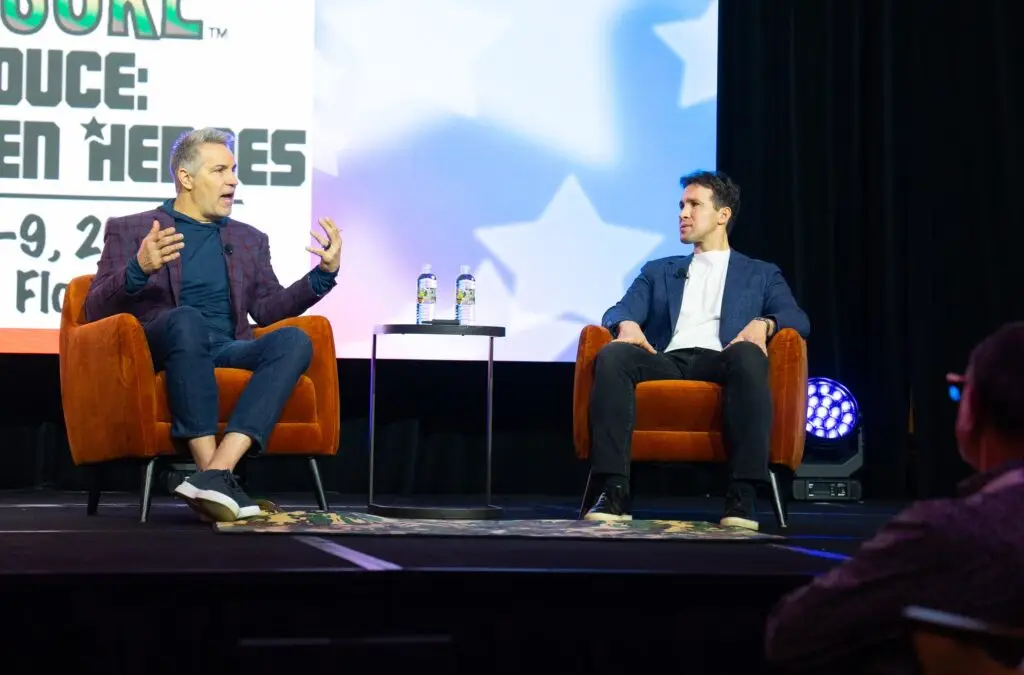


I recently went one-on-one with Annie Lu, co-founder and CEO of Laminar.
Adam: Thanks again for taking the time to share your advice. First things first, though, I am sure readers would love to learn more about you. How did you get here? What experiences, failures, setbacks, or challenges have been most instrumental to your growth?
Annie: My brother David and I co-founded Laminar together – he’s our CTO and co-founder. We come from a generational manufacturing background, which means we grew up on the shop floor, seeing firsthand what it takes to run and operate large manufacturing facilities. These aren’t abstract businesses to us – they are the most foundational, most ubiquitous sector of our global economy, and the people running them carry an extraordinary amount of responsibility every single day.
During COVID, what the world saw in real time was the brittleness of our global supply chains. For us, it was a clarifying moment. Given our deep roots in this industry and our personal experience, we felt a real sense of urgency and obligation to build technology that could equip the world’s most foundational sectors to face this next generation of challenges – inflation, margin compression, rising raw material costs, the loss of skilled labor creating serious business continuity risk, climate pressures on access to natural resources, and geopolitical volatility. These macro challenges are existential pressures on the industry we grew up in, and we set out to build the next generation of manufacturing to face them head-on.
One of the most defining moments early on was when a $40 billion industry giant told us that what we were trying to build was impossible. I think the reason people accept “impossible” is that their framework for what is possible is built entirely on conventional wisdom. For us, that was a signal. If the biggest incumbent in the space was telling us it couldn’t be done, that meant no one else was doing it either. We put our heads down and proved it out quietly, and today, Laminar is the leader in physical AI for process manufacturing.
Adam: How did you come up with your business idea and know it was worth pursuing? What advice do you have for others on how to come up with and test business ideas?
Annie: Innovation comes down to uncovering unobvious problems that face real people and building solutions that solve them with quantifiable, attributable ROI to real people. The way we got started was by approaching every single conversation with deep empathy and genuine curiosity – whether we were sitting across from a chief supply chain officer at a Fortune 500 company or a plant engineer on the shop floor. Every conversation started from a place of: I’m here to learn from you. That posture allowed us to hear things that a typical sales or discovery call would never surface. Listening helped us uncover the unobvious problems like the ones people had accepted as just the way things are.
Time and time again, from diverse sectors across process manufacturing, we heard the same thing: CIP and changeovers were among the biggest sources of loss in their operations, biggest consumers of water, energy, and chemicals, biggest cause of downtime, and the biggest driver of quality issues. The fundamental problem was the lack of the right data, in real time, with the ability to close the loop and act on it. What we built is a fully agentic, closed-loop system: sense, reason, act. The full turnkey stack, from proprietary inline spectral sensors to process-aware ML models that make dynamic decisions in real time, on every production line, in every facility we’re deployed across the world.
My advice for anyone trying to come up with and test a business idea: always start with the problem and balance that deep grounding in a real, tangible problem with a greater long-term vision because one without the other fails. Too much long-term vision with no immediate solve looks like a digital twin project that no one can connect to their system. Too much short-term problem focus with no vision just makes you a point solution that’s easy to copy. The magic is in holding both at the same time.
Adam: What are the key steps you have taken to grow your business? What advice do you have for others on how to take their businesses to the next level?
Annie: A few things have been critical to Laminar’s success. First, partnering with best-in-class investors – we’ve been fortunate to work with Greycroft, Construct Capital, and 2048 Ventures, and to have incredible people in our circle like Jim Moffatt, the former CEO of Deloitte Consulting. Having the right partners who believe in Laminar’s mission and can open the right doors matters enormously.
Second, building a mission-driven culture and a world-class team. Alongside credentials, our team here at Laminar is spectacular because this isn’t just a job for us. At a big company, people show up and do their work. For us, this is our life. When everyone on your team cares that deeply about the work and the impact it makes, you operate at a completely different level. That’s not something you can manufacture because you have to build it intentionally every day, starting from day one.
Third, and this is something our customers tell us directly, genuine customer obsession. Not just in a we-listen-to-customers way, but in a we-actually-understand-the-brewing-process, we-understand-what-it-takes-to-manufacture-Coca-Cola way. We don’t walk into plants and slap AI on things. We earn the trust of operators and engineers because we respect their craft on a first-principles level. That deep process engineering appreciation is what makes everything else possible.
Adam: What are your best sales and marketing tips?
Annie: The single most important thing in enterprise sales is becoming a trusted advisor to your customer. There’s a simple truth I’ve come back to over and over: if you try to sell, people want you to advise. But if you advise, people want to buy.
That means having a genuine give-first mentality. How do you teach your customer something they didn’t know before they got on the phone with you? How do you make them smarter, not just more aware of your product? Respect is never given; it’s earned. The way you earn it is by showing up as someone who cares about their problem more than your quota. That’s how you build trust, and trust is what closes enterprise deals.
Adam: What are the most important trends in technology that leaders should be aware of and understand? What should they understand about them?
Annie: AI is not a fad, especially physical AI. I want to say that clearly because I think there’s still a contingent of people waiting for the bubble to pop. What I see instead is one of the most unprecedented paradigm shifts in the last century, and it’s not going back.
What makes me most confident is that we’re seeing AI drive real, tangible, quantifiable value in physical industries. Physical AI is not just AI companies selling to other tech companies. The factory floors, the production lines, the chemical plants – they are getting genuine, measurable ROI from process-aware solutions.
You’re even seeing it at the leadership level of the world’s largest companies. Some Fortune 500 CEOs are turning over specifically because their boards want someone who can lead their organization through this new world order, someone who can navigate the AI age. That tells you everything about how seriously the most sophisticated organizations in the world are taking this shift.
There’s a lot of uncertainty right now, but all uncertainty is opportunity. At Laminar, we’re building real process-aware AI, pioneering self-driving factories for the physical world, and we couldn’t be more energized about what comes next!
Adam: In your experience, what are the defining qualities of an effective leader? How can leaders and aspiring leaders take their leadership skills to the next level?
Annie: Strong vision is everything, and I don’t just mean knowing where you want to go. I mean having the foresight to know where the puck is going to be in six months, three years, ten years, and being able to hold the short-term plan and the long-term vision simultaneously while instilling both into every person on your team.
Without that vision, the costs compound quietly. You build the wrong product for the wrong person. You make engineering decisions that create deep technical debt. You get out-competed by someone who saw further down the road than you did. The short-term plan keeps everyone rowing in the same direction right now. The long-term vision is why they’re rowing at all.
The second piece is that people want purpose. Compensation matters, but the best talent is motivated by something beyond a number. They want to feel like they’re in a history-making place, like they’re changing the course of something that matters. Your job as a leader is to instill that sense of inevitability and inspiration in every person on your team, to make them feel what’s actually at stake and why their contribution to it is irreplaceable. Vision is what makes people go the extra mile, stay through the hard quarters, and do the best work of their careers. That’s probably the hardest part of being a founder, but it’s also what separates a good leader from an absolutely legendary one.
Adam: What is your best advice on building, leading, and managing teams?
Annie: Empowering people and, specifically, learning to spot potential in someone before they see it in themselves. That’s a skill, and it might be the most valuable one a leader can develop.
When you give someone true ownership over their work, when they’re the one who conceptualized it, who is on the hook for it, who can genuinely say this is mine, something shifts. They don’t need to be managed to go the extra mile. They want to, because the outcome is personal to them. That sense of ownership creates deep responsibility, and deep responsibility is what makes people grow in extraordinary ways.
My biggest piece of advice: don’t just push everyone to bring their best every day. Push their best to be better every day. There’s a difference, and the compounding effect of that distinction is remarkable.
Adam: What are your three best tips applicable to entrepreneurs, executives, and civic leaders?
Annie: First, constantly spin at a faster RPM. The world is not slowing down. So, every single day you should be asking: how do I personally become a better leader? How do I up-level? Where is the boundary of what I know and what I’m capable of, and how do I push it? Constantly reinvent yourself, reinvent your organization, reinvent your assumptions about what’s possible. That relentless dedication to improvement and unlocking more capability is non-negotiable in this era.
Second, know why it’s you. Not your credentials, not your resume. Why are you specifically the person to make this vision a reality? What do you know, believe, or understand that others don’t? We came into this industry as nobodies by any conventional measure. However, we knew deep down that we had the vision, the technical foundation, the thesis for breaking conventional wisdom about what’s possible, and an understanding of the customer that no one else had built from the ground up the way we had. Knowing that and being able to articulate your unique advantage and leverage it deliberately is what separates founders who belong in the room from ones who just got there first.
Third, be obsessively customer-focused. Especially in a B2B enterprise: if you build a great product and wait for customers to come, they won’t. That’s just not how it works. You have to go to them. You have to understand them so deeply that your product feels less like a solution you’re selling and more like an answer they’ve been waiting for. Deep customer empathy and obsession isn’t just a go-to-market strategy; it’s the foundation everything else is built on.
Adam: What is the single best piece of advice you have ever received?
Annie: If you need to fundamentally change who you are to please someone else, they shouldn’t be on your team anyway.
That reframe changed everything for me. Instead of treating what makes us different as a liability to apologize for, we started treating it as our greatest asset. We don’t look like the typical founding team in industrial AI. We come from different backgrounds. We walked into rooms where people underestimated us immediately. For a while, it’s tempting to sand down those edges to fit someone else’s idea of what a credible founder looks like.
However, the moment you stop doing that – the moment you own everything that makes you distinctly you and lean into it fully – your authenticity becomes your moat. That mindset is core to who I am as a CEO, core to who David is as a CTO, and core to who we are as a team. We are exactly who we are. The right partners, the right customers, and the right talent recognize that, and they want to be part of it.