
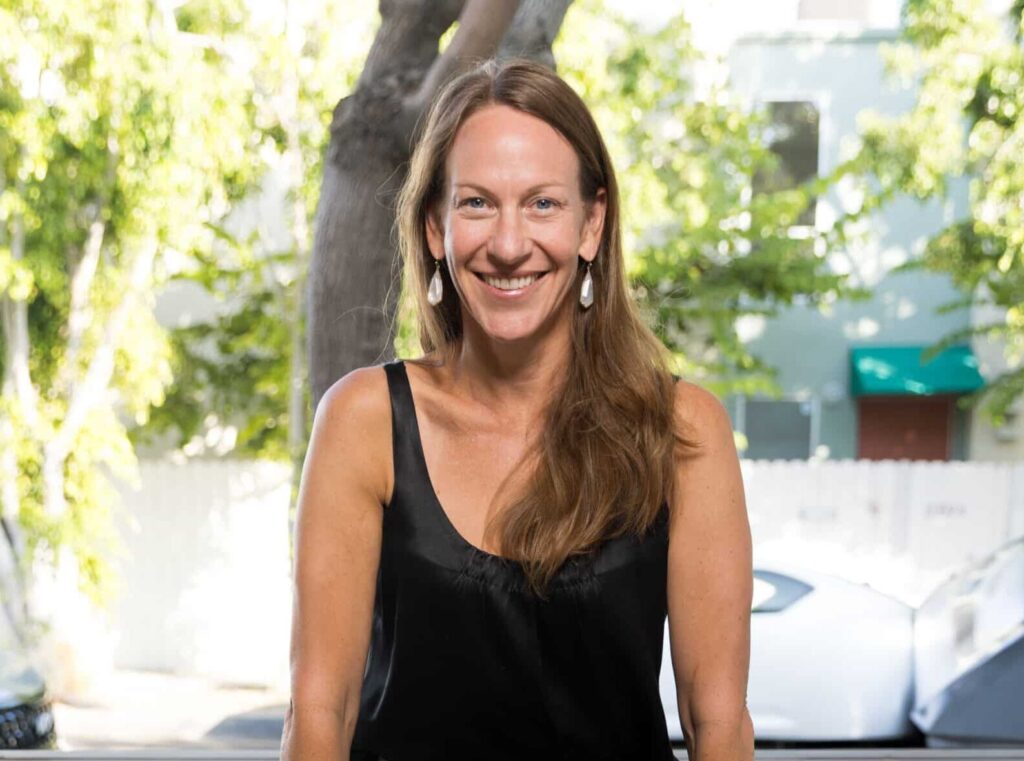
I recently went one-on-one with Lisa Gralnek, US Managing Director and Global Head of Sustainability & Impact of iF DESIGN.
Adam: What makes a great designer? What makes a great design leader? What separates the two?
Lisa: Oh, well, there’s a lot to unpack there, even more than my love of the East Coast versus the West Coast. Not versus, just in addition to. I think we have to define design because so many people think of design as pure aesthetics, and it’s not. Design is really about solving problems. Whether you’re interdisciplinary by force or whether that’s just the way you have to look across and think about things, design is interdisciplinary. You have to think about the user experience and the audience you’re serving. You have to think about manufacturing and supply chain. You have to think about what the technological capabilities are and what the use cases are.
Of course, ultimately, there are the aesthetics. That’s just a few of the things that come into play. There’s sustainability and policy and all sorts of other things, brand identity, et cetera. A great designer can do all of that and present a package, a product, a place, a platform, or even a policy that is really coherent and well-intentioned. That is what they can do because they can pull these disparate pieces together.
Whereas a great design leader not only can do that, but can also understand that result in a grander system, where it can go, what it can achieve, et cetera. They’re really thinking much more holistically. They also think about the designer as a team member, and they’re building that coherence as well. So I think of a design leader as someone who really is thinking systematically and inspiring across disciplines, as well as being able to encourage innovation not only from the one end outcome, but much more broadly.
Adam: How can anyone become a great designer? How can anyone become a great design leader?
Lisa: I think a great designer is somewhat inherent in someone’s innate skill set and vision, combined with training. The training doesn’t have to be formal training. It can be informal through the ways that designers historically have always learned, which is through apprenticeship and observation. But you also now have formal education that can train on tools and technologies that really help enhance the design, ask questions, and look at historic best practices, as in many fields.
To become a great design leader, I think you really have to get outside of your own self quite profoundly. Designers tend to, they’re not insular at all. They actually pull lots and lots of information from the world around them to build this holistic outcome. I keep calling it an outcome because I don’t want to keep repeating what I call the five Ps. You design products, packaging, platforms, places, and, as I said, you also design policies to some degree. So I don’t want to keep repeating it.
For these outcomes of what is designed, they pull in holistic influence from their inspiration on their morning walk, from nature, from history, from academia, and from user experiences and interviews. A design leader has gotten outside of their own narrow box to be able to explore what it means for the system, whether that’s the corporate system in which they work, the brand structure in which they work, their client, or their team, and what the bigger mission of the outcome is. Is it to change healthcare outcomes? Is it to beautify a building? It’s always going to be a question of the what, the where, the when, the why, and the who.
Adam: What separates exceptional design from work that simply looks impressive?
Lisa: I’ll just talk about where I’ve seen it. I’ve had a 30-year career where I would say design strategy, sustainability, and brand are the red threads in everything I’ve done. But for the last three and a half years, I’ve been the U.S. managing director and head of sustainability for iF Design, which is a nonprofit design institute that’s been around for 74 years and is headquartered in Germany.
One of the things that we do is run the prestigious iF Design Award. Every year, we get about 10,000 to 11,000 entries from more than 70 countries. While originally industrial-design-focused, it’s expanded. We now have nine disciplines, including architecture and interior architecture, and 93 categories of design. It’s a very rigorous and very objective process where I have nothing to do with the jurying except for helping support the jurors who come from the North American market, as well as 55 other countries, in their subject-matter expertise.
But what I do observe, especially if you’re speaking to architecture, interior architecture, or concepts therein, but across all 93 categories of design, as well as our Student Award and Social Impact Prize, is that the difference between good, great, and exceptional is sometimes quite subjective. On the aesthetic side, it is guaranteed to be subjective. That’s why design has to be considered as something so much more than the aesthetic, because that is just, as someone described it to me yesterday, the cherry on top of the sundae. The sundae, the bowl that you put it in, the flavors you use, the toppings that you use, and the spoon that is utilized, all of those are design decisions before you get to the aesthetic, which is the cherry on top.
What needs to happen, I think, in terms of excellence is thinking through who is eating the sundae, first and foremost. That is always the question. Who are you making this for? Then you can start to answer all the other questions. Especially in the built environment, architecture, interiors, landscape architecture, and urban planning, there are so many more stakeholders who need to be involved. There has to be inclusivity built into the design brief from the very beginning. Who is going to be eating that sundae? Who is going to be cleaning up the sundae? Who is going to be throwing away anything that’s left of the sundae? Just to keep using this ice cream analogy. Who’s giving you permission to use their ice cream? What flavors are available this year, and what’s going to sustain over the next 50 years in terms of preference if you only get to make it once? It keeps having to be remade, which is the case in the built environment.
So I think excellence is actually about thinking long term, being innovative, but most of all, being inclusive, always thinking about all of your stakeholders, building for them, and answering their needs holistically. That is for sure the biggest difference. It’s not just the aesthetics. It’s answering the design brief in a way that is very deeply satisfying, sustainable, and lasting.
Adam: What is objectively great design? What is subjectively great design? How do you distinguish between the two?
Lisa: This is a subjective answer from my perspective. Subjectively, to me, as someone who grew up in a house where art and design were always prominent and important, I think that there is an understanding of history and context, so of place, especially if we’re talking about built environments, buildings, and things like this. But it goes across all those areas of design that I’ve talked about. There’s a historical understanding. There’s a context. There is also an appreciation and willingness to challenge one’s own expectations. There’s a curiosity and open-mindedness.
What’s really boring to me is when someone’s like, “I don’t like it.” If you ask people who aren’t comfortable, especially, you have an MBA, I have an MBA, if you ask typical MBAs about the most amazing work, let’s use Mark Rothko or Picasso as an example, they might understand the value. I’m not saying all MBAs, but I had this firsthand experience multiple times during my MBA and subsequently with fellow alumni. They understand the value because someone told them that there’s value. But they will also say, about a Rothko, “I don’t understand. I could have done that. Why is this art?” Or Rauschenberg. I remember so many times going to places, and that was kind of the answer.
It’s like, why don’t they understand that this is excellence? They understand that it’s supposed to be excellent because it’s in a museum or it’s worth a certain amount of money, but they don’t understand why it’s excellence. The reason, in my mind, is that subjectively, it’s not their taste. They’re not informed enough to understand the context, the history, and the meaning behind it to the broader ecosystem. That’s okay. So they’re only judging it purely based on aesthetics and what they understand as being talent, meaning, or validation.
Whereas someone who understands the excellence is going to be able to say, “I don’t understand it, but I understand that this is the movement from which it came. I understand that in 1943, immigrating from Germany…” I’m not using Rothko anymore as an example. I’m just hypothetically making up a narrative of someone. They immigrated after losing all their family in the Holocaust. They immigrated to Canada, and they had to restart their practice in a studio where they were apprenticing when they had been a big celebrity artist. They had to flee. I understand why they’re now suddenly working in small format. I understand why this is what it is, and I understand why this led them to where they’re going.
You don’t need to understand all of that to understand excellence, but it helps enormously. That’s why, at iF Design, we only have the most senior designers and experts in their field of design jurying the projects that are submitted. They have that contextual understanding of the history, of the current context and marketplace, and also of where things are going. They can understand and say, is this in fact innovative? Does this actually solve an interesting design brief? Does this go above and beyond? Is it also aesthetically pleasing? Again, is that the cherry on top? I guess that’s a long-winded answer, but thanks for letting me play it out.
Adam: That’s a great answer. How do you explain that to those MBA students?
Lisa: I’ve gotten better. In the beginning, I actually thought it was a joke. I’d come out of the fashion world. As I had mentioned, I came out of a creative background, even though I’d studied political science. I’d been working in fashion for almost nine years at the point that I went to get my MBA from INSEAD. It was a very international crew, and I had lived abroad a lot. I was just kind of dumbstruck, to be honest. Most of the people in my circles were creatives, and I was suddenly with finance people, consultants, and Excel people. I thought it was, I really didn’t understand that they couldn’t understand.
I’ve gotten much better. Now I try to educate if someone’s interested. I don’t educate if someone’s not interested. You just say, “Ha ha, that’s funny. I don’t agree.” You move on. There’s no reason to try to squeeze water from a stone. But I think there’s always an opportunity. That’s where the curiosity of designers in general and creatives in general really inspires me. There is always an opportunity to learn more. There is always the possibility of pulling in disparate information from other sources, from other moments in time, from other cultures, and from other human experiences, and to start integrating it or at least using it to challenge your own assumptions.
Adam: On a complex project, how can a design leader set a clear direction and keep people aligned as more voices and constraints enter the equation?
Lisa: Well, I want to clarify because I am not a design leader. I am a leader in design. I would argue that I’m not a design leader. So someone who is a design leader would probably be able to answer this from a project-management and leadership perspective better. I’m going to answer it from my perspective, which is as a leader in the design field who has always worked as a strategist and brand builder.
I would argue that it’s the same thing that I’ve dealt with my entire career, which is being a change agent hired into roles that either never existed before or were created for me, also meaning that they never existed before. I’ve never held, in my 30 years, a role that existed before. I think design leaders end up in that situation as well, which is that you’re creating something new and you are affecting change.
Change is hard. People don’t like change that much, it turns out, even if they say that they do. Design is always pushing the limits if it’s good design. I’m not even arguing for excellence. I’m just saying basic good design is always changing, pushing, and questioning. How do we do it better? How are we more sustainable? How are we more efficient? I’m not talking about cost engineering for lower pricing unless you’re also adding value to the customer. I’m talking about how we actually build something meaningful. That’s the same thing as what I’ve always done. It’s what design leaders are always doing, which is really striving for that excellence.
You hold people together by building a vision, by having a baseline value system, and by really trusting. I hate to say this because that’s something that’s missing a lot right now, but it’s about giving people agency to bring new ideas to the table, to think outside the box, color outside the lines, or whatever trope we want to use, and supporting people’s ideation and not holding people to limits. But of course, there are limits. There are budgetary limits. There are supply-chain limits. There are customer limits.
So you are also, as a design leader or a change agent in strategy, always trying to make sure the circle is inclusive and big enough. But also, as the project comes to its end, you’re trying to filter and hone while bringing people along for the ride and making sure that voices are heard, and that you get to an end result that fully satisfies what the mandate is and was in the best possible way.
Adam: How can architects balance design ambition with practical realities?
Lisa: I think architects are often in a very tight bind, especially in America under current licensure, et cetera. I’m not against it. It’s not a criticism of the structure. It’s just that in the modern world, it is challenging, I know, for architects. You square that circle, again, by making sure that the umbrella can hold everyone.
You have to, which of course is not a given, so you don’t have to do anything. But in order for there to be true excellence, those three parties, plus all the others who are voices, the community, the city council, the urban planners, the landscape architects, the transportation designers, the wayfinders, the interior people, et cetera, you have to make a tent that’s big enough to hold everyone, with a clear enough vision of, again, I come back to the basic design brief. Who are we serving? Who’s eating the sundae?
If everyone can be on that page with clear constraints, not, “I gave you a $10 million budget for that one conference room, but actually, after you’ve designed it, I’ve decided I don’t like it. I’m only going to give you $1 million.” That’s not fair. That’s never going to create good outcomes. As much as people can be upfront, sometimes you discover things along the way, but if there’s open dialogue and good working relationships, and there is cross-disciplinary interaction, respect, and collaboration, your outcome is always going to be better.
For me, that is what I’ve always strived for in anything. It’s cross-disciplinary understanding, a clear vision, a willingness to raise questions, and a willingness to take risks together.
Adam: What needs to be protected, and where is there room to compromise?
Lisa: Yeah, I think every organization and every project will have its own red line. For me, I’ll use my career and my life as an example. I’ve been talking about values-based leadership for 28 years, and authenticity, well before these words were commonplace. I still don’t love the word purpose, but it has validity. I like vision much more. Where are you going, and why are you going there? The red line is ethics.
That’s why I keep coming back to inclusivity, especially in the design sense. Who are you designing for, and who are you not? Who are you excluding in your decision-making? I look at a big city like downtown L.A. You think about some of the ways that public spaces are designed to exclude certain types of people who are deemed unworthy. Well, that creates other problems. How do you think holistically about a community and who is going to be utilizing a space?
The same thing is true for a headphone. I just got off the phone with a huge audio company. Who are they designing for? They have professional-grade audio equipment, consumer-grade audio equipment, commercial equipment, and the gamut. There’s scale in there in terms of pricing, but there’s also scale in terms of the need base. Someone who has an auditory problem but is mixing sound needs something different from someone who, I’m not a music person, so I shouldn’t be using this example, but there are disabilities that need to be accounted for when you are building something because otherwise, you exclude.
If you’re going to exclude, you need to make that conscious decision. I don’t like when things happen by accident because that’s how you end up with these patches. I think that’s where we’ve ended up with greenwashing and purpose-washing happening, because people are patching the boat as it’s sinking over the last 15 years, and there’s not really the foresight.
I think if you have ethics as your base, and I’ll just say that, but values, you don’t need to have a big mandate, but what are your corporate values? What are your personal core values? If that is the red line, everyone knows what they are, and you can get on board; I think you end up with a much better outcome and much better team collaboration, and that agency and trust that I talked about before.
I come back to the employee. I was with a number of finance CMOs and real estate developer CEOs from some of the biggest companies last week, and we were discussing this. At the end of the day, employee experience equals customer experience. If the employees are good, and they’re given trust and an understanding of what they’re doing, and not just a script and not just a mandate to deliver this outcome or put the cherry on top of the sundae, but are integrated in and understand the downstream effect, your customer has a much better experience too. That’s kind of the win for everyone.
Adam: Lisa, what I’m hearing is that when you’re balancing competing priorities, two things come first: your customer and your core beliefs. Who are you designing for? What do you believe in? Everything else can add value and has its place, but your customer and your point of view are in the driver’s seat and passenger seat. The rest can go in the back seat.
Lisa: Yeah, I totally agree with how you just summarized it. I think a strong point of view and conviction is always the greatest decision in business and in design. Being mindful and educated on what that means and not making assumptions is the second best. Do the research. Talk to people. Get out there. Understand what the pain points are. Don’t assume. You know what they say about assuming. It makes an ass out of you and me.
It’s one of the greatest things I learned in my career after fashion and after business school, across many, many different industries and role descriptions, although they were always the red thread of change management, design, sustainability, strategy, and brand. That is what I’ve been doing for a long time. I think one of the greatest things I learned is stakeholder interviews.
When you go into a new organization, when you start a new client project, or when you take on a new initiative, whatever it is, stakeholder interviews. Who are the stakeholders? It’s not only the leaders of an organization. It’s the users. It’s the people who have to operationalize whatever you’re going to do. Sometimes, and I think it’s what makes me a good leader, it’s being empathetic and thinking through who are the people who are being forgotten or have historically been forgotten.
I think that, aligned with the brand, you’re never going to lose if you have clear brand guardrails, which are values, in my opinion. Then you know who you’re serving, and you’re listening to them.
Adam: How can you draw value from clients, consultants, colleagues, and other stakeholders without allowing their input to dilute the design?
Lisa: Yeah, it comes back to your original question about design leaders. What makes a great designer versus a great design leader, and what differentiates them? A designer may not be able to filter that noise. They might, and it depends on the level. Most design leaders are also designers, or they were at some point if they’re not still practicing.
But as a designer, you take this information in, and you synthesize it into what is hopefully, in working with others, the best solution to the problem that was posed. When you have all those different voices, some of those voices might lean more toward aesthetics. They don’t understand what design is trying to achieve because they might be that other mind that is like, “It’s all about the aesthetics. I could make that. That Mark Rothko isn’t so extraordinary. I could do that.”
Without understanding contextually the history and the excellence, a designer may be left to fend for themselves or may be more influenced by those voices because they don’t have someone in their corner. That’s largely what happens. They get beaten down, or they just don’t have the ability to push back against that. They don’t have the language.
A great design leader understands the bigger, interdisciplinary picture. It’s something I strongly want to see happen more. I launched an academy last year, and one of the courses, it’s all personal leadership development, future-proofing, scaling, and operationalizing great design teams. But the piece I’m most excited about is business fundamentals for design leaders.
Coming out of business school, I recognized how many designers don’t speak that language and how I didn’t speak that language, even though I was on the business side of the fashion world. I was in this hybrid, as I always am, creative-versus-business role. But I didn’t speak the language that my colleagues in business school spoke, not even remotely. I certainly couldn’t have learned as much as I did if I hadn’t ended up at BCG, the Boston Consulting Group, right out of business school, where I learned how little design matters or how little design is part of a good conversation in the top decision-making of these big corporations.
It doesn’t even come into play. Those are not the conversations. It’s operations, marketing, HR, M&A, and almost everything except design. Design cannot be forgotten because design is the crux of everything. As the former CEO of Reebok, who is a good friend, said at a roundtable I hosted with a bunch of design leaders in Boston that iF hosted, “If you all,” meaning all the designers in the room, “the great designers, don’t do your job well, I have nothing to sell.”
If you look at the best companies in the world, the reason they have the brand equity that they do isn’t because their cash holdings or asset holdings are so extraordinary. It’s because of the intangible brand value that is created because of loyalty. That is often because of what the brand represents, which is largely in the form of aesthetics, which again is completely subjective.
So what makes something valuable? What makes Nike so valuable? It’s not just its asset base. There’s an intangible brand value of cool, hype, or whatever it is. That comes from design, straight up. It certainly doesn’t come from the finance dudes or dudettes.
Adam: What should every design leader understand about business?
Lisa: I think the fundamentals are actually speaking the language of business. You don’t need to have an MBA. You need to be able to understand that just because something is awesome, innovative, and looks good, it’s not always going to sell. You need to understand data more than ever. You need to understand engagement and where it comes from. You need to understand supply chain.
You need to understand the end-to-end value chain, as we’d call it in business school. What is the start-to-finish? More and more, I would really love to see design leaders and business leaders both start to think about the afterlife cycle. There are huge service-innovation opportunities, material innovation, and reclaim opportunities in the circular economy that I would really like to see everyone start thinking about more.
Frankly, we can’t keep consuming at the levels we are if we’re not starting to think about end of life because we don’t have the materials on this planet, nor do we have the places to store the junk that we’re creating. I would hate to see space become a junkyard as well that we have to mitigate to create the Meadowlands or something.
So I really, really, really hope that end-of-life is considered. But a great leader, full stop, needs to be thinking end-to-end. It’s systems-level thinking. Today, more than ever, the decisions we make on the AI we implement, the office we open in Bangalore, who we’re hiring to do our warehousing, or the robots that we’re going to use have full-strength impact. So I would like people to start thinking about the end-to-end value chain.
Adam: What should design leaders understand about data and how can they use it most effectively?
Lisa: Data. Yeah. So I want to do two things. One is that designers, independently of design leaders, really should have a baseline understanding of the competitive market landscape. So often, when you’re young, and you’re not exposed to business, you don’t even know what that means. Competitive landscape, market landscape. You’re not asking that question.
It’s not something like, you might do competitive shopping analysis, but you don’t understand why. “I’m seeing their tablet versus our tablet.” Okay, but what does it mean? What are the numbers? Who’s buying it? Is their audience different from ours? Is it the same? What’s differentiated? Again, it’s not just the aesthetics, functionality, or innovation. It’s actually the business case behind their competitive advantage or disadvantage.
Then where do you fit in? Are there different positions in the market? Does this give you an opportunity? I would love to see every young designer understand the competitive market landscape, number one. I would also love every single one to understand and ask the questions that aren’t being asked about who you are building that sundae for. Those, to me, are the two most important data points. Fundamentally, everything else is gravy.
But if you come back to the end-to-end and design leaders, to the question that you asked, I think design leaders get the even bigger mandate. They need to be able to speak the language of ROI. They need to be able to speak about margin. They need to understand that the next generation is going to take a capital investment of X, Y, or Z, why that is going to be meaningful, and what the payback period is going to be.
They don’t need to run the model. That’s not their job. But they need to be able to speak to those things and understand them enough so that when they walk into a boardroom or meet with the senior executive team, they can say, like Walmart did in 2005 after Hurricane Katrina, “We are going to be more efficient. We are going to be more effective. We’re going to make small bets.”
In the case of Walmart in 2005, it was their electricity usage. They started transforming, first, some of their stores in a small part, and later their warehouses, then their corporate offices, et cetera, using LED lights. But in the last 10 years, from 2015 to 2025, after running tests for 10 years and showing 20% increased efficiency in electric usage, 12% reduced carbon emissions, and $100 million in cash savings, they were like, “This is a great test, and we’re going to roll this out to our 60,000 retail locations around the world,” or whatever the number is. It’s outrageous, at the world’s largest retailer and second-largest company.
So I think it’s the ability to ask the questions that give you the chance to make small bets, to prove something out, and to allow people in the room who aren’t designers to understand that you understand their pain points as well, and to partner. My favorite thing is to partner with our supply-chain people and operations people. It’s the geekiest part of what I’ve always done, but it makes me so happy because you always know that you’re going to get to a better solution when you’re partnering with them.
Adam: How can you tell when feedback is additive and when it is taking the work in the wrong direction? What can you do about it?
Lisa: It’s a great and interesting question. I have to give it some thought. There are a number of different directions I can go. I think you always, and again, context matters. If you are a one-person shop, you have one client, and your client is giving you feedback, it’s going to be a very different calculation between additive and detractive than if you are the subject-matter expert sought all over the world, and your 150th Fortune 1000 company is telling you something.
People respond to your perceived expertise differently. You have to understand that contextually and understand people’s personalities. Unfortunately, we’re all sensitive in our own ways. We have to know ourselves well enough to know if we get defensive if someone offers something that might be additive. So there’s a psychology, which is what makes your question very tricky. There’s a psychology, sociology, and anthropology behind it.
But if I were to remove those pieces, which aren’t removable whatsoever, and strip it down to the essence of what I think your question is, there is always room for feedback, in my world at least. But there is also a point, the 80/20 rule, when sometimes 80% is enough. The feedback after that is subjective, no matter what. No one fully has all the answers to anything.
One of the things that we’re seeing right now, I think, in the world of hiring, HR, moving toward the future, and adaptability for this crazy world we’re living in, where things are changing so quickly, is what I’m going to call the return to the generalist. I’m very much a fan of this as a generalist.
I think of a generalist as someone who is T-shaped. There’s breadth, and I think of that as being cross-disciplinary, a willingness to open your mind, ask questions, and things like that. It’s breadth combined with depth. For at least most of my career, we’ve been seeking I-shaped experts. Everyone wants depth, depth, depth, specialization, niche. I’ve been told that my whole career. “I don’t get it. What do you do?” You’re like, “What do you mean, what do I do? It’s really straightforward, isn’t it?” But they want an I. They want you to fit.
I don’t think that’s where we’re going. If you’re an I-shaped expert and you give feedback, people assume that it must be right. Again, taking away the sociology, anthropology, and psychology, if you’re an I-shaped expert, people go, “They know what they’re talking about. They’re a nuclear physicist. They must know the answer to that question.”
There are tens of thousands of nuclear physicists in the world, even though that seems hard to believe. They’re all going to have different experiences and exposure, and they’re going to provide different feedback on exactly the same question. There might be consensus, but you’re not going to have the privilege, if you’re making a decision, of getting 10,000 nuclear physicists to give you that feedback.
So you’re going to have to decide at some point whether you believe it, whether it’s additive, and whether it’s detractive. The same thing goes for anything. I think seeking out the I-shaped experts, again, very, very deep expertise, is incredibly valuable. We should not be making decisions on anything that is technical, scientific, mathematical, or financial without someone with deep expertise.
However, if only those people make decisions, you’re going to be missing a whole bunch of other pictures. So I come back to what I say all the time, which is, just build a bigger tent. The bigger the tent is, the more certain you are that at 80%, you are as close to 100% as you’re going to be because the rest of it is just subjective. I hope that answers the question. It’s a very interesting question.
I think, Adam, that’s where design thinking, it’s kind of a dead concept, but let’s just lay out that it’s not dead. The idea is how do you do what we’ve talked about, thinking across disciplines, bringing lots of voices together, using data, and really integrating a lot of different factors?
Increasingly, that’s what the design field is doing in order to be able to solve today’s problems, which are highly complex. You do not have a car that is only an automobile and a motor anymore. It is a moving computer. I’m just even talking about gas-based cars, not even electric vehicles.
You need to be able to think holistically and in systems, collaborate, and bring one team together. You asked before, what does leadership look like? Bring one team behind a strong vision, and you need to be able to deliver that design leadership.
That is exactly answering the former president’s mandate. How do you do it? It’s integrative problem-solving. It’s a one-team mentality, and it’s getting outside of the norms and the box to build something that is at least slightly better than what came before it.
Adam: What role should AI play in design and design leadership? Where are we today, where are we going, and what should leaders understand?
Lisa: Listen, I have lots of thoughts, and that could be its own thing. I am not in any way anti-AI or technology. Here’s what I’ll say. The tools are changing so rapidly, and there are so many. It is quite remarkable what they can bring to teams in terms of collaborative opportunities across geographies, teams, and iterations, and not losing information, but really being able to work together.
Ideation happens much faster. I think agentic AI combined with generative AI is going to be able to open new possibilities to all sorts of designers. I think that there are real strategies being put in place, from the biggest to the smallest companies, for how to use the tools, but also how to leverage the opportunity for customer-facing, as well as employee-facing, growth or improvement of experience.
Except the other side is my very deeply held conviction that it has all moved way faster, as we know, than regulation and policy have accounted for. I am really unhappy with the lack of oversight. I am not a big government person at all, but governance and government are not the same things. The governance of AI is completely missing. You have IP violations happening all the time, and it’s only going to become more that way.
You have experts who are unable to tell the difference between AI-generated imagery, videos, or voices and actual imagery, videos, or voices. This has happened within the matter of 18 months; basically, that this stuff has come online at this level, and it’s only accelerating.
Then there’s the piece, in addition to governance, that I think is absent, and the discernment that none of us is equipped for, frankly. There is the sustainability and environmental impact of every single time we choose to do an AI query, which isn’t even a choice anymore on most platforms, versus a regular Google search. It is 10 times more energy consumption and 20 times more potable-water consumption.
There are data centers, as we know, being built in places where it’s absolutely decimating landscapes. I am extraordinarily concerned about governments’ inability to control that because that is something that cities, states, and the federal government have to be involved in. I’m not only talking about America. That is a global problem.
It’s what’s going to ultimately make or break our plus-three-Celsius commitments and everything else. If AI can beat us to the finish line because of the climate change that it impacts or because it becomes sentient, I don’t know. But I am concerned about it for that.
I am very excited about what it can bring and deliver, and I’m very concerned that we are not thinking holistically, from a design-thinking perspective, about the implications.
Adam: How can architects, designers, and design leaders use AI most effectively?
Lisa: Look, I don’t know when this is going to come out, Adam, but on September 3, I will have 175 episodes of my podcast, Future of XYZ, which I started during the pandemic. I’ve had the immense privilege of speaking with, like yourself, CEOs, activists, artists, design leaders, scientists, and the top experts in their fields about whatever the XYZ subject is of the day.
Last year, I had the privilege of speaking with the woman who heads up Applied Research and Development, Applied R&D, at Foster + Partners, which is Norman Foster’s architecture firm based in London. She has been with the firm for almost 30 years, and she has been in this role. She has 26 people, if I remember correctly from a year ago, on this Applied R&D team.
Every single one of them is an architect, computer scientist, or mathematician, and some are also climate scientists. It’s a very small team. They are building AI models and algorithms that allow new materials to be tested, load-bearing to be tested, and greenhouse-gas emissions to be tested.
For every single design that Foster + Partners does in their incredibly innovative breadth of work across this planet, they get to about 75% to 80% accuracy on the data-bound information that they need before they actually send it back to the designers for refinement.
You don’t have to build the models in the same way anymore. You’re using actual scientific data that you’re pulling from the cloud, that you’re using from your own history, and that you’re using from your material vendors. It was one of the most intimidating conversations I’ve had on Future of XYZ. It was also one of the most fascinating because, number one, she’s so humble, which I think is a quality of any tremendous leader, and also so informative about, again, I seem to just keep coming back to it, the ability to synthesize so much information from disparate, accurate sources and to pose hypothetical questions to be able to create something that is completely brand new.
So AI use mixed with data can become our best friend. It can help us understand how not to have what’s happening at the Seagram Building in New York City, or sorry, the Pfizer building in New York City right now. You have a crushed column in a major structure that has basically required the evacuation, for a day, of a block-and-a-half-wide area of New York City.
That should not happen if it was put through the models with the correct data and the correct information. AI is going to be able to help us, in so many ways as designers, make things better, more sustainable, longer-living, and more suitable for the future climate that we’re all going to be living in. But we have to use it well, and we have to give it the right information and prompts.
That’s what I learned from Foster + Partners. They’ve built their own ecosystem because that’s what they can trust. That comes back to what you asked me before. The positive is, what am I excited about? I’m excited about the possibility. What am I concerned about? I’m concerned about the trust factor. Do you build your own, and do you understand what you’re putting in? You really have scientists, mathematicians, computer scientists, and architects all working as one team with your team, your experts, and your outside stakeholders on a clear vision.
I think you get to a place where AI really is incredibly powerful. It is not the answer, though. It is a key contributor to problem-solving.
Adam: How should design leaders weigh environmental and social impact alongside aesthetics, functionality, cost, and client priorities? What does it take to design for the long term?
Lisa: Look, I have been an outspoken advocate for sustainability and for the sustainable stewardship of our planet since I was a little girl, again, in L.A., watching wildfires, seeing things burn, and living through earthquakes, as well as human-made disasters.
It was always obvious to me that the one thing that was going to outlive us is the beauty that is our planet. That is what gives us all joy. It’s what gives us life. It’s what gives us food and sustenance. It is the only thing we actually have to take care of other than each other.
I would very much like to see sustainability cease being a conversation topic at all. I would like to see sustainability embedded into business. It’s not a trade-off. It’s inside good business. I use the Walmart example. There are hundreds of case studies that show that making good decisions is better for business.
It can improve your margin. Yes, there might be a capital expenditure, which unfortunately, the public markets, on their quarterly earnings, tend to question. If you make a capital expenditure, they’re like, “I don’t know about those wind turbines you’re putting up. That costs a lot of money.” You’re like, “The payback is 10 years.” “I want my dividend this quarter.”
Well, we have to recalibrate capitalism. I think that is really big and lofty. You said you wanted to go up a level. I’ll go up a level with you. We have to recalibrate. It’s not about socialism. People seem to think that there are these binaries of communism and socialism, which of course aren’t the same thing, but Americans don’t seem to know the difference. They’re just big, tropey words, and capitalism is a wonderful thing.
The free market is amazing. It’s what’s created all the value on our planet and every innovation. Innovations don’t come out of communist nations, of course not. But we have to recalibrate to more than quarterly earnings. The timeline of our planet is not a quarter. It’s not even five years. Neither are our lifespans. Neither are our kids’ or our grandkids’ lifespans. How do we start thinking about sustainability as, how do we care for the only thing that is sustaining all of us, which is the planet?
We are not doing that. We are doing that incredibly poorly, and we are not even asking the question. Then we make it political. It is not a political question. It is a fundamental question of what life you want to give to the next generations and live for yourself. I think that we need to be considering it.
I think that there are huge innovations and opportunities happening in terms of accreditations and certifications. If we talk about architecture, there’s obviously LEED, BREEAM, and all these things. They are imperfect. They’re for sure imperfect because, again, they all account for multiple stakeholders and multiple places, and there’s all this infighting and all sorts of crazy stuff.
If we could get behind one thing globally, there’d be a lot more impact. But that’s not the world we live in for lots of reasons. I am not Pollyanna enough to say that’s going to happen. But there are good things happening, and everyone should be choosing at least a few.
One Percent for the Planet. How hard would it be to give? I did, through my own personal company prior to iF Design, and I still do give 1% of gross revenues to environmental causes every year. One Percent for the Planet was co-founded by the founder of Patagonia, who also created a purpose trust for Patagonia that is giving everything toward the purpose, which is protecting planet Earth. All of the proceeds from Patagonia go to that after employees are paid and after stakeholders are paid. It all goes to the clear purpose.
It’s not about divvying out to rich people and their portfolios. I’m not against the stock market, but that is not going to help us save our planet for the long term. Companies need to start thinking bigger. When I say bigger, it’s also smaller.
We’re not recycling in this country particularly well. Europe does it well. No one else in the world is. They buy our trash, and what does that do for their population? What does that do for the microplastics in the water? We have to start thinking about the long term, and that is not going to be done on a quarterly basis.
I’m sorry. I’ll get off my soapbox. But I firmly believe there are good things happening. If every individual made some really big, small choices every single day and every year, got educated a little bit more, and didn’t just say, “That’s for other people to do,” or, “That’s not going to make a difference,” that would matter.
Every company could also say, “We’re not going to do it all, but we’re going to reduce our packaging.” What just passed in the EU in terms of not destroying clothing is important. Textile waste is huge. The fashion industry is the second-largest polluter in the world in terms of carbon emissions.
Ten percent of its finished goods end up incinerated or in landfills every year. That’s all for what? So that people can buy cheap fashion? I’m not against buying cheap fashion, but 10% of finished goods ending up incinerated, with the microplastics going into our water sources, is not good for anyone.
I don’t think most people have the ability to think that through. They don’t have that holistic view. Most people are surviving on this planet. So the corporate giants that are making decisions need to start making better decisions so that the individual consumer doesn’t have to constantly be thinking about this.
Adam: Architects and designers often aren’t the final decision-makers. They have to influence and persuade others without the authority to make the final call. How can they influence, persuade, and lead without ultimate authority?
Lisa: It’s such a brilliant question, Adam. I mean that sincerely. It seems to be a very popular question at the moment in terms of conversations that I get to have with design leaders, as well as CEOs.
We have a course in the iF Design Academy called Expanding Organizational Influence. It’s exactly for this reason. It talks a lot about what we’ve talked about. How do you pull in different voices? How do you ensure that you’re speaking the language of what matters to the people who are the decision-makers, which is usually the money people? How do you do that?
Then there’s this other piece of it, which is the soft skill of storytelling. Why does this matter? How are we doing it? Where is it leading? How does it tie into our brand history, the history of the movement, or the history of our country? What is it that actually is substantive?
Not every innovation or every product or packaging decision is going to be that substantive. But for the people making them and making those decisions, if they’re thinking about the things that I think make design excellent, which are longevity, sustainability, and impact on the stakeholders, as we talked about, who’s eating that sundae?
So I think when you don’t have ultimate decision authority, the influence that you can exert is only by telling the best story you can. I’m not talking about a bullshit story. We’ve all seen plenty of that. I mean, truly, if you’re doing work that’s values-based, values-aligned, and that has meaning and purpose, it’s not that hard to get behind your story.
Ultimately, if you’re working with and selling to people who don’t understand that at the end of the day, or can’t work with you to understand why the answer might be no, or that you’re going to be yes-and-ed, if the answer is always going to be no even after you do that good work, you’re probably not in the right place.
You’re probably fighting a battle that you’re always going to lose. You might want to think about why you’re there and where else you could go and use your talents. But none of us, everyone has a boss. A CEO has a board. I’m not going to go any further than that. Everyone has a boss, and very few of us are the ultimate decision-makers, even in our own lives.
There are people, circumstances, luck, and timing that influence us. How do you influence for the best? It’s about how you prepare the story, share that, and bring people along. Again, it comes back to values, cross-collaboration, one team, vision, purpose, and all the things. Authenticity. I kind of like these buzzwords that I’ve been using for 30 years that I don’t think are buzzwords. I think they’re fundamental.
Adam: Is there anything else you would like to share?
Lisa: I think you had asked in the preparation for advice for emerging leaders, and it came up a little bit just there. I think in the world that we’re living in, I’ve believed this my whole life: there’s nothing more constant than change. Change is forever.
If you stay curious, if you stay hungry, if you stay humble, and if you stay open-minded to others as well as to new ideas, you end up being much better at being able to integrate disparate information in real time. That can only help you get to better solutions. That’s very much a design kind of way of thinking about things.
The second piece is, of course, it’s about people. Who is your network? I don’t mean for advancing yourself. I mean, who are the people you’re learning from? Who are the people who challenge you?
That same person who might be the decision-maker, whose decision you really hate, might be the best guide or leader you’ve ever experienced. There might be a reason for their decision that you learn from. So I think staying curious, hungry, humble, and open-minded is the best thing that I can give to young designers or young leaders in general, but also to all of us. The world would be much better if those were the qualities that we were embodying.