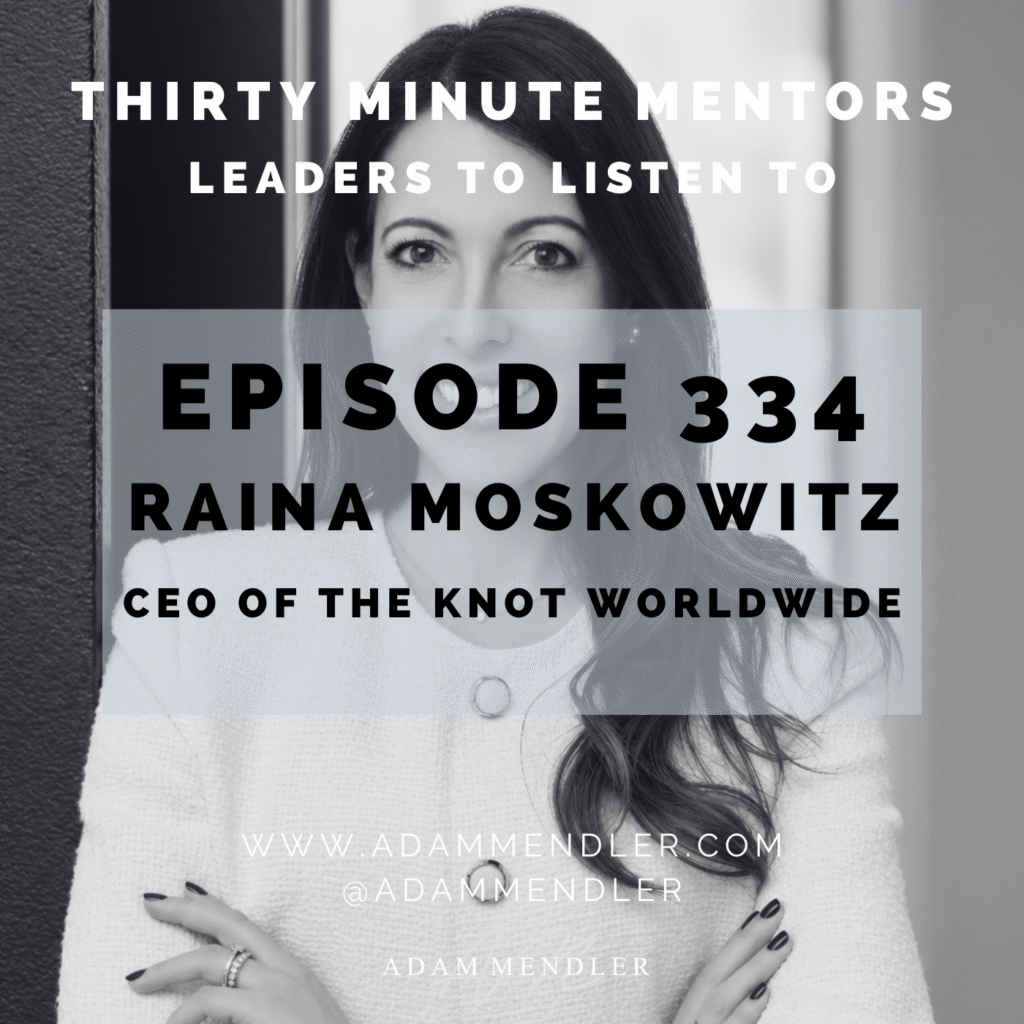
Raina Moskowitz is the CEO of The Knot Worldwide, one of the largest and best-known companies in the wedding industry, a role she took on in 2025. She previously served as Chief Operating Officer and Chief Marketing Officer of Etsy, and before that spent roughly 13 years at American Express. Raina joins Adam to share her journey and her best lessons and advice. Raina and Adam discuss a wide range of topics: leadership, team-building, career success, communication, community, trust, and much more.
Join Adam and the best network of mentors – Fortune 500 CEOs, founders of household name companies, Hall of Fame and Olympic gold medal-winning athletes, political and military leaders – for intimate half-hour conversations each week.
Thirty Minute Mentors is available wherever you listen to podcasts. If you enjoy the episode, visit your favorite podcasting app and subscribe, rate, and leave a review, and spread the word by sharing on your social media channels and sharing directly with your friends and colleagues.
Read the full transcript of Adam’s conversation with Raina Moskowitz.
Episode Summary
Raina Moskowitz spent roughly 13 years at American Express before becoming COO and CMO of Etsy and, in 2025, CEO of The Knot Worldwide. She credits her time at Amex with two specific lessons rather than a general sense of loyalty: the company moved her through eight or nine different roles across strategy, sales, marketing, and customer service, and it invested deliberately in leadership training on top of technical skill. A mentor there gave her a question she still asks her own team in every career conversation: what job do you want two jobs from now, rather than where do you want to be in five or ten years.
Now leading a company spread across 11 countries, Raina treats team connection as something that has to be built on purpose rather than left to chance. The Knot Worldwide runs a dedicated culture and experience team that plans and measures what it calls intentional gatherings, tracking them with the same rigor as any other business initiative. In hybrid meetings specifically, she watches for a very specific cue, someone who unmutes and then hesitates, and deliberately calls on them so remote voices aren’t crowded out by people in the room. Her test for whether a meeting was worth holding at all is blunt: if there wasn’t real debate, it probably could have been an email.
Raina describes trust as something that compounds in small, repeated actions rather than a handful of big moments. She points to her own habit of running recurring roundtables with employees at every level, taking notes, and following up visibly on one or two themes each time, arguing that failing to follow through on feedback erodes credibility fast. When hiring, she looks past pure technical expertise for people who are genuinely hungry for the mission, since she has found that hiring the most technically skilled candidate is not always the right call.
Raina also frames her own executive team as what she calls her first team. When she hired her current CFO, she told him directly that she didn’t need a head of finance, she needed a member of her executive team willing to show up united with the rest of the group. She closes by describing a habit she treats as a leadership requirement rather than a luxury: blocking calendar time for exercise, family, and sleep, on the premise that any unclaimed time on a leader’s calendar gets filled with work by default.
What You’ll Learn
- Why Raina spent years early in her career writing talking points and decks behind the scenes in a chief of staff role before communication became one of her defining strengths.
- Why Raina distinguishes between mentors and what she calls “champions,” people who actively put her forward for opportunities rather than just offering advice.
- Why Raina’s team publishes the results of its own internal employee survey even when the findings aren’t flattering to the company.
- Why Raina still asks her own team the same question a mentor once asked her, what job do you want two jobs from now, instead of the more common five or ten year framing.
- Raina’s test for whether a meeting was worth holding is blunt: if there wasn’t real debate, she believes it probably could have been an email instead.
- When Raina hired her current CFO, she told him she didn’t need a head of finance, she needed a member of her executive team willing to operate as a unified first team.
About Raina Moskowitz
Raina Moskowitz is the CEO of The Knot Worldwide, one of the largest and best-known companies in the wedding industry, a role she took on in 2025. She previously served as Chief Operating Officer and Chief Marketing Officer of Etsy, and spent roughly 13 years at American Express across a range of roles spanning strategy, sales, marketing, and customer service. Raina grew up in Cooper City, Florida, where she cheerleaded through high school and continued cheerleading at the University of Pennsylvania, crediting that early experience with an enduring focus on team and community that carries into how she leads today.
Related Episodes
- Episode 8: Former Campbell Soup CEO Doug Conant
Doug discusses leadership built on trust and a philosophy of winning in the workplace before the marketplace, the same foundation Raina describes building through small, consistent follow-through. - Episode 346: Techstars Co-Founder and CEO David Cohen
David hires first for intrinsic motivation over credentials, the same instinct Raina applies looking past pure technical expertise for people who are genuinely hungry for the mission. - Episode 345: Major League Soccer Founder Alan Rothenberg
Alan describes surrounding himself with good people and giving them real autonomy, the same delegation philosophy Raina applies building her executive team as a first team. - Episode 72: New Mountain Founder and CEO Steve Klinsky
Steve built a career mentoring people across dozens of portfolio companies, a similar emphasis on champions and mentorship to what Raina credits with accelerating her own career. - Episode 334: WWT Co-Founder and CEO Jim Kavanaugh
Jim discusses accountability and team building at a company scaled past ten thousand employees, similar territory to Raina’s account of engineering connection across a distributed team.