
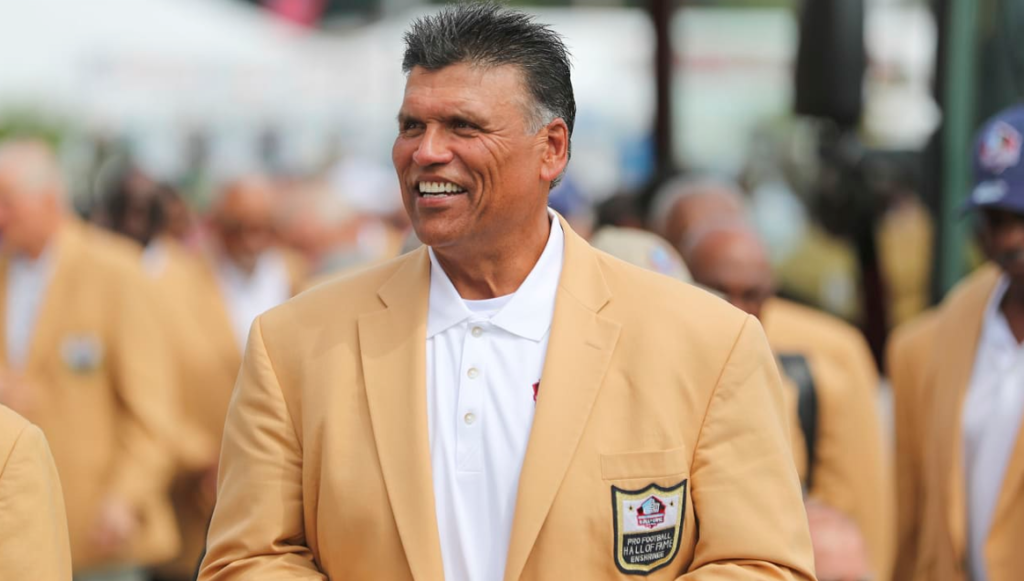
I recently interviewed NFL Hall of Famer Anthony Muñoz on my podcast, Thirty Minute Mentors. Here is a transcript of our interview:
Adam: Our guest today is an NFL legend, widely considered to be the greatest offensive lineman in the history of football. Anthony Munoz is an 11-time All-Pro, 11-time Pro Bowler, and member of the Pro Football Hall of Fame. Anthony, thank you for joining us.
Anthony: Adam, thanks for having me, man. Looking forward to chatting here.
Adam: I am too. You grew up in Ontario, California, right outside of Los Angeles, with a single mom and four siblings, and growing up with two older brothers, you played a lot of sports and developed a passion for baseball and for football, and you played both sports at USC, my alma mater. Can you take listeners back to your early days? What early experiences and lessons shaped your worldview and shaped the trajectory of your success?
Anthony: Adam, this is a great place to start. I tell young people when I’m talking to them, don’t ever forget where you came from. Not only don’t ever forget where you came from, but don’t forget what you’ve gone through, adversity and good times, and then, of course, when you achieve some sort of success, don’t forget those that have helped you along the line. And I’ll never forget where I came from. My mom, Esther Munoz, raised five of us. I had two older brothers and two younger sisters. Growing up, as you said, in Ontario, now that’s referred to as the IE. You got the OC, now you got the IE.
But I wouldn’t trade growing up there for anything, even though we never had a car, we didn’t have a whole lot. Like I said, Mom raised five kids by herself, two older brothers. My oldest brother Joe was eight years older than me. Tom was my next brother. He was two years older than me. We lost Tom, and then I had a sister Debbie just below me, about a year and a half, two years. We lost her within a year of Tom, and then my youngest sister Ruth, she’s the baby, the spoiled one in the family. So still, Ruth is here, I’m here, and the older brother Joe.
We knew Mom was Mom, and she filled in for Dad because my dad was in prison the entire time growing up. Never met him. Never did meet him after he got out. I heard indirectly he had passed away at a halfway house. Was a drug addict, sales guy. So I mentioned Mom was Mom, Dad. She was coach, unbelievable athlete, and then all five kids knew she was the boss.
But it’s interesting because athletics became a very big part of my life early on. Having two older brothers, they took me under their wing, and they saw that even though I was two years younger than one and eight years younger than the other, they saw that God had gifted me in the area of baseball, so I just started playing with them. I’d hang out with them, go to the park with them, play baseball with them. Although Joe was eight years older than me, so his crowd was a little different. But Tom and I played a lot of baseball together. De Anza Park was a park in South Ontario that we, at the age of six and a half, seven, man, we found out that Parks and Recreation in the summer opens up the shed at seven in the morning, throws out the bases, and you can go. And we would be there minutes before the head of Parks and Recreation would get there to help them open up the shed.
And so we didn’t have a whole lot financially. We had to find transportation. Two feet were the best transportation at the time, and we’d walk everywhere. So we’d get down there. But we had a lot of support. Mom supported us. She was one of 10, so we had uncles and aunts, and each one of her siblings had at least five to 10 kids. So we had a lot of relatives, and like I said, I learned a lot.
A lot of valuable lessons. Mom taught us work ethic. It wasn’t like she sat us at the table and said, “Okay, kids, this is what work ethic is all about.” No, all we had to do was watch her cross the railroad tracks as she walked to the local chicken ranch to pack eggs at seven in the morning, then return home late afternoon and take a few minutes’ rest and then cook us dinner. But she taught us some lessons because while she was gone during the school year, not as much, but in the summer, she taught us how to cook because five of us had to survive. We had to cook during the day when she was working in the summer. She taught us how to wash dishes, wash clothes, iron clothes, how to sew, all those things that are no longer done by kids. You got sewing machines, but we used to thread the needle and sew, and that’s how we held on to our clothes much longer than usual.
I really didn’t realize how much we didn’t have until high school, where you saw kids wearing different sets of clothes every other day or every day. Mom always said, “Just because you don’t have a lot, it doesn’t mean you look like you don’t have a lot.” So man, wash and wear the clothes, iron them. She taught us how to iron with that heavy-duty starch. Man, we would crease the jeans, and if our pants needed patches, we would iron on patches first, and then we’d reinforce them with sewing around them, so they’d last that much longer. If our shoes started to wear out, we’d pull out the insole, we’d cut out some thick cardboard, trace it, put it in the shoe, then put the insole back in there so we had some extra protection.
But she taught us responsibility, not only work ethic, but responsibility. Sports, like I said, became a big part of my life during the school year. If I wanted to go out and play sports with my buddies, whatever sport was in season, we had to get our homework done. Responsibility, do the things you need to do. In the summer, you’re there in Southern California, man. You can play a lot of baseball in the summertime, from when the sun comes up to when the sun goes down. But before we could do that, we had to do our chores.
It wasn’t just dusting the house, and we had to wash the dishes, put them away, wash clothes, hang them up on the clothesline, and pull them off the clothesline. Just things like that. So she taught us responsibility and valuable lessons that would carry from my childhood through high school, college, and the NFL, and even now as I continue to be a dad, a father, and a grandfather. So growing up there in Ontario, California, man, a lot of great lessons, a lot of great coaches and teachers that stepped in to show me what it was to be successful, but to do it right. So, like I said, I wouldn’t trade growing up there for anything.
Adam: I love it. You shared so much there that I love. You shared so much there that I would love to dive into. And something that you shared is that at a very early age, your siblings recognized, you recognized, that you were very talented at sports. But there are a lot of people who are very talented at sports who don’t make it, who don’t make it to Major League Baseball, who don’t make it to the NFL, let alone to the NFL Hall of Fame, and the difference between those who are supremely talented who make it and those who are supremely talented who don’t make it, often that difference is work ethic. Often that difference is resourcefulness. Often that difference is responsibility. The very lessons you learned from your mom, the very lessons you learned from your siblings, the very lessons you learned from those early days growing up in Ontario.
Anthony: One of the things that I didn’t realize, I’m 68, so it’s about 60, going on 62 years ago, is my older brother Joe, when he saw that talent I had, one of the first things he told me. Little did I know I was learning humility back at that age. He said, “Anthony,” and I mean, when he spoke at that time, I was much smaller than him. He said, “When you do something, don’t ever talk about how good you are. If you’re good enough, people will talk about you. You just go out there, and every time you have a job to do, get it done.” And that meant so much because even when I was in high school and college, that rang in my ears like he was telling me the day I was going out to every practice or every game. He said, “Just go out there and bust your tail and get it done.”
But you’re right, work ethic. When times are going good, it’s a little easier to go out there, but it’s when that adversity hits. How are you going to handle adversity? I had some adversity in my life, and that work ethic, responsibility, persistence, that all kicked in because when you’re sitting there complaining on Monday morning, or let’s say Sunday morning in college, Monday morning in the NFL, about how sore you are, all I’d have to think about was my mom who had rheumatoid arthritis from a very young age, and she had that pain every single day and never complained about it. And here I am. I know after the game I’m going to be sore, but then after a day or two, I’m going to recover, my body’s going to feel great. So I thought about her and what she did for us. She was playing hurt every day.
There’s a lot of guys in sports that won’t. Not that you have to play injured, but you play hurt, you play sore. She was doing it with five kids every day, so things like that just rang in my head. Adversity I went through, it’s just never giving up. Mom taught us don’t ever give up, don’t ever complain. The only thing she complained about was, “When you pull the clothes off the clothesline, don’t snap my clothespins in half. I need to use those, take them off gently.” But she never complained about anything.
But it was always just working extremely hard, and our whole family was that way. My siblings, my aunts, my uncles. I’m thankful that I was taught that from a young age. And as I look at every stage of my life, that has kicked in, and a lot of people look at things differently. A lot of people say, “Well, if you’re going through adversity and people are saying you can’t do it,” they have a chip on their shoulder. I said, “No, that’s one of my pet peeve statements.”
I don’t believe in a chip on the shoulder. I believe that you have a job to do, and you got to do the job. I mean, I could have looked at the three knee operations in college and said, “Man, people don’t give me a chance. I got a chip on my shoulder.” No, every rehab was my job to rehabilitate and come back even stronger the next time. So I’m going to replace that chip on the shoulder with, it’s your job to do, and you got to go out and just do it without saying anything.
Adam: So much of success comes down to having the right perspective and having the right mindset, and those are things that we can control. We can’t control how big we are. We can’t control how athletically gifted we are. We can control, to an extent, our ability to unlock the gifts that we have, and a lot of that comes down to our perspective and our mindset. Do you have a positive attitude? Do you show up with negativity? And appreciating that we may not necessarily be dealt the best hand every day, but what is the hand that we’re dealt, and how do we play our cards? So much of success comes down to not the hand you’re dealt, but how you play the cards that you’re dealt.
Anthony: Exactly, and the first thing that comes to my mind is: Are you going to be bitter, or are you going to get better? So quit using the victim card. There comes a point in time. Yeah, I never knew my dad. He was in prison. I didn’t have that male role model example, but man, I had an unbelievable mom that gave me some tools. So I’m going to take that.
Statistics say that a young man like myself, growing up in a single-parent home with just your mom, all these siblings, that you got to do this or do that. Your chances of being incarcerated and being busted, no, it doesn’t have to be that way. Your perspective is: I want to make something out of my life, and I’m going to use the motivation to say, “Okay, here I go. This is my job, and I’m going to do whatever it takes.” It was a gift God gave me, but now I can’t sit on that gift. I got to take that gift, and I got to be persistent in my workouts. I got to push myself and get stronger and get in better shape.
You talk about perspective and success. Let’s get rid of the ego and let’s get a mentor, someone that’s done something already. Go ask them questions, and that’s one of the things I did after I retired in the not-for-profit world, in business. Because quite frankly, I was playing football. I wasn’t a businessman. I didn’t know enough. So now let’s get rid of the ego and say, “Okay, I want to mirror you. I want to shadow you. You’re successful. I want to be successful like you. Teach me.”
The crazy thing is, athletes, we had a mentor every single year we played sports, and that’s the coach. Hopefully, you listen to your coach because he has all the fundamentals. He has the strategy in order to put you in a position to be better, and I could look at my football career, and this is rare, Adam, and you’ll know it. I had one coach in college, one coach in the pros. That’s 17 years, two coaches, and two of the best. My college coach, after he left college, 30-plus years in the NFL, considered one of the best. My coach my entire career for the Bengals coached college, he was in the pros over 30 years. Both those guys, as far as I’m concerned, in my humble opinion, two of the best, two in the top five, at least two of the top 10 line coaches that ever coached.
So utilize that. I tell young people, utilize the resources around you because we don’t know everything. And remain teachable, remain coachable, and continue to learn. Be a sponge, take it in. So I believe that’s perspective, and that’s eliminating your pride and saying, “Coach, I got enough.” Say, “Coach, give me some more on this. What do I have to do to improve?” If you’re in business, go to a businessman that’s in a similar arena and say, “I want to pick your brain. You’re successful. I want to get to where you are.”
It’s amazing. Last Sunday, our service at church was all about mentors, and if this guy’s living the way you want to live, go and ask him. He said, “You young couples in church, sit back in the back as these older couples come in that are holding hands. They’ve been married for a long time. They sit down together during worship. They hug each other. Go and talk to them. Let them be your mentors as a young married couple.” So that’s what I’m saying. It’s all about perspective. Are you going to get better, or are you going to be bitter? And are you going to remain coachable and teachable, and just take in from whoever you can in the area that you want to be excellent in?
Adam: Anthony, you mentioned your two coaches: your college coach, your coach with the Bengals, and the impact that they made over the course of your career, the impact that they made over the course of your life. What made those two coaches special? What makes great coaches great?
Anthony: Well, I use those coaches in football. So Hudson Houck was on the cutting edge of things that we were able to use. Before, offensive linemen couldn’t use their hands and couldn’t punch, and it’s just basic fundamentals: teaching you how to sit down, not bend at the waist, but bend at the knees, how to move in that position, how to use your hands. So not only was he sound technically, but both those coaches were very sound technically, both coaches very sound with strategy, how to put together running packages against defenses, how to put together pass blocking. But then you take it a step further: teach you technique, teach you strategy, and then teach you how to study the game, what to look for. A lot of times, as an offensive lineman, you just go up. Adam is playing right across from me.
Just, no. Look at the linebackers. Try to see what they’re doing as the entire unit instead of just looking at your guy. If you look at the linebackers, there’s certain stunts. Even at the beginning, they have to cheat and align different ways. So if you see that before you get in your stance, you’re like, “Huh, this might be happening.” So you’re at least aware of things.
So I think that’s what made those two guys amazing, as they really wanted to put you in the best position that you could be in, and my college coach never said it, but I’m sure it was. My line coach in the pros said it. He said, “I don’t want to be a coordinator. I don’t want to be a head coach. I just want to be the best offensive line coach and get my guys to be the best offensive linemen. Put them in the best position to be successful.” And like I said, my college coach, I never heard him say that, but for over 30 years, he was an assistant line coach, very smart, and I would imagine he could very easily have been a coordinator and maybe a head coach.
But that’s what made those two guys together, or both of them, so great working with them. And because I go from college learning a great foundation, then get in the pros, and it just takes off technically. And that was a big thing from it. So much of technique is important for offensive linemen.
Adam: I love that. Great coaches are great teachers. They teach you the fundamentals. They teach you beyond the fundamentals what you need to be successful. But beyond that, great coaches shift your perspective. They allow you to see things differently. In your case, you looked at the field differently. A great coach, a great leader, allows the people who they coach, allows the people who they lead, to get into the best position possible to be successful. Allows them to be at a place where they are their best selves.
Anthony: And you’re right. And those coaches that I talk about, it wasn’t about them. To me, leaders don’t make it about themselves. Great leaders make it about the team or the unit they’re leading to success. And that was the thing with Hudson Houck and Jim McNally; it wasn’t about them. It was about, “Okay, Anthony, I want to make you the best in college. Bruce Matthews, I want to make you the best.”
Brad Budde, in the pros, Max Montoya with Jim McNally, or Dave Lapham with Bruce Kozerski. It’s all about, “Okay, I have the goods here. I’m going to be the leader. I’m going to give the goods to you, so I can get you to the top.” And it’s, “I’m the coach, but it’s not all about me.” That’s what makes a great leader.
Adam: Anthony, what do you believe are the key characteristics among the very best leaders, and what can anyone do to become a better leader?
Anthony: When I look at leaders and those guys I’ve been around, and I’ve been around some amazing leaders, first of all, it’s the ability to encourage and hold accountable. If you’re doing things great, they’re going to encourage you because that’s good. But they’re not afraid to hold you accountable. Constructive criticism allows you to get better, and they’re not going to feel like they’re going to hurt your feelings. So encouragement, accountability, the ability to connect with the people they’re leading, and I had some great leaders that knew how to connect with us in different ways. One example, I believe, a great leader I played for was Boomer Esiason, and he knew how to connect with us offensive linemen.
It was one of those things where after our individual meetings would be over, he’d come right away before we left the room, and he would close the door, and he would run the video. So now, no coaches. It was all the linemen and Boomer. Let’s say we’re playing the Steelers, and we’d run their defensive film, and he would call a play, and we’d make the calls. So we’re seeing it up on the screen. We might not be on the field, but it’s your quarterback calling it, and we’d do that.
Then another way he knew how to connect. If a quarterback doesn’t know that he connects with his offensive linemen with food, they’re not smart. So Boomer, every Thursday night, Boomer took us out to dinner. Man, it was ribs and burgers, and it was an all-year thing. Thursday was a tough practice because that was our second day after we installed the game plan on Wednesday, full day of pads, and then we’d go to dinner and just get away from the facility, get away from football, so he knew how to connect with us by feeding us good food.
And then, of course, I think great leaders have a plan, and that plan is such a great plan that those he’s leading are going to buy into it. From the first guy I got with here in Cincinnati, Paul Brown. Just think about what Paul Brown brought to the NFL. I tell people, if you’re a football fan and want to know the history of different things that came to the NFL, go up to the Hall of Fame or read about Paul Brown. He was a great leader. He had a great plan.
Forrest Gregg, my first head coach. I mean, he comes in after the team was 4-12 two years in a row. He brings his plan out. Here’s a guy that played for Vince Lombardi, knowing that his plan is not going to make a lot of guys happy because these number one picks over the last couple years are going to get into shape, and the only way you get into shape is you work your tail off. He did that two years after he got in there with his plan. He got us all to believe we’re going to a Super Bowl after two 4-12s and a 6-10. So they had a plan that guys look at and say, “I believe in that. I’m willing to be all in.” So those are some of the things that I see great leaders having, and I’ve been around those guys, and they’ve done an amazing job.
Adam: Great leaders have a great plan, great vision, the ability to connect, and something you shared, which I don’t hear often from the many, many leaders who I interview, great leaders understand the importance of feeding the people who they lead, which is very true.
Anthony: Yeah, I’m a firm believer in that. I see it, and you try to do those types of things. And I got a foundation. I got a couple small companies, and it’s funny because most of my leaders have been around the athletic world, and after 25 years of the foundation, 20 years of that, I hope they don’t get tired of me using sports analogies. So I don’t think they do, but yeah. So it’s one of those things where, man, I tell you what, it’s not easy being a leader, and I’ve been fortunate.
I had a board member who ran a bunch of companies. He was a CEO for a bunch of companies. When I started the foundation, I didn’t know a lot about not-for-profits, but I knew that with my name on it, I had to learn. And he took me aside, man. I learned how to run it like a small business because he was a businessman, ran some big companies, and made it so much easier. So I was willing to say, “Okay, I’ve been playing football for 13 years. I got to get caught up on business and not-for-profits.” I tell you what, having those people around me, then I was willing to ask, and that’s why you put a board together, because they’re willing to do that. They’re willing to give you information because they have been successful, and I’m grateful for the board that I’ve had over the years.
Adam: Anthony, when I give keynotes, I share a list of the key characteristics among the very best leaders that I’ve put together from interviewing hundreds and hundreds of the most successful leaders, and on that list are two characteristics that we’ve been talking about. One you mentioned explicitly early on in our conversation, and another you mentioned implicitly right now. The first one is humility, something that you learned at a very early age, and that you spoke about within the context of playing sports. Let your play speak for itself. And the second is curiosity. The most successful leaders possess the humility to know what they don’t know, and possess the curiosity to want to learn as much as they can to get better and to gain the knowledge required to be the best that they can be, to allow their teams, their organizations to be the best that they can be.
Anthony: You’re right. I love that. To your point, I was up in Canton from Wednesday to Saturday. The new president started there four years ago. He started a residency program where he brings in a Hall of Famer from Wednesday to Thursday, and we just get involved in the community. Now, living in Cincinnati, being in the Hall of Fame up in Canton, I’ve been on the board. I was employed for three years up until about two years ago, so I’ve been in Canton a lot.
But being up there the last three days last week, it was a totally different thing because now I’m going to high schools and speaking to 300 freshmen and sophomore students. Saturday morning, this past Saturday, there was a team, Louisville High School. They just won their game the night before, but half their team was playing JV. So 30 of them were there, and that’s one of the things I shared with them. I said, “Guys, I was in my 11th and 12th year, and I was still learning about offensive line play.” I said, “Always remain coachable.” I always took notes, and from my rookie year to my 13th year playing, I might take notes on the same play, but every time you’re seeing something different, so take those notes because everything you put together is going to help you.
I had a notebook on all the guys I was playing with, and I said, “You know what? I’ve seen a couple guys during practice. The coach would come up and try to tell them something, and they said, ‘Coach, no, no, I got it, I got it. Don’t worry about it.'” And that was a slippery slope because you could tell that they thought they had it all when they really didn’t. And all of a sudden, they were blocking themselves from really continuing to learn. Therefore, I said, “I played 13. I was still learning about O-line play in my 13th year,” and even now I still watch. I try and talk to offensive line coaches when I can, and things are evolving and changing, but yeah, you just always remain coachable, always remain teachable, and I told those young guys, “Don’t ever get to a point where you think you know it all,” because, like you said, some serious businessmen that have been doing it for a long time, and they’re still learning.
Adam: Anthony, one of the amazing things about your career, not only were you such a great player, but you enjoyed such sustained greatness. You were successful from the time you got into the league, pretty much up until the time you retired. And we’re talking about 11 Pro Bowls, 11 All-Pro teams. That doesn’t happen by accident, and you shared a couple of the ingredients: the desire to continually learn, a continued focus on being coachable. What are some of the other ingredients that allowed you to remain so great over such a long period of time?
Anthony: Well, it’s interesting you ask that because I have this. It’s about 10 lines on being committed or interested in being excellent. When you’re committed to being excellent, the first one is: when you’re committed, you find a way. If you’re interested in being excellent, you find excuses. So one of the things that I tried to do, and I told those young men Saturday, I said, “Don’t ever be satisfied with success.” I said, and that was the thing with me.
My rookie year, I was an alternate Pro Bowler, so I didn’t quite make it. That was my goal. Then my second year, Forrest Gregg, my head coach, Pro Football Hall of Famer with the Green Bay Packers, pulled me out of a meeting and said, “You’ve just been voted to your first Pro Bowl,” and my first thought was, I don’t want to be satisfied. Now I’ve got to work that much harder because my goal when I entered the NFL was, of course, to play in the NFL 10-plus years. But another goal was every year I played, I wanted to be a Pro Bowler, so didn’t quite make it my rookie year.
So now I started. I said, now I want to not only start every year, and that was a goal. Every time I put on the gear, I want to be a starter for the Bengals. Earned that starting job three days into camp after I got drafted. I want to start 10-plus years. So now, how was I going to do that? Well, if I was saying this, I was saying that to myself.
I needed to be committed. I needed to find a way. So I worked this hard going into my second year to be a Pro Bowler. Now I had to work that much harder. So the thing I did was every year I worked even harder, I ran even harder, I lifted even harder, tried to get stronger, studied that much harder, worked on my football technique in the off-season that much harder. So to me it wasn’t like, “Okay, Pro Bowler. Well, let’s just run and lift weights in the off-season.” No, I always ran, lifted, and I always did some football technique because I wanted to stay sharp.
Then I found other workout programs that were going to get me better. I was always flexible for a big guy. Keep that flexibility, which is very important as a left tackle. Maybe find another type of workout, so I was always finding different things to improve my body, my mind, and that’s what I did going into my last year, my 13th year. I was 34 years old, and I could probably run a lot further, a lot harder than when I was 22 years old. That’s how hard I ran.
The strength coach would actually come out to my high school where I do my off-season running, and gauge what I was doing and put together our running tests for minicamps, or they call them OTAs now. That flattered me that he would come out and had been a head strength coach forever, that he’d come out to see my workout. So that’s the thing I did because I got in the league. I was 21, shortly turned 22. Now you’re young. You don’t know everything, so you’re working hard. But then the closer you get to 30, Adam, you’re becoming an old guy.
So I wanted to make sure that my cardio, my strength, was at the highest level. So that’s what I did, and that’s what I really believe that God allowed me to do through my work ethic and what I learned, to continue that pace. And what my wife says now is, “Why don’t you slow down a little bit?” I said, “Well, it makes me feel good.” She says, “Why don’t you work out five days a week instead of Saturday?” I said, “Well, it’s only an hour and a half, two hours.”
I still got the other 24 hours during that day, so I just got to keep moving, and it makes my body feel good. It keeps the soreness completely away, and I feel good. Now with all these grandkids, I get a chance, and when I can, I get her to travel with me. And I love playing golf, working out, and golf. So that was my whole process. That was the journey of wanting to stay at the highest level for every year that I played in the NFL.
Adam: And while playing in the NFL, you played on some really, really good teams. Two of your teams made it to the Super Bowl, and you played on some bad teams. What differentiated the winning teams from the losing teams? What differentiated the winning cultures from the losing cultures? And how can anyone turn a losing team and a losing culture into a winning team and a winning culture?
Anthony: Yeah, it’s funny. I’m going to answer that last one because 6-10 to 12-4, home-field advantage, and going to Super Bowl XVI. Then our second Super Bowl, it was 4-11 to 12-4, home-field advantage, and both times basically the same guys. Again, we get back to a lot of what we’re talking about: the commitment to being excellent. I think a lot of times, “I’m in the NFL,” and you relax. I mean, you can’t relax. You can’t take a day off.
I mean, I know you’re sore. I know you don’t feel like going. But I think that was the difference. The two years that we finished 12-4, week eight, week 12, nobody wanted to take time off. There was a true commitment. Prior seasons, it was like I didn’t see the full commitment. I didn’t see everybody totally in, and it was basically the same talent.
People just worked harder and got stronger and in better shape. And it was always strange to me. Why didn’t you do that the year before? I mean, you’re a professional, but people get into that lull of indifference and maybe some overconfidence. “I’m in the NFL now.” I say, “No, you’re in the NFL, so in order to be successful and continue that pace, you’ve got to commit yourself.” So I think that was a big thing.
I got to give Sam Wyche credit. Our second Super Bowl, not that we had a lot of racial dissent, but he came in after that 4-11 camp, which was rough. It was tough. Guys were bickering, so the first night at camp, you usually pick your roommate. It’s an offensive lineman for me. I roomed with Max Montoya. A DB gets another DB.
He had sheets, and he goes, “I have a new rooming list.” He said, “This year in camp,” which, back in the day, it was four or five weeks, two-a-day practices, full pads. Then he started. He goes, “White with Black, offense with defense,” and everybody’s like, I looked around. Best move he made. I roomed with a linebacker.
Well, when I was with another offensive lineman, whatever free time we have before bed check, all the guys that come into your room are offensive linemen because that’s who you’re rooming with. Now I had a linebacker. I had linebackers coming in my room. I had defensive backs coming in, so we got to know each other in a more in-depth, different way. And it was like at lunchtime, instead of having all the linemen sitting at one table scarfing all the food, we had DBs sitting with us, linebackers, maybe one other lineman. So there was really a great combination of integration, of really bonding together, and I can tell you, 40 years later, we’re still close friends because I have about 40 guys that I played with, and a lot of us played in that second Super Bowl, and we’re great friends.
So I think that was the key, Sam as the leader realizing, “I got to mix things up here. We got a pretty good plan. We got a great offense. Dick LeBeau is our defensive coordinator, and we have some really good talent. Let’s see what I can do to bring that talent together.” And I think that was a genius move. I really believe he was a genius in offensive strategy and play calling.
But man, he just showed me a lot by doing that. Never had a chance to ask him who he counseled or who he got information from to do that, but he did it, and that was great. So that was the difference. It just was a different feel coming to camp both those years. And the first Super Bowl, that start wasn’t great. We’re 5-2.
We go down to New Orleans and lose, get our butts whipped. Now we’re 5-3 halfway through the year, and we’re kind of at a crossroads. How good are we going to be? And then all of a sudden, we have five games in November, and I’m talking, Adam, we eliminated teams in the third quarter to go 5-0, and all of a sudden, from 5-3, we’re 10-3. Unlike for Super Bowl XXIII, we started, we were 6-0 at the beginning of the season. We just had that feeling right away, where we had to go through some adversity instead of that hard work.
So it’s just like totally two different seasons, but I could tell that guys just came together and just became dedicated to be the best. And to me, that was foreign that it’s not done every single year because that was my approach, my work ethic, and how I prepared. I just thought, hey, you’re an NFL football player, you’re a professional, and that should be the norm. It’s just busting your tail from the last game to the start of camp, start of camp through the season, but not everyone’s made that way. But we got it together those two years.
Adam: And from the outside looking in, it’s easy to overlook how important exactly what you shared is, not only to a professional sports team’s success, but to any team’s success. We look at the talent on the roster and we say, “Okay, this team either has what it takes or doesn’t have what it takes.” But what you described is what you can’t measure on paper. What is your team’s level of commitment to excellence? What is your team’s level of cohesion? And something else that you shared, which is really important, it’s not necessarily how you start, but it’s how you finish. There are going to be bumps along the way. There are going to be ups. There are going to be downs. There are going to be seasons within your season. How do you respond? And if you can’t respond, you’re not going to do very well. But if you can respond to adversity, those are the teams that win.
Anthony: I agree with it. It’s great because you’re bringing up a lot of stuff I just shared with a bunch of high school kids. I’m always asked, what would Anthony Munoz at my age tell an Anthony Munoz at 13, 14? Those are the grades I was talking to, and I said probably what I would tell now as a grandfather, as a father, as a husband, is I would tell a 13-, 14-year-old Anthony Munoz, don’t worry as much about the prize as you do about the journey and the process. Think about all that work that goes into becoming a high school varsity player, or a college player, or an NFL player, or even a Pro Football Hall of Famer. Just focus on that journey, man. Do whatever you can, and then hopefully that will lead to that prize, that goal that you have.
A lot of times, I was so stuck on, as a kid, I wanted to be a Major League Baseball player. Just being that Major League Baseball player, or it wasn’t until late in college I thought about the NFL. But just taking care of the details and the things that allow you to really just gain the confidence, gain that strength. I tell people all the time. I said, “If a Pro Football Hall of Fame football player tells you he never got knocked down, we’re going to fact-check that because all of us got knocked down.” We not only get knocked down in sports, but we get knocked down in life.
And it’s to your point: How are you going to handle that adversity? Are you going to bounce back up, or are you going to stay on the ground and, “Woe is me”? Are you going to get back up and get after it again, and that’s what you have to do, and that’s what I was taught, and I believe that’s what I had to do, especially in college. It’s like I got knocked down one year, get back up, knocked down a third time, my senior year, get knocked down again with my third knee operation. Had to pick myself up again, and you just don’t throw in the white towel, and you just take the responsibility. It’s your job, rehabilitate and get back. That’s the whole perspective of what you have to do. Just say, “Hey, I’m going to fight back. I’m going to do whatever I can.”
Adam: Anthony, you shared your advice for the 13-year-old Anthony Munoz. What can anyone listening to this conversation do to become more successful personally and professionally?
Anthony: We all have goals. I think a lot of people set goals. Understand, first of all, do whatever you can to move you towards that goal, but also understand that there might be some detours along the way. And what you do is you take that detour and use that same work ethic that took you to that detour, and even step it up to get you past that obstacle, that detour, knowing that sometimes if you’re looking to do this, it might be, “I want to do this,” but take that same work ethic to get there. And that’s what I would say, that the way you plan things doesn’t always necessarily happen that way. Sometimes they do, and God bless you if they do, but sometimes it doesn’t happen, and you just got to have your nose down to the grindstone and keep going and not get discouraged.
And like we talked about earlier, you can’t play the victim. “Well, I was working so hard and things…” Well, no, I was working so hard. Okay, let me just take a little detour here. Instead of going down this nice freeway that’s freshly paved, I got to go down one of these rocky, all-gravel roads, and then get back on the freeway. So that’s the attitude you have to have. And if you have that attitude, and just believe that you can overcome, and again, I’ve not met many people that overcome alone. There’s people that help them out.
I’ll use this analogy. So many times I hear self-made man, self-made woman. Okay, so okay, then they get an accolade. So now it’s their time during this ceremony to go up to the podium to accept this accolade that this self-made man or self-made woman earned, and they have three or four sheets as they’re giving their speech of people they thank that allowed them to accomplish it. And I’m thinking, I thought you said they were self-made. Wouldn’t you get up there with no notes and just say, “First of all, I want to thank myself. Secondly, I want to thank myself again”?
But they share with you all these support people, all these resources that helped them, and that’s what I tell people: utilize that, man. Don’t be isolated. I don’t believe we were made to be isolated. We got to stay in community.
Adam: Anthony, thank you for all the great advice, and thank you for being a part of Thirty Minute Mentors.
Anthony: Thank you, Adam. It’s been great. Great job. I love being with you, man. Appreciate you.