


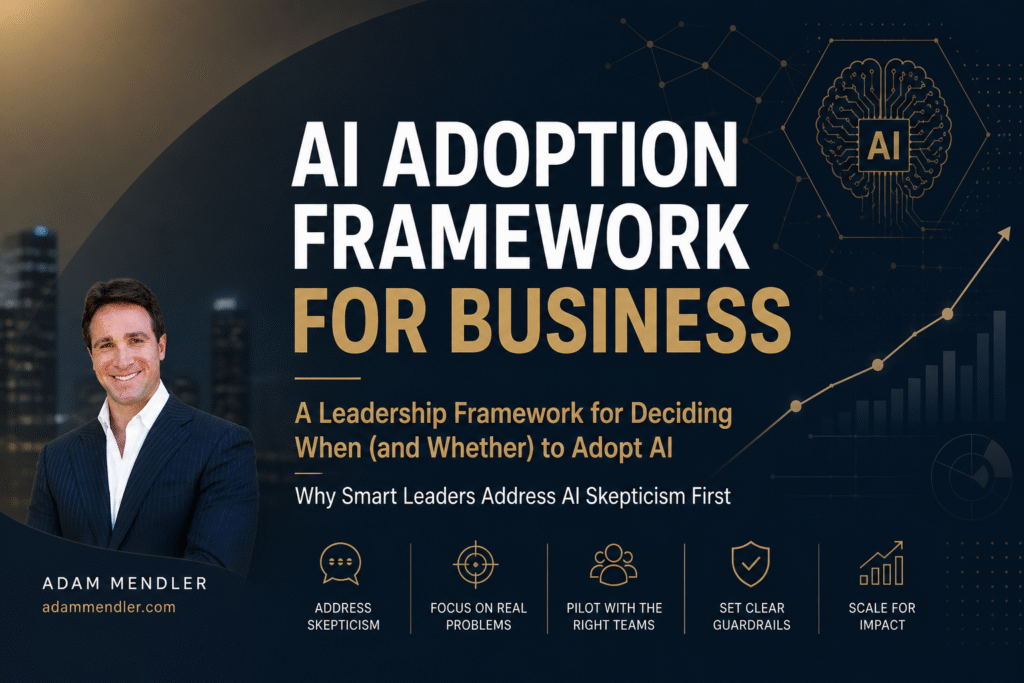
AI has improved faster than most organizations have adapted to it. The vast majority of leaders now believe the technology can help their businesses. The real question is whether their teams trust it enough to actually use it. That is where most adoption efforts stall.
I have been hearing versions of this same concern from leaders across industries. The team at Tote + Pears, which runs the Trending Now: AI series, recently pulled together research that aligns with many of the conversations I have been having with leaders. Pew Research found that half of Americans feel more concerned than excited about AI.
Edelman’s Trust Barometer shows trust in tech companies has slipped from 73% to 63% over the past decade. And the BILL AI in Finance Report, which provides an especially deep dive into how this phenomenon is playing out for finance teams, points to the same dynamic. Interest in AI is moving faster than trust in it. That tension is where many adoption efforts stall.
Most of what gets shared online is still just a list of tools. What leaders actually need is a framework employees will trust when uncertainty shows up. This piece walks through a framework I reference in conversations with leaders trying to navigate challenges associated with building cultures employees can trust.
Why AI Skepticism Is the Real Adoption Challenge
When AI rollouts stall, leaders usually blame the technology first. Most of the time, the real issue is simpler: the people expected to use it never fully bought in.
- Edelman’s Trust Barometer found that only 32% of Americans say they trust AI, and 44% feel comfortable with businesses using it. That describes a workforce curious about AI without being convinced.
- A widely cited MIT study reported that roughly 95% of generative AI pilots fail to deliver measurable returns. Many leaders take that as proof the technology is overhyped. More often, the failure comes from treating AI like a software rollout instead of an organizational change.
- Great Place To Work’s research on the Fortune 100 Best Companies points to the same finding. Their analysis of AI success as a leadership test shows the companies pulling ahead are the ones whose leaders communicated honestly and paced the rollout in a way employees could trust.
This is the part most rollout plans underestimate. If trust is not established early, the rest of the rollout becomes an exercise in managing resistance that could have been prevented.
“The leaders who make the greatest impact don’t wait for certainty. They take responsibility when the outcome is unclear and lead anyway.”
— Adam Mendler
The AI Adoption Framework I Recommend to Business Leaders
A strong AI adoption framework gives leaders a practical way to introduce AI without losing trust, momentum, or operational clarity in the process. The version below comes from years of conversations with CEOs on how great leaders make decisions under uncertainty.
1. Lead the Skepticism Conversation Before You Roll Anything Out
Resistance to AI rarely shows up as open rebellion. It is usually quieter than that. People hesitate. They slow down. They quietly wait to see whether leadership actually understands what they are worried about. The leaders who handle this well address those concerns directly, whether the fear is job loss, surveillance, or being held responsible when AI gets something wrong. Be clear about where AI will help, where it will not be used, and where human judgment still matters. That kind of clarity builds trust early, before skepticism hardens into disengagement.
2. Start With a Pilot Tied to One Specific Business Problem
The best AI rollouts usually start smaller than leaders expect. Most failed implementations begin with pressure to “use AI” before anyone defines a real operational problem worth solving. A better starting point sounds more like asking where AI could shave time off a monthly close that takes twelve days. Finance and operations leaders have the most leverage here. Invoice processing, reconciliation, expense categorization, and AP routing are common spots where AI is producing measurable time savings. BILL’s AI in Finance Report is one of the resources I point finance leaders to when they want to dig further. Pick the bottleneck that already costs you something.
3. Pilot With the Teams Who Want the Help
Skeptical employees rarely become comfortable with AI because of a presentation or leadership memo alone. Confidence usually builds when people see someone they trust getting real value from the tool in their actual workflow. Start the first pilot with the team that has already been asking for help, even if it means skipping the team you would normally choose first. Mandated rollouts usually create surface-level compliance, not real buy-in. Set a 60- to 90-day window and define what success looks like before anyone touches the tool. A goal like “cut invoice approval time by half” gives you something concrete to measure. “Better visibility” does not.
4. Set Guardrails Before You Scale
Once an early pilot works, many organizations try to scale too quickly. That is usually where things start to go sideways. Before scaling, write a short policy in plain language: what data the AI is allowed to see, where decisions stay with a person, and who is on the hook when something goes wrong. Reference it in every meeting where someone proposes expanding the rollout. Clear guardrails are what keep early momentum from turning into organizational confusion.
5. Measure What You Said the AI Would Fix
Logins matter, but they’re not the same thing as adoption. Plenty of companies have strong usage numbers without seeing much improvement in the actual work. What matters is whether the process gets better. If the goal was shortening the close cycle, track the hours saved week by week. If the goal was reducing errors, measure the error rate. Then bring those numbers back to the people who were skeptical in the first place. That’s usually when the conversation starts to shift.
Some organizations move faster once leadership teams have these conversations together in the same room. If that sounds useful for your organization, you can Book Adam to help your team adopt AI the right way.
Book Adam to SpeakWhat Successful AI Adoption Looks Like in Practice
The companies seeing the strongest results with AI usually handled the rollout differently from the start. Employees understood why the company was adopting it, where it would actually help, and where human judgment still mattered. Great Place To Work’s Fortune 100 Best research points to the same pattern. The organizations pulling ahead tended to communicate more consistently, move more deliberately, and let early results build credibility over time.
As Myles Corson, a senior executive at EY known as the company’s “CFO whisperer,” told me, “Rather than starting with the technology, start with the outcome. What problem are you trying to solve? What are you trying to improve? Once you have that clarity, you can think about how technology, including AI, can help you get there.”
Protiviti executive Chris Wright, a former partner at KPMG, shared a similar sentiment: “One of the biggest mistakes leaders make when responding to AI skepticism is forging ahead despite concerns because of a sense that the organization is behind and must do something without treating the initiative as an all-in business decision.”
AI adoption tends to play out differently in finance than it does in many other parts of a business. Finance teams operate with tighter controls, higher accountability, and far less room for error, which makes trust and process alignment just as important as the technology itself. René Lacerte, founder and CEO of BILL, spoke with me on Thirty Minute Mentors about building finance technology for small and mid-sized businesses. The BILL AI in Finance Report takes that conversation into AI specifically and is a useful resource for CFOs, finance leaders, operations executives, and heads of strategy evaluating where AI can realistically create value.
Across the organizations gaining traction with AI, a few patterns show up repeatedly.
| What works | What stalls |
| Constant communication after the announcement | A single rollout announcement |
| Starting with willing teams | Top-down mandates |
| Metrics defined before the pilot | Metrics figured out after launch |
Why Most AI Implementations Efforts Fail
Most failed AI rollouts follow a familiar pattern. A leader announces AI without a clear business problem. Too many teams get involved before any single use case proves real value. Skeptics watch, see no proof, and quietly disengage. Six months later, the project is paused, and the next budget cycle reframes it as a cost concern.
The leaders who struggle usually try to force adoption before employees have seen enough proof. The leaders who succeed build confidence gradually through smaller wins that people can actually see.
Three patterns show up almost every time:
- The pilot picks a tool before anyone defines the problem it is meant to solve
- Adoption gets mandated from the top, leaving skilled teams underutilized.
- Success metrics show up only after the work has already started
None of these failures are purely technical. Most of these problems begin long before the technology itself becomes the issue.
If you are seeing one of these patterns inside your own organization and want a second opinion, you are welcome to reach out directly.
Get in TouchFrequently Asked Questions
What is an AI adoption framework?
An AI adoption framework is a structured approach to integrating AI into an organization while handling the people, process, and strategy challenges that determine whether the change sticks. It moves a company from isolated experiments to consistent business outcomes.
Why do most AI adoption efforts fail?
Most AI adoption efforts fail because companies focus on the technology before they address trust, workflow changes, and employee buy-in. The real challenge is not the technology itself, but building trust, changing workflows, and helping teams understand how AI fits into their day-to-day work.
How do you adopt AI in a small or mid-sized business?
Pick one bottleneck that is already costing the business something measurable, run a 60- to 90-day pilot with a willing team, and define the success metric before the tool gets touched. Only scale once the pilot has produced clear results.
How long does AI adoption usually take?
A meaningful AI pilot usually takes 60 to 90 days, while broader adoption across a small or mid-sized business often takes 6 to 18 months, depending on leadership alignment, team buy-in, training, and workflow integration. The timeline usually depends more on leadership alignment, employee trust, and operational follow-through than on the technology itself.
What is the first step in adopting AI?
The first step in any AI adoption framework business leaders use is identifying a specific business problem they want AI to solve. Defining the problem clearly shapes everything that follows, including which tool to pick, how to pilot it, and what to measure.
Disclosure: This article includes insights from research provided by BILL, a company I am partnering with.