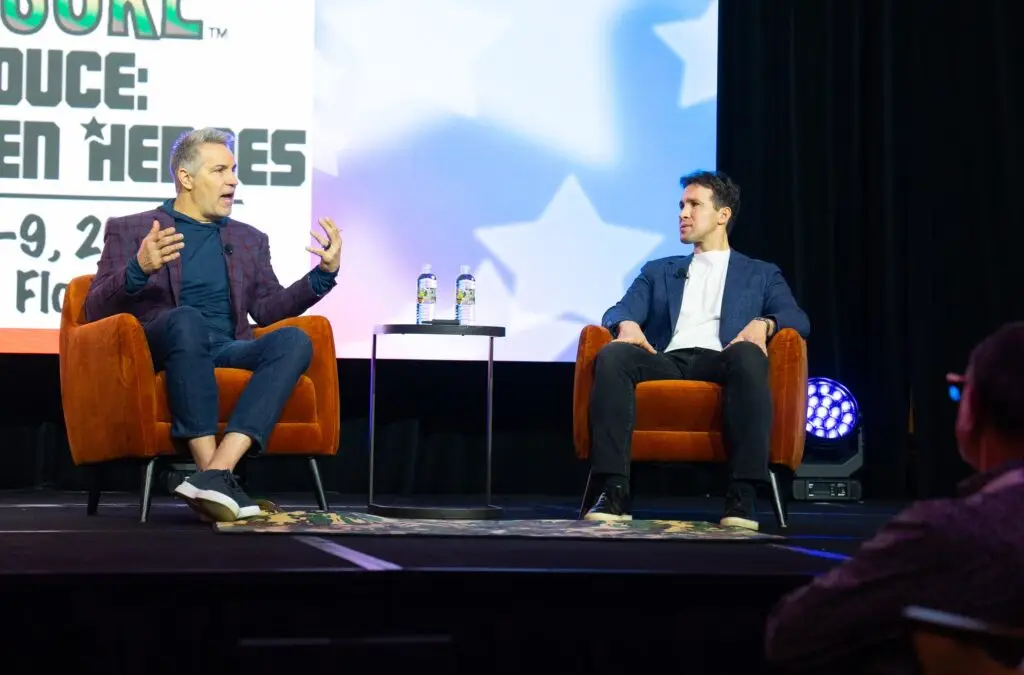

I recently went one-on-one with David Alpert, co-founder and CEO of Skybound Entertainment and producer of The Walking Dead and Invincible.
Adam: What drew you to the field of entertainment?
David: Ever since I was a little kid, I wanted to tell stories. Storytelling was something that was very highly prized in my family. When we would have Thanksgiving, we had the traditional setup where there was a grown-ups table and a kids table, and the moment that you were allowed to move from the kids table to the grown-ups table, which was something we all wanted, was that you had to tell a story. It had to be something that happened in your family, something you were connected to, something you were part of, and you had to add to the family lore. It wasn’t formally judged or anything like that, but once you told that story, you were welcomed at the grown-ups’ table.
And that, to me, was always something that I found really fun and inspiring. There are all these stories that I know about my grandfather, my great grandfather, my great-great-grandfather, because those stories were passed down within my family. So the notion of storytelling was always there for me. I didn’t know what that meant in terms of a career; I didn’t know how that translated into something you could actually do professionally, but I knew I wanted to tell stories. I didn’t know if that meant being a writer, a comic book writer, a novelist, a playwright, I didn’t know what it was. And in fact, I didn’t even know that being a producer was something that existed. But I always knew I wanted to be involved in storytelling in some way, and even from a very young age, that’s what I was drawn to.
Adam: How did you figure out that your interest in entertainment could turn into a career as a producer?
David: I think the first thing for me was really the intersection of creativity and business. That sort of right-brain, left-brain intersection was something that was interesting to me pretty early on. I was a big comic book fan as a kid, and there was this moment where they raised prices on comic books from 65 cents to 75 cents, which was a big deal for me because I couldn’t buy as many comics as I had been buying. I told the store owner that I couldn’t buy as many anymore, and he said, well, if you commit to buying more, I can give you a discount. And that was the first time that the difference between wholesale and retail really clicked for me.
So I started asking, how many books would I have to buy to get 20 percent off, 30 percent off, 40 percent off? And before long, I ended up selling comic books to my friends. I would tell them, if you buy from me, I’ll deliver them to your locker at school or your locker at swim practice, and I’ll give you a discount based on what I’m getting, and I would keep a little bit for myself. So I started to see that intersection between something I loved and a business opportunity. By the time I graduated high school, I was selling about 6,000 comic books a month. It became a pretty robust business. I wasn’t making a living from it, but I was supporting my own habit, paying to go to comic book conventions, and really getting deeper into that world.
That’s when I started thinking there might be something bigger here. I loved comics, I loved the business side of it, I loved speculating, buying, selling, all of that, and I started wondering if there was a way to combine that with other things I loved, like film and television and video games, and actually turn that into a career. When I got to college, I thought I was going to be a writer. That was really what I had in mind. And then I realized I wasn’t a very good writer, which is a problem if that’s your plan. So I pivoted. I ended up becoming president of the television station during college, and I really enjoyed that. That was my first real exposure to producing, where I was putting together creative, dealing with fundraising, managing people, and overseeing everything, and that’s where it really started to click for me.
I ended up running the television station during college, and that was really my first experience producing. I was putting together shows, organizing creative, dealing with fundraising, and managing all of the different moving pieces. And when I say I was running the television station, it sounds like a much bigger job than it actually was. Our audience was extremely small. We didn’t have a real broadcast channel. We had VHS players across campus, and we would distribute tapes of our shows to different dorms at roughly the same time, and that was our version of a network. So you’d have maybe someone who was hungover from the night before asleep in the room, or someone who was in the show who wanted to see what they did, and that was basically the audience. Maybe five people, maybe ten people. Most people on campus didn’t even know the station existed. But for us, it was real, and we treated it seriously.
We had a soap opera that had started before I joined that became our most successful show, and I was the head writer and producer. At one point, we decided to do a sex scene, and we shot it in the library. The storyline was that a professor was having an affair with a student, and we filmed them naked in the library because we didn’t know any better. The student was played by a student, and the professor was played by a teaching fellow, so technically a member of the faculty. After we shot it, my director, who was also my roommate, and I decided to create a letter-writing campaign protesting ourselves and demanding our expulsion. We wrote around 600 letters saying we were offensive, that we were pornographers, that we violated conservative values, and we sent them to the student newspaper. They didn’t publish them because they didn’t know what we were talking about, so we sent them to the Boston Globe, and they picked it up.
From there, the story got picked up by NBC News, and they called asking to run a segment. I told them I had two conditions. First, the segment needed to be titled First Amendment under assault at Harvard University. They actually liked that. Second, they had to air a minute of my show uninterrupted on national television, which is a long time. They pushed back, but I said that was the deal, and they agreed. We recorded that clip, used it as a fundraising tool, and ended up raising enough money to build a real studio on campus. That was really my first experience seeing how creativity, marketing, and producing all come together in a meaningful way.
Adam: What can anyone learn from that experience?
David: I think the first thing is that we were doing something that we thought was fun, but the real question is, why should anybody else care? That’s the challenge not just in entertainment, but everywhere today. There’s endless social media, endless music, endless movies, thousands of games coming out every year, more video being uploaded every minute than you could ever watch in a lifetime, so why should anyone pay attention to what you’re doing?
I don’t think creators always spend enough time on that question. You have to figure out why something is relevant, why it’s interesting, why it’s entertaining, and what the hook is. But at the same time, you still have to make something good. In our case, the stunt got attention, but the show itself wasn’t that great. If it had been great, maybe it would have turned into something bigger. Instead, it worked as a fundraising tool, which was valuable, but that was ultimately the outcome. So the real lesson is that you need both. You need something that gets people to care, that gets their attention, but you also need the substance to back it up. And you have to be clear about what you’re actually trying to accomplish, because that will determine how you measure success.
I think ultimately, incentives dictate behavior. You show me the incentive, I’ll show you the behavior. It really is that simple. And I think part of the issue we have today, especially in social media, is that we reward things that make people angry or that play to base instincts, so it’s not surprising that what rises to the top is often polarizing or divisive. That’s just a reflection of what the system is rewarding. So if you think about it from a leadership perspective, or even just as an individual trying to stand out, you have to be really clear about what you’re optimizing for. If the squeaky wheel gets the grease, then you’re going to end up with an organization full of squeaky wheels. And once that becomes the behavior that gets rewarded, you can’t be surprised when everyone is constantly asking for something or trying to get attention in that way. You’ve effectively trained people to behave that way.
So you have to be thoughtful about the incentives you’re creating, whether that’s in a company or in how you position yourself. You have to make sure you’re reinforcing the behaviors that actually matter, the ones that lead to real outcomes. And at the same time, you still need substance. You can package something well, you can position yourself well, and that might get attention in the short term, but without something real behind it, it doesn’t last. So it’s not one or the other. You need both. You need to understand how to present yourself and how to stand out, but you also need to have the substance to justify that attention once you get it.
Adam: What are the keys to successful leadership?
David: I think the key thing for a leader is being able to clearly communicate a direction and a vision. That doesn’t necessarily mean that the leader has to be the one who comes up with the vision. I think people sometimes get stuck on that idea, that you have to be the visionary who originates everything. In reality, a big part of leadership is recognizing a strong idea and then helping guide it to execution, making sure that it actually happens.
Clear communication is critical. People need to understand where they’re going and why. They need to understand what success looks like and how their role fits into that. Setting the right incentives is also critical, because that’s what drives behavior over time. And then building the right team is everything. If you have the right mission and the right vision but the wrong team, you’re not going to get there. You need all of those pieces working together.
And the reality is, you don’t always get to choose your team. Especially earlier in your career, you’re often working with people who are already there, and you have to figure out how to make that work. As you move into more senior roles, you get more control over building your team, which is a big advantage, but even then, you’re still working with partners, clients, and other stakeholders that you didn’t choose. So leadership becomes about alignment. It’s about bringing people together around a common goal, making sure everyone understands it, and then creating the structure and incentives that allow that group to actually execute.
Adam: What are the keys to working effectively with people you didn’t choose?
David: I think the first thing is recognizing that if someone is in a role, somebody believed they were good at something. There’s usually a reason they’re there, even if it’s not immediately obvious to you. So instead of starting from a place of frustration or focusing on what’s not working, I try to figure out what that person is actually good at and where they can contribute in a meaningful way. Almost everyone has something they bring to the table, and part of the job is identifying that and putting them in a position where they can use it.
The other piece is engagement. If someone is not engaged in what they’re doing, they’re not going to do their best work. That’s just reality. We all have things that we avoid or push off because we’re not interested in them, and we know we’re not going to do a great job on them. It’s no different in a team environment. So a big part of working with people you didn’t choose is finding a way to connect what you’re doing to something that matters to them, helping them understand why it’s important, and getting them genuinely bought in. Because once someone is engaged, the quality of their work improves, their attitude improves, and everything becomes easier to manage.
Adam: How did The Walking Dead come together?
David: I have a set of partners that I’ve worked with for decades now. I’ve worked with my two main partners at Skybound for about 25 years. I met Robert Kirkman in 2001 at a comic book convention, and we became friends pretty quickly. We had a very similar view of how the world was evolving, especially around the idea that comics, film, television, and video games were all going to intersect in a much bigger way. At the time, that was not the prevailing view. Today it seems obvious because you can look at everything from Marvel to video game adaptations and see how connected everything is, but back then, studios really didn’t think that way.
So we spent a lot of time talking about that and thinking about how those worlds could come together. Then one day, he called me and said he had an idea for a zombie story, and my initial reaction was that I didn’t want to hear another zombie pitch. It felt like that space had already been explored a lot. But he said this one was different, and I said okay, what is it. And he said it starts the day after the zombie movie ends. That was the thing that immediately stood out. Every zombie story tends to end the same way. Either everyone dies, or a small group survives, but they’re completely changed, and now they’re living in this new reality. And his point was, what happens next. They can’t just go back to their normal lives. They have to figure out how to live in that world over time.
Then he layered in the idea that, at its core, it’s really a human story. There are relationships, there’s conflict, and there’s even a love triangle. It’s structured almost like a soap opera, but set in this post-apocalyptic world. And that’s when it really clicked for me. It wasn’t just a zombie story. It was a story about people, about relationships, about how they deal with extreme circumstances, and the zombies were really just the backdrop. That combination is what made it feel different and compelling.
Adam: What did you learn from the experience of building The Walking Dead into such a massive success?
David: The thing about it was, I remember very clearly how many people told us all the reasons why it would never work, and that included me at the beginning. My first reaction was that I didn’t want to hear another zombie idea, and then, when I actually understood what made it different, that changed. So one of the lessons there is that you really have to take the time to understand something before you dismiss it. It’s very easy to look at something at a surface level and assume you know what it is, and be completely wrong. At the same time, we live in a world where people are making decisions faster than ever, often based on very little information. People are judging things off a title, a thumbnail, or a quick description, without actually engaging with the content. So there’s a tension there. You need something that can break through at a surface level, but you also need depth behind it.
The other big lesson is that when you believe something is great, you have to be willing to push through resistance. We were told over and over again that it wouldn’t work, that it wasn’t commercial, that it wasn’t right for television. And if we had listened to that, it never would have happened. So there’s a level of conviction that’s required, where you’re willing to keep going even when other people are telling you that you’re wrong. That’s a big part of why I founded Skybound. My mother was an artist, and I always felt like she didn’t get a fair shot in the system that existed. So when I came into this business, yes, I wanted to tell stories, but I also wanted to build something that treated creators differently. The traditional model was that you give up all your rights, and we didn’t think that was right.
So when The Walking Dead started to gain traction, and people wanted it, they wanted it on their terms, and we said no. We said we’re going to do it our way, we’re going to retain those rights, and we’re going to build something bigger around it. And people thought that was crazy. I had people tell me I would never eat lunch in this town again. At the time, I thought that was a joke, but they were serious. But we stuck with it, and eventually we found partners who were willing to work with us on those terms. And that’s what allowed us to not just make the show, but to build a company and a broader business around it.
Adam: How do you know when something is worth fighting for?
David: For me, it usually starts with a feeling. I think about it almost like a spectrum where extreme reactions are actually closer than people think. If I really love something and I can’t stop thinking about it, that’s a signal. But if I really hate something and I can’t stop thinking about it, that’s also a signal. In both cases, it’s creating a strong emotional reaction, and that usually means there’s something there worth paying attention to. What I worry about more is when something feels neutral. If something is just fine, that’s the biggest failure. If someone engages with something and their reaction is just that it was okay, that’s not what you want. I would much rather create something that people have a strong reaction to, even if it’s not universally positive, because at least that means they’re engaged.
From there, I start to analyze it more traditionally. I look at what exists in the market, what the comps are, and whether there are examples in other areas that haven’t been applied in the same way. With The Walking Dead, for example, there hadn’t really been a serialized horror show on television. There were horror movies, there were zombie games, but that format on TV was relatively unexplored. So you start to see an opportunity. But even then, execution matters. You can have a great idea, but if you don’t execute it well, it doesn’t matter. So it becomes a combination of instinct and analysis. It starts with that initial reaction, but then you have to build a real case around it and make sure you can actually deliver on it.
Adam: What do you look for in the people you work with?
David: I think about it across a few different dimensions. The first is subject matter expertise. I want people who are really good at what they do, whether that’s directly in the role or in something adjacent where they can bring a valuable perspective. You need people who actually know what they’re doing, who can operate at a high level and contribute in a meaningful way.
The second is passion. Especially in entertainment, and especially in the early stages of something, the financial rewards are not always immediate or guaranteed. So you need people who actually care about what they’re working on. If someone is only there for the money, it usually doesn’t work, because this is the kind of work where you have to push through a lot of uncertainty and a lot of challenges, and that’s hard to do if you’re not personally invested in it.
And then communication is a big one. I think communication is one of the most undervalued skills. We have more ways to communicate than ever before, but the quality of communication has gone down. It’s very easy to send quick messages without really thinking through what you’re saying or how it’s being received. Being able to communicate clearly, to distill things down, to make sure people understand what matters and what doesn’t, becomes more and more important as you move into leadership roles. So for me, it’s really that combination. You want people who are capable, who care, and who can communicate effectively.
Adam: How can you effectively communicate in today’s landscape?
David: I think what’s interesting right now is that we’re seeing two extremes. On one side, you have very short-form content that’s designed to be consumed quickly and then forgotten. On the other side, you have long-form content, like podcasts or long interviews, where people are going really deep and spending a lot of time engaging with something. What’s disappearing is the middle. And I think that creates an interesting dynamic. If you’re creating something, you have to be really clear about which lane you’re in. If you’re trying to create something that people are going to spend a lot of time with, you have to earn that. You have to give them a reason to stay engaged, because you’re asking for a significant investment of their time.
At the same time, if you’re creating something short-form, you have to understand that it’s inherently more disposable. It’s meant to be consumed quickly, and then people move on. The mistake is trying to sit in the middle and not fully committing to either approach. So a big part of effective communication today is being intentional about format, understanding how your audience is consuming content, and then aligning what you’re creating with that behavior.
Adam: How do you approach risk?
David: I think the first thing is you have to accept that zero is a possible outcome. You can make something great, and nobody shows up. That’s especially true today. There’s so much content, so much competition, that even very high-quality work can get lost. That’s just the reality of the environment we’re operating in. So you have to think carefully about why something should exist in the first place. What is the reason for it? How does it fit into the broader landscape? And timing matters a lot, because the market is changing quickly. Trying to predict what things are going to look like years from now is incredibly difficult. If you’re working on something that takes five or six years to develop, you’re making a bet on a future that is very hard to see clearly.
So I tend to prefer operating on a shorter time horizon, where I have a better understanding of what’s happening in the market and where things are heading. And I also think about distribution and discovery from the very beginning. It’s not enough to just build something and then figure out how to get it in front of people later. You have to think about how people are going to find it, why they’re going to care, and how it’s going to stand out, because otherwise you can end up with something good that nobody ever sees.
Adam: What skills have been most important to your success?
David: I think one of the biggest is resilience. I was a distance swimmer, and that gave me a very high tolerance for discomfort. Not just physical discomfort, but mental and emotional discomfort as well. Being able to stay in something when it’s difficult, when things aren’t working, when you’re not getting the results you want, that’s incredibly important. Because in this business, you’re going to have things that don’t work. You’re going to have projects that fail. You’re going to get rejected. That’s part of the process. And if you can’t handle that, it’s very hard to succeed over the long term. So resilience is a big one.
Adaptability is another. Things change quickly. The market changes, technology changes, and opportunities change, and you have to be willing to adjust. You can’t be so locked into one way of doing things that you’re unable to evolve. And then there’s a bias toward action. You can’t just sit there analyzing everything forever. You have to think things through, but at some point you have to make decisions and move forward. That combination of resilience, adaptability, and action has been really important for me.
Adam: Is there anything else you would like to share?
David: I think a lot of people get stuck in decision paralysis. They wait for perfect information before they act, and you’re never going to have perfect information. At some point, you have to make the best decision you can with what you have and go. You’re going to make mistakes. I’ve made plenty of bad decisions along the way. That’s part of how you learn. You make a decision, you see what happens, you adjust, and you keep moving forward. If you wait too long trying to get everything exactly right, you end up not moving at all, and in a lot of cases, that’s the biggest mistake you can make.