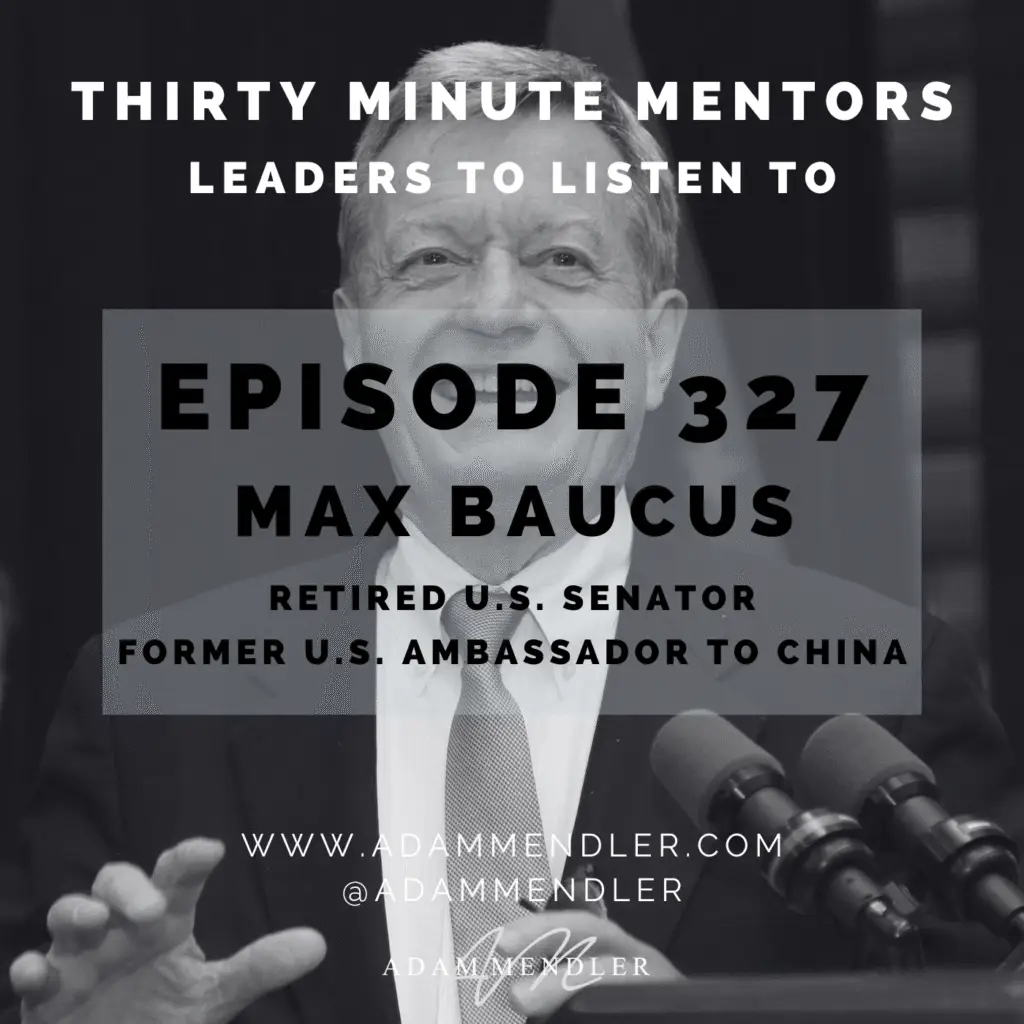
I recently interviewed Senator Max Baucus on my podcast, Thirty Minute Mentors. Here is a transcript of our interview:
Adam: Our guest today served for more than 35 years in the United States Senate before becoming the United States Ambassador to China. Max Baucus is the longest-serving United States Senator in Montana history and one of the most influential senators in modern history. Senator Baucus, thank you for joining us.
Senator Baucus: You bet. Enjoyed being here. Thank you.
Adam: You grew up in Helena, Montana, but you spent a couple of your earliest years in Los Angeles, my hometown, before making your way back west to go to Stanford for college and for law school. Can you take listeners back to your early days? What early experiences and lessons shaped your worldview and shaped the trajectory of your success?
Senator Baucus: I have no recollection in LA. Frankly, my mother lived in LA, married a Stanford University professor. They got divorced. She took me and my sister to Montana. My mother then met a wonderful man named John Baucus, and although technically my stepfather, in effect, he is my real father, a wonderful, wonderful man. So I grew up in Helena, Montana, in a ranching family. We have a ranch, a cattle sheep ranch, about 20 miles north of Helena. That’s where I spent all my summers, and a good part of spring and fall. Loved it out there. As I got older, my father would work me and work me hard, right to the bone. That’s great. I knew he was doing it to instill good values in me. Fencing, stacking hay, working livestock, whatever had to be done on the ranch. I really liked it. It was outdoor work. It meant a lot to me. After high school, I decided, well, I love the ranch. It’s just terrific working outdoors. Montanans are really outdoor people. We love the outdoors, I think, more than people in any other state. We hunt, we fish, we backpack, maybe a forest products industry, maybe outfitters, mining, you name it. We’re an outdoor people, and ranching is certainly a big part of Montana outdoors. But I left high school and decided I wanted to go out of state. I always wanted to have one foot in Montana, one foot with the ranch. I just love the ranch and Montana so much. We’re very lucky to be Montanans, and the other foot in the rest of the world, because I knew there was more outside in addition to Montana. So I went away to school, college, Carleton College one year, didn’t like that. It was too isolated. Transferred to Stanford University. Loved it. Great institution, Stanford. Then I applied to an overseas campus in France, got selected after six months, but around 1962, heck, I haven’t learned anything. I just didn’t learn anything over here. So I decided not to come home. I just stayed put, knapsack on my back, handbag, and I hitchhiked around the world for a full year, August 62, August 63, and that trip really planted the seeds for my future interest and future career, because I learned on that trip, like an epiphany in the Belgian Congo, it just hit me, a lightning stroke. If the world’s getting smaller, our resources are diminishing, and we’ve got to work better together if we’re going to do well as a people. And maybe if I put my effort into it, maybe my life might be a little better, but somebody else’s life might be a little bit better too, because the more we work together, the more the whole is greater than the sum of the parts. So anyway, I came back after the trip. Wonderful trip. It’s fascinating. People really spurred me on. Beforehand, I just had average grades at Stanford. I was just an average student. After that trip, I got all A’s. I was so excited. I was on fire. It just kindled something in me. So I went, finished school, then law school, worked at the SEC. Didn’t know much about the East Coast. I thought, well, better go to the East Coast, see what that’s all about. I loved working at the SEC, and at the SEC, I decided after three years, I want to come home. I’ve been away from home almost 10 years now. I want to come home, and when I come home, guess what, I think I might want to run for public office. So the decision was made back there about 1970, roughly, in Washington, DC, sitting in my office at the Securities Exchange Commission.
Adam: You decide to run for public office, you win. You run again, you win. You run again, you win. Every time you ran, you won.
Senator Baucus: Well, actually, to be fair, I remember sitting in my office at the SEC asking myself, okay, Max, you’re 28 years old now, what in hell are you going to do? About time you decide for yourself what you’re going to do with your life. And the more I thought about it, the more I thought, gee, I’m interested in public service. I was inspired by a great Montana senator, Mike Mansfield. He’s always been sort of my mentor, my role model. Wonderful, wonderful, wonderful man. On the other side of the coin, I saw Nixon appoint terrible people to the Supreme Court. Carswell, Haynsworth. Wow, that’s terrible. That just made me angry. We need good people in public service, not just mediocre, bad people. And really, to be honest, I thought, ultimately, I want to be in the Senate. Why? Because I saw the Senate back then sort of be the board of directors of the United States of America, kind of overall set policy like a board of directors does in a corporation. I want to be part of that and help set America in the right direction, decide good policy. I kind of knew when I went back home to Montana, that’s what I would end up trying to achieve.
Adam: That’s a very lofty goal. And there are many people in every state who have that goal, and only two people in every state are able to achieve it. You were one of those two people. How were you able to do it?
Senator Baucus: I was lucky. Great education. I had great parents. So far, good health. And in addition, I was very focused, in the sense that when I came home, before I came home, I was on that telephone, I called my parents, I think I’m coming home. Oh, great. They’re so happy to learn I’m coming home to Montana. Then I said, you know, I think I might run for public office. Silence on the telephone. And they weren’t too sure about that. Then I went to the next step when I said, I think I’m a Democrat. And, oh, dead silence. My whole family, brothers, sisters, parents, aunts, uncles, all strong Republicans. There’s a Democrat in the family. So that was a bit of a shock when I told them that. And why did I make that decision? Pretty simple. I’m younger, looking to the future. I just felt at the time that the Democratic Party is a little more open, more open to change, more inclusive, bigger tent, whereas the Republican Party is a little more exclusive, a little closed in, a smaller tent. I want to help people. I want a little larger tent. So I’m more inclined to go with the crowd that really wants to make things better, rather than the crowd that likes the status quo. That’s basically why I made that decision, and I still think that’s fairly accurate. Anyway, I was very lucky. Over time, my parents started to come around a little bit. It took a couple or three or four years, and then after a while, basically, blood was thicker than politics, so they really were very helpful. Once, I did a fundraiser in my family home in Helena, Montana. My dad called all his buddies to come to the fundraiser. Well, all his buddies were Republicans, so it was about two thirds Republicans. We had a pretty successful fundraiser. And after it was all over, he sat down in his regular chair there in the living room, and he looked at me and says, you know, Max, I sort of fancied myself another Joe Kennedy. He was very proud that he was helping his son proceed. But basically, the answer to your question is, as I look back on it, I was totally focused. I knew when I ran for the state legislature, I would win. I knew the day I filed, I was going to win. And when I got elected, I knew in four years hence, I was going to run for Congress. I knew it. I was going to win. And I knew when I ran for the Senate, I was going to win. I just knew it. And why did I think that? I thought that because it was 100 percent focus, 100 percent dedication. I worked full time at it, full time, leave no stone unturned. I learned soon that there’s a nagging little thought in the back of your brain. It’s the oh thing, oh, don’t worry about that. That’s what you do worry about. You don’t leave anything unattended. And I look back like, man, I was gutsy. I did things I wouldn’t dream of doing today, gutsy in the sense that I’d walk into an unannounced TV studio in Missoula, Montana, say, hey, why don’t you put me on TV? I could explain to viewers what’s happening in Helena. We were writing a new constitutional convention in Montana. I was acting executive director. So I’ll just walk in and tell everybody in Missoula, Montana, if I run for the legislature, what’s going on in Helena. The TV manager said, oh yeah, we’ll find time, go on, do that. So I did that every week, just a way to get going, get my name out. I don’t know. I was very focused and worked really hard, I think, for all the right reasons. I wanted to help people. When I talked to people running for the legislature, I said, gee, here’s what I’m doing. I had a brochure. What issues would you like the legislature to address? How can I help you? I really cared. I wanted to show people I really cared about them, and I did. I really did. That’s why I ran for this job. That’s why all the way along the line I tried to pursue. In a certain sense, it’s a little like Ted Lasso. I came across Ted Lasso years later. In retrospect, it’s really kind of what that was.
Adam: I love it, and I love those lessons, the importance of focus, determination, passion. There’s no substitute for pursuing something that you’re deeply passionate about. And you mentioned the importance of taking risks, not being afraid to take chances. They’re not always going to work out, but if you don’t take chances, you already know that it’s not going to work out.
Senator Baucus: Well, that’s true. I counsel myself even today, and I counsel others, take risks. And I tell my staff, both in the Senate and over in Beijing, I want you to take risks. I want you to make mistakes. I want you to make mistakes. Because if you’re making mistakes, you’re making decisions. You’re not just sitting, twiddling your thumbs. You’re making a decision, and you’re going to learn from your mistakes. And you’re not going to make a huge, humongous mistake because you thought about it. And when you do make a mistake, you correct for the next time, but you’re doing something. You’re getting something done. Politics is motion. It’s action. It’s not concepts, it’s motion. It’s action. I urge anybody I’m associated with and might work with me, make decisions, make mistakes, and I trust they’re going to be not horrendous mistakes. They’re maybe not great, but you’ll learn a lot. We’ll go a lot farther.
Adam: And during your career in the United States Senate, you were one of the most influential senators. You were one of the most productive senators. What were the keys to working across the aisle? What were the keys to being influential, to being productive?
Senator Baucus: Well, thank you for saying that. I think we did get quite a bit accomplished. Basically, it sounds corny, but just keep your eye on the ball and do what’s right. Ask yourself, what’s the right thing to do here? What’s the right thing to do? What’s best for Montanans? What’s best for the country? What’s the right thing to do? And usually there’s an answer, what’s right. Rather than take the expedient way, or an easy way, or a superficial way, or maybe a disingenuous way, what’s right? What’s the right thing to do? As a consequence, though, almost by definition, even though I’m a Democrat, I was a moderate Democrat. I wasn’t a real left-wing Democrat. I wasn’t a real right-wing Democrat. I was a moderate Democrat. And I do think, as Aristotle says, moderation, it makes a difference. Moderation is really important. I can remember, too, when I first started running, I met the then Montana governor. His name was Forrest Anderson. I walked into his office when I came back to Montana, asked to see him, his advice. He said, well, Max, don’t be a cause guy. All these cause guys, they rant and rave. They don’t get anything done. Don’t be a cause guy. Be a doer. Get stuff done. Boy, that stuck with me. Cause people are great. They enumerate issues. They expose things. That’s wonderful. But I’m a little bit more of a background kind of guy, more of a doer, not a flamethrower, not one who really gets out there and tries to be sensational. I’d rather talk straight, really straight, but in a very sort of constructive way. I think I developed a reputation for my candor. I tend to be honest and candid about things, because that’s how I see it. It’s not shaded. Of course, I don’t go too far one way or the other, but people have mentioned to me many, many times, gee, Max, you’re candid. They’re kind of surprised. I’ll take that.
I’ll take that even further. When I was serving as US Ambassador to China, a job I loved, I developed a reputation over there with the Chinese government of being candid, just being honest and being straight, not being somewhat of an expected ambassador who would be very critical of China and talk down to China, almost arrogant. No, I just talked straight. My whole goal was to make the Chinese minister I was sitting across the table from, or whomever I was talking to, feel that I am no better than they and they are no better than I. We are really on this planet together. We have got to work together. And so I was not obsequious. I was not condescending. I did my very best to ask very constructive questions, almost break into the pat speech they’re giving. I did break it many times, interrupt. Well, gee, could you maybe explain that a little bit, please? I didn’t understand that. Or maybe give me an example. They loved it. And then I started asking and being more candid about it all. It’s an approach I tried to pursue. Be honest, be candid. Don’t be a jerk. Don’t be too critical of anybody, but just try to be candid with a view of being constructive and trying to advance the ball and get an agreement or get closer to an agreement.
Adam: Word you mentioned several times, which I think is so important, being constructive. It’s something that we should ask ourselves every day. Am I being constructive? Is the action that I’m taking a constructive action? Am I taking action at all? Something that you mentioned, there are talkers, and there are doers. Am I a talker? Am I a doer? Treating people with respect, treating people with dignity, being open, being honest, being candid, being someone who other people can count on, other people can rely on, being a person of integrity.
Senator Baucus: You mentioned a very boring word, respect. I think it’s critical that you show the person you’re talking to that you respect that person. You respect that person’s point of view. That’s another person. That person has his or her own views, and if you show your respect by listening to them, really listening, not just checking the box, but really listening. And how do you really listen? You listen by just standing back a little bit, and then you start to ask a constructive question. Gee, that’s interesting. Could you explain that a little more? I did not know that. Gee, that’s fascinating. When you show respect, you’re going to learn a lot more, and it makes you feel much better about yourself. Frankly, it’s very helpful.
Adam: Can you talk about some of the deals that you were involved in? The one that is top of mind, the Affordable Care Act, but there are many others where you played a critical role in bringing legislation to life and bringing different parties together that didn’t necessarily see eye to eye. Can you talk about how you were able to help make things happen and what you took away that anyone listening can apply to their lives and to their careers?
Senator Baucus: I am very lucky to be a Senator from Montana, even luckier to be on the Finance Committee, and still more lucky to be chairman of the Senate Finance Committee. That’s the best committee of the Congress by far. You talk to anybody in DC, they candidly tell you that is the committee. That’s where many of the most important decisions in Congress are made. Back in about 2006, 2007, through there, it was apparent that our country did not have any kind of real, coherent health care policy. Hillary Clinton was delegated by President Clinton to come up with a health care policy. She tried. It didn’t work. It didn’t work basically because it was top-down. She and her excellent team put together what they thought our health care plan should be, basically, and took it to Congress, and it was just too much for Congress to swallow. It just didn’t work. So I did just the opposite. It was bottom up, not top down, but bottom up. We in Congress were going to determine what it should be, then we would take it to the President. And we, for two years, almost 15 months, and we ended up around late November with our white paper, which is the plan. But the more important part, I think, is this. When we began, I set up several rules for the Finance Committee, trying to determine what our health care system should be. Senators, Republicans and Democrats had no idea how Medicare is reimbursed, how hospitals are paid, doctors, insurance companies, labor unions, small business. They didn’t really know. Nobody knew. I didn’t know. So we had all these hearings to try to figure out what the facts were, so we could determine what to do. So at the very beginning, I said, okay, no one’s going to get political here, no member of the committee, and no witness. If anybody gets political, I’m cutting them off at the knees. This is not a political exercise. This is a fact-finding exercise so that we can determine what makes the most sense. That’s rule number one. Rule number two, everything’s on the table. All proposals are considered, because if somebody says, oh no, take mine off the table, then another could rationalize, well, take mine off the table. No, no, no, no, we’re all good. Which really got to another third main point, which is, hey everybody, we’re all in this together. Every American is affected in two ways with what we’re doing. One is, every American is concerned about his or her health. People want to be healthy. Number two, every American is going to pay for health one way or another. So we’re all in this together. This is America. America. We’re in this together. And I’ll also add another rule, third rule, which is, if anybody brings a problem to the committee, he or she has got to bring a solution. We just don’t complain. We come up with solutions. And the whole effort here was to develop trust. So we worked as a team. We worked together. And we did. We finally put our white paper together, the blueprint, about November 2008. During that year, 2008, to be honest, we didn’t care if John McCain got elected president or Barack Obama got elected president. It was irrelevant. What we were trying to do was what was right for the country, and that was my view, and I think it was the view of a vast majority of members of the committee. So we issued a white paper two weeks after President Obama got elected, and then the next year our committee implemented it. Other committees took our white paper, they implemented their parts. Basically, it all came from the white paper, and then about a year or two later, the bill was enacted into law. However, in the meantime, it did become political. Unfortunately, it became political. There wasn’t much I could do about it. It became political because it moved out of committee. It went to a presidential level, a higher level. To be honest, I think Mitch McConnell, then the Minority Leader, saw this as an opportunity for a big wedge issue to drive the American people away from the Democrats with their passing the Affordable Care Act. And by the way, they call it Obamacare. Obama didn’t like it at first. After a while, Obama was okay. Call it Obamacare. But it did become political at the end, and not one Republican voted for it at the very end. But up to that point, it was non-political. I did all I could to make sure it was not political. Then at the end, we had to work hard to make sure we had enough votes to get it passed.
Adam: When you reflect on that experience, what are the key lessons, key takeaways for you?
Senator Baucus: Well, everybody has his or her own passions, views, interests, and that’s wonderful. But for me, it was service, public service, and for me, it was results for the greatest common good. And that meant building trust, working with all the people who are relevant, and getting their trust. And how do you do that? You just be honest with them, direct with them, and be totally straight. Never say anything negative about them, directly or indirectly, because that never helps. Be positive. Don’t be too officious in your praise, but recognize good works when you see it and let people know they’re doing a good job without being over the top about it, but being honest about it. And build trust in small meetings by not name-dropping, not being indiscreet in what you disclose about the meeting. One lesson that’s going to sound really weird was from my son. My son went to a private school in Washington, DC, and he developed a reputation of being the one that all the kids would go to whenever there was a dispute on the playground. Why? Because he kept his cards close to his vest. He didn’t gossip. He didn’t blab. Everybody came to my son, Xeno. Xeno, what do you think? What do you think? And he helped put things together and was very judicious. It’s a real lesson I frankly learned from my son. Just really, really don’t blab. Don’t gossip. Don’t be a name dropper. Just respect what people say. And another lesson there is from my mentor, Mike Mansfield. I was at an event with him many years ago, and I walked up to Mike Mansfield, Senate Majority Leader for 17 years, longest in history, continuously. Met many heads of state, leaders, and just saw so much during the Civil Rights Act, during Vietnam. He just saw so much. I said to him, Mike, boy, I can hardly wait to read your memoirs. He looked at me and said, oh, all those conversations were confidential. That hit me hard. That made a lot of sense. Just don’t blab things that are confidential, and people will trust you more, and if they trust you more, you’re more effective.
Adam: How did you cultivate the relationship with Mike Mansfield, clearly such an influential mentor in your life and your career? How did that relationship form, and what advice do you have for anyone on how to form and build a powerful mentor mentee relationship in the way that you were able to with Senator Mike Mansfield?
Senator Baucus: Well, I’d see him occasionally. He’d give me advice. But anybody who knows Mike Mansfield knows that Mike is a man of few words. He doesn’t say a lot, but when he does say something, he’ll listen. Once he said to me, when I told him I think I’m going home to Montana, he said, where are you going to live? I said, I’m not sure. He said, whatever you do, don’t live in Helena. Why do you say that? Because Helena is the capital city, and everybody in Helena is chasing his tail or chasing rumors. Real people don’t live in Helena. But I didn’t have much choice, because that’s where my family was. But I knew what he was saying. Don’t listen to the fancy people. Don’t listen to people who are self-promoters. You’ve got to separate the wheat from the chaff. Be really careful who you’re listening to. He also once said to me just a few words, but I remember it to this day, and I try to apply it. I told him I’m coming home, going to run for office. He said, well, it takes a lot of hard work. It takes a lot of shoe leather and a little bit of luck. All that’s true. But the work is obvious. But for him, and for Montana, it’s the shoe leather. It’s get out, meet people. Just go out, meet people, shake their hands, go over, talk to a table of people in a restaurant. Hey, Max Baucus, what are you guys talking about? Oh yeah, that’s it. People love it. People also love to be asked questions. People want to tell you their opinion about something. So ask, what do you think about this? Ask questions, not just to be tactical, but because it’s real, it’s honest. You learn a lot more that way by asking questions. So that’s another lesson I learned from Mike. Ask questions. It takes a lot of shoe leather. That’s what he meant by shoe leather. Go out and talk to people, real personal like. Then he had some other things I should do or not do. And what it is really is a perfect role model. I think all of us can teach more effectively the more we are better role models for our family, for our colleagues, whoever we’re with, if we really encourage ourselves as individuals to be really good people, be really good role models in every sense of the term. That’s a great teacher. That’s what people look at. They look at how you are as a role model, and if you’re a good role model, it’s very inspirational, it’s very constructive, it’s very helpful. Mike Mansfield, to me, was a tremendous role model.
Adam: And you’ve had the fortune of being around many great role models, many great leaders. What do you believe are the keys to great leadership? What can anyone do to become a better leader?
Senator Baucus: Well, a lot of books are written on this, and they have their own views. I think there are several things that come to mind. One is having a vision. Have a vision of where you want to take the organization. It’s got to be thoughtful. It’s got to be careful, well considered. But you have to have a vision. You have to be going someplace, not just status quo, a vision. Then the second is buy-in from everybody you’re working with. They’ve got to buy into the vision. How do you do that? Well, explain it, talk about it. They may have some views, but listen, listen to them so they also are part of it. And it’s also focus. I think it’s also very important to get other people’s points of view. That is, I’ve learned this over the years, whenever I have a meeting of 10 or 15 key staff, I like to go around the table and ask each person, we’ve talked about this, what do you think? Is that a good idea, not a good idea? Go around the table. Don’t just be the only one talking or just one other person being the presenter. We’re all in this together. And then you get to learn a lot, and they realize that, hey, they’re being appreciated, because they are. That’s really important too. So it’s vision, as you said earlier, it’s passion and it’s focus. You’ve got to stay focused, not be distracted by a lot of noise, a lot of stuff that really is not relevant. Just stay focused on your vision, your mission, and making sure the organization is truly on track. And make decisions. You’ve got to make decisions. You can’t just let things hang out and be studied to death. You’ve got to make decisions because that’s action. And people want you to make decisions. They look to you as a leader. They want you to make some decisions.
Adam: What was the toughest decision that you had to make in your political career?
Senator Baucus: Probably the toughest. I’d served in the Senate almost 36 years. Loved it. I loved the job. But after almost 36 years, it got a little easy for me. I knew how to raise money. I knew how to run a committee. I knew how the system worked. I didn’t have quite the same excitement and passion that I had earlier. I loved it, but it wasn’t quite the same. So the most difficult professional decision I ever faced in my life was whether to run again for another term, run for a seventh term. I think I would have been elected, but that’s easy. I’ve done that. The other option was to retire. Not retire, but then just jump into the private sector. See if I could swim. Just take the risk. Can I do something totally new and different, test myself? And I said to myself, I probably will not have sufficient self respect if I stay and do the easy thing, which is run again. I’d have a lot more self respect if I take the risk, don’t run again, and just jump out into the ocean, see if I can swim. Have a lot more self respect. And that’s what I decided to do. It was exciting. It was scary. That was a tough decision, frankly, and I’m glad I decided not to run for a seventh term, because I was then, after a while, two months later, Barack Obama called me up, asked me if I would go to China. I had no idea. I didn’t resign because of going to China. That was just me deciding to swim. And then he called me up. That was a tough decision.
Adam: You wound up swimming in China.
Senator Baucus: I went swimming in China. Yes, that’s true. I loved that job too. It was a wonderful job.
Adam: What were the best lessons that you learned from your experience serving as US Ambassador to China?
Senator Baucus: Well, China is a different country than a lot of other countries. The biggest challenge is trying to get behind the curtain. When I was in the Senate representing Montana, I’d bring the current Chinese ambassador to the United States to Montana. So four different Chinese ambassadors working in Washington, DC, over about 20, 30 years, I’d bring them to Montana, show them Montana. I wanted Montana to learn a little about China, because it’s clear to me that China is part of our future. I mentioned Mike Mansfield. He’s an expert on China, and he’s another reason I became very interested in China because of that interest. And a little side note here, he wrote a paper in 1968 about US and China, typewriter, words crossed out, before word processors and all that. I read it. One of the best speeches I’ve ever, ever, ever seen, and it was about China. Basically, we’ve got to get along. China’s in our future. You can’t ignore it. It’s there. So let’s start thinking about how we deal with that. But when I got over to China, I thought some of my former ambassador friends would be good friends. Well, they were pretty good friends, but I started asking questions of them a little more deeply about what’s going on in the Chinese government. Boy, they clam up. They would not tell me anything. And that’s the Chinese system. It’s very, very closed. They don’t say very much. So that was a real challenge, to try to figure all that out. I had to talk to a lot of different people, connect the dots, and be persistent. One thing I learned when I was in China, after about maybe a year or something, it’s corny, but in China, to be effective, I developed what I call my three Ps. You’ve got to be patient. You’ve got to be positive. And you’ve got to be persistent. So on an issue, you stick with it. Be persistent, but in a positive way, upbeat way, positive, positive, but be patient. Sometimes it takes a while. I found that worked pretty well. I didn’t know when a decision was going to be made favorably. I didn’t know if it was going to be made favorably. But after a while, just by sticking with it and talking to different ministers, different agencies, different people, kind of on the same issue, I knew that behind the scenes, behind the curtain, there was a lot of discussion about this among themselves. I’m not part of it, but among themselves, and that was a way to sort of be effective. It was very interesting. Too often my staff, embassy staff over there, they’re terrific, really good, they’d come to me and try to get a meeting, ask me to get a meeting with the Minister of, say, Agriculture. Why? Well, my staff were having a hard time getting meetings with the agriculture ministry staff. They couldn’t get them, so they asked me to have a meeting with the minister. Sure. So we’d go, and they’d start making connections and follow up and so forth. But the challenge in China was penetrating that curtain, and I felt like I’d be more effective if I knew better what was going on behind that curtain, but it was really hard to get at that. I was lucky, frankly. I was able to see any minister in China I wanted to. Subsequent ambassadors had a hard time getting appointments over there. I was able to, because tensions between the US and China were not quite as bad then as they are today. And second, I really worked at it and developed that reputation of just being candid and honest. And I think they wanted to talk to me.
Adam: And there’s a lot of crossover between your experience in the Senate and your experience serving as ambassador to China. A lot of the same skills, a lot of the same responsibilities, in charge of high stakes negotiations, responsible for developing very important relationships with people who might not necessarily see eye to eye with you on very big issues, but you have to bring people together. You have to ultimately find middle ground. Any tips on how to make that happen?
Senator Baucus: Essentially realizing and conveying that we’re all in this together, that Americans really are no better than Chinese, and Chinese are really no better than Americans. We’re not smarter than they are. They’re not smarter than us. We’re all people, and as people, we have the same hopes and desires. Basically, what are they? Most Americans care about a decent income, food on the table, taking care of their kids, a decent education for their kids, air and water pollution addressed, decent health care, being left alone a little bit to pursue their dreams. Chinese are the same. Chinese are the same. People around the world are the same. Everybody’s about the same. Different situations, but basically the same desires and worries and so forth. So I think in all meetings, just kind of helping everyone in the room realize we really are in this together, as I worked on during the Affordable Care Act. We’re all in this together. All Americans are in this together. In this case, we’re in this together, US and China. I believe strongly that the living standards of our kids and our grandkids, Americans and Chinese, very much depend upon how well the US and China manage this relationship. If it’s managed well, then our standard of living is going to be a little better. If it’s not managed well at all, then the standard of living is a little bit in jeopardy. There are huge issues. AI, for example. US and China, it’s huge. Nuclear missiles and ballistic missiles, huge issues. Climate change, huge issues. Biotech, the chip industry, semiconductors, you name it. They’re huge issues. But we’re really kind of, each wants to do a good job, but basically each kind of wants to live well enough to be cooperating with the other.
Adam: It’s a really important point, because there are going to be fundamental differences, and that’s why you have negotiations. That’s why you have to iron things out between two parties. But in order to be able to do that, you have to get to a place where both sides agree on the same direction, agree that we both kind of want the same thing, and that we’re people, whether we’re Democrats and Republicans, whether we’re Americans and Chinese, whether we’re this or that, we both fundamentally, at a very high level, kind of want the same things. And when you’re able to communicate that, then you’re able to get to a place where you can start ironing out the differences.
Senator Baucus: I think that’s right. Sometimes you don’t reach agreement. Sometimes you just can’t reach an agreement, for various reasons. When that happens, it’s just good to leave the conversation on an upbeat measure, so people, when they go home, are thinking more positively about it than not, even though there’s no agreement, and also agree to come back again at a certain time upon reflection. A lot of good things sometimes happen, maybe not at the meeting, upon reflection a little later on. I’m not going to go too far here, but we know the brain needs to sleep. It needs to sleep. Your brain kind of organizes things in a positive way, and you wake up and hey, things look a little bit better than they did maybe the night before. And I think reflection is very important. But add to that, I sometimes think the means is more important than the ends. It’s really how you do something, because the ends are always going to be a bit elusive. They change. They’re just hard to suddenly define. But the means, I mean, if you approach a problem, the means really solidly, constructively, and honestly, and that other side knows that’s who you are, you’re trying. The means are so important. It’s how you do something. I think it’s really powerful. One way, you just dictate an answer. No, that’s not very good. Sometimes decisions have to be made, but when you’re negotiating, it’s better to show you really care, you’re trying, but you’re also respecting the other. You’re respecting yourself. It’s got to be mutual self-respect, because that’s really powerful when each side knows that the other has very strong individual self-respect. That is going to help get to a solution, too. That means you can’t bowl somebody over. You shouldn’t try to, because that’s not going to be a solution. If you force something down somebody’s throat because that other person doesn’t have sufficient self-respect, it’s not sustainable. It’s not going to last. It’s going to change. It’s not sustainable. That’s one thing I tried to do in the Affordable Care Act: come up with something that’s sustainable, not just ad hoc for the moment, but sustainable. And I think that when your approach is positive, you get more buy-in. If you get buy-in, it’s sustainable. If you don’t get buy-in, it’s not sustainable.
Adam: Senator Baucus, what can anyone listening to this conversation do to become more successful, personally and professionally?
Senator Baucus: I don’t know. Do your best in life. We have only two choices: try or do nothing, and that’s easy. You try. Second choice, if you try, do you try your best or not? Try your best. Well, of course, you try your best, and it more likely will work out than not. If it doesn’t work out, that’s not too bad, because you tried. You have the self-respect of trying to do something which you thought was right, and you tried your doggone best to do what was right. That gives you a lot of self-respect, and that gives you a lot of confidence. People who try and try their best will develop self-confidence and be more effective because they’re trying to find solutions that are for the greater good.
Adam: Senator Baucus, thank you for all the great advice, and thank you for being a part of Thirty Minute Mentors.
Senator Baucus: Good luck, everybody listening. Thank you.