
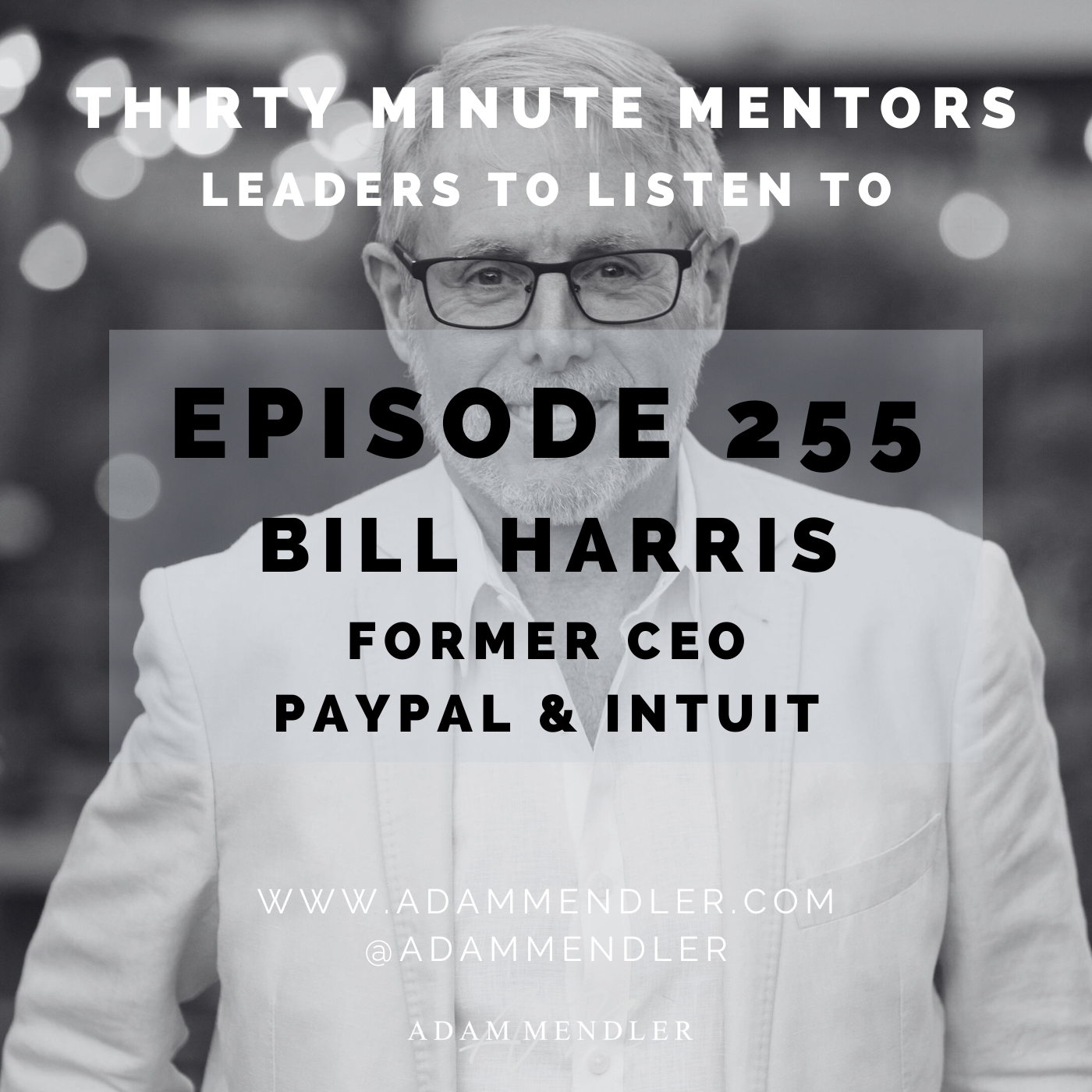
Episode 255: Former PayPal and Intuit CEO Bill Harris
Bill Harris was CEO of two of America’s most successful technology companies – Intuit and PayPal – and was the founding CEO of Personal Capital, which was acquired for $1 billion. Bill joins Adam to share his journey and his lessons and advice. Bill and Adam discuss a wide range of topics: leadership, personal and professional discovery and success, innovation, hiring, learning from failure, and much more.
Join Adam and the best network of mentors – Fortune 500 CEOs, founders of household name companies, Hall of Fame and Olympic gold medal-winning athletes, political and military leaders – for intimate half-hour conversations each week. Thirty Minute Mentors is available wherever you listen to podcasts. If you enjoy the episode, visit your favorite podcasting app and subscribe, rate, and leave a review, and spread the word by sharing on your social media channels and sharing directly with your friends and colleagues.




Read the full transcript of Adam’s conversation with Bill Harris.
Episode Summary
Bill Harris is the former CEO of Intuit and PayPal and was the founding CEO of Personal Capital. He tells Adam how his father shaped his drive, why the most important lesson of his career was learning what he is not good at, and why getting comfortable with ambiguity is one of the keys to innovation.
Bill traces his drive to his father, who he says was an orthopedic surgeon as well as an inventor and researcher. He says his father had 100,000 citations over a 20-year period, twice as many as anyone else in his field, and that he invented equipment, prostheses, and medications. Bill describes his father as driven by discipline and himself as driven by enthusiasm, and says that while he is not terribly disciplined, he has persistence and will not give up. His first chance to lead came, he recalls, as a senior at Middlebury College, when a Boston magazine where he had interned offered him a job and he returned to campus every two weeks for a senior seminar. As a resident assistant in a freshman dorm, he gathered the students who stood out as leaders and told them he was leaving and would come back only if they did not do well. He says it became the best-behaved dorm on campus because he gave them the responsibility.
On leadership, Bill says the starting point is having the moxie to step into the role, but people tune out a leader who barges in and tries to dominate; the better approach draws other people out and builds something that reflects what the group is saying. He admits that listening is the area he most needs to work on. His defining lesson came, he says, at age 40 or in his late thirties, when he was running a public company with 5,000 employees. He wanted to be a product person and was really not good at the large-scale administrative responsibilities of a public company CEO, so he left for PayPal and the chaos of starting a company. Understanding what you are not good at, he says, is more important than knowing what you are good at, because it lets you find situations where you excel and people who are good at what you are not. He points to Jay Shah, his Chief Operating Officer at Personal Capital, who made the trains run on time while Bill brought the ideas, and who took over the company when Bill left.
Bill describes moving from doing what he thought his father wanted, to what he thought society wanted, to what he wanted. At 68, he says, what makes him happy is ideas and mastery, the feeling that he did a good job. Drawing on what he thinks are nine companies he has started, he says that being willing to take risks matters, but being comfortable in ambiguity matters far more, because in a new company there is no playbook. Individuals get there by getting out of their comfort zone, and leaders can encourage effort over results. His hiring mantra is to hire for attitude and aptitude rather than experience and knowledge.
Of PayPal, Bill recalls going from zero to a million customers in six months inside a company he calls a zoo, where, he says, every one of its leaders thought they were CEO. He would not recommend that environment, but he says the chaos led them to try a bunch of new things, and 10% of them hit. From Elon Musk he learned boldness, and from Peter Thiel, whom he calls the personification of a contrarian, the willingness to go dramatically against the crowd. His closing advice is to understand what you are good at and not good at, chase the first, and cope with the second by finding help elsewhere, a skill he says his dyslexic son learned growing up, once turning his math homework into a game for the family to answer.
What You’ll Learn
- Learn what you are not good at, Bill says: admitting it lets you find situations where you can excel and partners who are good at what you are not, as his Chief Operating Officer Jay Shah was for him at Personal Capital.
- Get comfortable with ambiguity, Bill says: being willing to take risks matters, but in a new company there is no playbook, and accepting that you just don’t know frees you to consider several possibilities.
- Hire for attitude and aptitude rather than experience and knowledge, Bill says: an experienced hire may do far better for the first six months, but over time the person with attitude and aptitude will far outpace everyone else.
- To encourage innovation, encourage effort over results, Bill says, and let your people know you are focused on them taking risks and trying something new, not on punishing them if it doesn’t work.
- Step into leadership without dominating, Bill says: draw other people out so that what you build reflects the group, an approach he used when he handed a freshman dorm to the students who stood out as leaders.
- Understand what you want to do, Bill says: he moved past doing what he thought his father and then society wanted, and now finds happiness in ideas and in doing any job well, even mowing the grass.
About Bill Harris
Bill Harris is a serial fintech entrepreneur and the former CEO of Intuit and PayPal. Earlier he worked in the magazine industry and was President of ChipSoft, which Intuit acquired in 1993. He became Intuit’s Executive Vice President in December 1993 and its President and CEO on August 1, 1998, and after leaving Intuit he became the founding CEO of PayPal. He was the founding CEO of Personal Capital, a wealth management firm he started that Empower acquired in 2020. In 2025 he launched Evergreen Wealth, a registered investment advisor.
Related Episodes
- Episode 298: Xero CEO Sukhinder Singh Cassidy
For more on self-awareness in leadership, Sukhinder, the CEO of Xero and a former President of StubHub, discusses looking for places where her values fit and her strengths are valued, and how she thinks about self-awareness, perspective, and culture. - Episode 20: Electronic Arts Founder Trip Hawkins
For more on driving innovation, Trip, who worked with Steve Jobs at Apple before founding Electronic Arts, discusses his time at Apple, how he executed his vision for EA, EA Sports, and Madden NFL, and how entrepreneurs and leaders can engender innovation. - Episode 48: Waze CEO Noam Bardin
For more on building a technology company, Noam, who led Waze through its acquisition by Google, discusses the keys to building a billion dollar business, culture, competition, and hiring. - Episode 186: Pure Storage Co-Founder John Colgrove
For more on turning ideas into companies, John, who co-founded Pure Storage in 2009, discusses entrepreneurship, ideation, creativity, vision, growth and scale, leadership, and culture. - Episode 12: Billionaire Inventor Dr. Gary Michelson
For more on invention, Gary, an orthopedic spinal surgeon and inventor, discusses how anyone can become an inventor, how to overcome inhibitions and reach your potential, and how to approach decision-making and hard choices.