
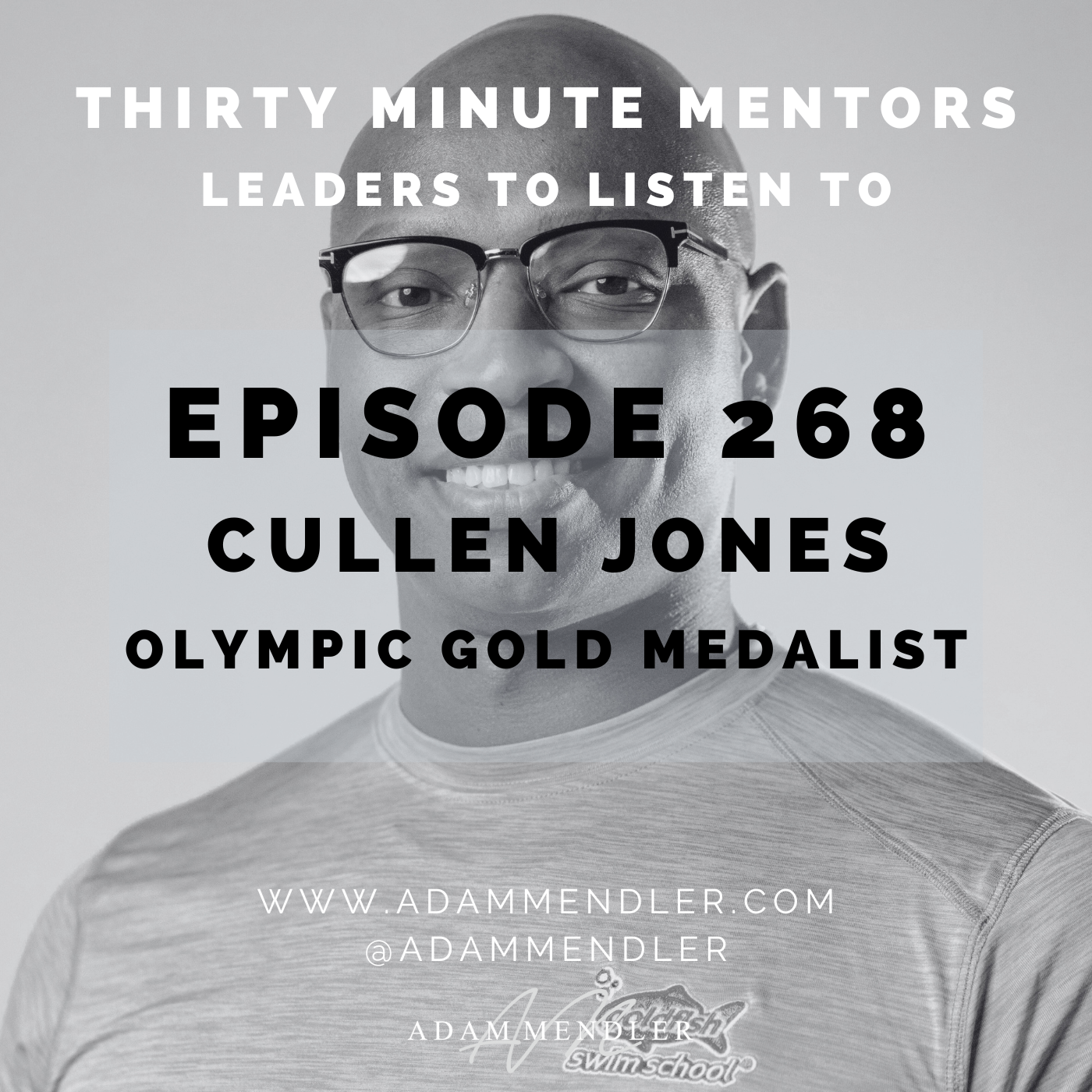
Episode 268: Olympic Gold Medalist Cullen Jones
The first Black swimmer to set a world record, Cullen Jones is a two-time Olympic gold medalist, winning gold medals in the 2008 and 2012 Summer Olympic games. Cullen is currently a water safety ambassador for Goldfish Swim School. Cullen joins Adam to share his journey and his best lessons and advice. Cullen and Adam discuss a wide range of topics: reaching peak performance and attaining greatness; motivation; goal setting; mental wellness; managing and performing under pressure; developing comfort in your own skin; and much more.
Join Adam and the best network of mentors – Fortune 500 CEOs, founders of household name companies, Hall of Fame and Olympic gold medal-winning athletes, political and military leaders – for intimate half-hour conversations each week. Thirty Minute Mentors is available wherever you listen to podcasts. If you enjoy the episode, visit your favorite podcasting app and subscribe, rate, and leave a review, and spread the word by sharing on your social media channels and sharing directly with your friends and colleagues.




Read the full transcript of Adam’s conversation with Cullen Jones.
Episode Summary
Cullen Jones is a four-time Olympic medalist who won gold at the 2008 and 2012 Summer Olympics and is the first African American male swimmer to hold a world record. He tells Adam how nearly drowning at age five led to a mission to get people to learn to swim.
Cullen recalls following his dad down the biggest ride at a water park, flipping upside down, and going under, even though, he stresses, he was listening to the rules and fully supervised. The only thing that could have helped him, he says, was swim lessons, which is why he is such a big advocate for them. He says it took five different teachers before he started to feel comfortable around water again, that he has been teaching lessons since he was 15, and that his priority is giving people a positive experience in the water. He did not take to speed right away, he recalls, collecting sixth- and seventh-place ribbons and swimming for the pure joy of it. He also played basketball and water polo, ran track, played soccer, and did gymnastics, crediting track with his endurance and gymnastics with his spatial awareness, and he tells parents not to specialize too early.
On greatness, Cullen says failure is part of the process: you have to find the ways that don’t work before you find the way that does. People see the gold medals and the world record and assume he was always winning, he says, but there were a ton of losses, and he dealt his entire career with feeling like a Black kid in a sport that didn’t look like him. He urges listeners to find an anchor point that turns a goal into a lifestyle, to take baby steps toward it, and to rely on consistency, since motivation, he says, is not what gets you an Olympic gold medal. Some days, he recalls, just getting to practice was the goal. To keep going, he put pictures of his competitors winning around his house, including on his fridge, and today he works against a timer at his desk and rewards himself when he finishes a task.
Cullen says the pressure in 2008 came mostly from himself, as he wanted to be on the relay while Michael Phelps went for eight gold medals and the French team said they were there to crush the Americans. Afterward, being called the Venus and Serena, the Tiger Woods, and the Arthur Ashe of swimming made him feel that every loss let down his culture and his family. He says he was going to break mentally if he did not start investing in his mind, so he worked with sports psychologists and psychologists, studied breathwork and Wim Hof’s breathing method, and, on his therapist’s advice, wrote down his worries the night before a race and threw the paper away. He came to see his nerves as a sign that he cares.
Cullen says he is still usually the only Black person in the room, or one of about three, that he has been called intimidating or angry when he is simply passionate, and that he deals with at least one racist comment a day. After losing all of his hair to alopecia, he says, he had to work on the new person he saw, and he does self-talk every morning to build himself up. He recalls that his father, who died of lung cancer when Cullen was 16, told him never to let anyone slow him down or stop him. His advice for success: identify what success looks like to you, then map it out.
What You’ll Learn
- Make your goal a lifestyle, Cullen says: find the anchor point that makes it more than just an affirmation, and you will live the way you need to live to accomplish it.
- Treat failure as part of the process: Cullen says you have to find the ways that don’t work before you find the way that does, and behind his gold medals were a ton of losses.
- Figure out what it will take to motivate you, Cullen says: pictures of winning competitors on his fridge drove him in swimming, while a timer and small rewards keep him on task at work.
- Train your mind as well as your body: after 2008, Cullen says, he worked with psychologists and practiced breathwork, and he learned to see nerves as a sign that he cares.
- You may never feel fully comfortable being different, Cullen says, but you can do the work every morning to build yourself up and get into a positive mindset.
- Map it out: Cullen says defining what success looks like and breaking it into small, specific steps keeps a goal from becoming an empty promise to yourself.
About Cullen Jones
Cullen Jones is a four-time Olympic medalist and the first African American male swimmer to hold a world record. Born in the Bronx and raised in Irvington, New Jersey, he nearly drowned at age five. At NC State, he won the 2006 NCAA title in the 50-yard freestyle. He won Olympic gold on the world-record-setting 4×100 freestyle relay at the 2008 Beijing Games, and at the 2012 London Games he won gold on the 4×100 medley relay and silver in the 50 freestyle and the 4×100 freestyle relay. He is an ambassador and board member of the USA Swimming Foundation, and in 2021 Goldfish Swim School named him an ambassador.
Related Episodes
- Episode 103: Olympic Gold Medalist Ryan Lochte
For more on peak performance in the pool, Ryan, a six-time Olympic gold medalist swimmer, discusses how to reach peak performance and how to navigate and bounce back from the most challenging experiences. - Episode 300: NBA Hall of Famer Sidney Moncrief
For more on the keys to greatness, Sidney, a Basketball Hall of Famer and two-time NBA Defensive Player of the Year, discusses his GRIT principles of growth, resilience, intentionality, and tenacity, along with teamwork and competing against the NBA’s best. - Episode 100: Football Legend Ricky Williams
For more on mindset, Ricky, a Heisman Trophy winner, discusses navigating highs and lows, how to develop a healthy and winning mindset, and motivation. - Episode 253: Former Olympic Gold Medalist Marion Jones
For more on failure and resilience, Marion discusses navigating the highest of highs and lowest of lows, failure and success, and mindset. - Episode 9: Mindfulness Guru Dr. Kamlesh Patel
For more on mental wellness, Dr. Patel discusses how to reduce stress, make better decisions, and integrate yoga and meditation into your routine.