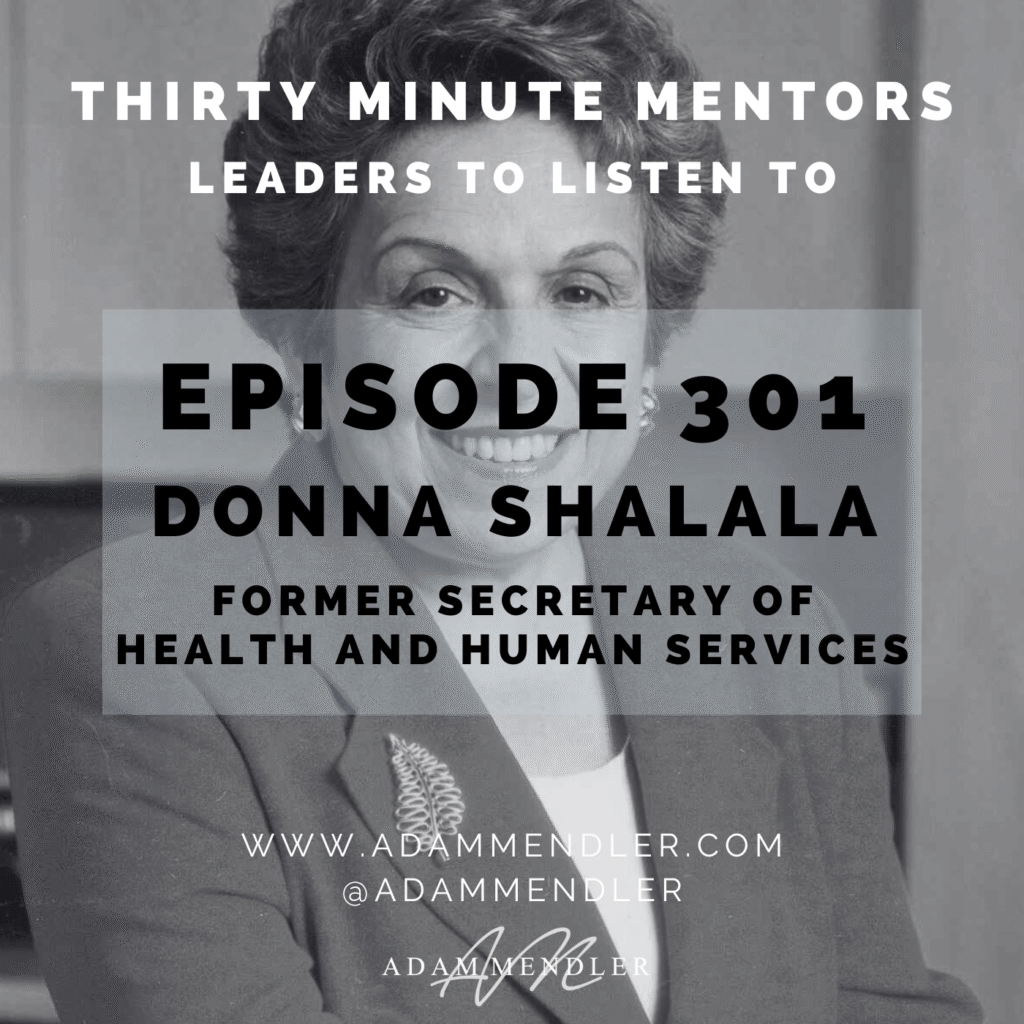
Donna Shalala was the longest-serving Secretary of Health and Human Services in American history. Secretary Shalala has also served as the President of the University of Miami, the Chancellor of the University of Wisconsin, Madison, the President of Hunter College, and a member of Congress. Secretary Shalala joins Adam to share her journey and her best lessons and advice on leading people and organizations and building successful relationships, networks, and careers.
Join Adam and the best network of mentors – Fortune 500 CEOs, founders of household name companies, Hall of Fame and Olympic gold medal-winning athletes, political and military leaders – for intimate half-hour conversations each week.
Thirty Minute Mentors is available wherever you listen to podcasts. If you enjoy the episode, visit your favorite podcasting app and subscribe, rate, and leave a review, and spread the word by sharing on your social media channels and sharing directly with your friends and colleagues.
Read the full transcript of Adam’s conversation with Secretary Donna Shalala.
Episode Summary
Donna Shalala is the longest-serving Secretary of Health and Human Services in U.S. history and a former president of the University of Miami. She tells Adam how one question, what would be the greatest adventure, carried her from the Peace Corps into academia and government, and why networking, listening, and understanding people’s lives sit at the center of her approach to leadership.
As a college senior who had trouble picking a major, Secretary Shalala says, she applied to law school, a PhD program in political science, jobs in Congress, newspaper jobs, and even medical school. She laid her acceptances out on her bed and asked which would be the greatest adventure, and the answer was the Peace Corps, which was inspired by John Kennedy. She lived in an Arab village in Iran, taught English at a small agricultural college, and worked to get villagers to build schools. She calls it the position that had the most profound effect on her: it made her a citizen of the world and taught her that to get things done, you first have to understand what the people in a community really want.
She followed a boyfriend to graduate school at Syracuse; he hated it and left, she says, while she loved it, stayed, and got a PhD. She describes her career as an adventure of always overreaching and then learning the job. Her advice for rising is to never eat lunch at your desk and to network. She met the Clintons before they were married and kept in touch over the years. Governor Hugh Carey, whom she had helped as a young academic, put her on the panel created to deal with New York City’s possible bankruptcy, she recalls, where Felix Rohatyn made her treasurer because only the treasurer had to disclose their income. She says joining that panel changed the trajectory of her career, and a letter from Rohatyn later opened the door to Katharine Graham’s dinner parties in Washington. She became president of Hunter College without ever having been a dean or provost, she says, after people who knew her work recommended her.
On leadership, Secretary Shalala stresses listening to people’s goals and pairing long-term strategy with short-term changes people can feel. At HHS, she says, she never met with just the political appointees, treated the career experts with great respect, and built a team with economic and other kinds of diversity. President Clinton taught her that to make good policy, you have to understand people’s lives. At Hunter, she polled students, faculty, and staff, who most wanted clean and safe buildings, so she hired the retiring head of the Housing Authority Police Department as police chief and a hospital’s head of sanitation. At Wisconsin, she fired the athletic director and the football coach, and with Pat Richter hired Barry Alvarez, who turned the program around. At Miami, she took the student government’s list seriously, down to free washers and dryers and ice machines in the residence halls.
She also built relationships with legislators of both parties. When a Wisconsin legislator mocked her as a woman from New York who drinks white wine and eats quiche, she sent him both, and he became a good friend. In Congress, she says, she worked with Republican doctors on bipartisan legislation to stop surprise billing, and she describes teaching a health policy course at the University of Miami with Alex Azar, who served as HHS Secretary under President Trump.
Her advice for success is to understand people’s lives, network, have goals, and like people regardless of their politics. She recalls Mayor Wagner’s lesson that patience can look like slow decision-making, says that when she hits a brick wall she turns and goes in another direction, and urges listeners to make friends, recalling that people she did small things for have written years later to say it changed their lives.
What You’ll Learn
- Weigh opportunities by asking which would be the greatest adventure, Secretary Shalala says: that question led her to choose the Peace Corps over law school, medical school, and a PhD program, and she has asked it throughout her career.
- Never eat lunch at your desk, Secretary Shalala says: meet people, including those of your own generation, and keep in touch, because she met the Clintons before they were married and knew nearly everyone at her first Clinton Cabinet meeting.
- Leave jobs while you still love them, Secretary Shalala says, not when you are tired of them, and move on to the next adventure.
- Listen first and deliver short-term wins people can feel, Secretary Shalala says: when her polling at Hunter College showed everyone wanted clean and safe buildings, fixing that built more credibility than an academic move would have.
- To make good policy and good decisions, you have to understand people’s lives, Secretary Shalala says, a lesson she credits to President Clinton and now passes on to her students.
- Disarm critics with humor and find common ground, Secretary Shalala says: she answered a legislator’s jab about white wine and quiche by sending him both, and he became a good friend even though they did not see eye to eye on a lot of issues.
About Donna Shalala
Donna Shalala served eight years as Secretary of Health and Human Services under President Bill Clinton, becoming the longest-serving HHS Secretary in U.S. history. One of the nation’s earliest Peace Corps volunteers, she worked in Iran from 1962 to 1964 and earned her master’s and doctoral degrees from Syracuse University’s Maxwell School. She was president of Hunter College from 1980 to 1988, chancellor of the University of Wisconsin-Madison from 1988 to 1993, and president of the University of Miami from 2001 to 2015. She represented Florida’s 27th Congressional District from 2019 to 2021. She received the Presidential Medal of Freedom in 2008, and she has taught at the University of Miami.
Related Episodes
- Episode 236: Former CDC Director Dr. Mandy Cohen
For more on leading in public health, Dr. Cohen, who was North Carolina’s Health and Human Services Secretary during the COVID-19 crisis, discusses leadership, crisis management, communication, and trust. - Episode 81: Former Secretary of Veterans Affairs David Shulkin
For more on leading a federal department, Secretary Shulkin, a former Secretary of Veterans Affairs, discusses how to lead and drive change at large bureaucratic organizations and lessons from working for dramatically different presidents. - Episode 173: Former Secretary of Labor Tom Perez
For more on building relationships in public life, Secretary Perez, a former Secretary of Labor and Chair of the Democratic National Committee, discusses leading people and organizations, building winning relationships, and taking risk. - Episode 71: Former White House Press Secretary Joe Lockhart
For more on serving in the Clinton administration, Joe, who was White House Press Secretary during President Bill Clinton’s impeachment, discusses crisis management, performing under pressure, communications, and relationship building. - Episode 254: Vice Admiral Ted Carter
For more on leading a university, Vice Admiral Carter, a former Superintendent of the United States Naval Academy and President of the University of Nebraska System, discusses leadership, career development, performance, and trust.