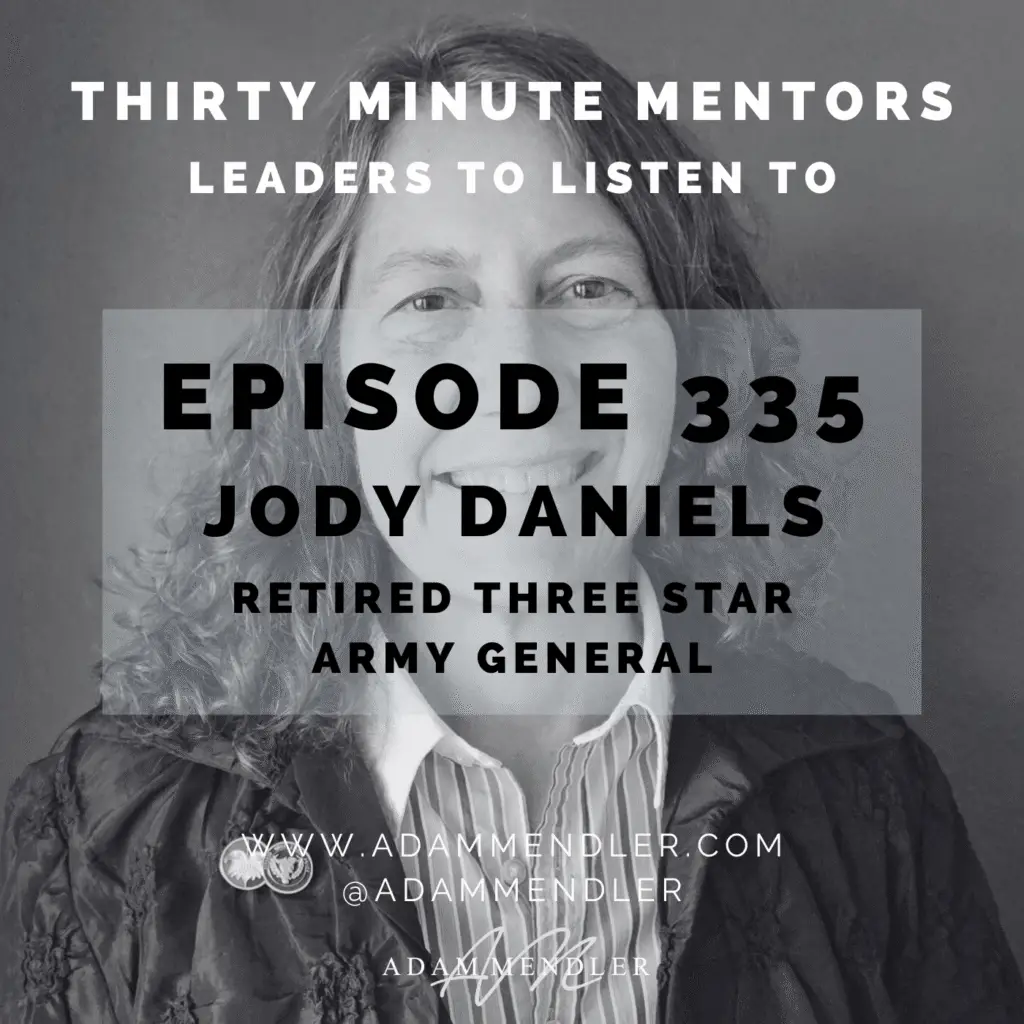
Lieutenant General Jody Daniels is the first woman to lead the United States Army Reserve, serving as commanding general of the U.S. Army Reserve Command. General Daniels joins Adam to share her unique journey – from an accidental start in Army ROTC to three-star rank in a historically male-dominated institution – and her best lessons and advice. General Daniels and Adam discuss a wide range of topics: leadership, decision-making, delegation, mentorship, and much more.
Join Adam and the best network of mentors – Fortune 500 CEOs, founders of household name companies, Hall of Fame and Olympic gold medal-winning athletes, political and military leaders – for intimate half-hour conversations each week.
Thirty Minute Mentors is available wherever you listen to podcasts. If you enjoy the episode, visit your favorite podcasting app and subscribe, rate, and leave a review, and spread the word by sharing on your social media channels and sharing directly with your friends and colleagues.
Read the full transcript of Adam’s conversation with General Daniels.
Episode Summary
Lieutenant General Jody Daniels, the first woman to lead the U.S. Army Reserve, came to the Army through an ROTC scholarship that let her attend universities she could not otherwise have afforded, and her first lessons were about the people around her. The first was to train your replacement, since a deputy who can make decisions in your absence lets you move up, and even take a vacation with your phone off. The second was to listen to the people who work for you. A sergeant she respected would pull her aside to tell her she was about to muck something up, and she says to take that kind of feedback without taking it personally.
As a senior leader, General Daniels says, listening gets harder because people stop being honest with someone so senior. She made herself approachable by giving soldiers rabbit ears in photos and grinning when they gave them right back to a three-star general, and she wrote a nine-page, easy-to-read paper on what she wanted people to focus on, giving the same pitch to everyone from company commanders to two-star generals. When soldiers told her their units were still doing things she had told them not to, she asked for the organization but not the name, and passed the issue to the two-star above them, so the message came from their boss and the soldier stayed anonymous.
She also set a rule for meetings: material had to reach her 48 hours in advance so she could read it and send questions, which turned briefings into conversations with whoever was the expert, regardless of rank. On accountability, she describes setting expectations, agreeing on milestones, and writing up meeting takeaways so both sides knew what was agreed. In the defense industry she handled performance improvement plans, and for people who were not a fit, she helped with their resumes and cover letters so they left on good terms.
Talent matching shaped her deployment to Iraq, where the advance party matched about 800 incoming people to positions based on civilian skills, such as a city planner or a teacher, rather than only their Army career field. She says looking at people’s skills and talents holistically matters in industry as much as in the military.
What You’ll Learn
- Commit to decisions: endless extra questions are a way to defer deciding, General Daniels says, and a decision made privately after the last person leaves the room undermines transparency.
- Delegate authority deliberately: early in her last job, General Daniels went policy by policy, writing a memo for each, to push signature authority down as far as regulation allowed, and she says it saved her time later.
- Focus on what you do well rather than your weaknesses, General Daniels says, unless the weakness is illegal, unethical, or immoral, and look for ways to expand your toolkit.
- Her hardest calls were military justice cases, where she says to embrace the gray: be consistent, be transparent, and go with your conscience, because a discharge can shape a life.
- Don’t suppress the qualities that make you a good leader: General Daniels worried that evaluations praising her for caring would hurt her as a woman in the 1990s Army, kept caring anyway, and later saw senior leaders call it a leader imperative.
- Look two positions out: one boss suggested a master’s and PhD to a new lieutenant, and another, in Iraq, told her she could not make general without attending the Army War College.
About Lieutenant General Jody Daniels
Lieutenant General Jody Daniels was the first woman to lead the United States Army Reserve and the first woman to serve as Commanding General of the United States Army Reserve Command. She studied computer science at Carnegie Mellon University, earned a master’s and a PhD in computer science from the University of Massachusetts, Amherst, and began her career building artificial intelligence expert systems for the Army. She spent seven and a half years on active duty before transitioning to the Army Reserve, worked in an artificial intelligence lab for a defense contractor, and later served in full-time roles in the Army Reserve, including a four-year tenure in her final job.
Related Episodes
- Episode 234: Vice Admiral Carol Pottenger
For more on listening and communication as a senior leader, Vice Admiral Pottenger, the first female three-star admiral to lead in a combat branch, discusses confidence, inclusivity, and mentorship. - Episode 322: Lieutenant General Karen Gibson
For more on leadership development and managing change, Lieutenant General Gibson, one of the highest-ranking women in Army history, discusses crisis leadership and her later role as Senate Sergeant at Arms. - Episode 340: General Gary Brito
For more on communicating through organizational change, General Brito discusses holding a town hall to share what he knew, what he did not know, and the goal ahead. - Episode 192: Lieutenant General Robert Caslen
For more on building trust as a senior leader, Lieutenant General Caslen discusses leading West Point as superintendent and the University of South Carolina as president. - Episode 329: General Paul Funk
For more on developing soldiers at scale, General Funk discusses leading the Army Training and Doctrine Command and the world’s largest international coalition against ISIS.