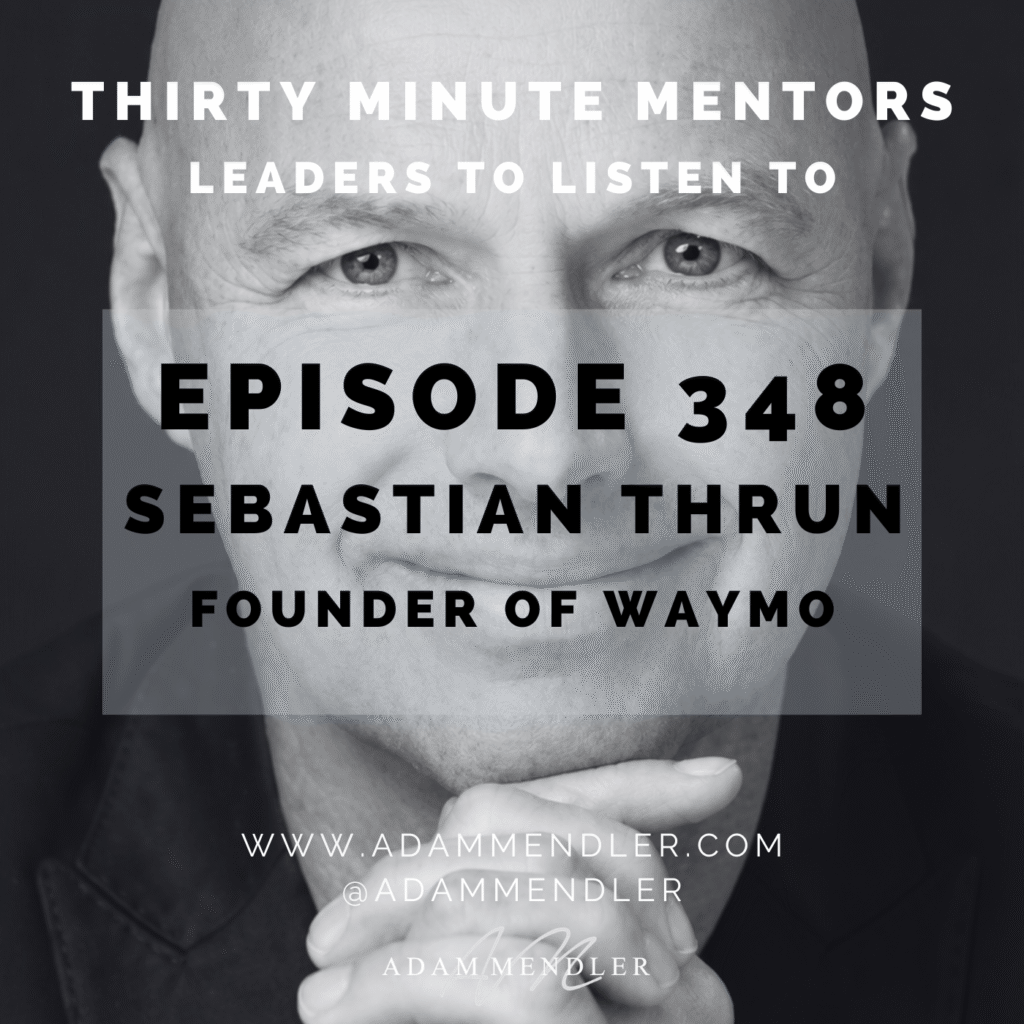
Sebastian Thrun is the founder of Waymo, the market leader in the United States in autonomous driving. A pioneer in the fields of computer science, robotics, automation, education, and artificial intelligence, Sebastian is recognized as the godfather of the self-driving car industry. Sebastian is also the founder and former CEO of Udacity. Sebastian joins Adam to share his journey and his best lessons and advice. Sebastian and Adam discuss a wide range of topics: innovation, purpose, trust, decision-making, team building, AI, leadership, success, and much more.
Thank you to Ai4 for hosting this interview.
Join Adam and the best network of mentors – Fortune 500 CEOs, founders of household name companies, Hall of Fame and Olympic gold medal-winning athletes, political and military leaders – for intimate half-hour conversations each week.
Thirty Minute Mentors is available wherever you listen to podcasts. If you enjoy the episode, visit your favorite podcasting app and subscribe, rate, and leave a review, and spread the word by sharing on your social media channels and sharing directly with your friends and colleagues.
Read the full transcript of Adam’s conversation with Sebastian Thrun.
Episode Summary
Sebastian Thrun, the founder of Waymo and Udacity, recalls that in 2009, having just sold a company to Google, he was visited in his cubicle by Larry Page, who proposed building a self-driving car company for ordinary people in cities. Sebastian, whose robotic vehicle had won the 2005 DARPA Grand Challenge, told Page flatly that it could not be done and was too dangerous. Page kept coming back for several days, eventually asking Sebastian to simply write down the technical reasons it was impossible so Page could explain the decision to Sergey Brin and Eric Schmidt. Sebastian could not find one. That failure to object became the birth of Project Chauffeur, which later became Waymo.
Sebastian is candid that the same expertise that made him credible almost stopped Waymo from existing, and he carried that lesson into how he built the team. He hired an automotive expert early on who insisted the whole codebase be rewritten to match an existing industry norm, and Sebastian fired him for it. He staffed the project instead with former students and postdocs he already trusted, choosing people for their willingness to learn over their credentials.
On decision-making itself, Sebastian estimates that roughly eighty percent of the decisions made while building something new are not perfect, and that even successful companies would rebuild themselves five times faster with the benefit of hindsight. His answer is a decision system built around ownership rather than command: whoever owns a decision has to bring the right people into the room, reach a consensus, then document and freeze the decision so it cannot be quietly reopened. Once a decision is delegated further down, the original owner becomes an advisor rather than a boss. He credits a conversation with Jeff Bezos, who called himself Amazon’s “chief slowdown officer” because the next seven quarters were already locked in and he could only really influence the eighth quarter and beyond, with reshaping how he thinks about a leader’s actual span of control.
Sebastian says he long ago tried to abandon two emotions, fear and guilt, because they hold people back. For skeptics, he recommends two weekly experiments: a “no-grump Tuesday,” when you say yes to ideas instead of picking them apart, and a “no-complaint Thursday,” when you treat anything that goes wrong as something you might have prevented. He also points to Dale Carnegie’s How to Win Friends and Influence People, which he calls his all-time favorite book and is now reading for the fourth time, and its lesson that leaders have to understand what their people really want.
What You’ll Learn
- Pick problems you are not yet an expert in: Sebastian deliberately chooses work he’s bad at, because experts know the past of a field, not its future.
- Experiment with AI yourself: Sebastian says today’s AI mostly makes existing businesses more efficient, the real transformation will come when AI combines with fields like crypto, cybersecurity, and robotics, and leaders should start by building with it hands-on.
- People rarely leave over pay, Sebastian says: almost everyone wants more respect, dignity, ownership, and development, so connect what people want for themselves to what is good for the company.
- Build on people’s strengths instead of fixing their weaknesses, Sebastian says, because people who feel supported in their strengths and passions perform better in every dimension.
- Trust your instincts but test your ideas: borrowing from Zynga founder Mark Pincus, Sebastian says the big goal is usually right even when the steps you pick are wrong, so test ideas quickly and drop the ones that fail.
- Treat leadership as engineering an organization, Sebastian says: everyone in it works for both the company and themselves, so find what people want and tie it to what is good for the company and the world.
About Sebastian Thrun
Sebastian Thrun is the founder of Waymo, the current market leader in autonomous driving in the United States, which grew out of a Google self-driving car project he helped start in 2009 as Project Chauffeur. He grew up in West Germany and earned his PhD in computer science and statistics from the University of Bonn, drawn to the field because it let him fully understand and build systems in a way other disciplines could not. Before Waymo, he led development of Stanley, the Stanford robotic vehicle that won the 2005 DARPA Grand Challenge. He also co-founded Udacity, and he has long believed that computers should be trained rather than programmed.
Related Episodes
- Episode 54: Coursera CEO Jeff Maggioncalda
For more on online education, Jeff discusses leading Coursera, which serves more than 70 million people globally, and co-founding Financial Engines. - Episode 48: Waze CEO Noam Bardin
For more on building a company that Google acquired, Noam discusses leading Waze through its acquisition by Google for over a billion dollars and what it takes to build a billion-dollar business. - Episode 166: Software Pioneer Mitch Kapor
For more on technology pioneers, Mitch discusses creating Lotus 1-2-3, the application that drove business adoption of the personal computer, and co-founding the Mozilla Foundation. - Episode 117: NetSuite Founder Evan Goldberg
For more on innovation in software, Evan discusses founding NetSuite, the first cloud computing company, which Oracle acquired for $9.3 billion. - Episode 272: NTT DATA CEO Abhijit Dubey
For more on leading innovation at scale, Abhijit discusses leading NTT DATA, one of the world’s largest IT services providers, and his lessons on trust, ethics, and innovation.