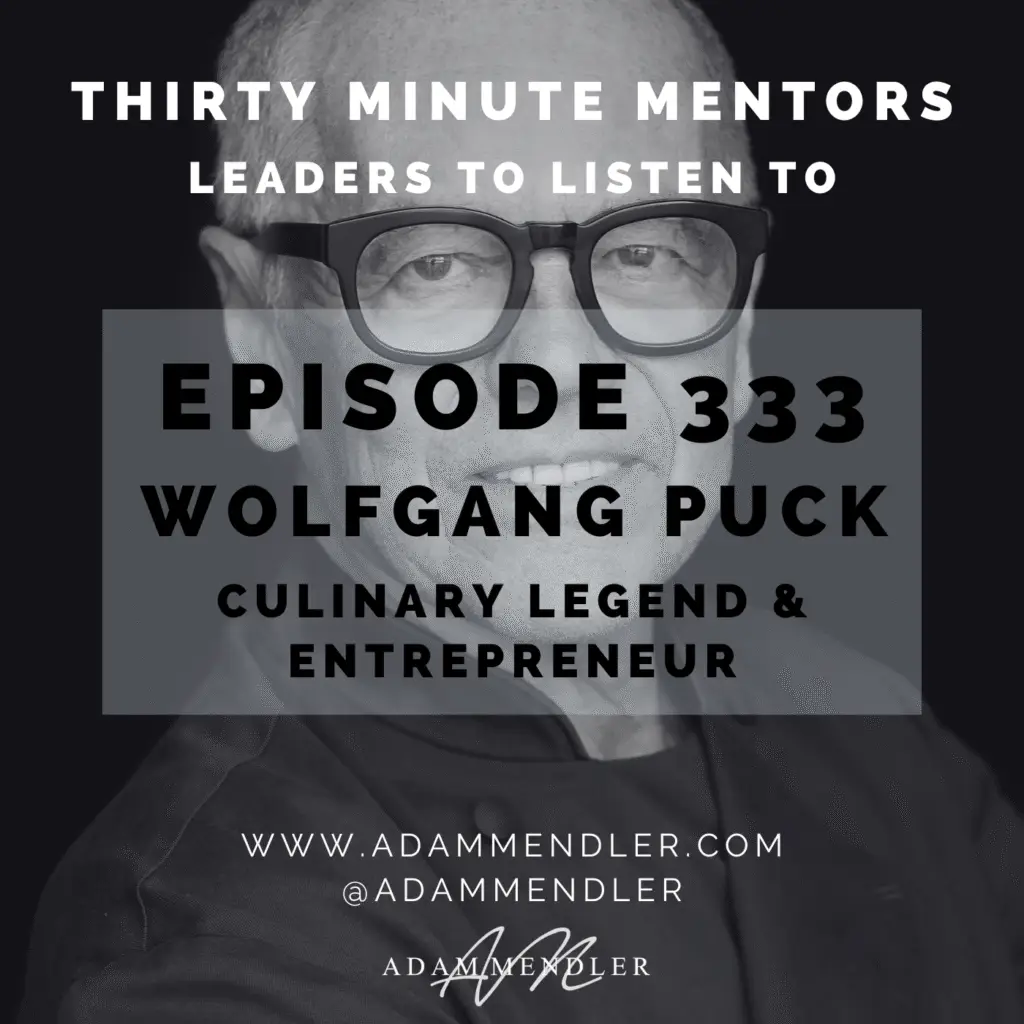
Wolfgang Puck is the founder of Wolfgang Puck Fine Dining Group, Wolfgang Puck Catering, and Wolfgang Puck Worldwide Incorporated. Wolfgang joins Adam to share his unique journey – from a difficult childhood in Austria to becoming one of the most recognized chefs and restaurateurs in the world – and his best lessons and advice. Wolfgang and Adam discuss a wide range of topics: mentorship, innovation, leadership, reinvention, and much more.
Join Adam and the best network of mentors – Fortune 500 CEOs, founders of household name companies, Hall of Fame and Olympic gold medal-winning athletes, political and military leaders – for intimate half-hour conversations each week.
Thirty Minute Mentors is available wherever you listen to podcasts. If you enjoy the episode, visit your favorite podcasting app and subscribe, rate, and leave a review, and spread the word by sharing on your social media channels and sharing directly with your friends and colleagues.
Read the full transcript of Adam’s conversation with Wolfgang Puck.
Episode Summary
Wolfgang Puck, the chef and restaurateur behind Spago, grew up in a tiny village in southern Austria, where his mother worked summers as a chef at a resort hotel and he helped in the kitchen. His childhood was difficult, with a stepfather who always told him he was good for nothing. He wanted to be an architect, but his family could not pay for school in Vienna, so at 14 he left home for a cook apprenticeship in Villach. When a chef told him to go back home, Wolfgang refused, kept working, and was moved to a second hotel, where a kinder lady chef told him to do his job and it would be fine. At 17, after three years of apprenticeship, he went to France.
In France, Wolfgang wrote to the famous restaurants named in the Guide Michelin. The first yes came from Raymond Thuilier at Baumanière, a three-star restaurant in Les Baux where everything was cooked to order. Wolfgang says that is where he found his passion and that Thuilier, who brought Picasso and Elizabeth Taylor into his kitchen, became his mentor. After Maxim’s and Monaco, he came to America, reaching Indianapolis by Greyhound bus after 36 hours before moving to Los Angeles.
At Ma Maison, Wolfgang replaced a chef who made mashed potatoes from powder and became a partner. After five years, he asked the owner for a 50-50 partnership, was told “I always own 51%,” and left. In January 1982 he opened Spago in West Hollywood with an open kitchen, and it became an overnight hit. Chinois, Spago in Tokyo, and the first chef-opened restaurant in Las Vegas followed. His rule was never to copy, since a singer who only sings Elton John’s songs never becomes Elton John, and he hired young talent such as Mark Peel and Nancy Silverton.
Wolfgang says great hospitality means giving guests something better than they expected, such as remembering a returning guest’s name and where they like to sit. It is all about the guests, not the chef, he says, just as a quarterback fails without a team. He rejects how his first chef treated him, asks how something can be done better, and wants staff to feel like family, so some employees’ children now work there.
On change, Wolfgang says you cannot wait until business goes down, so after 15 years he moved Spago to a better kitchen while it was on top. After 60 years of cooking, he still has the passion he had 30 years ago and recently hired an art professor to teach him to paint.
What You’ll Learn
- Failure is not the end of the world in a kitchen, Wolfgang says, because this is not brain surgery, and he compares chefs who fear it to baseball hitters who are great at .330.
- Spago’s smoked salmon pizza was born when the kitchen ran out of bread, and Wolfgang says creativity comes from experience meeting necessity, not from a key you can simply turn.
- Young chefs often assume that different is what guests want, but Wolfgang says that if the food is not delicious, people come twice and then return to the place they trust.
- Learn your craft well while you are young, Wolfgang says, even by traveling to Europe or Asia, instead of chasing television, because a real craft is what AI will not easily replace.
- Wolfgang uses AI for back-of-house work, such as finding which waiter at his Singapore restaurant received complaints and why, while insisting that the guest experience still depends on the human touch.
- At work, be fully at work, and at home, put the phone away and interact with your children and spouse, since Wolfgang says a restaurant life is not easy on the people who love you.
About Wolfgang Puck
Wolfgang Puck is the founder of Wolfgang Puck Fine Dining Group, Wolfgang Puck Catering, and Wolfgang Puck Worldwide Incorporated, and his name has become synonymous with the best of restaurant hospitality. He was born in southern Austria, where his mother was a professional chef, and began his apprenticeship at 14 before training in France under Raymond Thuilier at Baumanière. He opened Spago in West Hollywood in January 1982 and followed it with Chinois in Santa Monica. His Spago at Caesars Palace was the first restaurant opened by a chef in Las Vegas. Wolfgang has cooked for 60 years, and his son Byron works with him.
Related Episodes
- Episode 259: Celebrity Chef Duff Goldman
For more on creativity and reinvention, Duff, the star of Ace of Cakes, discusses creativity, relevance and reinvention, and branding. - Episode 240: Celebrity Chef Andrew Zimmern
For more on a nonlinear path to success, Andrew, an Emmy Award winner and four-time James Beard Award recipient, discusses resilience, humility, and attaining greatness. - Episode 288: Celebrity Chef Robert Irvine
For more on mentorship and leading with empathy, Robert, a celebrity chef and host of Restaurant Impossible, discusses leadership, ego, accountability, and trust. - Episode 349: California Pizza Kitchen Co-Founder Rick Rosenfield
For more on building a restaurant brand, Rick describes leaving law with Larry Flax to start California Pizza Kitchen, borrowing $250,000 against their law practice to open the first restaurant. - Episode 92: Shake Shack CEO Randy Garutti
For more on building a restaurant business at scale, Randy describes how he and Danny Meyer turned Shake Shack from a hot dog stand into a multibillion-dollar business.