
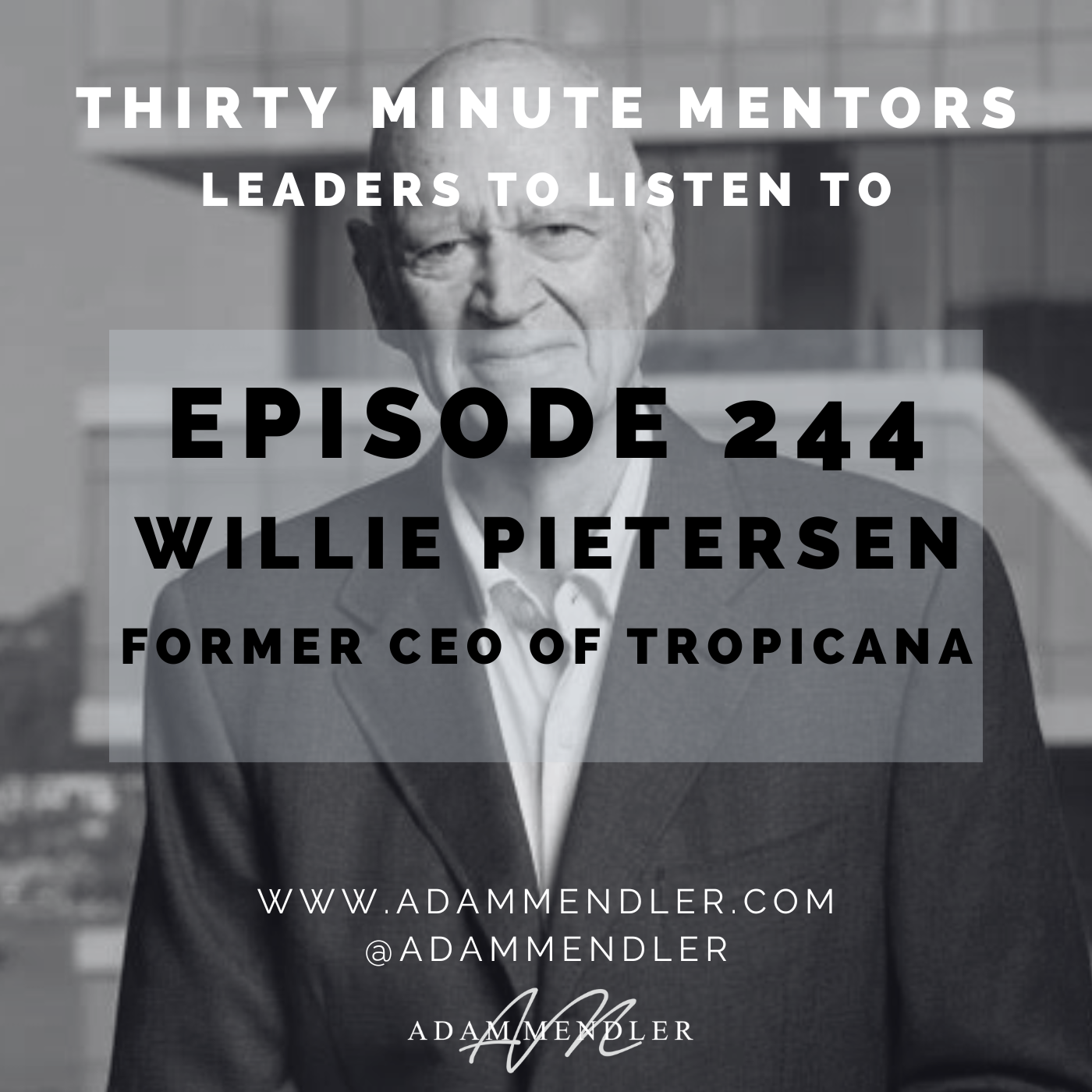
Episode 244: Former Tropicana CEO Willie Pietersen
Willie Pietersen was the CEO of four different multibillion-dollar businesses, including Tropicana and Seagram USA. Willie joins Adam to share his journey and best lessons on leadership and career success. Willie and Adam discuss lessons from growing up in South Africa when apartheid began; navigating a nontraditional path to the C-suite; keys to growing and excelling as a leader; the importance of ethics in leadership and business; and much more.
Join Adam and the best network of mentors – Fortune 500 CEOs, founders of household name companies, Hall of Fame and Olympic gold medal-winning athletes, political and military leaders – for intimate half-hour conversations each week. Thirty Minute Mentors is available wherever you listen to podcasts. If you enjoy the episode, visit your favorite podcasting app and subscribe, rate, and leave a review, and spread the word by sharing on your social media channels and sharing directly with your friends and colleagues.




Read the full transcript of Adam’s conversation with Willie Pietersen.
Episode Summary
Willie Pietersen was the CEO of four multibillion-dollar businesses, including Tropicana and Seagram USA, and is a Professor of Professional Practice at Columbia Business School. He tells Adam how growing up under apartheid in South Africa shaped the way he thinks, and shares what he has learned about learning, leadership, character, and ethics.
Willie says he grew up with apartheid as the only reality he knew, with every authority figure around him reinforcing that imprinting. Studying law at a small liberal arts school in South Africa, where, he says, he became chairman of the Students’ Representative Council and began protesting against apartheid, moved him only a few inches. A Rhodes Scholarship to Oxford let him look at South Africa from the outside in for the first time. Back home as a lawyer, he represented clients before a race classification board, where a pencil was put through their hair to test its kinkiness and members of the same family were separated. That night, he recalls, he told his wife they could not raise a family there. He left the law for Unilever, hoping for an international career, and says he was posted to Holland, Australia, England twice, and the United States.
On learning, Willie quotes Margaret Wheatley: you cannot change a living thing from the outside; you can only disturb it so that it changes itself. Learners, he says, have to invite new disturbances in. He says maybe 20% of the books he reads are business books. He recommends learning to ask the right questions and keeping a learning journal, citing the German psychologist Hermann Ebbinghaus, whose research, he says, found that after 30 days we typically forget 90% of what we learn. The antidotes, he says, are to write down what you’ve learned, retrieve it regularly, and practice it, and Willie adds a fourth: teach it to your team.
Willie recalls his first CEO assignment, leading Unilever’s food group in South Africa, when he was told he was the youngest person in Unilever to hold such a position. He saw leadership as an intellectual game of chess, but after three months, he told his chairman that what surprised him was how much time he spent on people, and the chairman replied, “Welcome to leadership.” Leadership is about the people and management is about things, Willie says, and great work happens through inspired people. Employees always have three questions, he says: what are we aiming to achieve and why should I care, where does my department fit and what’s expected of me, and how will we measure success and what’s in it for me. The answer to the last, he says, is very seldom money. It’s meaning.
Authenticity is number one, Willie says, and it includes vulnerability and admitting mistakes. If you’re not making mistakes, you’re not taking risks, and the value of the learning has to be bigger than the cost of the mistake; if we bury mistakes, we bury the learning. He traces his understanding of moral courage to his father, a station master who, he recalls, volunteered to fight in the Second World War 6,000 miles away because it was the right thing to do. In the liquor industry, after Willie gave a new distributor a contract worth millions of dollars a year to that distributor, the man asked if there was anything else he could do for him, and Willie realized he was being offered money. He says it was important to say no, and that you will never be happy with ill-gotten gains.
For success, Willie borrows Voltaire’s idea that we all have to cultivate our own gardens. Beyond character, he names simplicity, creating a clear set of priorities from a world of increasing complexity, and, above all, creating a learning organization. Drawing on Charles Darwin, he says organizations must practice outside-in thinking and adapt to the external environment, because an organization’s lifespan is a factor of its adaptive capacity.
What You’ll Learn
- Invite new disturbances into your thinking, Willie says: read widely beyond business, seek out diverse perspectives, and learn to ask the right questions, because a living thing can only be disturbed so that it changes itself.
- Keep a learning journal, Willie says: write down what you’ve learned, look at it regularly, practice it, and teach it to your team, because, he says, we have very poor memories.
- Leadership is about the people, Willie says: management is about things, but great work happens through inspired people, a lesson he learned in his first CEO job when he was surprised by how much time he had to spend on human issues.
- Answer the three questions on every employee’s mind, Willie says: what are we aiming to achieve and why should I care, where does my department fit in and what’s expected of me, and how will we measure success and what’s in it for me.
- Own your mistakes and learn from them, Willie says: if you’re not making mistakes, you’re not taking risks, and if you bury your mistakes, you bury the learning.
- Do the right thing regardless of the personal risk, Willie says: he learned moral courage from his father, and he says organizations need a system of calling each other out and never bury ethical breaches.
About Willie Pietersen
Willie Pietersen is a Professor of Professional Practice in the Faculty of Business at Columbia Business School, which he joined in 1996, and specializes in strategy and the leadership of change. Raised in South Africa, he earned BA and LLB degrees at Rhodes University and received a Rhodes Scholarship to Oxford University. After practicing law, he joined the Unilever Group in 1968 and, over a period of twenty years, served as the CEO of multibillion-dollar businesses such as Lever Foods, Seagram USA, Tropicana, and Sterling Winthrop’s Consumer Health Group. His books include Reinventing Strategy, Strategic Learning, and Leadership: The Inside Story.
Related Episodes
- Episode 102: Former Unilever CEO Paul Polman
For more on rising to lead Unilever, Paul, who led Unilever as CEO, discusses career development, leadership, why businesses should lead on social issues, building a winning culture, and international business. - Episode 145: Former Medtronic CEO Bill George
For more on leading people, Bill, the former CEO of Medtronic, discusses how to lead people, teams, organizations, and yourself. - Episode 278: Uncle Nearest Founder and Former CEO Fawn Weaver
For more on building a business, Fawn, the founder and former CEO of Uncle Nearest Premium Whiskey, discusses leadership, entrepreneurship, marketing, and creativity. - Episode 200: Former Secretary of Commerce Carlos Gutierrez
For more on rising to lead a major food company, Secretary Gutierrez, who was the youngest CEO in Kellogg history and later the United States Secretary of Commerce, discusses leadership, career development, sales, building winning teams and cultures, and mentorship. - Episode 121: #1 NYT Bestselling Author Marshall Goldsmith
For more on personal growth and learning from mistakes, Marshall, who is regularly named the world’s #1 executive coach, discusses personal and professional development, leadership, feedback, transformation, and learning from mistakes.