
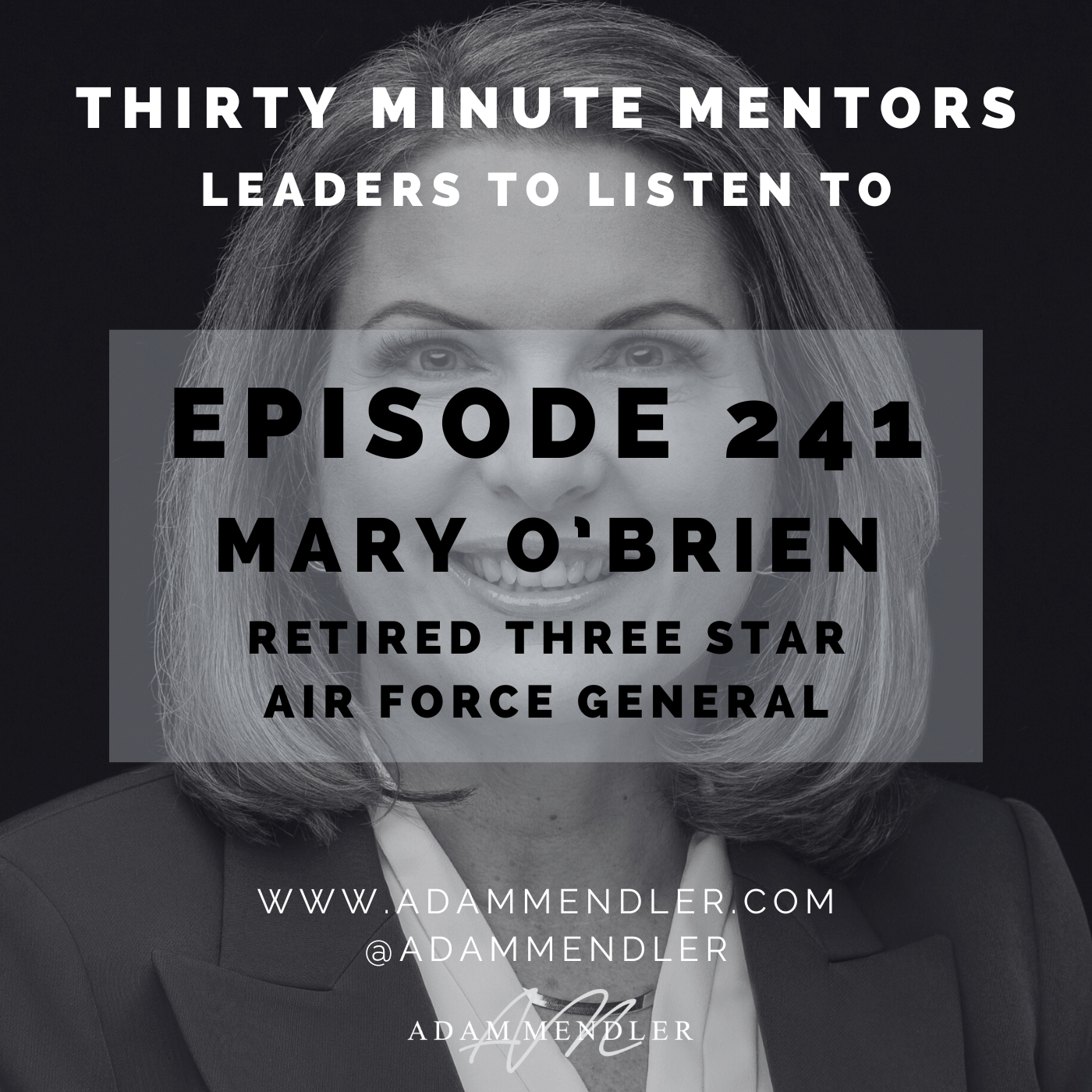
Episode 241: Lieutenant General Mary O’Brien
Lieutenant General Mary O’Brien served in many leadership roles over the course of 38 years in the United States Air Force, including commanding the Air Force’s premier military intelligence organization and, most recently, leading one of the Defense Department’s most important modernization initiatives. General O’Brien joins Adam to share her journey and her best lessons and advice. General O’Brien and Adam discuss a wide range of topics, including persistence, building high-performing teams, self-awareness, communication, and much more.
Join Adam and the best network of mentors – Fortune 500 CEOs, founders of household name companies, Hall of Fame and Olympic gold medal-winning athletes, political and military leaders – for intimate half-hour conversations each week. Thirty Minute Mentors is available wherever you listen to podcasts. If you enjoy the episode, visit your favorite podcasting app and subscribe, rate, and leave a review, and spread the word by sharing on your social media channels and sharing directly with your friends and colleagues.




Read the full transcript of Adam’s conversation with Lieutenant General Mary O’Brien.
Episode Summary
Lieutenant General Mary O’Brien is a retired United States Air Force officer who commanded Twenty-Fifth Air Force and later served as Director of Command, Control, Communications and Computer/Cyber, and Chief Information Officer, J6, on the Joint Staff. A self-described question asker, she tells Adam how she built her leadership around hearing “not yet” instead of no, putting people in the right roles, and seeking out self-awareness.
General O’Brien says her path started with the space shuttle and science. She wanted to become a mission specialist, took every AP science class offered, and tested out of freshman chemistry at the Air Force Academy. She says she was the fourth child between her mother and stepfather to start college in four years, and with money kind of tight, she applied for and won an ROTC scholarship to Purdue and checked a box on the form saying she was also interested in the Academy. After she was accepted, a letter arrived saying she had failed the hearing test and had lost both the scholarship and her Academy admission. She applied for a waiver and received one for low-frequency hearing loss, valid only for the Academy, which she says is very difficult to get.
Her approach, she says, has always been that it’s not over till it’s over. People may think they have told her no, she says, but what she heard was not yet. As a leader, when an idea had merit but lacked funding, skills, or technology, she said not yet and asked what it would take. Very few successes, she says, are the result of one person’s good idea, and she has shared a Harvard Business Review article on the new science of team chemistry, which describes pioneers, drivers, guardians, and integrators, with every command and organization. She defends guardians, who she says get lumped unfairly into the “frozen middle,” and says the integrator, who can speak all three of the others’ languages, forms the team.
Teams still need leaders willing to make changes early, she says, and she describes an assistant who stayed until 8, 9, 10 o’clock at night yet struggled in a job full of interruptions. Instead of telling him he was not doing well, she asked how he thought he was doing, and he told her he felt he was letting her down every single day. Without firing him, she moved him to a job in the organization he thought he would be good at. She says he has gone on to a very successful career, and that he learned it is better to improve his strengths than to spend so much time trying to become adequate at his weaknesses.
Self-awareness sometimes takes someone else’s help, General O’Brien says. At a Center for Creative Leadership program the Air Force sent her to, 360-degree feedback and a coach showed her that her risk for senior leader derailment was being perceived as skeptical, because asking a lot of questions may lead people to think you do not support an idea. Since asking questions is how she learns, she began telling people that up front. She also adapts to others: in Afghanistan, she recalls, General Dunford learned by reading, while his successor, General Campbell, learned through discussion and listening, so her team changed its processes to support him. As a two-star general, she says, she sought out what she called her under 30 mentors to learn how the newest airmen communicate.
She names integrity, empathy, intellectual curiosity, and being bold as enduring leadership traits, and says leaders today also need digital familiarity or digital fluency. Citing the Ted Lasso episode where he said “be curious,” she says she learned to end briefings, meetings, and unit visits by asking whether there was a question people had hoped she would ask. Her advice for success: keep learning, ask questions, work on your self-awareness, and start by deciding you want to become a better leader.
What You’ll Learn
- Treat a no as “not yet,” General O’Brien says: pursuing one more step, a waiver, kept her path to the Air Force Academy open, and as a leader she answered ideas with merit that lacked funding, skills, or technology with “not yet” and then worked out how to get there.
- Build teams that combine pioneers, drivers, guardians, and integrators, General O’Brien says, because very few successes will be the result of one person’s good idea.
- Put people in the jobs that fit their strengths, and make the change early, General O’Brien says: she moved a struggling assistant, without firing him, to a role he thought he would be good at, and she says he went on to a very successful career.
- Don’t assume you are self-aware; seek it out, General O’Brien says: 360-degree feedback and a coach showed her that her many questions could make her seem skeptical, so she began telling people up front that asking questions is how she learns.
- Learn from people a generation removed from you, General O’Brien says: her under 30 mentors showed her where young airmen were getting their information, including valid sites blocked by old network policies.
- End your meetings by asking what you have not asked, General O’Brien says: she asks whether there is a question people hoped she would ask, and she says the answers have brought out information that would never have come out otherwise.
About Lieutenant General Mary O’Brien
Lieutenant General Mary O’Brien is a retired United States Air Force officer. She was commissioned in 1989 upon graduating from the U.S. Air Force Academy with a Bachelor of Science in chemistry. Her commands included the 70th Intelligence, Surveillance and Reconnaissance Wing and Twenty-Fifth Air Force, which she led as its first female commander. She served as Director of Intelligence at U.S. Cyber Command and as the Air Force’s Deputy Chief of Staff for ISR and Cyber Effects Operations. In her final post, as J6 on the Joint Staff, she was a key player in the Defense Department’s Joint All-Domain Command and Control initiative. She retired in 2023.
Related Episodes
- Episode 322: Lieutenant General Karen Gibson
For more on leadership in military intelligence, General Gibson, who spent 33 years as an Army intelligence officer and went on to serve as Sergeant at Arms of the United States Senate, discusses inspirational leadership, crisis leadership, leadership development, and managing change. - Episode 163: Lieutenant General Jeff Buchanan
For more on leading troops, General Buchanan, who served four combat tours in Iraq and one in Afghanistan over a 37-year military career, discusses service to others and leading by example. - Episode 337: Headspace CEO Tom Pickett
For more on going from military service to technology leadership, Tom, a former Navy fighter pilot who helped build YouTube at Google, discusses leadership, career growth, artificial intelligence, and company culture. - Episode 342: The Knot Worldwide CEO Raina Moskowitz
For more on building strong teams, Raina, who spent roughly 13 years at American Express before becoming Chief Operating and Marketing Officer of Etsy, discusses team-building, communication, and trust. - Episode 32: Nobel Prize Winning Scientist Dr. Lou Ignarro
For more on science and innovation, Lou, a Nobel Prize winning scientist known for his research on nitric oxide, discusses how to overcome self-doubt and how to inspire innovation.