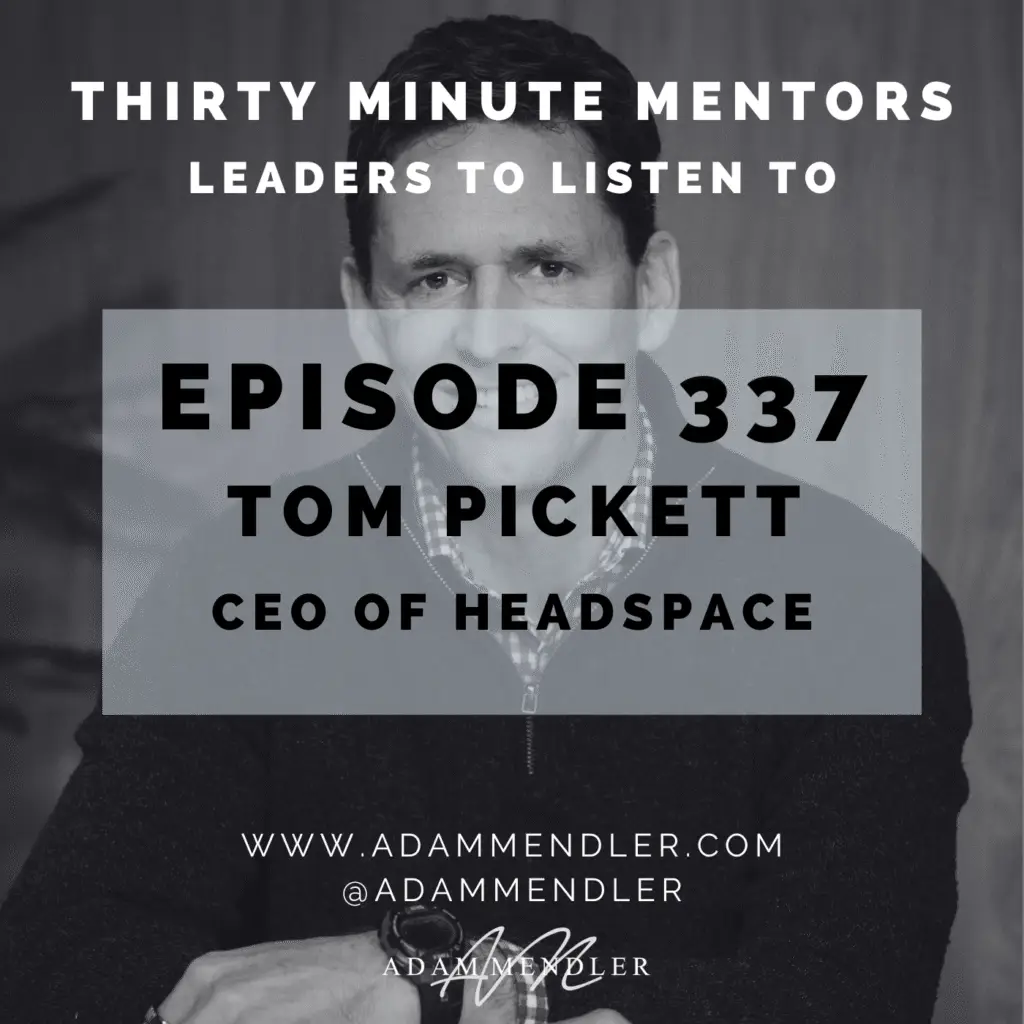
Tom Pickett is the CEO of Headspace, a mental health app downloaded by more than 100 million people. Tom joins Adam to share his unique journey – from Navy fighter pilot to helping build YouTube at Google to leading one of the most recognized names in mental health – and his best lessons and advice. Tom and Adam discuss a wide range of topics: leadership, career growth, artificial intelligence, company culture, and much more.
Join Adam and the best network of mentors – Fortune 500 CEOs, founders of household name companies, Hall of Fame and Olympic gold medal-winning athletes, political and military leaders – for intimate half-hour conversations each week.
Thirty Minute Mentors is available wherever you listen to podcasts. If you enjoy the episode, visit your favorite podcasting app and subscribe, rate, and leave a review, and spread the word by sharing on your social media channels and sharing directly with your friends and colleagues.
Read the full transcript of Adam’s conversation with Tom Pickett.
Episode Summary
Tom Pickett, CEO of the mental health company Headspace, was 27 when he was flying off an aircraft carrier, leading briefings and debriefings, and leading a package of 20 to 25 airplanes over Iraq as a Navy fighter pilot. He says the military gives people management responsibility far earlier than business does, and that flying taught him to get good as a team and to be self-critical about what went well and what did not. His answer on becoming a better leader is practice: put yourself out there, volunteer to lead, and put in the reps.
At Google, which he says had about 1,800 people when he joined in 2004, the biggest accelerant of Tom’s career was YouTube. Sheryl Sandberg, who ran his group, told him YouTube was about 100 people, growing fast, with nobody who knew how to scale it, and asked him to go. Tom was nervous, since acquired companies sometimes got shut down inside Google, and he had to convince YouTube co-founder and CEO Chad Hurley to take him. He started with problems he calls unsexy: content review at scale, copyright compliance, and user support. That work led to running the partner program that let creators make money, and over seven years he helped build YouTube into a multi-billion-dollar revenue business and ended up running global partnerships and business operations.
Tom says his leadership style depends on the company. At Google he learned a servant leadership model, giving smart people rope, unblocking them, and acting as their champion. At DoorDash, where he worked for four and a half years, getting food delivered in a tight window means technology, people, vehicles, restaurants, and consumers all have to work together, which required a more directive, aligned model. Across both, he says the team is bigger than you, and the company is bigger than your team.
At Headspace, Tom hired four or five new executives and looks for what he calls T-shaped leaders, people who can think at 50,000 feet and also go deep on how the product is built and why it breaks. He tests for it by peeling the onion in interviews and by asking executive candidates to present a case study that can take four to eight hours to prepare. Headspace has also brought in AI with care, starting with journaling and gratitude before opening up broader conversations with Ebb, its empathetic AI, with clinical guardrails in place.
What You’ll Learn
- Tom hires strong problem solvers with no mental health or healthcare background and pairs them with clinical experts, because he sees problem solving as a skill that transfers across industries.
- Headspace Heroes is a new award for ownership, built on the idea that when everyone runs from a fire, firefighters run toward it, and problems that fall between teams need someone who does the same.
- A company operates at the pace its management sets, Tom says, which is why he runs a weekly business review and pushes managers to move timelines into the yellow zone.
- Staying with a problem builds a reputation, Tom says, and he points to ten years at Google, seven of them at YouTube, as time to drive real impact, unlike changing jobs every year and a half.
- The new competition for jobs is not a colleague working the same way but a super-powered employee using every AI tool, and Tom leads from the front by trying each new one.
- One Headspace value is make the mission matter, which Tom explains means feeling good about working on mental health only if you are changing the lives of a large number of people.
About Tom Pickett
Tom Pickett is the CEO of Headspace, whose mental health app has been downloaded by more than 100 million people. He grew up across the Northeast and studied electrical engineering at Rensselaer Polytechnic Institute on an ROTC scholarship. He spent the first nine years of his career in the military, flying F-18s and landing on aircraft carriers, before going to business school and working as a consultant. Tom joined Google in 2004, spent seven years on the leadership team of YouTube, and later worked at DoorDash for four and a half years before joining Headspace.
Related Episodes
- Episode 298: Xero CEO Sukhinder Singh Cassidy
For more on scaling inside and beyond Google, Sukhinder discusses her path from executive roles at Google and Amazon to president of StubHub and CEO of Xero. - Episode 206: DocuSign CEO Allan Thygesen
For more on leading at Google’s scale, Allan discusses running a $100 billion business within Google before becoming CEO of DocuSign. - Episode 348: Waymo Founder Sebastian Thrun
For more on where AI is headed, Sebastian discusses why he believes AI’s biggest transformation will come as it combines with fields like crypto, cybersecurity, and robotics. - Episode 264: Congressman Patrick Kennedy
For more on mental health, Congressman Kennedy discusses his advocacy, including co-authoring the Mental Health Parity and Addiction Equity Act. - Episode 209: Teladoc Health CEO Jason Gorevic
For more on building a values-driven culture in health technology, Jason discusses leading Teladoc Health, the world’s largest telehealth company.