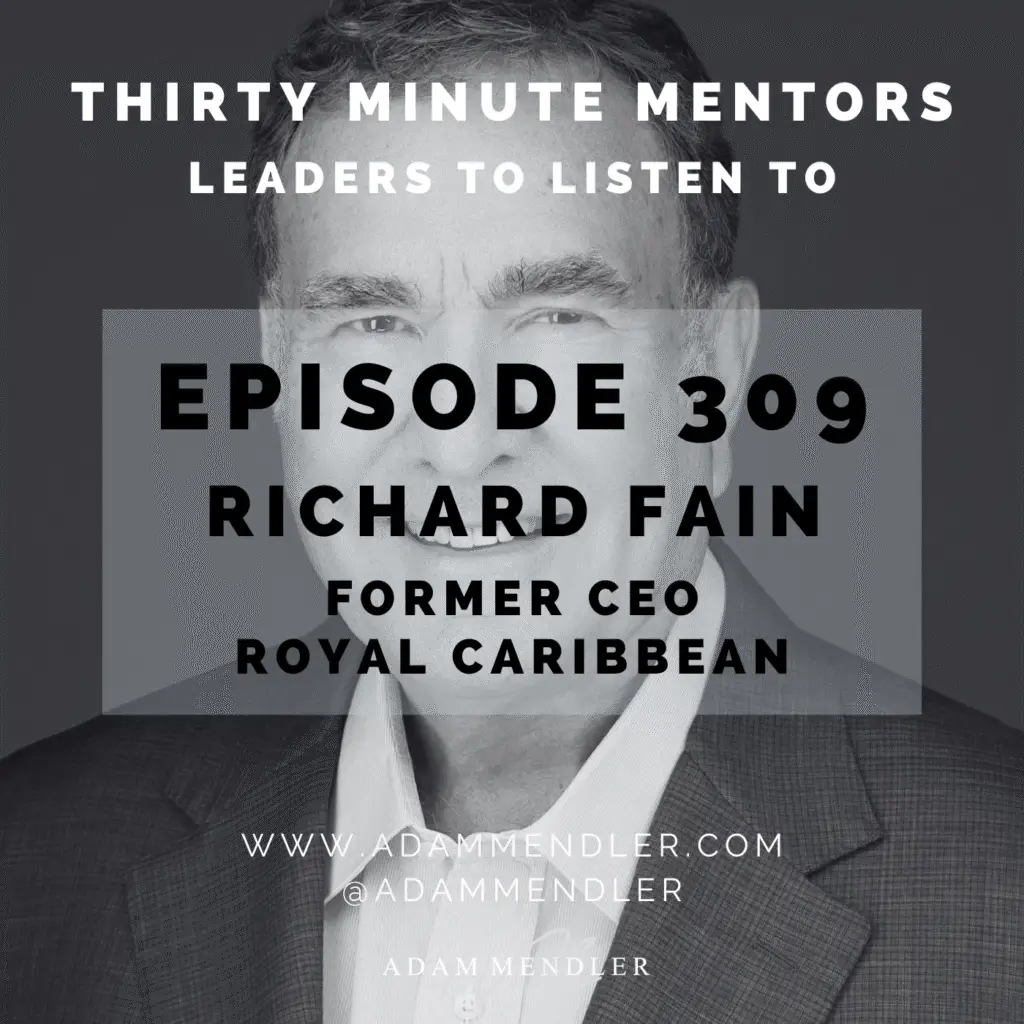
Richard Fain was the CEO of Royal Caribbean Group, the parent company of Royal Caribbean, Celebrity Cruises, and Silversea Cruises. Richard joins Adam to share his journey transforming Royal Caribbean from a small cruise operator into a market leader and his best lessons and advice. Richard and Adam discuss a wide range of topics: leadership, alignment, building winning teams and cultures, how to deliver an extraordinary customer experience, how to overcome and emerge stronger from a crisis, and more.
Join Adam and the best network of mentors – Fortune 500 CEOs, founders of household name companies, Hall of Fame and Olympic gold medal-winning athletes, political and military leaders – for intimate half-hour conversations each week.
Thirty Minute Mentors is available wherever you listen to podcasts. If you enjoy the episode, visit your favorite podcasting app and subscribe, rate, and leave a review, and spread the word by sharing on your social media channels and sharing directly with your friends and colleagues.
Read the full transcript of Adam’s conversation with Richard Fain.
Episode Summary
Richard Fain is the former chairman and CEO of Royal Caribbean Group, which he led as CEO for more than 33 years, and the author of Delivering the Wow: Culture as Catalyst for Lasting Success. He tells Adam how a clear North Star, real alignment, and a deliberately built culture helped expand what he describes as a small, well-run cruise line, and how his team approached the Covid pandemic.
Richard recalls that at UC Berkeley he met his first mentor, the woman he ultimately married; that was 60 years ago, he says. Raising money together for a campus charity called Cal Camp, they brought people from their dormitories into the effort and, he says, raised eight times what had been raised the year before, a lesson in getting everyone working toward one objective that he still finds instructive. When he first got involved with Royal Caribbean, he recalls, it had three ships of 720 guests apiece and a culture of passion and doing the right thing, but cruising was a niche market for older people and only in the wintertime. The goal became to be not just the best cruise line but the best vacation provider, a North Star that he says gave everybody something to work toward.
Alignment, Richard explains, simply means everybody shares one goal and pulls in one direction. He compares it to a rowing crew: the coxswain’s beat does not have to be exactly right, but if the rowers are not coordinated, the boat does not go very fast. Nobody expects to reach the North Star, he notes; it shows the direction, and that matters because everyone, from the head of purchasing to a waiter or cabin steward, makes decisions. One hurdle, he says, is the person who complies with the boss’s direction but tweaks it, which leaves people operating at cross purposes. At Royal Caribbean, he says, everyone got to weigh in and argue before leadership made a decision, an approach he sums up with an expression he heard and liked: everyone has their say, not everyone gets their way.
Richard argues that culture is not something innate in a company’s DNA but something leaders must work on explicitly: key decisions are not disseminated, he says, they are inculcated. Royal Caribbean made employee engagement part of everyone’s bonus plan, and in hiring it first confirmed that candidates could do the job, then looked at fit, not fitness. He recalls interviewing his eventual successor, Jason Liberty, over 20 years ago for a role as head of internal audit and talking not about auditing but about Jason’s daily exercise routine and his family. He adds that data is a way to motivate people rather than check on them, and that delivering the wow means going the extra little bit for guests and colleagues alike, guided by a phrase he heard from marketer Jay Chiat: good enough is not good enough.
Covid, Richard says, was an existential crisis, with revenues going from a billion dollars a month to zero and no one knowing how long it would last. Rather than aim simply to get through it, he says, his leadership team agreed the goal was to emerge strong, refusing short-term survival decisions and continuing to invest in computer programs, the travel advisor community, and employees. He recalls that when he boarded Celebrity Edge the day before guests returned, it took him an hour and a half to cross 20 or 30 feet to the elevator lobby as crew members, many of whom had been trapped on ships for months, shared their stories, and one told him the next guests would have the best cruise in the history of cruising. His advice to listeners: do what you love, love what you do, and commit to it with intentionality.
What You’ll Learn
- Give everyone a North Star, Richard says: a clear direction, not a destination anyone expects to reach, lets every employee, from the head of purchasing to a cabin steward, make decisions that serve the whole.
- Aim for real alignment, not grudging compliance, Richard says: people who follow the boss’s direction but quietly tweak it end up working at cross purposes, like rowers out of time with the coxswain’s beat.
- Let everyone weigh in before you decide, Richard advises: at Royal Caribbean, people argued their views openly before leadership made the call, because everyone has their say, not everyone gets their way.
- Treat culture as deliberate work, Richard says: it is not something in a company’s DNA, and leaders have to spend real time and thought inculcating it, then keep reinforcing it.
- Once you know a candidate can do the job, hire for fit, not fitness, Richard says, which is why he spent his interview with Jason Liberty talking about exercise and family rather than auditing.
- In a crisis, plan to emerge strong rather than merely survive, Richard says: during Covid, his team refused decisions that helped only in the short term and kept investing in technology, travel advisors, and employees.
About Richard Fain
Richard Fain served as chairman and CEO of Royal Caribbean Group from 1988 through January 2022, more than 33 years as CEO, and continued as chairman until November 2025. Under his leadership, the company introduced new ship categories, including Royal Caribbean International’s Sovereign, Voyager, and Oasis classes and Celebrity Cruises’ Solstice and Edge classes. Earlier, he spent 13 years as treasurer, CFO, and joint managing director of Gotaas-Larsen Shipping Corp. He earned a bachelor’s degree in economics from UC Berkeley and an MBA from Wharton, chaired the University of Miami Board of Trustees from 2016 to 2019, and wrote Delivering the Wow: Culture as Catalyst for Lasting Success.
Related Episodes
- Episode 215: Former Celebrity Cruises CEO Lisa Lutoff-Perlo
For more on leading in the cruise industry, Lisa, the former CEO of Celebrity Cruises and the first female CEO of a major cruise line, discusses leadership, crisis management, customer centricity, and culture. - Episode 105: Former Caesars CEO Gary Loveman
For more on using data to understand customers, Gary, the former CEO of Caesars Entertainment, discusses analytics and customer behavior, hiring and culture, and leadership and management. - Episode 137: Former Home Depot CEO Frank Blake
For more on culture and the customer experience, Frank, the former CEO of Home Depot, discusses leadership, culture, customer-centricity, and takeaways from Jack Welch, George H.W. Bush, and Bernie Marcus. - Episode 293: Booking CEO Glenn Fogel
For more on leading a global travel company, Glenn discusses his journey and his lessons on leadership, business strategy, and career success. - Episode 92: Shake Shack CEO Randy Garutti
For more on hospitality and hiring, Randy discusses how he and Danny Meyer transformed Shake Shack from a hot dog stand into a multibillion-dollar business, along with lessons on leadership, customer centricity, and hiring.