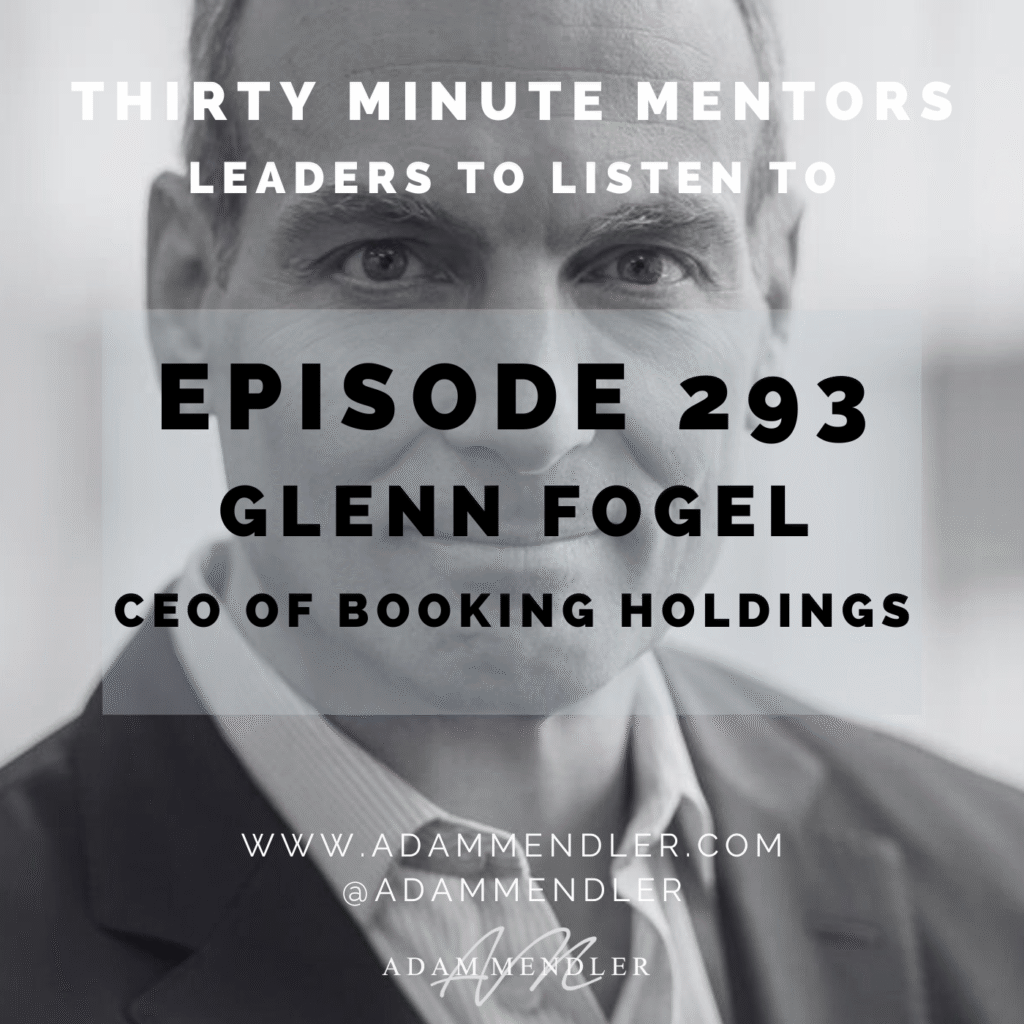
A Fortune 500 CEO and the leader of a company valued at more than $180 billion, Glenn Fogel is the CEO of Booking Holdings, the world’s leading provider of online travel and related services, and the parent company of Booking.com, Priceline, Agoda, Rentalcars.com, KAYAK, and OpenTable. Glenn joins Adam to share his journey and his best lessons and advice. Glenn and Adam discuss leadership, business strategy, career success, and much more.
Join Adam and the best network of mentors – Fortune 500 CEOs, founders of household name companies, Hall of Fame and Olympic gold medal-winning athletes, political and military leaders – for intimate half-hour conversations each week.
Thirty Minute Mentors is available wherever you listen to podcasts. If you enjoy the episode, visit your favorite podcasting app and subscribe, rate, and leave a review, and spread the word by sharing on your social media channels and sharing directly with your friends and colleagues.
Read the full transcript of Adam’s conversation with Glenn Fogel.
Episode Summary
Glenn Fogel is the President and Chief Executive Officer of Booking Holdings, the parent company of Booking.com, Priceline, Agoda, KAYAK, and OpenTable, and he is also Chief Executive Officer of Booking.com. He tells Adam how he came back from a stroke at 17, how a winding career brought him to Priceline, and what he has learned about acquisitions, change, and treating people well.
Glenn recalls waking up one day near the end of his junior year of high school after a left temporal lobe stroke, unable to speak, read, or write. He says it took a long time and very hard work to come back, and that nine years later he graduated from Harvard Law School with honors. Life is never a linear upward trend, he says, and how you deal with the drops is what makes the difference.
After college, he recalls, he worked as a coder in the back office at Morgan Stanley, then went to law school and became an investment banker at Kidder, Peabody, where he was part of a large group that was let go. He says he did not work for a couple of years, later became a trader, and then wanted to be part of the internet. He says he arrived at Priceline.com in February 2000, one week before the Nasdaq peaked, and that within that year the stock fell to the equivalent of $6 a share; even his mother thought the company had gone bankrupt. Twenty-five years later he is still with the company, he says, and the stock is in the five thousands, but it was never a straight line.
Glenn resists the hero story. He says much of any success comes from things you have no control over, that nothing is done by a single person, and that the company was very fortunate. What it could control, he explains, started with discipline about cash after it nearly ran out, which led it to concentrate on hotels, the most profitable part of travel. Later, while he was running the company’s European efforts, it brought in two small startups, Active Hotels in 2004 and Booking.com in 2005, for roughly $300 million combined, he says. He prefers the word partnering to acquiring, and says the key was finding entrepreneurs who execute and giving them incentives to stay and build.
On change, Glenn says the hard part is convincing a successful organization that it needs to adapt. He reminds people of BlackBerry and Nokia, and he warns that companies not actively working with generative AI will disappear. He is candid that technology displaces people, citing the human translators once needed for the more than 40 languages he says the company operates in, and he asks what is fair and just for them. Having been fired himself, in a scene he likens to the movie Margin Call, he says letting people go requires a fair financial package, time to adjust, and respect, and that he will never be proud of it.
On leadership, Glenn calls empathy foundational when Adam raises it, and he adds curiosity and seeing the bigger picture, along with learning from good and bad bosses and listening to a trusted team. With 25,000 employees, he says, his job is not to code but to make sure everyone understands the vision and to hold people to what they say they can do, much as a football coach builds the units rather than playing. He wants people who want to win, not people who just show up. His closing advice: not everybody can be the best, but everybody can be better, so be disciplined about how you spend your time.
What You’ll Learn
- Expect setbacks and focus on how you respond, Glenn says: life is never a linear upward trend, a lesson he ties to the stroke at 17 that left him unable to speak, read, or write.
- Give credit to luck and to your team, Glenn says: much of any success comes from things you have no control over, and no championship has ever been won by one person.
- Treat an acquisition as a partnership, Glenn says: look for entrepreneurs who are actually executing, and give them incentives to stay and build, as he says the company did with Active Hotels and Booking.com.
- Fight complacency by reminding people that today’s success guarantees nothing, Glenn says; he points to BlackBerry and Nokia, and he warns that companies not actively working with generative AI will disappear.
- When you have to let people go, provide a fair financial package, time to adjust, and respect, Glenn says, a view shaped by how abruptly he was let go as a banker.
- Be disciplined about how you spend your time, Glenn says: not everybody can be the best, but everybody can be better, and the hours lost scrolling social media could go toward improving yourself.
About Glenn Fogel
Glenn Fogel is the President and Chief Executive Officer of Booking Holdings, a role he has held since January 2017, and he has also been Chief Executive Officer of Booking.com since June 2019. He joined the company in February 2000 and later served as Head of Worldwide Strategy and Planning and as Executive Vice President, Corporate Development, leading key acquisitions including Booking.com, KAYAK, OpenTable, Rentalcars.com, and Agoda. Earlier, he was a trader at a global asset management firm and an investment banker specializing in the air transportation industry. He is a graduate of Harvard Law School and earned a Bachelor of Science in Economics from the University of Pennsylvania’s Wharton School.
Related Episodes
- Episode 330: Priceline Co-Founder Paul Breitenbach
For more on the early days of Priceline, Paul, a co-founder of the company, discusses his journey from working musician to internet entrepreneur, coachability, innovation, team building, and marketing. - Episode 1: Kayak Co-Founder Keith Melnick
For more on building a travel business, Keith, a co-founder of KAYAK, discusses entrepreneurship, leadership, and hiring, including the key to raising capital and why the best employees think they are about to get fired. - Episode 190: OpenTable Co-Founder Chuck Templeton
For more on building OpenTable, Chuck, the company’s co-founder, discusses entrepreneurship, leadership, sales, culture, and customer centricity. - Episode 216: Former 7-Eleven and Blockbuster CEO James Keyes
For more on leading through disruption, James, the former CEO of 7-Eleven and Blockbuster, discusses leadership, managing adversity and change, and cultivating confidence. - Episode 309: Former Royal Caribbean CEO Richard Fain
For more on leading a travel company, Richard, the former CEO of Royal Caribbean Group, discusses alignment, building winning teams and cultures, and how to overcome and emerge stronger from a crisis.