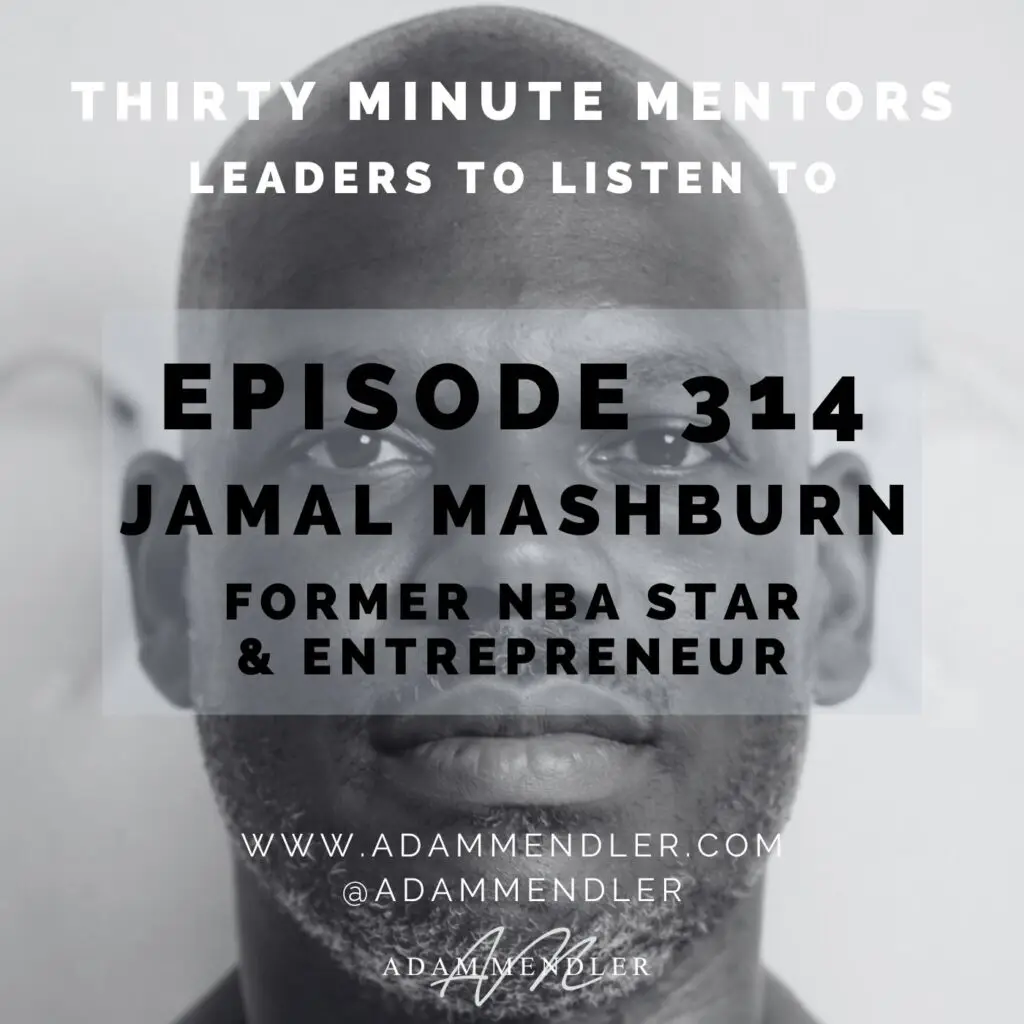
Jamal Mashburn was a star in the NBA, but he has enjoyed even more success off the court. A highly successful entrepreneur, Jamal owns more than 100 businesses. Jamal joins Adam to share his journey and his best lessons and advice. Jamal and Adam discuss a wide range of topics: leadership, motivation, strategic thinking, professionalism, building winning teams and cultures, authenticity, trust, and much more.
Join Adam and the best network of mentors – Fortune 500 CEOs, founders of household name companies, Hall of Fame and Olympic gold medal-winning athletes, political and military leaders – for intimate half-hour conversations each week.
Thirty Minute Mentors is available wherever you listen to podcasts. If you enjoy the episode, visit your favorite podcasting app and subscribe, rate, and leave a review, and spread the word by sharing on your social media channels and sharing directly with your friends and colleagues.
Read the full transcript of Adam’s conversation with Jamal Mashburn.
Episode Summary
Jamal Mashburn is a former NBA All-Star who starred at the University of Kentucky, went fourth overall in the 1993 NBA Draft, and built a business career spanning restaurants, car dealerships, and real estate. He tells Adam how a kid from Harlem who wanted to be an NBA player who carried a briefcase bridged athletics and business, and what he learned from Rick Pitino and Pat Riley along the way.
Jamal’s father was a professional boxer before he became an NYPD officer, and Jamal says watching him compete without making much money demystified professional sports. His mother, who he says came to New York from Beckley, West Virginia, at 18, brought him to her office when she could not afford aftercare and taught him debits and credits. Riding the train to a private school downtown, he watched the passengers change from construction workers to people carrying briefcases to Wall Street, and he says that at about 10 or 11 he began to dream of bridging athletics and business. He credits his mother, who took him to museums and restaurants, with teaching him long-term thinking, and he describes his father as a short-term thinker.
At 17, rather than choosing a college for its tradition, Jamal wrote his own criteria: honesty and integrity, a coach who would buy into his goal of carrying a briefcase, and ties to the NBA. Rick Pitino, who he says met him at about 14 at Five-Star basketball camp and who had coached the New York Knicks, fit every box, even though Kentucky was on probation and could not play in the NCAA Tournament in Jamal’s first year. After Jamal practiced against the first Dream Team with the USA Select Team, Pitino told him he would be no less than the fourth overall pick. The day after Kentucky lost to Michigan’s Fab Five in the Final Four, Jamal hired a business manager. His first investment, he says, was as a limited partner in Outback Steakhouse, followed by car dealerships, real estate, and waste management. He frames the draft as his IPO and a halftime stat sheet as a balance sheet, and he says too many athletes see themselves as part of the marketing machine rather than as operators within it.
Jamal says winning teams are built on vision, structure, and discipline. He recalls flying commercial in his first NBA season in Dallas and says he forced a trade, naming the Indiana Pacers and Miami Heat because he wanted structure. In Miami, he says, Pat Riley ran the team like a CEO and taught him how to be a professional: show up and do your job every day to the best of your ability, whatever is going on in your life. Jamal says he learned the most not from the night he scored 50 but from a Sunday in Minnesota when he had to manufacture 20 points while struggling and tired. He tells his son, now in his first year of professional basketball, that every shot is feedback for the next one.
On leadership, Jamal says you cannot lead others if you cannot lead yourself, and that the best leaders listen and learn before they talk. He gravitated toward teammates who fought their way into the league, such as David Wesley, and in his family office he asks people what they want for themselves, not only what he needs from them. His advice for success starts with personal core values, which for him include honesty, integrity, accountability, perseverance, and accepting criticism, along with learning from misses, controlling your ego, and taking a long approach.
What You’ll Learn
- Choose partners by how they will help you reach your goals, not by tradition, Jamal says: at 17 he built a list of criteria, including honesty, support for his business ambitions, and NBA ties, and Rick Pitino met all of them.
- Seek out people who will be honest with you in bad times as well as good, Jamal says, because the quicker you get better, the bigger your impact, and Pitino’s honesty with him helped Kentucky attract other top players.
- Ask what the other person wants, not only what you need from them, Jamal says; he runs his family office that way so that everyone is aligned around one goal.
- See yourself as an operator, not just a brand, Jamal says: if the product is bad, the marketing does not matter, and many athletes do not understand the finance and operations side of business.
- Show up and do your job to the best of your ability every day, Jamal says, a lesson he credits to Pat Riley, and treat every miss as feedback rather than an indictment of who you are.
- Lead yourself before you try to lead others, Jamal says, and listen and learn before you talk; he recalls that Riley could tell when a team tuned him out, and says leaders have to pick their moments.
About Jamal Mashburn
Jamal Mashburn is a former NBA All-Star and entrepreneur. Born in New York City, he attended Cardinal Hayes High School in the Bronx and starred at the University of Kentucky, where he was a two-time All-American, helped lead the Wildcats to the 1993 Final Four, and has his No. 24 jersey in the rafters at Rupp Arena. The Dallas Mavericks selected him fourth overall in the 1993 NBA Draft, and with the Mavericks, Miami Heat, and Charlotte and New Orleans Hornets he averaged 19.1 points per game, earning an NBA All-Star selection in 2003. His business interests have included restaurant franchises, car dealerships, waste management, and real estate.
Related Episodes
- Episode 110: Basketball Hall of Famer James Worthy
For more on teamwork and leadership in the NBA, James discusses Showtime with the Lakers, the key to performing in big games, and his takeaways from Kobe Bryant, Magic Johnson, and LeBron James. - Episode 33: NBA Hall of Famer David Robinson
For more on building a winning culture, David discusses turning around a losing Spurs team by setting an example and following through on culture. - Episode 164: Basketball Legend Tony Parker
For more on basketball and business, Tony discusses teamwork, leadership, culture, the wine business, and lessons from Tim Duncan, Gregg Popovich, and Kobe Bryant. - Episode 250: Basketball Legend Muggsy Bogues
For more on overcoming the odds in the NBA, Muggsy, the shortest player in NBA history, discusses leadership, teamwork, mentorship, and overcoming adversity. - Episode 285: Klutch Sports Founder and CEO Rich Paul
For more on earning trust in professional basketball, Rich discusses relationship building, dealmaking, excelling as a trusted advisor, and lessons learned from LeBron James.