

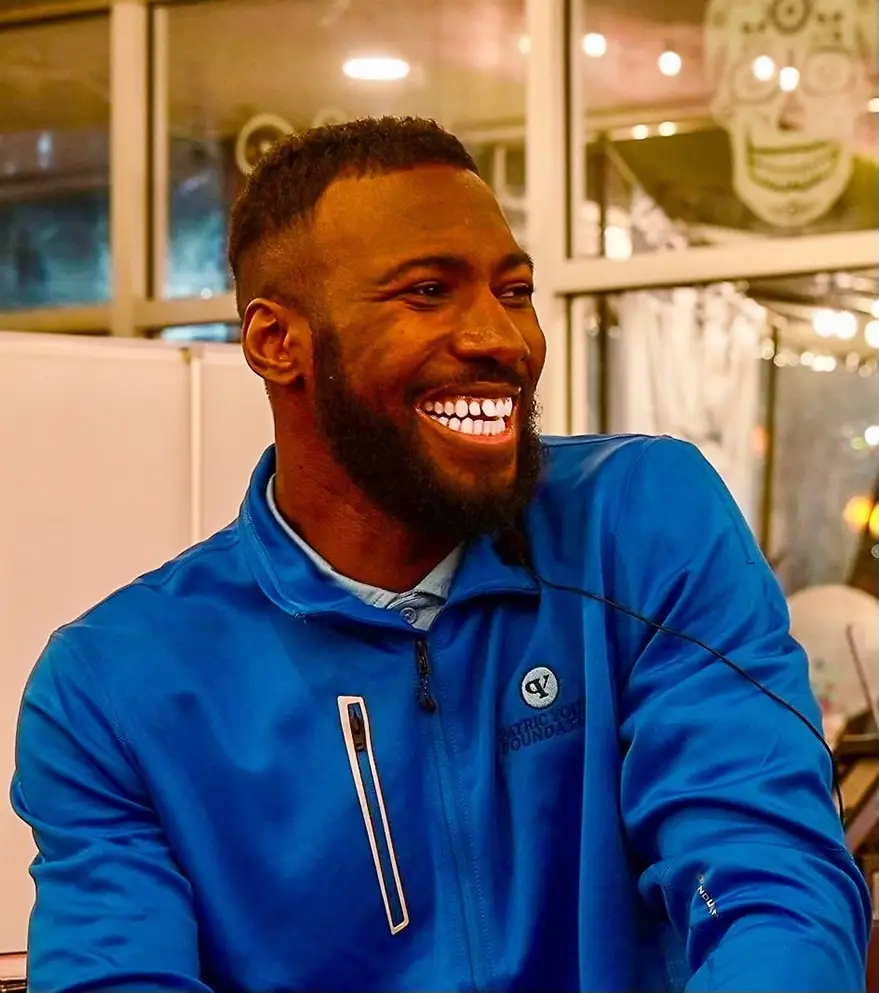
I recently went one-on-one with Patric Young. A former college basketball star, Patric is a college basketball analyst for ESPN’s SEC Network.
Adam: Thanks again for taking the time to share your advice. First things first, though, I’m sure readers would love to learn more about you. How did you get here? What experiences, setbacks, or challenges have been most instrumental to your growth?
Patric: I always knew I wanted to share a message and inspire people. What I didn’t have was clarity on what that message would be. That changed on June 29, 2022.
I was in a car accident that left me paralyzed from the waist down. In a moment, everything I had built my identity around shifted. Basketball. Strength. Independence. The version of myself I had known was gone. The accident didn’t just change my circumstances. It forced me to confront a deeper question: If I’m not who I was, then who am I now?
That season was painful. It stripped me down. But it also revealed something I hadn’t fully understood before: life is too valuable to waste in self-pity, and purpose doesn’t disappear just because your path changes.
Through rehab, reflection, and rebuilding, I gained clarity. I realized my story wasn’t about loss. It was about resilience, perspective, and choosing faith over fear. My platform became less about performance and more about impact.
Things are still hard. Challenges didn’t vanish. But now I understand what I can do with the cards I’ve been dealt. My responsibility is to steward this story well, to use it to serve others, and to make sure that what broke me physically never breaks my spirit.
That’s how I got here.
Adam: What are the best lessons you have learned through your career in basketball?
Patric: One of the greatest lessons basketball taught me is simple: the more love and respect you give to the game, the more it gives back to you.
That doesn’t guarantee championships. It doesn’t promise awards, but it does put you in the best possible position to succeed. Basketball rewards discipline. It rewards preparation when no one is watching. It rewards the player who shows up early, stays late, and takes care of their life off the court as seriously as their work on it. The craft demands your full attention. When you give it that, you grow.
At the end of the day, it is just a game, but the lessons are not small.
Basketball teaches you how to submit to something bigger than yourself. It teaches you how to accept coaching, how to handle criticism, how to sacrifice personal glory for team success. You learn to commit to a shared goal with a clear timeline. You learn that daily habits decide outcomes.
Most importantly, the game forces you to be present. The next play is all that matters. You cannot live in the last mistake or get distracted by the next opportunity. Every possession counts. Every moment matters.
That mindset translates directly to life. Success is rarely about one big moment. It is about showing up, locked in, again and again. Basketball prepared me for that.
Adam: What are the best lessons you have learned through your career in broadcasting?
Patric: The first lesson I learned was not to take the job too seriously. During my first year on air, I mispronounced someone’s name on live television. I was frustrated with myself because I wanted to prove I deserved to be there. In my mind, one mistake felt enormous.
After the show, my co-host looked at me and said something I’ll never forget: “We’re not here to save lives. We’re not splitting atoms or curing cancer. We’re blessed to talk about sports for a living. Just give your best. No one is going to remember that.”
That perspective changed everything. Broadcasting demands excellence, but it also requires composure. If you tighten up every time you stumble, the audience feels it. You have to stay loose, stay present, and move to the next play just like in basketball.
The second lesson is that preparation is your best friend. You will never regret spending extra time watching film, studying rosters, or digging into storylines. Even if you feel overprepared, that work shows up in confidence, clarity, and credibility. Preparation gives you freedom.
And the third lesson came the hard way: the microphone is always on. Just like in everyday life, your words carry weight. In broadcasting, you have to be mindful that someone is always listening, whether you intend for them to hear you or not. That awareness sharpens your discipline and reminds you that professionalism isn’t situational.
Looking back, I’m grateful for those early mistakes. They taught me humility, perspective, and focus. And now, I can laugh at them, which might be the best lesson of all.
Adam: Who are the greatest leaders you have played for and with and why?
Patric: Billy Donovan is, by far, the greatest leader I’ve ever played for. What set him apart wasn’t just his basketball IQ or résumé. It was his love for what he did. You could feel it every single day. He showed up to practice energized, focused, and ready to improve. Not just the team, but himself.
He never positioned himself above the players in a way that created distance. He connected. He challenged you, but you always knew it came from belief, not ego.
Coach Donovan always had a stellar supporting cast, and the proof of his leadership is visible in the fruit of his tree. Look at the number of coaches who came through his program and now lead teams across college basketball and the NBA. That doesn’t happen by accident. That happens when a leader develops people, not just players.
What I learned from Coach Donovan is that leadership requires sacrifice. You cannot win in every category of life at the same time. There will always be trade-offs. The key is being secure enough in who you are to make those sacrifices intentionally and being humble enough to adjust when something isn’t working.
He modeled consistency. He modeled growth. He showed me that the best leaders are not obsessed with control. They are committed to development.
Adam: What do you believe are the defining qualities of an effective leader? How can leaders and aspiring leaders take their leadership skills to the next level?
Patric: I actually think the question needs to be broadened. “Effective” isn’t necessarily positive or negative. A leader can be effective and still leave damage behind.
For me, the goal isn’t just effectiveness. It’s impact. It’s being the kind of leader people want to emulate. With that in mind, an impactful and positive leader is consistent, secure, patient, open, and solution-oriented.
Consistency is the foundation. When people know what you bring to the table, whether that’s reliability, wisdom, grace, or decisiveness, you create stability. Consistency reduces volatility. It builds trust. And trust is the currency of leadership.
Security is next. A secure leader delegates well. They aren’t threatened by other people’s strengths. They understand their own weaknesses and surround themselves with people who complement them. Insecurity creates control. Security creates empowerment.
Patience allows a leader to take risks without being impulsive. It gives space for growth, timing, and discernment. Not every opportunity needs an immediate reaction. Sometimes leadership is about waiting for the right moment.
Openness expands capacity. When you’re open, you can see multiple paths to the same outcome. You can adjust without losing vision. A closed mind eventually becomes its own obstacle.
And being solution-oriented keeps momentum alive. Problems are inevitable. Effective leaders don’t ignore them. They face them and move forward.
If someone wants to take their leadership to the next level, it starts with leading themselves. Before you ask, “How do I lead others?” ask, “How am I leading my own life?” Are you consistent with your habits? Are you secure in who you are? Are you patient in growth? Are you open to feedback?
Leadership doesn’t begin with a title. It begins with self-governance. The beautiful thing about leading yourself is that you can start small. Identify what’s best for you right now, and go do it. Then repeat it tomorrow.
Adam: What are your three best tips applicable to entrepreneurs, executives, and civic leaders?
Patric: First, learn before you leap.
Observation is underrated. Before you dive into something new, study it. Seek out people who have already walked the path you’re considering. Learn from their mindset, their systems, their mistakes, and their blind spots. You can shorten your learning curve drastically by borrowing wisdom instead of reinventing every lesson the hard way. Humility accelerates growth.
Second, regularly ask yourself, “Why?”
Build a rhythm of self-examination. Why am I doing this? Is this a win-win? Is this actually moving the needle? As leaders, we’re often presented with opportunities that look good on the surface but quietly pull us away from our core priorities. Not every “yes” is alignment. I’ve learned to place constraints around my time and energy. Boundaries aren’t selfish. They are strategic. If you don’t guard your focus, someone else will gladly spend it for you.
Finally, protect your life as much as you protect your work.
There will be seasons when your business or mission demands more from you than you’re comfortable giving. That’s reality. But if work-life balance matters to you, then discipline around boundaries becomes essential. Hard lines. Clear expectations. Intentional time with the people you love.
Success without presence is hollow. If you want to lead well in your organization, you have to experience life well outside of it. That’s what keeps you grounded, creative, and emotionally available. At the end of the day, leadership isn’t just about building something impressive. It’s about building something sustainable.
Adam: What is the single best piece of advice you have ever received?
Patric: The best advice I’ve ever received was simple, but it changed my life: stop trying to please everyone.
For most of my life, I operated with a high level of independence and drive. As my basketball career grew, so did the attention. With success came visibility, and with visibility came people. Not all of them were there for the right reasons.
At one point, I realized I was carrying the weight of other people’s expectations. I wanted to perform well, represent well, and keep everyone happy. But you cannot build a healthy life trying to satisfy people who won’t even stand beside you when things get hard. What became clear to me is that the real people in my life did not care whether I kept playing basketball. They did not need me to be perfect. They did not need me to pretend I had everything together.
They loved me for me.
Someone close to me told me, “No one is asking you to be Superman. Being Patric Young is more than enough.” That freed me. It allowed me to shift from performance to authenticity. From approval-seeking to purpose. From trying to be impressive to trying to be honest. And that shift has shaped how I lead, how I speak, and how I live.
Adam: What can anyone do to pay it forward?
Patric: When people hear “pay it forward,” they often think about money. And yes, generosity can absolutely be financial. But one of the most powerful ways to pay it forward costs nothing. Kindness.
Every single person you encounter is carrying something you cannot see. Stress. Grief. Pressure. Doubt. And yet we often overlook the simplest gestures because they seem too small to matter. A kind word. Eye contact. Encouragement. Patience. Gratitude.
These things don’t require a financial investment, but they do require attention. And attention is rare.
We tend to discount what is easily accessible. Because kindness is free, we assume it’s insignificant. But in reality, small moments of compassion can have massive returns for someone’s mental health, emotional stability, or even their belief in themselves.
You may not be in a season where you can give financially. But you can always give dignity. You can always give respect. You can always give care. Every day you wake up is an opportunity to leave someone lighter than you found them.
That’s paying it forward.
Adam: Anything else you’d like to share?
Patric: I would leave people with this: there is no linear path to success.
Failure, detours, setbacks, and mishaps are not signs that you’re off track. They are part of the track. We know this intellectually, yet we still fall into the trap of comparing our behind-the-scenes reality to someone else’s highlight reel. Comparison distorts timing.
I firmly believe that God understands the right timing for the right opportunities in our lives and whether we are prepared to handle them. Sometimes the delay isn’t denial. It’s development.
FOMO is one of the most damaging mindsets we carry. It convinces you that life would be better if you were somewhere else, doing what someone else is doing. But FOMO kills gratitude. And when gratitude disappears, perspective goes with it.
Your current season has purpose. Don’t let anyone else define the narrative of your story. You have a choice in how you frame your life. You can see obstacles as endings, or you can see them as chapters.
You cannot control everything that happens to you. But you can control your response. You can control your effort. You can control your attitude. And you can control how you bounce back.
Growth isn’t about avoiding hardship. It’s about refusing to let hardship define you.
That’s the journey.