

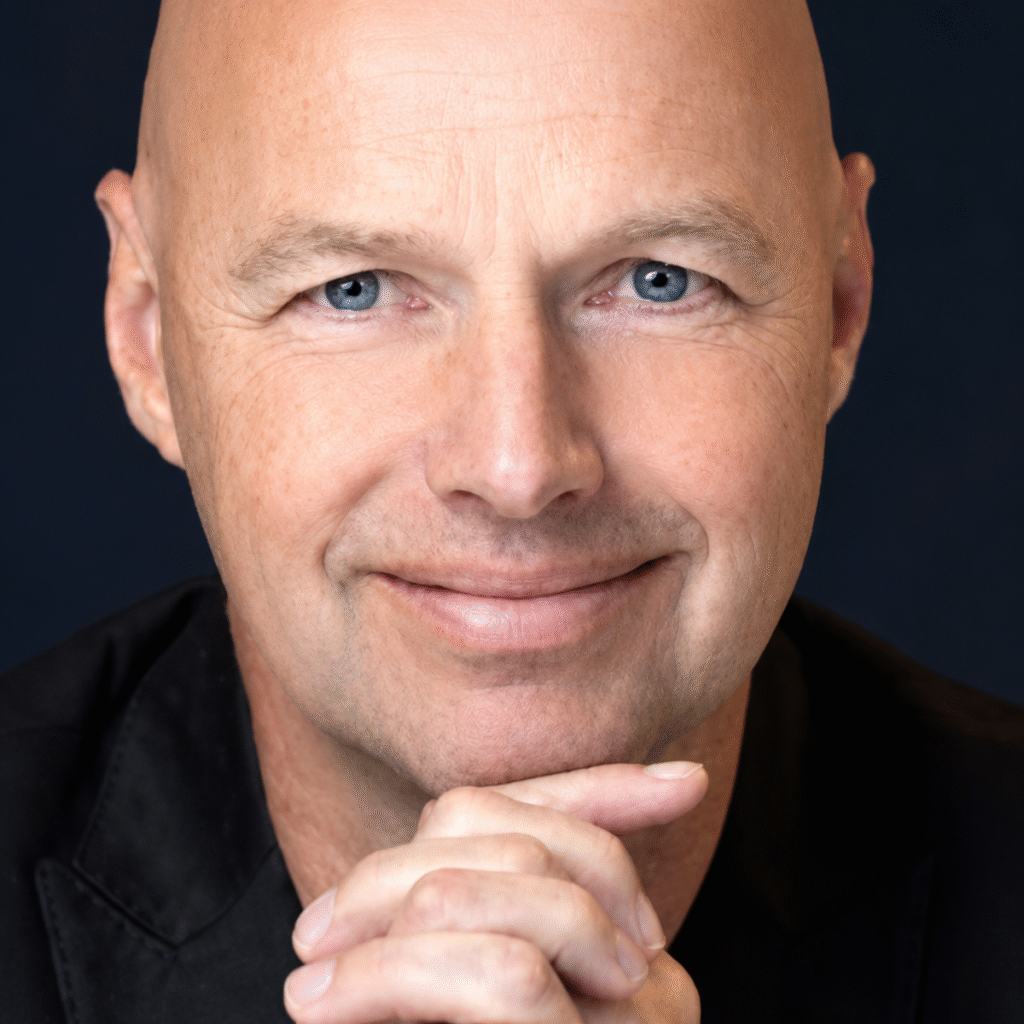
I recently interviewed Waymo Founder Sebastian Thrun on my podcast, Thirty Minute Mentors, at Ai4. Here is a transcript of our interview:
Adam: Our guest today is a pioneer in the field of self-driving vehicles. Sebastian Thrun is the founder of Waymo, the market leader in the United States in autonomous driving. Sebastian, thank you for joining us.
Sebastian: It’s a total pleasure, Adam.
Adam: You grew up in West Germany, a ways away from where we are today in Las Vegas at Ai4. Can you take listeners back to your early days? What early experiences and lessons shaped your worldview and shaped the trajectory of your success?
Sebastian: So I was in Germany at its best phase after World War II. It was basically recovered. My parents’ generation was suffering from World War II, and we were in the baby boom and growth phase, where Germany all of a sudden flourished. And it was great to be in West Germany, seeing how the country became stable and safe and interconnected, but sad to see right next door a different political system in East Germany completely destroying what they had. The same Germany, two systems, two radically different outcomes.
Adam: What did you learn from that experience?
Sebastian: Systems matter. It really matters how to motivate people. It’s really important that you understand what people really want and give them a chance to get what they want. That’s something West Germany did exceptionally well, and East Germany did not.
Adam: You studied computer science as an undergrad. You studied computer science as a grad student, earning a PhD. What sparked your passion for technology?
Sebastian: I keep joking I got my PhD 30 years too early. Given what’s happening today, there was machine learning, it turns out, in my master’s program as well. But I was interested in people. I cared about people, and I really wanted to understand what makes people tick. And I took a class in philosophy, in medicine, in biology, psychology, but computer science was this funny thing that you could build an agent back then, or a robot, and really understand every line of code. Whereas in philosophy, you can’t open a brain and understand every line of code in a human being. So while I was scaling down the ambition of understanding people, it gave me a lever to make something that would act like a mini human.
Adam: At what point in your process of studying computer science or working in technology did you realize that you had the potential to be great at it?
Sebastian: Oh my God, I’m not sure that’s actually true. Getting older, “great” is a big word. I developed a passion for it, and I really felt that early on I had this conviction that computers should not be programmed, they should be trained. I felt like machine learning should win over conventional programming, which is what happened the last two or three years finally, and that just kept me driving. I wanted to explore, I wanted to learn, I wanted to meet people, communicate, publish, impact, and all that stuff. Most of my friends laughed at me. They went into places like music or pedagogy or literature. Computer science was not a hot topic at the time. It was not the thing you would choose to make money. You become a lawyer or a doctor or a finance person, but not a computer scientist. So I literally did this because I was curious about it. I wanted to learn about the world. I was very lucky that computer science turned out to be the best thing to ever study. For most of my friends, they thought it was boring, it was nerdy, it was disconnected, it had no business in the 1970s, ’80s. Right? I mean, this is a long time ago.
Adam: What a great example of the importance of pursuing your passion, blocking out the noise, not worrying about what your friends are studying, what’s in vogue, but this is what feels right to me. And when you bet on your interests and you follow your instincts, there’s a pretty good chance that it’s going to pay off.
Sebastian: And that’s what you did when you were 28. When you said, “Look, I built all these small businesses, and I want to make my life impactful.” And now you’re the world’s best motivational speaker for dealerships and one of the world’s best interviewers and panelists.
Adam: Really appreciate the kind words. I appreciate the compliment. But I had a similar journey in that there was that wake-up call for me. Was there a wake-up call moment for you where you decided, I have to pursue this?
Sebastian: The first wake-up was second year in college when I realized I had a talent, and the way I found this out is that I went into a math exam that everybody failed except for two students out of 100, and I had the only A in class. And I did not know I was good in math up to that point. I just didn’t know it. In my high school, I got good math grades, but I was so disinterested in high school and so bored that I never developed any interest in anything at school. And only at college, all of a sudden, I realized, “Wow, I have a talent.” Late, but not too late. The second moment came when I had a chance to visit the United States, and I went here to give a paper at a conference. It’s now called NeurIPS. I was 21 years old, and I got a chance to interact with other scientists, and I found this entire world of amazingly deep scientists. Geoff Hinton was there. Many of the famous people, Rich Sutton was there, that you know today as famous people. At the time, no one was famous, but they were there, and I could talk to them, walk up to them, and ask them a question and embarrass myself. That made me believe this is my path. I want to become an academic. I want to get a PhD. I want to see the world. As a kid, you get told by the environment a lot what you should be and should do, and so on. And most of it is kind of negative. It kind of holds you back. It’s like you want to be the same. You want to be compliant. You want good grades and so on. I have yet to meet kids that actually deeply care about good grades. Find a hobby. Find something you want to do. My oldest son is 18, and his deep, deep, deep hobby and now profession is making music. And look, at one level, I think being a musician right now is a tough business. I would not wish this on my son as a lifetime profession, but he’s so passionate about it and so good at it. I did whatever I could as a parent to support him. I bought him all the equipment he needed, gave him all the freedom. He just got accepted to Berklee College of Music. Very proud of him. Find your passion. Passions can go nonlinear. They will surprise you. Passions pick you.
Adam: And Sebastian, what you just described, you recognize that your role as a parent isn’t necessarily to judge, isn’t necessarily to push back, but on the contrary, is to listen, to encourage, to foster, to help however you can. And what you’re describing isn’t only the role of a great parent, but it’s the role of a great mentor.
Sebastian: So first of all, I believe in fatherhood. There’s a flip when they’re roughly 13 years old. Before that point, you’re their manager, and you have to set rules and so on. Past that age, you’re the advisor, you’re the mentor, and you will have no impact on their decisions, no matter what. But you can coach them to make great decisions, and it goes hand in hand with my observation about people. When I grew up, I was being told when you’re a manager, you have to find out where your people are weak and work on their weaknesses. But I’ve learned it’s the opposite. You completely ignore the weaknesses and you work on their strengths. When you work on people’s strengths, they’re so happy that you support and build their strengths and their passions. They’re going to be much, much, much better performers in every dimension.
Adam: How did you figure out what your unique strength is? You discovered that you were passionate about computer science. You discovered that you were good at computer science, you were good at math, but how did you figure out within this relatively large field what it is that you’re exceptional at?
Sebastian: I’m still looking at that. I get passionate about things. I want to solve things, and all the things I get passionate about have one and one intention only, to make the world a better place. I know it sounds funny coming from Silicon Valley, but I truly believe we make the world a better place. We’re trying to. And when I find something to work on, I get very passionate and start thinking about it very, very deeply and talking about it and talking to people, and that tends to lead to new things, to new solutions. For example, self-driving cars. And then once it crystallizes, it becomes clear what we should really make with our time. I try to get a good team of people. I can’t do everything myself. I always joke that I take the credit for other people’s work. I never built a self-driving car myself. It’s true. I get a lot of credit for that. But at the end of the day, yeah. So it’s teamwork. It’s like bringing people together.
Adam: And when you talk about impact, something that I share all the time to audiences that I speak to: when you’re trying to figure out what you want to do, you want to try to check three boxes. Number one, am I doing something that I love? Number two, am I doing something that I’m great at? Number three, am I doing something that allows me to make a positive impact in the lives of others? And when you’re checking all three of those boxes, that’s it.
Sebastian: Yeah, so I check two of the three and fail in the third one. I’ll tell you which one it is. So I’m passionate in my own work. I want to maximize my impact, and I deliberately pick stuff I’m bad at, not I’m good at. Why do I pick stuff I’m bad at? Because if I’m good at it, there’s a whole bunch of problems with being good at something. A, I’m not going to learn anything because I’m very good at it. Second, in my business, you have to invent the future. It’s no coincidence that the great, great, great businesses are mostly started by very young people who are bad at that stuff because they can come in with a fresh mind. When you’re good at it, you’re an expert. And you’re good at the past of it, and not the future of it. And you’re an expert of the past, for example, how it’s been done in the past, but you have no clue what’s going to be done in the future. So even if you believe you’re good at it, you’re probably bad at it if you want to be a Silicon Valley entrepreneur.
Adam: And Sebastian, what you’re sharing really speaks to one of the most important characteristics among the most successful people, one of the most important characteristics among the most successful leaders, and that is humility. Even if you’re great at something, questioning: Am I really great at this? Can I be better? How can I be better? You’re one of the leading experts, and you’re saying, “Well, I’m not really that great at this,” and that’s a textbook example of humility.
Sebastian: I can tell you some embarrassing stories of being an expert. 2005-ish, we had a robot race called DARPA Grand Challenge that I won. Blah, blah, blah. Built the very first self-driving car for the military, and in 2009, I worked at Google at the time. I just sold a company to Google, and Larry Page comes to my little cubicle. And Larry Page is the founder of Google and the smartest person who ever lived. He says, “Sebastian, I think we should build a self-driving car company inside Google for normal people to use in cities.” And literally at this moment, I was the world’s most celebrated, most respected expert on self-driving because of my past. Whether that’s fair or not, outside the scope here. And I said to Larry, this is a true story, “Doesn’t work. It can’t be done.” He said, “Why not?” And I said, “It’s too dangerous.” And he was disappointed. But Larry Page is a very persistent man. Lucky for me, otherwise I wouldn’t be here today. Came back the next day and said, “Sebastian, I thought some more. We should do this. We should build a self-driving car company.” I said, “God damn it, it doesn’t work.” And after three or four days, he changed his tack and said, “Sebastian, I understand you’re the expert. You will know better than us because you’re the expert. Give me the technical reasons so I can tell my co-founder Sergey Brin and my boss Eric Schmidt why we shouldn’t do this at Google.” And I went home in agony. I couldn’t fathom any technical reason why it would be impossible to build a self-driving car. And this sounds like a joke from today’s perspective. But that was my moment. And I looked in the mirror and went there and said, “Look, I can’t find a technical reason.” He looked at me and said, “Why don’t we give it a try?” And that was the birth moment of Project Chauffeur, now known as Waymo. Here was I, the world’s best expert, in denial of my own future, what I could build possible for the world, because I was the expert. This is my most embarrassing expert story. So the day when I then started building things, for example, we built Waymo, we had not a single automotive expert on the team. At some point, we hired an automotive expert who said, “Oh, there’s this and this ISO norm. We have to rewrite all the software.” He started rewriting software. I fired him because he was an expert. The true innovators are not experts. The true innovators are people who have a vision, have tenacity, aren’t within anything else in a box. They do their U-turns, and then they become experts over time. And when they’re experts, they’re pretty much useless, like myself. It’s really embarrassing.
Adam: You were the opposite of useless. You were the leader who brought this all together.
Sebastian: Well, Larry was.
Adam: Larry inspired the project and brought you in, but you built the team and you figured out: I want this person here. I want that person there. I don’t want this person here.
Sebastian: I made 50,000 other mistakes the next two weeks. Yeah, I made some good decisions too. I hired Dmitri. So once the vision was set, the next thing I wanted, I wanted clarity of what progress really means. Because I’ve seen in many phases of my life, when someone gives me a problem and says, “Solve this,” I’m very, very good. And when someone says, “I won’t give you any problem. Just solve it anyhow,” I get wavering. I move back and forth. That’s a mistake. So I went back to Larry and said, “Larry, let’s define what progress means.” And Larry and Sergey spent hours carving out 1,000 miles of public streets in California and said, “Once you drive those, we talk again.” And that was good because now we had a plan. We said, “Okay, here’s 1,000 reference miles broken into like 10 pieces, and we want to drive them completely hands-off. Let’s just do this.” And that made my life much easier. Because trust me, you have a vision, you have a mountain you want to climb, but you can’t waver and argue. You have to also say, let’s go this way over here and try that. And that step in the right direction is really important. So set yourself a goal that you could accomplish in three months, six months, a year. It’s insanely important, even if the goal tends to be not correct and not intellectually correct. So we had that goal, and then I hired people, and I hired the best of the best that I could find. Tends to be the best of the best. Pretty much all the people in the field that have a name right now were part of these initial teams, and then we started building. We bought eight cars, we instrumented them, and we started driving.
Adam: You told me what you wanted to avoid in the people who you were hiring. What did you look for in the people who you were hiring?
Sebastian: So they were definitely not the experts. There were many, many experts who would love to join the team. They were relatively young people. Most all people I kind of knew before. Postdocs of mine, doctoral students of mine. There was a great doctoral student or postdoc at Carnegie Mellon who became later a total leader, Chris Urmson. We hired about 10 people or so, all from our social network.
Adam: What were the key characteristics that you looked for when you were bringing the team together?
Sebastian: Wicked smart, willingness to learn, very important thing for me. I have a way to figure this out, tease out of people: Are you willing to learn? And then just people to be fun around with. People I want to hang out with. Ultimately, it’s trust, right? And if I know people beforehand, like a doctoral student, then the trust is already established and they hit the ground running. If it’s a new person, then there’s no trust for the next half year. Both sides have to work in creating the trust. That slows us down a little bit.
Adam: How, as a leader, can you build trust among the people that you’re leading? How can you build trust as an employee so that your leader trusts you?
Sebastian: Couple of rules on trust. Number one, it’s never bestowed; it’s earned in all directions. Second, being famous is an obstacle. It makes it actually harder to be trustworthy than being a no one, because if you’re very well known, people are scared to talk to you sometimes. A lot of it’s culture, a culture of honesty. If you show vulnerabilities to people and show that you’re vulnerable, that goes a long way for them to be willing to also be vulnerable in your presence. As a leader, you’re going to zigzag. There’s no other way, right? So you have to take people along. Many people make the mistake. They go and proclaim what the right zigzagging movement is, and then people have to eat it. That works really well if every single decision you make is perfect. But in my land, 80% of my decisions are not perfect. Many of them are bad. So how do you build trust? You incorporate people in decision-making. You listen to them. You build consensus. And when the decision is made, you document the decision. And then when the decision is bad, you get a better decision because you listen to your people, which is actually generally a good thing to do for a leader. But secondly, if the decision is truly bad, people won’t throw you under the bus anymore because you’re a part of the decision process, and that is incredibly empowering. Innovation, when you build something new, a business that never existed before, you gotta make bad decisions. Any CEO of a successful company, go ask them, say a successful startup company, from big ones like Google to smaller ones, ask them how much faster could you rebuild the business given what you know today? They give you typically a 5x faster. 5x. Okay, so if the week for you has five days, one day of the week you’re brilliant. You make everything right. Four days, you’re a shit show. You either make a bad decision or you unmake a bad decision. You hire someone, you fire that person. You build something, you throw it away. You go to market with a certain product, you throw the product away. That’s the reality. So the baseline is 80% of your time is spent on either bad decision-making or undoing bad decisions. Let’s just cement this for a second. Okay. So how do you survive in a world where that’s the case? You need a good North Star. You need a good intuition. Intuitions tend to be correct. Decisions tend to be bad, but the instincts tend to be correct. So build something that excites you a year from now, two years from now. Like, I know democratized education was my thing for like 15 years, and then you need a decision process, and that’s really, really important. In my company, every decision has an owner. Then a person knows who the owner is. The owner does not make the decision. The owner manages the decision. To manage the decision, it has to be an open decision. The owner has to get the right people in the room that are affected or can contribute. They have to sit with these people until there is a consensus decision, as we call it, agree and commit. Then he has to document the decision and freeze the decision so it doesn’t get reopened. Then he can recurse that down the organization, so the owner might now delegate a sub-decision to a person underneath them, and then this person owns the decision. And then the moment you delegate a decision downwards, the original owner, the manager, is now an advisor to the decision, not an owner anymore. Otherwise, it won’t work. And you trust this person underneath you. That person applies the same recursive mechanism, comes up with their decisions, announces it, documents it. Decision is made. In that way, you get a lot of good stuff. A, you get slow decision-making, which is good. Which means people who make hasty decisions also unmake the decisions hastily, and that’s a disaster for the people underneath them. You get certainty and clarity in the company. You build trust because you can trust the decision process. You get buy-in from the people that are in the decision body, which is really important because they have to defend your decision, argue for decisions, and carry your decisions. And you get generally better decisions because you listen to people. I apply this kind of recursive scheme of ownership and decision-making very, very radically in my company. In many, many cases, I have no opinion, but I do care that we have a decision process that is properly implemented. And ever since I’ve done this, my companies are incredibly productive, and incredibly happy, and incredibly trusted.
Adam: How can anyone get to a place where they are at their most innovative?
Sebastian: Look, I mean, every situation is different. Every person is different. I have many blind spots. When I look around me, the people I truly admire, like the Larry Pages in the world and a few others, Elon Musks, they are very different from me. I care a lot about people, sometimes to my complete detriment. In Silicon Valley, being more radically logical is actually a plus, and I admire this in those people. I can’t do it the same way. You have to work with yourself and look in the mirror at what you’re good at and what you’re bad at. My second problem is I’m not as detail-oriented as some of these people are. When I look at, let’s say, Larry and Elon, they’re insanely deep in all the details at a level that behooves me. I wish I was. They’re just so good at that. I need to work in a system that lets me get away without knowing all the details. I screw many things up. I recently violated my own decision procedure when someone came to me, showed me a demo, and I said, “Oh my God, you made a decision yesterday. That’s the new decision.” The carnage that I created was gigantic. And I looked back and said, “Oh my God, I did that. I’m here preaching how to do it right, and I violated it myself.” And I talk to Adam, like, listen to the best of the best. Pick the things that work for you. Maybe get yourself a coach. I had a coach for two years, and it really helped me with this kind of stuff. Set yourself goals. Maybe the last two things that I feel are important for my life. And people are different. A long time ago, I tried really hard to abandon two emotions. One is guilt, and one is fear, because I feel like they hold us back. Fear, in particular, is bad. And in Silicon Valley, the world is so uncertain that fear is eating you every day. Can you just believe you’re gonna win, and take that trust with you all along, even if you make hard decisions, and admit that 80% of decisions are bad? Maybe you make bad decisions just because you’re not fear-driven anymore.
Adam: How do you abandon fear? How do you abandon guilt?
Sebastian: When I make a mistake, I feel bad about it. I’m the first to apologize and come forward and say, “Look, it was my mistake.” Guilt as an emotion that bogs me down feels like it was invented by my fictitious grandmother to make sure I do my laundry correctly, or something like that. It’s a control mechanism. It can really badly accelerate in people to the point they’re becoming incapable of sticking out their neck and trying something new. I mean, I see it. I always feel bad for the person, and my goal is to make them feel safe and so on. Fear is even worse, and many decisions are driven by fear. Then you ask yourself, how many decisions are truly driven by fear? If you knew in advance you’re going to win, how would you act differently? Fear holds us back. Fear makes us very spontaneous. We make very ad hoc decisions under fear. It’s a very common thing, and then if you are fearful ad hoc decision-makers, decision-making is symmetric. You make a decision fast, but you are making the next decision equally fast that unmakes your previous decision. Can you somehow wrap something around it? The really great companies innovate slowly, not fast. And the person who drove this home for me was Jeff Bezos, who gave me a speech when he said, “Look, Sebastian, I’m the chief slowdown officer.” I thought about this. I said, “Tell me more.” He said, “Well, look, Sebastian, in my company called Amazon,” still CEO back then, “the next seven quarters have sailed. There’s nothing I can do about it. I can only influence the eighth quarter from now. But if I do a good job, the company will have twice the value afterwards.” And I thought about this. We want to control the small things, but we can’t. The bigger the company, the bigger the ship, and you can’t turn a big ship on a spot. But you can turn a big ship slowly over time, and that takes true leadership in my books. And when you recognize this, then fear plays no role anymore.
Adam: What can you control? What can’t you control? And the best leaders understand that there’s a significant gap between the perception of what they can control and what they actually can control. In reality, most people, most leaders control very little. But what can we control? That’s what we need to take ownership of.
Sebastian: I can tell you. I mean, in my world, I feel I had a major impact on many, many, many, many people. So I have no lack of self-admiration for the control that I have. The method of doing this is what’s key. Which is, at the end of the day, when you work in a company, you have to understand what your people want and give them what they want. That’s the core of human interactions. You have to empower them and line up their empowerment with your corporate objectives. Then you’re going to succeed. This is a wisdom that is found in my all-time favorite book that’s now 90 years old by Dale Carnegie, How to Win Friends and Influence People, which I’m just right now reading for the fourth time, and it’s been a bible of my life. If you line this up well, you know, in Silicon Valley that’s actually not that hard because we all have amazing visions, right? We want to change the world. Like, for example, in Waymo, the vision was 1.2 million people die in traffic every year. That’s a massive number. Back then, it was the cause of death of young people in the developed world. Even today, it mostly is, despite drug overuse and stuff like this. Can we invent technology that saves 1.2 million lives every year? That’s something that can excite people. That then makes people happy. Like, we say, “I want to work on this.” They can go to their parents and to their colleagues and say, “I’m admired for saving 1.2 million lives a year.” That’s step number one. If that vision is missing, but I think every company has a vision like this. If you make better muesli, if you invent better toilet paper, there’s a vision behind it. There’s actually utility in inventing better toilet paper. It’s actually something you do great for the world. It’s actually important, so important that all of us use it every single day. Right? It’s a big deal. Don’t feel that what you’re doing is not a big deal. Don’t be depressed. If you work in a bank, don’t be depressed. Banks are just the most important institution ever made, and most of my banker friends are depressed because they think they do nothing. It’s not true. You add value. You add credit to people. So tease out the vision and get excited about the vision. If you can’t find it, then you’re probably in the wrong job. Okay, don’t stay there if you can afford changing jobs. And then it’s ownership. It’s really ownership. I don’t want to be micromanaged. I don’t want random people telling me what to do. Can you set up a system of ownership where the ownership is so safe and so clear that people who own something can truly own it? And there’ll be times where you feel this guy is an idiot making a mistake, and you want to step in and tell them, “Do it better.” Hold yourself a little bit back. If you do it, do it in a way that doesn’t compromise ownership. Do it as a coach, like what I do with my 18-year-old. Say, “Hey, look, have a beer. Have some thoughts, some insight. I want to hear your perspective. Why are you doing it the way you’re doing it?” Don’t be condescending. Don’t talk down to them. You’re probably smarter. Probably think you’re smarter. You might not be smarter. You don’t even know, but I bet you think you’re smarter because we all do. Hold yourself back. Think about when everything is going well. When people are such amazing performers, they’re so happy and so happy to be trusted. You’re not going to fix this by talking down to them and by mansplaining them, whatever we do. I sometimes do.
Adam: Sebastian, what do you believe are the key characteristics of the very best leaders, and what can anyone do to become a better leader?
Sebastian: And I wouldn’t even claim I’m a great leader. I love my life. Apart from no fear, no guilt, I have other principles. One is you can make every mistake, every person, but only once. You can’t make it twice. So, do you have a mindset that lets you learn from your mistakes? That’s generally helpful. I read a great book, Life in the Suite of Play, by the Zynga founder, and in this book, he characterizes instincts and ideas, and he says basically instincts are right, ideas are wrong. As a very simple template, Mark Pincus, obviously. Sorry for that. Sorry, Mark. Love you, man. In that beautiful book, it dawned on me that there’s some truth to it. Instincts are objectives. They are mountains you want to climb. There are things you want to solve for the world, and they tend to be right. Ideas are the micro-steps along the way that you pick. Let’s say you want to climb a mountain, and your instinct is this mountain has to be climbed, but no one can tell you how to climb it. You are going to make mistakes. You are going to walk a false summit. You’re going to get trapped in a thunderstorm, whatever, in bad weather. So realize that your instincts are correct, but the ideas might be wrong, and test the ideas really fast, and then revert from it if they’re wrong. Don’t be married to ideas just because it was your idea. Be open-minded because if you are willing to test your ideas, says Mark Pincus, and improve them over time, you will eventually get up the mountain.
Adam: We’re going to fail, so fail fast. And when you make a mistake, learn from your mistake, and don’t make the same mistake twice.
Sebastian: Yeah, failure is not failure. Failure is what a normal person would do in a situation. You’re damn smart, so you picked the smartest path to go, and then you learned, okay, that this doesn’t work. And trust me, all your competitors will make the same mistake. The fastest way to success does involve pivots, but they’re necessary. They cannot be avoided because no one has a clue what really, truly works.
Adam: We’re recording here at Ai4. AI is a topic top of mind for leaders at all levels. What should leaders understand about AI?
Sebastian: It’s rewriting everything. Whatever you know about the world is wrong at this point. It’s rewriting the speed of development, testing, composition of teams, what you can accomplish yourself. And frankly, no one has a clue where it’s going. If the world was a World Cup, we’re in the very first 10 minutes of the opening games. Yeah, just beginning. There’s much more to come. The ideas we see today are basically AI 1.0, and that is effectively using AI to replace or make existing businesses more efficient, make your software team more efficient, your marketing team, your finance, your legal team, your compliance team more efficient. But that’s putting AI into the existing system. AI 2.0 is going to build new businesses. Mobile 2.0 was Airbnb, was Uber, was PayPal, was these businesses that required the conjunction of a number of things that were impossible to see before you had a mobile phone that could also do geolocation and mapping and payments and all that stuff. Now with AI, we haven’t yet seen what happens if we combine AI with many, many other ideas, with crypto, cybersecurity, with physical AI, robots. When these emerge, we fundamentally transform absolutely everything. And you, as a leader, want to be on top of this. That’s going to be a challenge. You know nothing about the world. I know nothing about the world. Let’s at least take the attitude for a second. You might be a good person to know about your company, but you have no clue about the future. Let’s take this for ado, because this is what I believe about myself. Let’s figure out where this can go. The absolute most important way is just experimentation. Play with stuff. On a Sunday afternoon, don’t watch Netflix. Go to Claude and build yourself an app. Okay, if your board meeting comes up, go to Claude and have it make you a board presentation. Spend a few hours and see if you can harass a board presentation out of Claude. The answer is yes, you can. By the way, it’s very doable. It’s going to be better than your analyst and your legal team does it for you right now if you just do it the right way. And then pass this on to your team. Challenge your team and say, “Look, let’s use AI.” Build your own hackathon in your company. Build a hackathon where for one or two days, everybody gets together and builds an AI for something that bugs them about their business. Give a prize. You’d be shocked how much a hackathon can transform the world. Hackathon is like the Halloween for innovation, right? Halloween, you can be a slut, you can be Napoleon, whatever you want, and everyone forgives you because this is one day where fear and guilt don’t exist, right? On the entire year, if I dress the same way to work as I dress at Halloween, I get fired. So think about Halloween for your company. One day where fear and guilt don’t exist, and people can openly innovate whatever they want. You’ll be shocked what will come out of the other end, how much it will transform your thinking and the thinking of your people. If I’m wrong, send me an email. I apologize in advance. Sorry for that, but you lost one day. If I’m right, you gain years.
Adam: Is there a way to apply that Halloween mentality to your organization and to yourself on a daily basis, so that you can show up every day without the fear, without the guilt, and be at your freest, most innovative self?
Sebastian: I can tell you, for all the grumps in the world, and all the skeptics, and all the pessimists, like all of Germany, for example, my recipe is, okay, let’s make a deal in making the no-grump Tuesday, and Tuesday can be an optimist. You say yes, whatever they say. “That’s a great idea. I love it. Let me think about it. Let’s do it. Let’s get it done.” Just on Tuesdays. On Wednesday, you can be the old grump again, and the cynical person that you like to be, that all of us want to be at some level, or many of us are. But one day a week. And if you do this one day a week, do this for a month, and see how it feels. It’s like a very, very quick weight-loss recipe, except it’s a version much better than weight loss because you’ll see that one day is transformative. And if you do this and it works for you, I would love to hear from you. Then let’s do the second thing. Let’s make a no-complaint Thursday. Okay, we all love complaining. 90% of the bad stuff happening in our life is somebody else’s fault. Kind of doesn’t work. More 50-50. But, oh my God, we love complaining. We complain all the time to other people. It’s our natural element. Now, complaining has this mistake that first we’re getting the math wrong. 50% should be us just by math, half and half. And secondly, I’ve never seen changing another person by complaining. All you do is make them defensive. So if you want to change something, look in the mirror, right? Michael Jackson, “Man in the Mirror.” Complain about yourself. So one day a week, anything goes wrong, it’s going to be your fault. Just for this one day a week, if someone spills coffee over your pants, it’s not that idiot that spilled the coffee. It’s something that you caused that made your pants be in the way of the coffee and the floor. And figure out what that is. And it might not always be your fault, but you’d be shocked how often it is. And even when it is not your fault, you can still say this is the other person’s fault. But I can change something on my side that prevents me from being in the misery again that I just experienced. Do this for a day a week, for a month, and just try it out. You’d be such a better person. In my world of Silicon Valley, the only people who ever change the world are blatant optimists, and I’m often viewed as, “Oh my God, you’re so optimistic, you must be sick or pathological,” and I am somewhat. Oh, I was out a little bit, right? But in the history of world advancement, it was always the optimists that changed the world, and never the pessimists. I’ve never seen someone who’s negative and says it can’t be done, and I’m against it, change the world. It’s always been the people that say, “Give it a try,” and sometimes things don’t work out. But almost anything that the people the last 200, 300, 400 years said is impossible to make turned out to be possible to make. We have electricity. We have flight. We can speak at the speed of light into a cell phone from here to Australia, not the speed of sound, but the speed of light. We have a chair at 36,000 feet in the air, and we complain about the service not being good enough. Honestly, seriously, coming in 10 minutes late, you complain.
Adam: Who do you want to follow as a leader? Do you want to follow someone who is negative, someone who is pessimistic, someone who shows up complaining all the time, or do you want to follow someone who is positive, happy, uplifting, upbeat, glass half full? Those are the best leaders.
Sebastian: Look, anybody listening, this might not be the right advice for you at this moment. This is the advice that worked for me. Maybe this at some point. Maybe advice you give to your spouse or something. I don’t know. But advice-giving is hard. But maybe something sticks. There’s something in there. I’ve made every management mistake under the planet. First-time manager, I was unbelievably bad. At the end of the thing we built, which was a robot for a Smithsonian museum, we almost killed each other. I was horrible, and I went there by just not making decisions when people expected me to make decisions, and then playing favoritism and everything under the bucket that you could imagine that a bad manager would do, and I kind of worked my way up. I asked myself, like, why am I such a bad manager? And even today, there’s moments that are just not good. I swap. If you aspire, I mean, since you’re already listening for half an hour now, you love Adam, as do I. You obviously have an interest to learn from this stuff. Okay, extend. I can teach you something. That kind of self-learning thing is very, very powerful. It’s unbelievably powerful. And if you start saying, “Look, let my pride out of the way. My pride is my learning. It’s not what I’ve accomplished or what I know. It’s my learnings.” And maybe read the Dale Carnegie book just for fun of it and apply this, you soon get all the stuff you want. You get all the admiration you want, all the love you want. People will look up to you. People will praise you, will applaud you, and say, “You’re my hero,” and all that stuff that you always wanted.
Adam: Sebastian, what can anyone listening to this conversation do to become more successful personally and professionally?
Sebastian: Let’s define success. Many people believe success is money. I distinctly disagree. What does success mean? At some level, success means happiness for me, and it should for everybody at some level. Even though we do understand someone who’s on marijuana all the time is not necessarily successful. For me, it means giving. It means empowering other people. That’s the biggest love I can find: empowering other people. But it could also mean business success, right? To build a product that works, which is a very important, important component of it. When you figure out what success means for you, and there could be a moving target over time, if only you work without fear and guilt, you’d already be twice as fast and good in doing this, whatever it is. And in my world, it’s innovative, so there’s no expertise. It’s people. I can never build something alone. I always need a team. So I have to empower those people, and I eventually take the credit for the work of those people, as opposed to my own work. Then you realize you’re an engineer now. You’re not engineering an aircraft or a helicopter. You’re engineering an organization, and organizations have their own rules. Every single person in your organization, yourself included, will be in there for two things: one is for the company, and one is for themselves. You have to balance these things. You have to figure out how to give them what they want for themselves, and tie this back into what’s good for the world and good for the company. When you dive into what people really want, you might think they want more money or more stock options, but almost everybody wants more respect, more love, more dignity, more ownership, more development. If you can connect to people’s innate desire for recognition, for being a good human being, for respect, for impacting other people, and somehow tease this out, I think you build longer-lasting relationships than paying them more. At least in my experience, paying them more has never really worked. In fact, I don’t think people ever leave a company because of pay. At least in my world, we pay well. They leave a company because they hate their manager or hate me, and that happens. Trust me. One person I know just came to me last week and said, “Sebastian, you destroyed my aspirations. I’m going to leave you. I hate you.” Fair. Sorry for that. Figure out what makes him tick, and that’ll be great.
Adam: Sebastian, thank you for all of the great advice, and thank you for being a part of Thirty Minute Mentors.
Sebastian: Thanks for having me on your show, Adam.


