

Coaching vs. mentoring is a question that comes up for anyone responsible for developing people, and the two words often get used interchangeably. The more useful question is usually which one a specific person needs right now. Coaching usually focuses on a specific skill or goal, often in a structured way with clear markers of progress. Mentoring usually supports someone’s broader development through a relationship with a more experienced person. The two overlap more than people expect, and the same leader often does both. Both are ways of developing the people on your team, so knowing when to lean on each one changes how well you use your time and attention.
I’ve spent years interviewing thousands of leaders, including more than 500 of America’s most successful CEOs, founders, athletes, and military leaders. Developing people is one of the subjects I return to most, and getting clear on the difference between coaching and mentoring helps you give each person on your team the kind of support that fits.
What coaching and mentoring actually mean
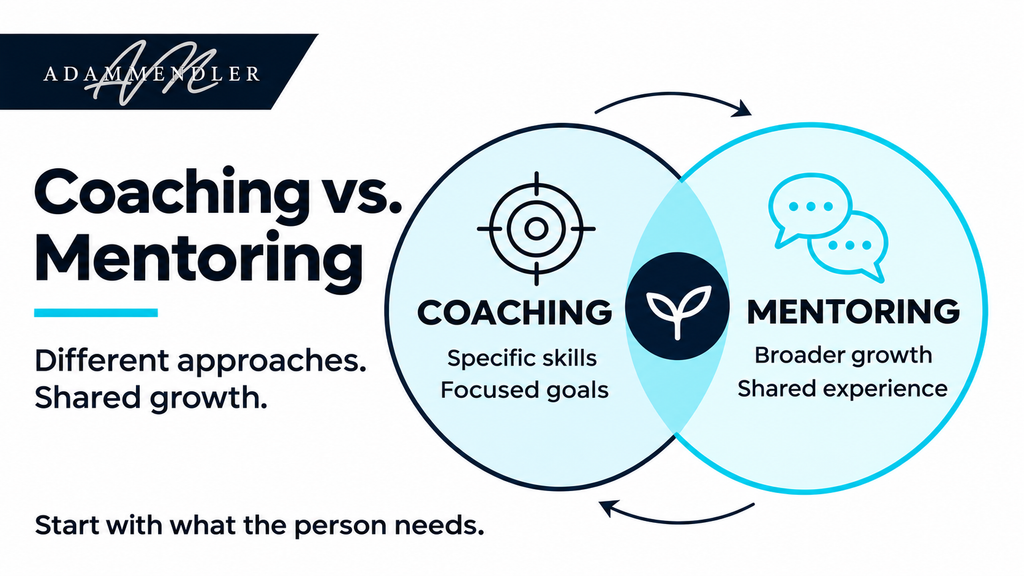
Coaching tends to focus on performance in a specific area. A coach helps someone build a specific skill, change a particular behavior, or reach a defined goal, often working with some structure and a way to tell whether things are improving. Good coaching leans heavily on questions, feedback, and practice, which helps the person strengthen their own judgment over time.
Mentoring tends to focus on a person’s broader growth. A mentor shares experience, perspective, questions, feedback, and advice to help someone develop. That experience doesn’t have to come from the same job or the same industry. What matters is that it’s relevant to what the person is working through, and the learning often goes both ways. A mini mentor is someone whose guidance can make a meaningful difference through a single interaction or occasional conversations.
In practice, the two blur more than the definitions suggest, and approaches vary. Some workplace coaching includes direct guidance, while some professional coaching deliberately leans on questions rather than advice, and a good mentor often asks questions as much as gives answers. What matters more than the label is being clear about what the person in front of you actually needs.
Coaching vs mentoring at a glance
| Coaching | Mentoring | |
| Common focus | A specific skill or behavior | A person’s broader growth and direction |
| Typical shape | Structured, with a way to track progress | A relationship, ongoing or occasional |
| What the helper draws on | Questions, feedback, and practice | Experience, perspective, questions, feedback, and advice |
| Time frame | Often set, with an end in mind | Anything from a single conversation to years |
| Useful when | Someone needs to build or improve something specific | Someone needs perspective, direction, or support as they grow |
These are general tendencies, not strict rules. One person can need coaching one week and mentoring the next, which is why it helps to decide case by case rather than assign everyone a single kind of support.
Where coaching and mentoring overlap
The two get confused partly because they share a foundation and often happen in the same conversation. Both depend on trust and honest feedback. Trust helps people speak openly about their challenges. Honest, constructive feedback helps them identify what to improve. Without that foundation, the conversation tends to stay on the surface.
One person can play both roles, too, though it takes some care. A manager might coach someone through a presentation this week and mentor them through a career decision next month. The risk is sliding between the two without noticing, so you end up offering advice when the person really needed space to think, or holding back when they needed a straight answer.
Coaching as a management skill
Coaching is now a recognized and growing profession. The International Coaching Federation’s 2025 Global Coaching Study, conducted by PwC across 127 countries, estimated 122,974 coach practitioners worldwide, with leadership and executive coaching the most common specialization, cited by 54 percent of coaches. That gives a sense of how established coaching has become as a profession. It doesn’t prove that any particular program improves performance.
Coaching also isn’t only something you bring in from outside. The ICF has studied how managers and leaders use coaching skills inside their own teams, without being professional coaches. A manager who runs a one-on-one well, who asks what someone has already tried before jumping to a fix, is using those skills. Building that habit helps the people on your team rely less on you to solve every problem and lean more on their own judgment.
Listen to Thirty Minute Mentors.
I sit down one-on-one with the leaders who’ve spent their careers bringing people along, and ask how they actually do it.
Listen to Thirty Minute MentorsWhy mentoring is so common in large companies
Mentoring is widespread in large companies too. MentorcliQ’s 2024 Mentoring Impact Report found that 98 percent of US Fortune 500 companies offered mentoring programs in some form, up from 84 percent two years earlier. That tells you how common these programs have become, though it doesn’t by itself tell you how well any of them work. What makes mentoring valuable is harder to capture in a statistic. It passes along the kind of judgment that’s hard to write down, like how decisions actually get made or how someone came back from a setback.
Mentoring programs vary widely, and the strong ones usually involve more than a quick pairing. They often include preparation and ongoing support. Both formal and informal mentoring can work when they’re set up with care.
When I interviewed Artis Stevens, who leads Big Brothers Big Sisters of America, the country’s largest mentoring organization, on Thirty Minute Mentors, he made a few points that stuck with me. He stressed that good mentoring starts with authenticity, showing up as yourself rather than performing a role. He described mentoring as a two-way relationship in which the mentor often learns as much as the mentee. And he pointed out that mentees get far more out of it when they come prepared, with specific questions and a clear sense of what they want help with. That last point is worth remembering if you’re the one being mentored, because the quality of the guidance often depends on the quality of the questions you bring.
How to tell which one your team member needs
When someone on your team is stuck, it helps to slow down before reaching for the first kind of help that comes to mind. A few questions make the choice clearer.
- Start with their goal: What are they trying to do, and over what time frame? A specific, near-term goal often points toward coaching. A broader question about direction or growth often points toward mentoring.
- Check what they already know: If they’re missing basic knowledge or skills, instruction or training may need to come first, or run alongside coaching while they build the fundamentals.
- Weigh the challenge in front of them: Match the help to what the situation calls for. A problem that calls for outside perspective or hard-won context points toward mentoring, while a specific skill or behavior to sharpen points toward coaching, whatever the person’s level.
- Factor in how they prefer to be helped: Some people work best when you ask questions that help them reason through a problem, while others want direct input from someone who’s been there. Treat this as one consideration alongside their goal and experience, not the deciding factor, and use it to make your support more useful.
- Notice your own reflex: If you tend to jump straight to advice, pause and check whether the person needs direct guidance or room to think it through. Both are useful at different times.
Here’s how this can look in practice. Say a newer manager on your team is struggling to run effective meetings. Coaching them might mean helping them set a specific goal, like keeping their next meeting to its agenda, agreeing on one change to try, and checking in afterward on how it went. Mentoring them might mean stepping back to talk about the kind of leader they want to become, and sharing what helped you at a similar stage. An employee can benefit from both, and choosing a label isn’t the point. The point is giving them a concrete next step and following up on it.
What makes coaching and mentoring actually work
Whether you’re coaching or mentoring, honesty matters, and so does agreeing on any follow-up that would actually help. Sometimes that means checking in as the person puts the advice to work, and other times a single conversation is enough on its own. When I interviewed Marshall Goldsmith, widely regarded as one of the world’s most influential executive coaches, on Thirty Minute Mentors, he walked through the process he has used with senior leaders for decades. His approach involves gathering confidential feedback from the people around the person being coached, identifying a behavior to improve, and having that person ask others for suggestions and follow up consistently. What helps people change is the combination: honest feedback about where to focus, effort on one behavior rather than many, and steady follow-through over time.
That approach reaches well beyond professional coaching. A manager can gather input, help someone pick one thing to improve, and check in on it as needed. A mentor can do something similar over a longer arc. One attendee shared this feedback after a session with me:
“Adam brings a true authenticity and transparency to his story and advice on how to pursue career goals, build key relationships, and remain agile in the business and life planning process. I left a 90-minute session with Adam inspired, while also clear on tactical steps I could take tomorrow to improve my career and business. My biggest takeaway was the power of relationships and people in your career. I’d encourage everyone in any industry to listen to Adam’s message and use his story to redirect or re-inspire your team.”
— Ryan Campbell, Snowflake
Bring these ideas to your team.
I speak and run workshops on leadership and developing people, built on what I’ve learned from more than 500 of America’s top leaders.
Book Adam to SpeakFrequently asked questions
What is the main difference between coaching and mentoring?
Coaching usually focuses on a specific skill or goal, often in a structured way with clear markers of progress. Mentoring usually supports a person’s broader growth through a relationship with someone more experienced. The two overlap, and one leader can do both.
Can the same person be both a coach and a mentor?
Yes, and it’s common, especially for managers. The same leader might coach an employee through a specific project and mentor them on their longer-term growth. What matters is paying attention to what the person needs in the moment, whether that’s a question that helps them think or candid advice drawn from your experience.
Should my company use coaching or mentoring for employee development?
Most organizations benefit from both, because they tend to serve different needs. Coaching often helps with specific performance and skill goals. Mentoring often supports broader growth and retention. The main thing is to match the support to what each person actually needs rather than treating the two as the same.
Are coaches paid while mentors are usually volunteers?
The common pattern is that coaches are paid professionals and mentors volunteer, but it isn’t a hard rule. Professional coaches are typically paid for their expertise, while mentors often help because they want to give back or already have a relationship with the person. Inside companies, both can be run as formal programs, and managers increasingly coach their own teams as part of the job.
How do I know whether an employee needs coaching or mentoring?
Start with their goal and what they already know. A specific, near-term goal usually calls for coaching, while a broader question about direction or growth usually calls for mentoring. If they’re missing basic knowledge, begin with instruction or training, which can run alongside coaching. It’s also worth simply asking the person what kind of support they’d find most useful.
Is the idea of a manager as coach realistic for busy managers?
It is, and it’s often one of the best habits a busy manager can build. Coaching in the flow of work doesn’t require formal sessions. It can be as simple as asking what someone has already tried before offering a fix, which helps them rely less on you over time and build their own judgment. The International Coaching Federation has researched how managers and leaders use coaching skills, not only professional coaches.
The bottom line
No one needs the same kind of support forever. A person might want a mentor’s perspective while facing an unfamiliar challenge, and focused coaching at another point when they’re sharpening a specific skill. The order isn’t fixed, and it won’t be the same for everyone. Part of developing people well is paying attention to where they are now and adjusting as they grow. Coaching and mentoring are both tools for that, and the leaders who use them well keep asking a simple question: What does this person need from me right now, and what will they need next?