


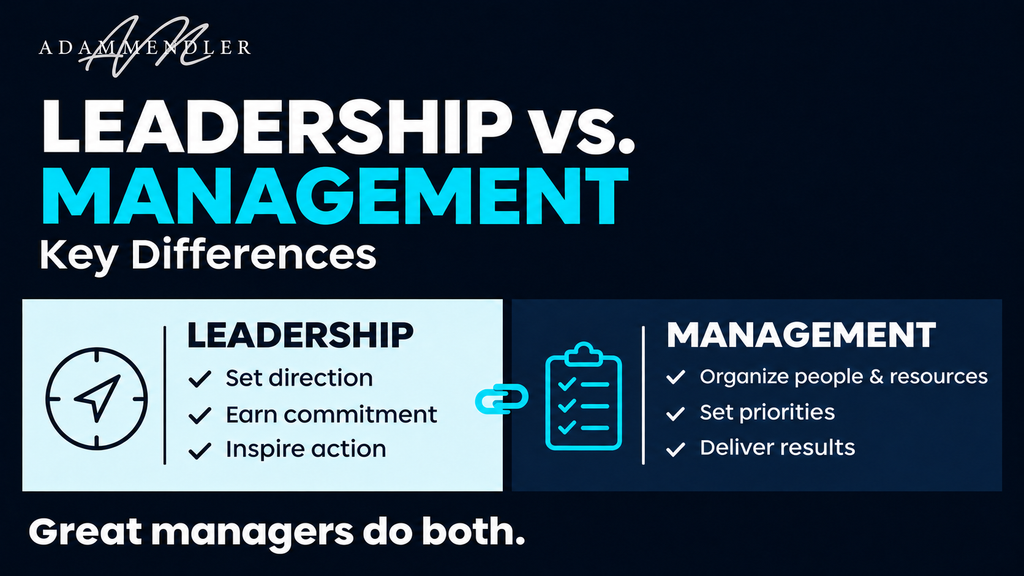
Leadership vs. management isn’t a choice between two kinds of people. Management is a real job with responsibility for people, resources, and results, and doing it well takes leadership. Leadership is a big part of what makes someone good at managing, and people can show it without managing anyone at all. The distinction is worth getting right, because how you think about it shapes how you handle the everyday leadership challenges that come with running a team.
So what’s the actual difference between the two? Management is the responsibility for getting results through people and resources. That means setting priorities, organizing work, developing a team, and being accountable for how it turns out. Leadership is the ability to set a direction and get people to commit to it.
What is the difference between leadership and management?
Management involves responsibilities that require leadership. A manager owns outcomes for a team, a budget, and a set of goals. Meeting those obligations well means giving people a direction worth working toward, earning their trust, and helping them do their best work. That’s leadership, applied inside the job of managing.
This question has been debated for a long time. One influential framework comes from John Kotter, whose Harvard Business Review article, What Leaders Really Do, described management and leadership as separate but complementary systems, management focused on handling complexity and leadership on driving change. It’s a useful way to see the different emphases. I’d put the relationship more simply: leadership is part of how you manage well, not a different role you switch into.
It also runs the other way, because you don’t need a title to lead. Someone with no direct reports can set an example, influence how a team works, and move people toward a better way of doing things. That’s why leadership and management overlap so much without being the same thing. Management is a role with responsibilities, and leadership is a capability that makes those responsibilities, and plenty of work outside any formal role, go better.
Leadership vs management: a side-by-side comparison
Leadership and management emphasize different things, but they overlap far more than the usual side-by-side suggests. The table below lays out where the emphasis tends to fall. Effective managers use leadership skills throughout their work.
| Focus | Management | Leadership |
| Main responsibility | Delivering results through people and resources | Setting a direction and getting people to commit to it |
| Where it shows up | Formal roles accountable for people, budgets, and outcomes | At any level, with or without a title |
| How influence works | Authority of the role, strengthened by earned trust and credibility | Trust and credibility, earned rather than granted |
| Relationship to change | Planning change, carrying it out, and improving how the work gets done | Recognizing the need for change and rallying people to it |
| Working with people | Setting clear priorities, developing people, and keeping them motivated | Developing people, motivating them, and setting the example |
| Time frame | Immediate decisions and longer-term planning | Immediate example and longer-term direction |
Good managers earn trust rather than relying on authority alone. They develop and motivate their people, think past the current quarter, and drive change instead of only maintaining what exists. The differences are real, but they’re differences of emphasis inside overlapping work, not a wall between two kinds of people.
Why managing well depends on leadership
Every core management responsibility has a leadership demand built into it. Clear priorities help people focus, and explaining their purpose helps people understand why the work matters. Being fair and consistent strengthens trust and makes accountability more effective. Getting through a hard change requires explaining why it matters, not just assigning the tasks. The authority to direct people comes with the role, but whether they actually follow with any commitment comes from the trust and credibility you earn, which effective managers work hard to build. A lot of that trust forms in small, visible moments, through the everyday behavior that shapes a team’s culture more than any policy does.
This is also why the “are leaders born?” question misses the point for most managers. As Dan Moceri, co-founder of the global security company Convergint, told me in a conversation I published, leadership is a learned skill. You can get better at the parts of managing that depend on it, the same way you get better at planning or budgeting, through practice, feedback, and paying attention to what works.
Why managers matter so much, and need support
Managers have an outsized effect on how their teams do. In its State of the American Manager research, Gallup estimates that managers account for about 70% of the variance in employee engagement scores across business units, which is a striking finding about how much the person in the role shapes the experience of everyone around them.
Gallup’s findings also highlight the challenges facing managers. In its 2026 State of the Global Workplace report, Gallup found global employee engagement was 20% in 2025, and that manager engagement itself fell from 27% in 2024 to 22% in 2025. Gallup estimates that low engagement costs the global economy around $10 trillion in lost productivity. The role is demanding, and the practical response is to support and develop managers, including the leadership skills the job requires, the same way you’d invest in any other capability the organization depends on.
Developing your managers?
If you’re working to strengthen how your managers lead their teams, I speak with leadership teams on exactly that.
Book me to speak at your next eventWhere managing tends to break down
If you want to get better as a manager, it helps to look at specific responsibilities rather than getting stuck on the manager vs. leader question of which type you are. Most problems show up in a handful of familiar places, and each one can be improved directly.
- Unclear priorities: When everything is urgent, nothing is. Make sure every person can name the one or two things that matter most right now, and revisit those as circumstances change.
- Weak delegation: Handing out tasks isn’t the same as handing over ownership. Give people real responsibility for outcomes, and match that responsibility with the authority, resources, capability, and support they need to deliver. Resist the urge to take it back the moment it gets hard.
- Too little feedback: People can’t improve on guesswork. Give specific, timely feedback, both the corrective kind and the kind that tells someone exactly what they did well so they do more of it.
- Poor follow-through: Credibility erodes fast when commitments slip. Track commitments, follow up on agreed actions, and communicate promptly when plans change.
- Limited development: The best managers treat growing their people as part of the job, not a favor. Dan Moceri offered a useful question for managers to ask their teams: “What can I do to help you achieve your goals?” Managers should use what they learn to identify appropriate development opportunities or support.
That kind of attention is what people remember. After a session I led for the team at WANDR, their founder put it this way:
“Adam was a fantastic speaker to have for our group. We were training our interns and new company members when Adam came to talk about leadership and management. What was great about his session was that it really got the group diving deep about self awareness and what makes each of us unique. Would love to have him speak again.”
— Jinny Oh, Founder, WANDR
Learn from people who’ve done it.
Every week on my podcast, I sit down with CEOs, founders, and other top leaders to talk through how they actually lead and run their organizations.
Listen to Thirty Minute MentorsFrequently asked questions
What is the difference between leadership and management?
Management is the responsibility for delivering results through people and resources, which includes setting priorities, developing a team, and being accountable for outcomes. Leadership is the ability to set a direction and get people to commit to it. They’re closely linked rather than separate: doing a management job well requires leadership, and you can show leadership without holding a management role.
Can you be a leader without being a manager?
Yes. Leadership doesn’t require a title or direct reports. Anyone who sets an example, shapes how a team works, or moves people toward a better approach is leading. At the same time, anyone who manages a team well has to lead, so the two show up together far more often than people expect.
Is leadership or management more important for a business?
It’s not really an either/or question, because management is a role with real responsibility for people and results, and leadership is part of what it takes to carry that responsibility well. A business needs managers who can lead, and it benefits from people who show leadership wherever they sit.
Can leadership be learned, or are leaders born?
It can be learned, and while some people start with natural advantages, the skills that make someone an effective leader develop over time through experience and feedback. Dan Moceri, co-founder of Convergint, called leadership a learned skill that takes a real investment in yourself.
Do managers earn trust, or does the title give them authority?
A management title grants formal authority, but it doesn’t automatically earn people’s trust or commitment. Effective managers earn trust and credibility through how they make decisions, how they treat people, and whether they follow through. That earned trust is what turns a position of authority into real influence.
Do you need a title to show leadership at work?
No. People show leadership at every level by taking ownership, communicating clearly, and helping others succeed. Holding a management role gives you more formal authority to work with, but it doesn’t grant leadership on its own, and plenty of leadership happens without any title at all.
The bottom line
Management is the job, and leadership is a large part of what makes someone good at it. Trust, clarity, and accountability on a team don’t come from a mission statement. They’re established or undermined in the ordinary decisions a manager makes every week: which priorities to name, what feedback to give, whether they honor their commitments, and how they support employees’ development.