

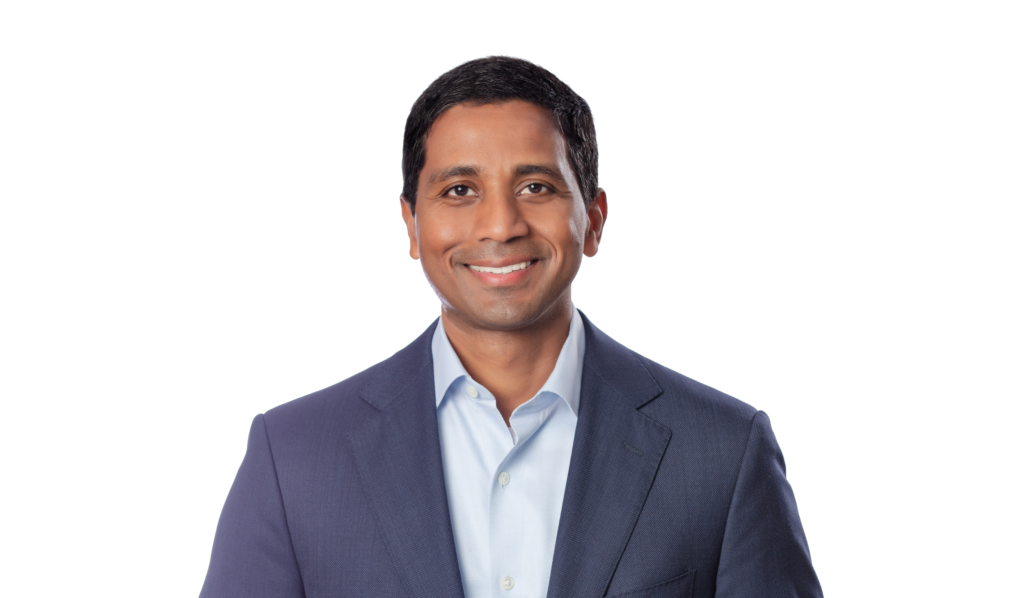
I recently went one-on-one with Nigel Vaz, CEO of Publicis Sapient.
Adam: Thanks again for taking the time to share your advice. First things first, though, I am sure readers would love to learn more about you. How did you get here? What experiences, failures, setbacks, or challenges have been most instrumental to your growth?
Nigel: As a child, I was diagnosed with dysgraphia. With my limited motor skills, I struggled to hold a pen or pencil and had to find other ways to communicate. Technology gave me superpowers. I was fascinated by comic book heroes who used technology to overcome their limitations, and from quite an early age, I began to see how technology can imagine new futures. That belief – that technology has the transformative ability to make a difference in the world and to people’s lives – has been a driving force throughout my career.
I have also learned that no job, experience, or title completely prepares you for the next one. What has helped me most is a focus on creating meaningful value for the people I serve, coupled with a willingness to take risks, put myself in unfamiliar situations, and learn as I go. Early in my career, I was drawn to complex problems where the answer was not obvious, where people had competing views and where the cost of getting it wrong was real. That taught me that leadership is not about having all the answers, but asking better questions, bringing the right people together, and creating enough clarity to make progress even amid uncertainty.
Setbacks have been equally important. Not long after we launched Sapient in the UK, a client was happy with our work but, as it grew, felt it needed a larger partner alongside us. I believed the arrangement was wrong because we had fundamentally different views on how the client’s culture needed to change. The work deteriorated, and we made the difficult decision to walk away. It taught me that leaders must sometimes choose long-term conviction over short-term comfort. A larger lesson is that progress is usually the result of many small corrections rather than one dramatic breakthrough. You need humility to acknowledge what is not working, curiosity to understand why, and resilience to keep moving.
Adam: In your experience, what are the key steps to growing and scaling your business?
Nigel: The first step is to be clear about the value you are trying to create and for whom. Growth gives leaders lots of visible metrics to pursue: revenue, customers, headcount, markets, or product lines. But scaling activity without a clear understanding of value can create complexity faster than it creates progress. I encourage leaders to begin with ‘why?’ Why does this problem matter? Why are we uniquely suited to solve it? Why would a customer, employee, or partner choose us? If you cannot answer those questions with precision, you risk building an organization that is busy but not genuinely differentiated.
Second, make sure the operating model can scale alongside ambition. Too many businesses add new layers, systems, and processes without reconsidering whether those things still support speed, accountability, and customer value. Growth often exposes silos that become debilitating at scale. The customer experiences one organization, so the organization needs to operate as one. Third, build a culture of testing and learning: form hypotheses, test them quickly, learn from the results, and change course when the evidence changes.
Finally, recognize that people are central. A business does not scale simply because it hires more people. It scales because people understand the mission, have the context to make good decisions, and can collaborate across boundaries. The role of leadership is to make the organization coherent as it becomes more complex.
Adam: What is your best advice on building, leading, and managing teams?
Nigel: Start with purpose and context. People do their best work when they understand not only what they are being asked to do, but why it matters and how it connects to the wider mission. Communicating tasks can produce compliance; communicating the problem you are trying to solve creates ownership. The strongest teams also have a shared commitment to candor. Leaders should create an environment in which people can challenge assumptions, identify problems early, and disagree without fearing that disagreement will damage their careers. Constructive tension is healthy. Silence is often more dangerous than conflict.
It is also important to give teams real autonomy while maintaining clarity about outcomes. Define the goal, boundaries, and decision rights, then ensure people have the information, tools, and air cover to act. Leaders must also be thoughtful about what they measure and reward. As work changes, old metrics may no longer reflect real contribution. Measure people for the outcomes and judgment that matter now, not simply for activities that mattered in the past.
Lastly, leaders must listen. Not performative listening, but genuinely seek out the perspectives that may challenge their own. The people closest to customers, operations, and emerging problems often see things senior leaders cannot see from a distance.
Adam: What are the most important trends in technology that leaders should be aware of and understand? What should they understand about them?
Nigel: AI is naturally at the center of the conversation, but leaders should resist treating it as a standalone technology project. AI increasingly functions like an operating system for the organization: it affects how work is done, how decisions are made, how customers are served and how knowledge is accessed. Leaders should understand that AI is not principally a tool for making existing processes more efficient. The more consequential question is whether a process, service, or business model should exist in its current form at all. A common mistake is trying to make the irrelevant more efficient rather than stepping back and asking, ‘Will customers or employees want to work this way tomorrow?’ Publicis Sapient’s research based on a global survey of 1,550 AI decision-makers illustrates the gap: 73% of leaders say AI is used regularly in the workplace, yet only 10% say it is core to how their business operates. In other words, AI adoption is becoming widespread, but redesigning workflows is not.
Second, data remains foundational. AI is only as reliable, useful, and responsible as the information, governance, and context around it. Organizations need to understand where their data is, how it connects, who can access it, and what biases or gaps it may contain. Third, AI makes the human side of transformation more – not less – important. People need to understand how their roles will change, what skills will matter, and how success will be assessed. If incentives and performance measures continue to reward yesterday’s ways of working, even excellent technology will struggle to gain adoption.
Finally, ethics, security, intellectual property and trust cannot be afterthoughts. Leaders have to build guardrails into how technology is used. The objective should be human-and-machine collaboration: using technology to expand capability while retaining human judgment, accountability and care.
Adam: What do you believe are the defining qualities of an effective leader?
Nigel: Effective leaders combine clarity with curiosity. They articulate a compelling direction, make difficult choices and give people confidence about where they are going. They also recognize that the world changes quickly, that they do not possess all the relevant information and that a good idea can emerge from anywhere. Adaptability is particularly important today. I often describe the ability to learn, unlearn, and relearn as a superpower. Leadership requires the confidence to let go of a familiar approach when the context has changed. That is not abandoning experience; it is applying experience in a new way.
Empathy is another defining quality. What looks like an exciting opportunity from the top of an organization may look like uncertainty or personal risk to others. Empathy does not mean avoiding difficult decisions. It means explaining the rationale, being honest about the trade-offs, and helping people see a credible path forward. I would add courage and gratitude. Courage means taking responsibility when the answer is unclear. Gratitude reminds you that leadership is a privilege and exists because others are willing to contribute their time, talent, and trust.
Adam: How can leaders and aspiring leaders take their leadership skills to the next level?
Nigel: Begin by becoming more intentional about reflection. In demanding roles, it is easy to spend all your time reacting to the business of today. Leaders need to create time to ask whether the work they are doing today will remain relevant tomorrow. A useful discipline is to keep asking ‘why?’ When someone proposes a project, investment, new process or technology, ask why it is needed, who is affected and what value success would create. That can reveal whether you are addressing a root problem or merely treating a symptom.
Seek practical exposure to new technologies and ways of working. Use the tools yourself. Spend time with employees who are experimenting and talk to customers whose expectations may differ from the assumptions built into existing systems. Finally, build breadth as well as depth. Expertise matters, but many of the most valuable problems sit between disciplines. The goal is not to become an expert in everything; it is to become fluent enough to ask informed questions and bring the right expertise together.
Adam: What are your three best tips applicable to entrepreneurs, executives, and civic leaders?
Nigel: First, stay close to the people you serve. The most important opportunities and problems are often visible first at the edges of an organization or community. Second, build for the future rather than defending the past. Ask what you would build if you were starting today and what you would stop doing if you were not already invested in it. Third, make learning a discipline. Identify one assumption or behavior that has served you well in the past but may now be holding you back, then test an alternative. Effective leaders turn curiosity into a regular practice.
Adam: What are your best tips on the topics of sales, marketing, and branding?
Nigel: My starting point is that the brand is the experience, and the experience is the brand. Brand cannot be reduced to a campaign, a logo, or a promise. It is the cumulative result of every interaction people have with an organization: how easy it is to engage, how reliably it delivers, and how it responds when something goes wrong. For sales, focus first on the customer’s underlying problem rather than on your own offer: what is the customer trying to achieve, what is getting in the way, and what would a better outcome look like? The aim should be to create value, not merely to complete a transaction.
For marketing, relevance is increasingly important. Customers have more choice and less patience for generic communication. Data can help organizations understand needs and personalize engagement, but there is a fine line between relevance and intrusion. Trust is difficult to earn and easy to lose, so transparency about how data is used matters. For branding, consistency and authenticity are vital. The external story has to match the internal reality. The most enduring brands make a clear promise and then organize themselves to keep it.
Adam: What is the single best piece of advice you have ever received?
Nigel: While I was in college, I co-founded Internet Solutions, a venture focused on bringing internet access to schools across sub-Saharan Africa. As I was trying to get the company off the ground, I met with a VC to seek start-up funding. He point-blank refused to sign the NDA I was holding under his nose. I can’t remember his exact words, but it was generally, “Son, ideas are a dime a dozen. If I’m going to invest at all, I’m going to invest in you.” I’d been focusing on the wrong thing. What matters is people and their ability to make their ideas a reality.
To this day, I’m reminded that success isn’t founded on a static idea, but on the ability of people to imagine what’s possible and ability of organizations to help them deliver it. It’s why my aim as a leader is to foster an environment where everyone can thrive, and to create a more diverse and inclusive business in which people can not only work happily and effectively but can see opportunities to develop and grow their careers within the company.
Adam: Is there anything else you would like to share?
Nigel: Technology is expanding what organizations and individuals can do at remarkable speed. That should be exciting, but it should also make us more deliberate about the choices we make. The goal should not be technology for technology’s sake, or speed without direction. It should be to create more value, widen access to opportunity, and solve problems that matter. The leaders who will make the greatest difference will pair ambition with responsibility, technical fluency with human understanding, and confidence with the humility to keep asking: why?