
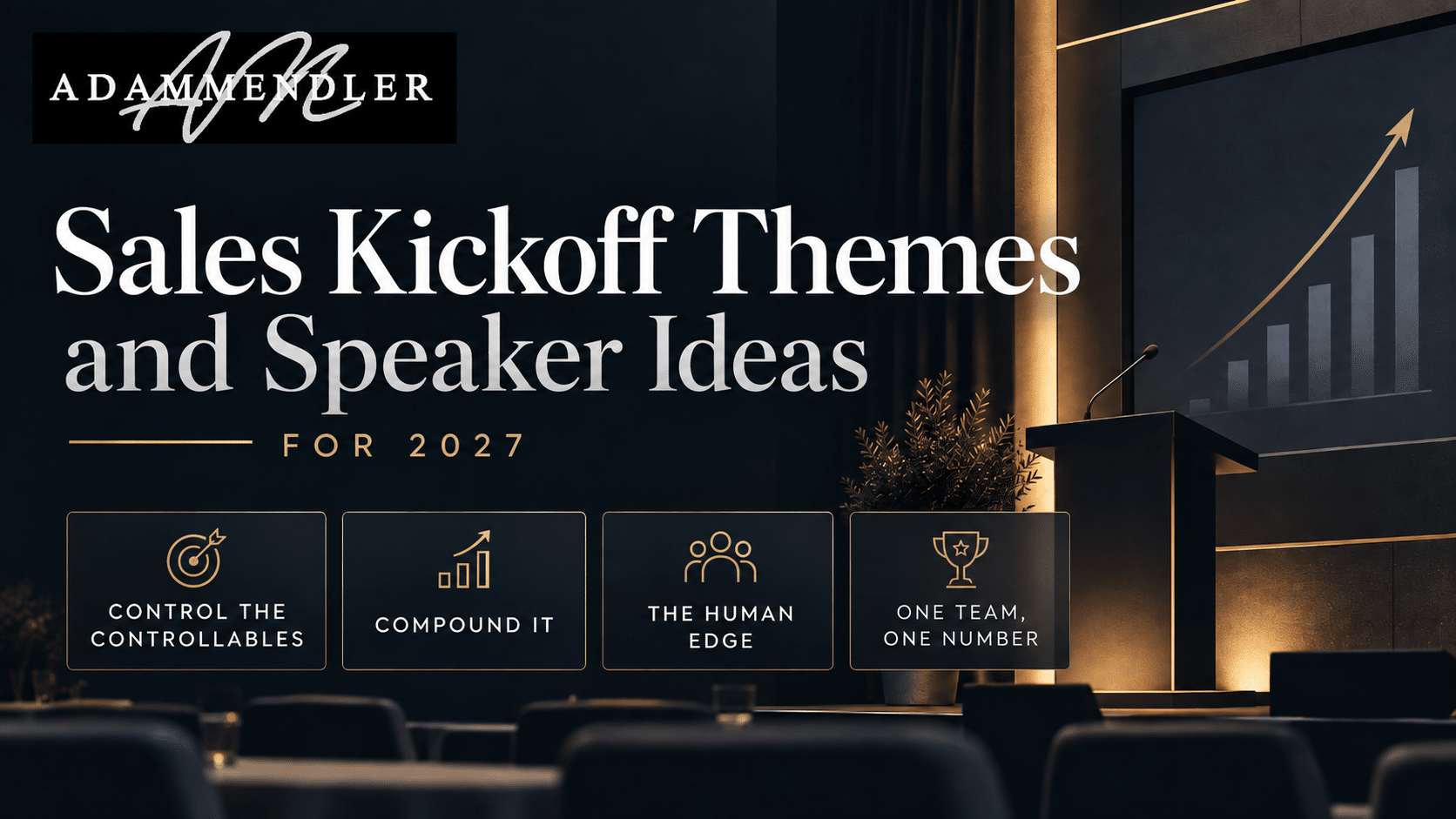
Too many sales kickoff themes are picked in the last hour of a planning meeting and forgotten by the second week of February. A word that sounds like momentum goes on the banner and the hoodie, and the team leaves the ballroom no clearer about what the year asks of them. That wastes the one morning all year when the whole sales organization is together and paying attention. A sales kickoff theme is a leadership decision before it’s a design decision. The best ones name the single thing the team has to do differently, fit the situation the team is in, and are built to outlast the event. This guide covers eight sales kickoff themes worth using in 2027, grouped by the situation your team is in, plus how to choose the one that fits and the speaker who can carry it into a sales conference.
What a Sales Kickoff Theme Is Really For
A sales kickoff, or SKO, is the annual meeting where a sales team resets for the year, covering new targets, strategy, product training, and recognition. The theme is the idea that ties those pieces together and gives the event one message the team can carry out of the room. Without it, the day becomes a stack of unrelated sessions that nobody remembers by lunch.
The theme matters more in 2027 because the buyer has changed. Gartner’s 2026 sales survey found that 67% of B2B buyers prefer a rep-free buying experience and that 45% used AI during a recent purchase. Buyers now do much of their research on their own and arrive already informed. What they still want is a salesperson who can help them make sense of what they have found and decide with confidence. A theme built around old-fashioned pipeline hustle misses that shift. The sales kickoff themes that earn their place in 2027 sharpen how the team sells into it.
Sales Kickoff Themes for 2027, Matched to Your Team’s Situation
The strongest sales kickoff themes start from the situation your team is in, not a generic list of sales kickoff ideas that sound exciting. Here are eight SKO themes worth using in 2027, grouped by the four situations I see most often. Each one names who it fits, what the team has to do differently, and what leaders have to reinforce for it to hold.
Coming off a hard year
Control the Controllables fits a team climbing out of a rough year, when morale is low, and reps feel like the numbers are happening to them. It asks the team to put their energy into the inputs they own, the calls, the preparation, the discovery, and the follow-through, rather than the outcome they cannot dictate. For it to work, leaders have to name the hard conditions honestly and then track those controllable behaviors as closely as they track the number.
Earn the Next Yard suits a team that needs discipline and consistency more than a pep talk, especially when the pipeline is thin. It reframes the year around steady, repeatable gains instead of a few heroic quarters. It holds only if leaders reward the disciplined daily behaviors that produce those gains, even in a stretch when nobody lands a marquee deal.
Building on a strong year
Compound It is for a team riding a strong year, where the danger is that success makes people comfortable. It tells the team to identify what worked and repeat it deliberately, rather than assume a good year will renew itself. That depends on leaders being precise about what drove the results, because a team that cannot name why it won will struggle to do it again.
Raise the Floor fits an organization that pours its attention into the top 10% and leaves the broad middle to fend for itself. The shift is to aim the year’s coaching and development at the solid performers who sit one habit away from a much better number. That means holding managers accountable for improving the middle of the team, rather than only celebrating the reps at the top.
Selling through change and AI
The Human Edge is built for a team adopting AI tools while buyers do more of their own research. It points reps toward what still belongs to them: judgment, trust, and the ability to tell a buyer something they could not have found on their own. Leaders bring it to life by using the tools openly themselves and holding reps to a higher standard on the human skills that move a deal.
Trusted Advisor, Faster fits teams selling a complex or considered product, where buyers arrive well researched and wary of a standard pitch. What they need from a rep is help validating what they have already learned and reaching a decision with confidence. Train the team to add substance early, and give reps the product and customer knowledge to do it, because you cannot fake advisor-level credibility on the spot.
After a merger or reorganization
One Team, One Number works for a group that has just been through a merger, a reorganization, or a year of fast hiring, and has splintered into pods that each optimize for themselves. It puts one shared number at the center and makes working together the way to hit it. The catch for leaders is removing the internal incentives that quietly reward people for competing instead of collaborating.
Own the Whole Deal fits a team where deals stall in the handoffs between sales, sales engineering, and customer success, and it works for a year built around retention and expansion, not only new logos. It asks the team to take responsibility for the customer’s experience across every handoff, from the first call through renewal. Leaders have to make ownership clear, so the customer isn’t left wondering who is responsible when something slips.
| Situation | Themes | What it tells the field | What leaders reinforce | How to keep it alive |
| Coming off a hard year | Control the Controllables / Earn the Next Yard | Focus on the inputs you own | Name the conditions honestly, reward disciplined behavior | Track a controllable metric weekly, next to the number |
| Building on a strong year | Compound It / Raise the Floor | Repeat what worked, lift the middle | Be precise about what drove results, coach the middle | Manager development plans for non-top performers |
| Selling through change and AI | The Human Edge / Trusted Advisor, Faster | Judgment and trust are the advantage | Model the tools, invest in product and customer knowledge | Enablement that continues after the event |
| After a merger or reorganization | One Team, One Number / Own the Whole Deal | Alignment and end-to-end ownership | Remove internal competition, make ownership clear | Shared metrics and cross-team rituals |
Why Most Sales Kickoff Themes Are Forgotten by February
A theme does not survive on its own. The room leaves energized, and within two weeks the talk track fades, and people fall back on the habits they walked in with. That is rarely a problem with the wording. It is a problem with what happens after the lights come up.
Two conditions keep a theme alive after the event ends. The first is a message simple enough that a frontline manager can repeat it in a Tuesday one-on-one without a slide. The second is managers who carry it, which is where most themes live or die. Gallup has found that managers account for 70% of the variance in team engagement, so whatever you launch on stage is reinforced or quietly dropped by each manager over the months that follow.
Plan the reinforcement before you plan the run of show. Tee the theme up before the event so people arrive knowing why it was chosen, tie every session and award back to it during the event, and give managers the prompts and metrics to keep it in front of the team through the first quarter. The keynote is part of that system, and the right speaker leaves the team with a way of thinking they keep using long after the applause.
Choosing a Speaker Who Carries the Theme
Once you have a theme, the keynote is the loudest way to express it, so choose the speaker and the theme together. The mistake is to lock the theme and then shop for sales kickoff speakers by name recognition, ending up with a talk that has nothing to do with the message you built the event around.
Two factors matter far more than a speaker’s fame. First, match the speaker to the challenge your team faces this year, since a talk that lands with a room of new reps can miss a veteran enterprise team. Second, insist that the speaker tailor the talk to your theme, your market, and your numbers. A speaker who will not customize is the wrong choice at any price. I go deeper on both in my guides to choosing the right leadership keynote speaker and the questions to ask before you book.
That kind of tailoring is what separates a keynote that fits from one that could have been given anywhere, and it’s what clients tend to remember:
“Adam was extremely flexible and willing to meet several times to ensure the speech was not only on topic but engaging and relevant. I highly recommend Adam for any speaking event as he has a unique ability to tailor the material to the targeted audience with immeasurable impact.”
— Kim Donovan, Sr. Partner, Talent Acquisition Programs, DIRECTV
Planning a sales kickoff for 2027?
Adam Mendler keynotes sales kickoffs and corporate events, tailoring the talk to your theme, your market, and your team, and translating lessons from more than 500 interviews with top leaders into a message your managers keep using after the room clears.
Book Adam to SpeakFrequently Asked Questions
What is a sales kickoff theme?
A sales kickoff theme is the single organizing idea that runs through an SKO, giving the training, recognition, and leadership talks one message the team can remember and act on all year.
How do you choose the right sales kickoff theme?
Start from where your team is this year rather than from a list of slogans. A team climbing out of a hard year needs a different message than one building on a strong year, one selling through AI and change, or one that has just merged or reorganized. Name the single change you need most, then pick the theme that points at it.
What sales kickoff themes should you avoid?
Avoid generic slogans like Excellence, All In, or Unleashed. They sound motivating but say nothing; many reps have heard them before, and a theme that could belong to any company in any year gives the field nothing to act on.
How far in advance should you book a sales kickoff speaker?
Most companies hold sales kickoffs in the first quarter and book their speakers the previous fall, so start three to six months out. Strong speakers fill their calendars early, and more lead time also lets them tailor the talk to your theme.
A Theme Is a Promise
A good theme is a promise about the year ahead. Your team hears it, then watches to see whether leadership and the calendar back it up. Choose one that names something true about 2027 and give your managers what they need to reinforce it, and it becomes the way the team talks about the work long after the banner comes down. Choose a slogan instead, and that’s all you’ll have printed.