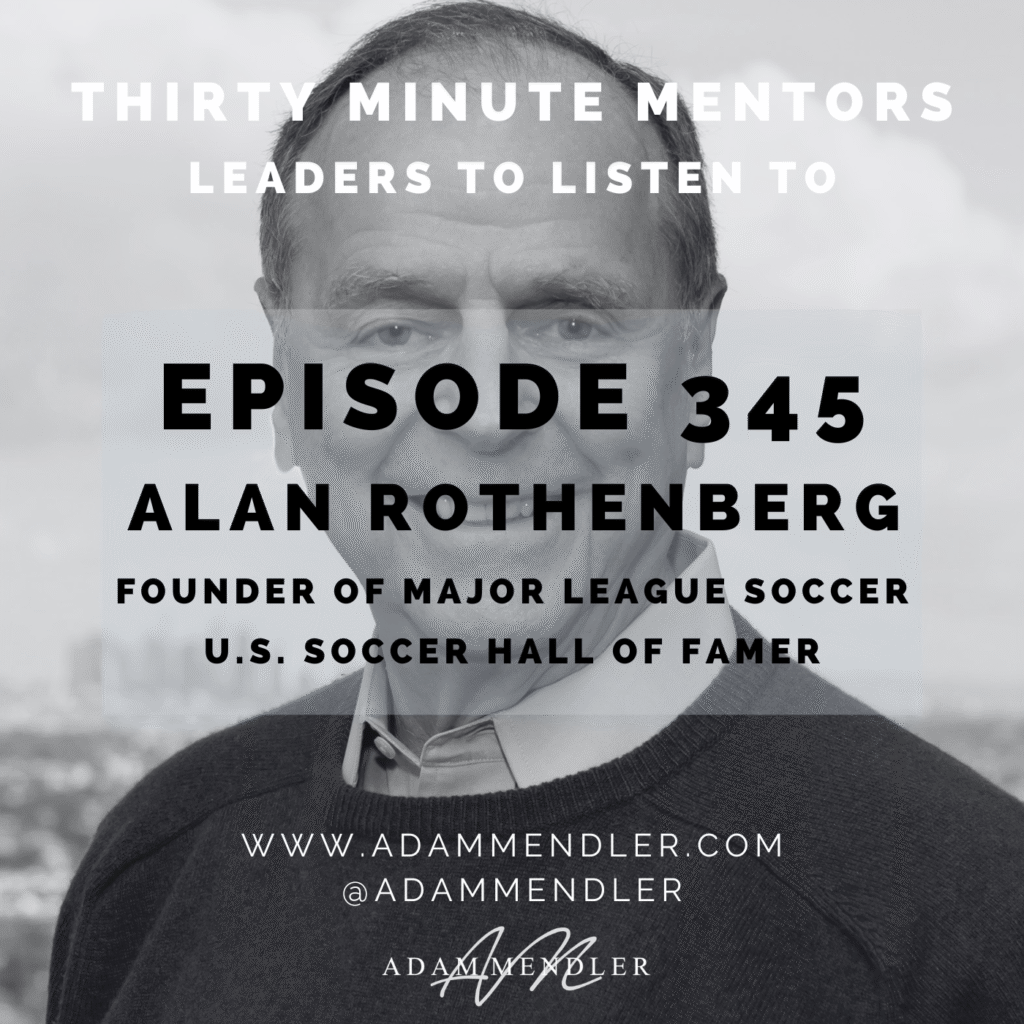
Alan Rothenberg led the growth of soccer in the United States. A member of the National Soccer Hall of Fame, Alan was the president of U.S. Soccer, the governing body of American soccer, where he oversaw the 1994 FIFA World Cup and the 1999 Women’s World Cup and founded Major League Soccer. Alan joins Adam to share his journey and his best lessons and advice. Alan and Adam discuss a wide range of topics: leadership, career success, authenticity, reputation, risk, and much more.
Join Adam and the best network of mentors – Fortune 500 CEOs, founders of household name companies, Hall of Fame and Olympic gold medal-winning athletes, political and military leaders – for intimate half-hour conversations each week.
Thirty Minute Mentors is available wherever you listen to podcasts. If you enjoy the episode, visit your favorite podcasting app and subscribe, rate, and leave a review, and spread the word by sharing on your social media channels and sharing directly with your friends and colleagues.
Read the full transcript of Adam’s conversation with Alan Rothenberg.
Episode Summary
Alan Rothenberg, the founder of Major League Soccer and former president of U.S. Soccer, took his first real risk when he left the law firm O’Melveny & Myers to work full time for Jack Kent Cooke, the notoriously difficult owner of the Lakers. Alan decided that not taking the job would mean wondering what if for the rest of his life. Cooke taught him the value of leverage in business, a sharp contrast to the reasoned argument Alan had learned in law school, but Alan noticed early on that copying Cooke’s combative style wasn’t him. When an NBA expansion deal Alan was negotiating in Houston collapsed on the eve of closing, he called Cooke devastated, and Cooke told him to come sit courtside at the Lakers game anyway, reminding him that trying and failing honestly was nothing to be ashamed of.
Decades later, Alan started 1st Century Bank on a simple insight: relationship banking was disappearing as banking became commoditized, and plenty of entrepreneurs and small business owners missed it. He raised the money entirely from friends and family, without investment bankers, on the strength of a reputation he describes as a mosaic built one tile at a time. One investor cut him off mid-pitch and said he was buying preferred stock in Alan Rothenberg, not evaluating the deal itself.
Alan’s path into soccer ran through pure accident. Jack Kent Cooke handed him a professional soccer team to run in 1968 at age 28, after Alan had seen exactly three soccer matches in his life. That eventually led to running the 1994 World Cup, where he treated the tournament as an entertainment problem rather than a soccer problem, since most Americans didn’t care about the sport itself: Diana Ross performed at the opening match, Robin Williams emceed the group draw, and the Three Tenors played the night before the final. When Major League Soccer was founded afterward, Alan required every investor to build a soccer-specific stadium rather than rent out oversized football venues, a rule that Lamar Hunt endorsed immediately and built the league’s first prototype for in Columbus.
Alan turned down the chance to become MLS’s first commissioner himself, running the numbers rather than his emotions: he judged an 80 to 90 percent likelihood of years of struggle before any real payoff, weighed against having to uproot his established life in Los Angeles for New York, and passed. He is equally proud of a less publicized decision: discovering he did not even know the U.S. women’s national team existed when he took over U.S. Soccer, then funding the team for the first Women’s World Cup, which the U.S. won in 1991, and pushing FIFA to expand the 1999 tournament into full-sized stadiums after watching the crowds at the 1996 Atlanta Olympics.
What You’ll Learn
- Build your reputation one tile at a time: Alan compares reputation to a mosaic, where a few tiles on the edge can fall out, but losing one from the middle makes the whole picture disappear.
- Choose partners you know you can trust: Alan turned down several chances to start a sports marketing firm before saying yes to Randy Bernstein, whom he had worked with for years and knew to be smart and honest.
- Give young, ambitious people room to grow: Alan elevated Jason DiNapoli, a young banker he recalls being in his late thirties, to president and ultimately CEO of 1st Century Bank.
- Aim high, then trim: Alan’s World Cup offices displayed Robert Browning’s line “a man’s reach should exceed his grasp, or what’s a heaven for,” and he asks his team to design the perfect plan before cutting it back to what is practical.
- Know your audience: Alan concluded the 1994 World Cup would not succeed on soccer alone, so he turned it into a huge entertainment event for Americans who love a big event.
- A board’s single most important job, Alan believes, is choosing the right CEO, then staying active without interfering in day-to-day operations.
About Alan Rothenberg
Alan Rothenberg is a member of the National Soccer Hall of Fame who served as president of U.S. Soccer, oversaw the 1994 FIFA World Cup and the 1999 Women’s World Cup in the United States, and founded Major League Soccer. Before his career in soccer, he practiced law at O’Melveny & Myers, then worked directly for Lakers owner Jack Kent Cooke and later helped run the Clippers under Donald Sterling. Alan later founded and sold two banks, including 1st Century Bank, and co-founded the sports marketing firm Premier Partnerships. He is the author of The Big Bounce: The Surge That Shaped the Future of U.S. Soccer.
Related Episodes
- Episode 257: Basketball Hall of Famer Val Ackerman
For more on building women’s sports, Val discusses serving as the founding president of the WNBA, president of USA Basketball, and commissioner of the Big East Conference. - Episode 195: US Olympics CEO Sarah Hirshland
For more on leading in American sports, Sarah discusses leading the United States Olympic & Paralympic Committee and navigating crises and failure. - Episode 93: Orlando Magic Co-Founder Pat Williams
For more on building a sports franchise, Pat discusses co-founding the Orlando Magic and his more than 50 years in the NBA, along with lessons on negotiations and sales. - Episode 160: ESPN Founder Bill Rasmussen
For more on taking a big risk in sports, Bill discusses founding ESPN, the first television network fully dedicated to sports, and overcoming obstacles and setbacks. - Episode 285: Klutch Sports Founder and CEO Rich Paul
For more on dealmaking in sports, Rich discusses founding Klutch Sports Group, relationship building, and excelling as a trusted advisor to players including LeBron James.